Seemapuri Collapse Owner Arrested: What the Probe Has Found So Far
Police have arrested New Seemapuri building owner Mohammad Anwar as investigators continue examining structural conditions, nearby demolition work and reported cracks. Four deaths remain confirmed while DNA identification of recovered remains is awaited.
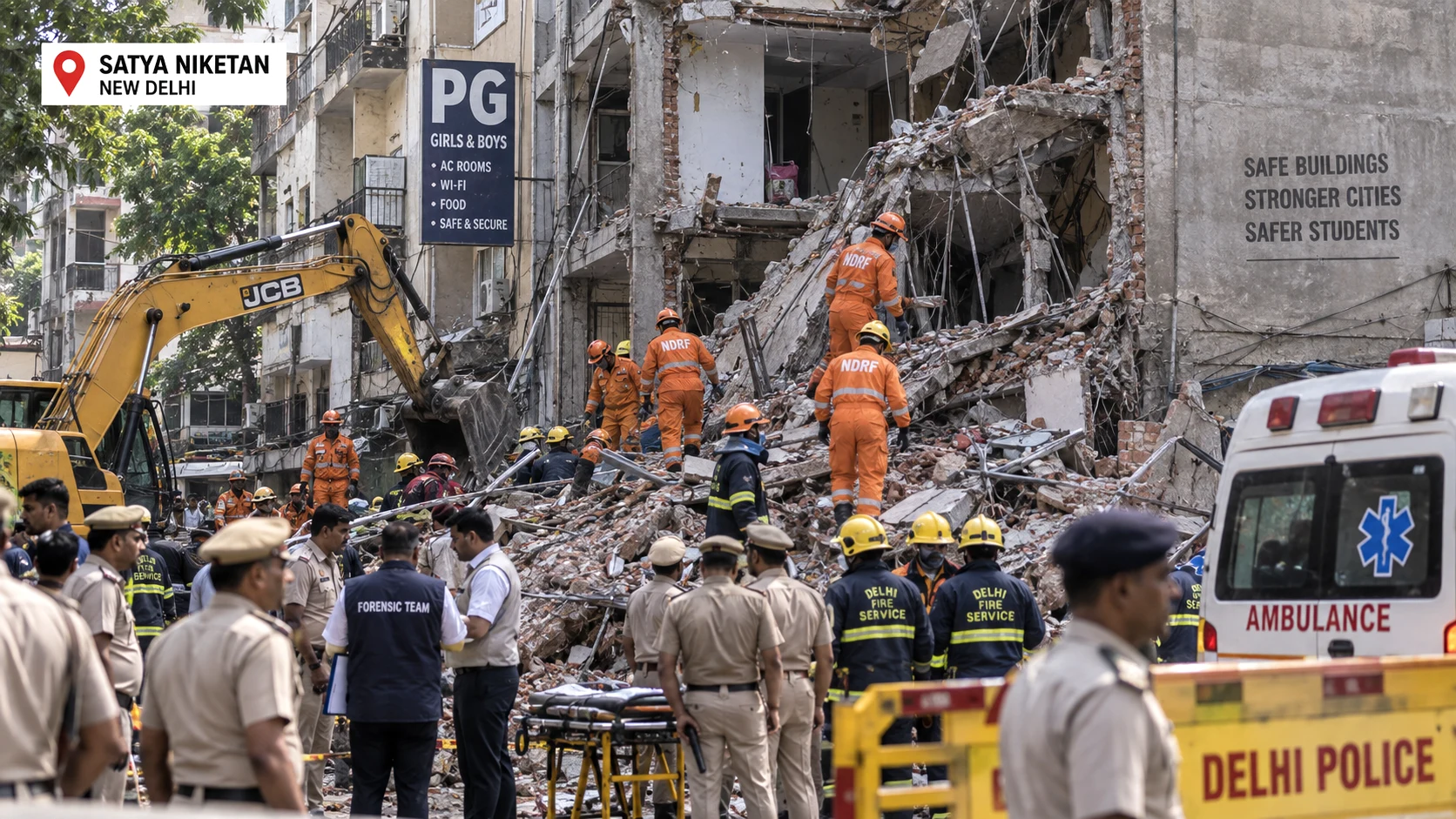
Editorial illustration representing the Seemapuri building collapse investigation and owner arrest
Table of Contents (19 sections)
NEW DELHI, October 13, 2026: Police have arrested Mohammad Anwar, the owner of the multi-storey building that collapsed in New Seemapuri on October 7, marking a significant new development in an investigation that is still trying to establish exactly why the structure failed and who, if anyone, bears criminal responsibility.
The arrest changes one important part of the case. Anwar had previously been reported as untraced after the collapse. The latest police-linked reporting says he was arrested on Saturday, October 10.
It does not, however, settle the larger questions surrounding the disaster.
Four people remain confirmed dead, while DNA examination of human remains recovered separately from the debris is still important to determining whether the final casualty count changes. Investigators are also examining the condition of the building, additional construction, demolition work at an adjoining property and reports that cracks appeared around the time earthquake tremors were felt in Delhi.
No final engineering cause has yet been announced.
Recommended Reading
Related Stories & In-Depth Guides
Curated editorial perspectives matching this topic.
Four deaths remain confirmed in the New Seemapuri building collapse as DNA identification of recovered remains continues. The building owner was still untraced in the latest direct police-linked update, while investigators examine structural conditions, nearby demolition work and reported cracks. Ci
Delhi Police have arrested a PG operator and labour contractor as the Satya Niketan building collapse probe widens into repairs, structural alterations and management.
The distinction is important: an arrest is a development in the criminal investigation, not a finding of guilt, and several competing or potentially overlapping explanations for the collapse remain under examination.
Key Takeaways
Building owner Mohammad Anwar arrested on October 10.
Four deaths confirmed; DNA tests on recovered remains ongoing.
Investigators examining structural condition, additions, nearby demolition and reported cracks.
Arrest is not a finding of guilt.
Magisterial inquiry also underway.
The Most Important New Development: Building Owner Arrested
Mohammad Anwar, who is in his late 50s, was away when the New Seemapuri building collapsed.
Police had been trying to trace him in the days immediately following the disaster. Rajatheertha's October 12 update reported that no reliable subsequent announcement of his arrest had been located at that stage.
That position has now changed.
The latest reporting, based on people aware of the police investigation, says Anwar was arrested on Saturday.
Members of his own family were among those directly affected by the collapse. His daughter Nusrat was killed, while his wife, son and three-year-old grandson were among the injured.
The arrest gives investigators an opportunity to question the owner about the building's construction history, any additions made to it, work underway before the collapse and what was known about the reported condition of the structure.
But those questions remain investigative matters.
Anwar's arrest should not be reported as proof that he caused the collapse. Criminal responsibility can be determined only through evidence and the legal process.
Four Deaths Remain Confirmed
Confusion over the death toll emerged during the search-and-rescue operation because bodies as well as separate human remains were recovered from the rubble.
Early accounts put the toll at five.
Delhi Police subsequently revised the confirmed figure to four, explaining that body parts recovered separately could not automatically be counted as belonging to additional victims until forensic identification was completed.
The four confirmed victims are three women and a young child.
They include Hazra Bibi, 56; Nusrat, 33; and Gulafsa, 21, who was around four months pregnant. The fourth confirmed victim was described as a child aged around three or four years.
Five recovered body parts were reported to have been sent for identification.
DNA examination is intended to establish whether those remains belong to people already included among the confirmed victims or whether they represent one or more additional deaths.
That is why the accurate current position remains four confirmed deaths rather than relying on earlier provisional reports of five.
Eight people were also reported injured.
What Happened on October 7
The residential building came down on the afternoon of October 7 in the densely built New Seemapuri area of Delhi.
Emergency services received information about the collapse at around 3.30 p.m.
Police, Delhi Fire Services personnel, disaster-response teams and civic authorities joined the rescue operation as residents and people nearby were searched for beneath the rubble.
The narrow lanes and dense construction complicated access to the site.
Eleven people were reported to have been trapped or rescued during the emergency response, with eight injured people taken for medical treatment.
Search-and-rescue work continued for roughly 28 hours before the immediate operation was concluded and attention shifted towards clearing dangerous debris, identifying the dead and investigating why the structure failed.
The Criminal Case
Police initially registered a case invoking Sections 105 and 110 of the Bharatiya Nyaya Sanhita.
Those provisions concern culpable homicide not amounting to murder and attempt to commit culpable homicide.
The use of serious criminal provisions reflects the gravity of the allegations being investigated. It does not establish that Anwar or any other individual has committed those offences.
Public accounts of the FIR have not always used identical wording about who was named at the earliest stage. Police-linked reporting described the case as initially registered against unknown persons while investigators were attempting to trace the owner.
The investigation now has to establish which actions are supported by evidence.
That includes who authorised construction or alterations, who carried out relevant work, whether permissions were required, whether structural danger was apparent beforehand and whether any person's action or failure to act can legally be connected to the deaths.
A separate magisterial inquiry is also underway.
Investigation Focus 1: Work at the Neighbouring Building
One of the most significant investigative leads involves demolition activity at an adjoining property.
Preliminary information cited by district authorities indicated that demolition work involving vibrating machinery had been carried out there for several days before the collapse.
Investigators are examining whether that activity created vibrations or disturbances that contributed to the failure of the neighbouring structure.
That possibility should not yet be treated as an established cause.
Even if investigators eventually determine that nearby demolition acted as a trigger, engineers would still need to establish why the building was vulnerable to that disturbance.
A collapse can involve both a trigger and an underlying structural weakness.
The investigation therefore needs to separate the immediate event that may have preceded the failure from the longer-term condition of the building.
Investigation Focus 2: The Building's Age and Structural Condition
The Municipal Corporation of Delhi described the structure as roughly 20 to 25 years old and located on a small plot in a jhuggi-jhopri cluster associated with the Delhi Urban Shelter Improvement Board.
Reports have generally placed the plot at around 25 square yards.
There have been differences in public descriptions of the building's precise number of floors, with municipal information and other reporting not always using the same configuration.
What matters for investigators is the actual structure that stood immediately before the collapse: how many floors it had, when each part was constructed, what foundation and load-bearing system supported it and whether later additions were structurally accommodated.
Those questions cannot be answered from the building's appearance alone.
Investigation Focus 3: Additional Construction
Police-linked reporting has said investigators are examining allegations that additional rooms were being added to the upper part of the property.
The latest reporting also says Anwar had allegedly added upper floors over the years to the original structure.
These remain matters for investigation rather than final findings.
Additional floors can substantially change the loads imposed on a building. Whether they create danger depends on the original structural design, foundation capacity, materials, reinforcement and whether appropriate strengthening was carried out.
Investigators therefore need more than evidence that the building became taller.
They need to establish how it was altered, who was responsible for the work, whether professional structural advice was obtained and whether the resulting building could safely carry the additional loads.
Investigation Focus 4: Reported Cracks After Tremors
The earthquake angle attracted immediate attention because cracks were reportedly noticed after tremors were felt in Delhi before the collapse.
The sequence makes those cracks relevant to the investigation.
It does not establish the earthquake as the cause.
Cracks can range from relatively superficial damage in plaster to evidence of movement affecting structural components.
Investigators will need to determine where the reported cracks appeared, whether they were new, whether they widened, which parts of the building were affected and whether the structure already had vulnerabilities before the tremors occurred.
The correct conclusion at this stage is therefore that earthquake-related cracking is being examined — not that the earthquake has been proven to have brought down the building.
A Combination of Factors May Be Possible
The investigation does not necessarily have to end with one simple explanation.
A building may have an existing weakness and remain standing until another event creates additional stress.
For example, an inquiry could theoretically find that structural additions weakened a building over time, while nearby demolition or ground vibration acted as an immediate trigger.
It could also reach an entirely different conclusion.
That is why photographs, neighbourhood accounts and the timing of individual events cannot replace an engineering assessment.
Investigators need physical evidence from the site, construction records, witness accounts, documentation of alterations and technical examination of what remained after the collapse.
Why DNA Testing Still Matters
The forensic identification process is separate from the question of what caused the building to fall, but it remains one of the most important unresolved parts of the case.
Its purpose is not merely statistical.
Correct identification allows families to know conclusively whether recovered remains belong to their relatives.
It also establishes an accurate official casualty record for the investigation and any subsequent compensation, prosecution or inquiry.
Until those results clarify whether the separately recovered remains belong to victims already counted, the police-confirmed toll of four should continue to be used.
Early headlines reporting five deaths should not be treated as more authoritative than the later revised police count.
What the Arrest Changes — and What It Does Not
Anwar's arrest is important because investigators no longer have an untraced owner at the centre of questions about the property's construction history.
Police can now pursue questioning and other lawful investigative steps connected with records, construction decisions and the condition of the building.
But the arrest does not answer the technical cause of the collapse.
It also does not establish:
that unauthorised construction caused the failure;
that adjoining demolition caused the failure;
that earthquake tremors caused the failure;
that the owner knew the structure was about to collapse;
or that any offence alleged by police has been proved.
Those conclusions require evidence.
The case will also have to proceed through the courts, where the prosecution's claims can be tested and the accused can exercise the rights available under law.
What We Don't Know Yet
Several major questions remain unresolved as of October 13.
The final casualty count remains subject to DNA identification of recovered human remains.
No final engineering report publicly establishes the exact mechanism of the collapse.
There is no conclusive finding that the October 6 earthquake caused the building to fail.
There is no conclusive finding that demolition activity at the adjoining property was the sole trigger.
The complete history and structural effect of reported additions to the building have not been publicly established.
The public record reviewed for this update does not establish the final outcome of the DNA examination.
The precise legal case against each person potentially connected with the construction or demolition work remains subject to investigation.
No court has determined criminal guilt.
The magisterial inquiry has not yet produced a publicly verified final finding establishing responsibility.
These gaps are not minor details. They are the evidence needed to distinguish a suspected explanation from a proven one.
Civic Responsibility Is Also Under Scrutiny
The case goes beyond the actions of a private property owner.
Questions have also been raised about how unsafe or unauthorised structures are identified and regulated in densely populated parts of Delhi.
Previous Rajatheertha coverage examined differing positions involving the Municipal Corporation of Delhi and the Delhi Urban Shelter Improvement Board over responsibility for construction enforcement in the locality.
Those institutional questions will ultimately require documentary evidence.
Investigators and the magisterial inquiry may need to establish whether complaints had previously been made, whether officials inspected the property, whether notices were issued, what construction was recorded and which agency had statutory authority to intervene.
Under the Delhi Municipal Corporation Act, municipal authorities have powers relating to buildings considered dangerous, including requiring demolition, securing or repairs and directing buildings to be vacated in certain circumstances.
The central accountability question is therefore not simply which agency's name appears on land records.
It is whether a known danger existed, who had the authority and information to act, and whether the legally required steps were taken.
What Happens Next
Three developments are especially important to watch.
First are the DNA results. They will determine whether the official death toll remains at four or needs revision.
Second is the technical investigation into the collapse itself. Evidence about the foundation, structural alterations, cracks and adjoining demolition work will be much more important than early assumptions about any one cause.
Third is the criminal process following Anwar's arrest. Investigators will have to connect any alleged act or omission to evidence and applicable law, while the courts will determine custody, subsequent proceedings and ultimately any question of guilt.
The magisterial inquiry can address a broader set of questions about the chronology before the disaster and the roles of different authorities.
Tenant Checklist: Warning Signs That Should Not Be Ignored
A tenant cannot determine whether a building is structurally safe simply by looking at it, and serious concerns should be assessed by competent professionals. However, visible changes can justify urgent caution.
Before renting or remaining in an older or heavily altered building, ask whether major structural modifications or additional floors have been made.
Pay attention to new, wide or rapidly growing cracks, particularly around columns, beams, slabs and structural walls.
Treat visible damage to columns, sagging slabs, leaning walls, falling concrete or exposed reinforcement as reasons to seek professional assessment.
If cracks suddenly appear after an earthquake, nearby excavation, piling, demolition or repeated use of heavy vibrating equipment, report the change rather than assuming it is cosmetic.
Sudden jamming of several doors or windows, visible movement between walls and floors, or new gaps around structural components can also justify inspection.
Keep photographs and dated records when serious deterioration develops.
Raise major concerns with the owner or property manager in writing.
In Delhi, the MCD provides its citizen complaint system through the MCD311 platform and lists 155305 as its citizen call-centre number.
Where there are signs that a structure could fail imminently — such as major structural movement, rapidly worsening cracks, pieces falling from structural elements or a visibly unstable wall or slab — personal safety should come first.
Move to a safe location and alert the appropriate emergency or civic authorities.
Do not re-enter a seriously damaged or visibly unstable structure merely to collect belongings.
The Delhi Municipal Corporation Act allows action against buildings considered dangerous, including orders requiring repair, securing or demolition and, in specified circumstances, evacuation.
Why This Case Still Matters After the Arrest
The arrest means one previously unresolved part of the story has changed.
The fundamental public-interest questions have not.
Four people are confirmed dead. Families are still awaiting clarity around recovered remains. Investigators have not announced a definitive technical explanation for the collapse.
The case also raises a broader urban-safety question: how can potentially dangerous alterations or deteriorating buildings be identified before a disaster rather than after one?
That question is particularly important in dense neighbourhoods where small plots, ageing structures, additional floors and construction activity can exist within metres of one another.
Effective prevention depends on property owners, contractors, professionals and public authorities responding to structural risks before warning signs become an emergency.
Bottom Line
Mohammad Anwar, the owner of the New Seemapuri building that collapsed on October 7, has now been arrested, replacing the earlier status in which police were trying to trace him.
Four deaths remain confirmed and eight people were reported injured.
DNA examination of recovered remains remains relevant to establishing the final casualty count.
Investigators are examining the building's structural condition, reported additions, nearby demolition activity and cracks reported around the time earthquake tremors were felt in Delhi.
A magisterial inquiry is also underway.
None of those investigative leads has yet been established as the definitive cause of the collapse, and Anwar's arrest does not amount to a finding of guilt.
The next meaningful answers should come from forensic identification, structural evidence, construction and enforcement records, and the continuing police and magisterial investigations.
Key Takeaway
Owner Mohammad Anwar arrested. Four deaths confirmed; DNA tests pending.
Probe continues into structural condition, additions, demolition and cracks. No final cause established.
The Rajatheertha Team publishes news, explainers, guides and updates across India and the world. Our coverage follows Rajatheertha's editorial, verification and corrections standards.
Delhi Police have confirmed four deaths in the New Seemapuri building collapse while DNA tests on recovered remains continue. Investigators are examining the structure, adjoining demolition activity and possible regulatory failures as questions over accountability grow.
Four deaths are confirmed in the New Seemapuri building collapse as DNA tests continue on recovered remains. Police and a magisterial inquiry are examining structural conditions, additional construction and demolition activity nearby, while questions over civic responsibility remain unresolved.
Delhi Police have seized more than 2.5 tonnes of illegal firecrackers in two October 15 operations as Diwali 2026 approaches. Here is what Delhi’s current firecracker restrictions mean, the legal risks, how green-cracker proceedings before the Supreme Court affect the position, and how residents can
RPF and GRP personnel recovered the turtles from two sacks and a backpack left outside the toilet of sleeper coach S-8 on the Rishikesh-Howrah Doon Express. No one was arrested at the scene, and the animals have been handed to the Gaya Forest Department for identification and further legal action.
Crime/ International Crime | Hate Crime Investigation11 min read
A 19-year-old Illinois man has been arrested over an alleged mass-shooting plan that investigators say may have targeted a Hindu place of worship in Aurora. Prosecutors say the suspect reported that his rifle malfunctioned, while police recovered weapons, ammunition, body armour and material express
Police have arrested Kalyan Bainsla and his cousin Lavnish, who was allegedly inside the car during the September 13 Golf Course Road incident involving biker Shivani Chauhan, alias Sia. Investigators have added an attempt-to-murder charge after examining video evidence, while Sia is seeking action










0 Comments