Seemapuri Building Collapse: 4 Confirmed Dead as DNA Tests Begin; Cause and Accountability Under Probe
Delhi Police have confirmed four deaths in the New Seemapuri building collapse while DNA tests on recovered remains continue. Investigators are examining the structure, adjoining demolition activity and possible regulatory failures as questions over accountability grow.
Editorial illustration representing the New Seemapuri building collapse rescue and investigation
Table of Contents (15 sections)
NEW DELHI, October 10, 2026: Four people have been confirmed dead after a multi-storey residential building collapsed in New Seemapuri, while DNA examination of human remains recovered from the debris could determine whether the final death toll is higher.
Delhi Police initially reported a higher toll during the rapidly changing rescue operation but later revised the confirmed number to four because some recovered body parts had not yet been established as belonging to separate victims.
Eight people were also reported injured after the October 7 collapse.
The investigation has now moved beyond rescue work to a more difficult question: why did the building fall, and who, if anyone, bears criminal, civic or regulatory responsibility?
Police have registered a culpable-homicide case, a magisterial inquiry has been initiated, and investigators are examining multiple possible contributing factors. These include the structural condition of the building, additional construction and demolition activity at a neighbouring property.
None of these factors has yet been established through a completed inquiry as the sole cause of the collapse.
Latest Status — October 10, 2026
4
Recommended Reading
Related Stories & In-Depth Guides
Curated editorial perspectives matching this topic.
Four deaths are confirmed in the New Seemapuri building collapse as DNA tests continue on recovered remains. Police and a magisterial inquiry are examining structural conditions, additional construction and demolition activity nearby, while questions over civic responsibility remain unresolved.
Delhi Police have seized more than 2.5 tonnes of illegal firecrackers in two October 15 operations as Diwali 2026 approaches. Here is what Delhi’s current firecracker restrictions mean, the legal risks, how green-cracker proceedings before the Supreme Court affect the position, and how residents can
Confirmed deaths:
Reported injured: 8
DNA testing: Underway on recovered body parts
Building owner: Police say efforts to trace him are continuing
Police case: Registered under Bharatiya Nyaya Sanhita Sections 105 and 110
Magisterial inquiry: Initiated
Exact cause: Not yet conclusively established
Rescue operation: Concluded; debris clearance and action on damaged neighbouring structures followed
The casualty figure requires particular care because several early reports placed the death toll at five.
Delhi Police subsequently clarified that four people had been definitively confirmed dead and that recovered remains required DNA examination before authorities could determine whether they represented additional victims.
That makes four the appropriate confirmed figure at the time of this report, while leaving open the possibility that the toll may change following forensic identification.
Key Takeaways
Four deaths confirmed; DNA tests ongoing on recovered remains.
Eight people reported injured.
Criminal case registered under BNS Sections 105 and 110.
Magisterial inquiry initiated.
Investigators examining structural condition, additional floors and neighbouring demolition.
MCD–DUSIB dispute over regulatory responsibility continues.
Why Did Early Reports Say Five People Had Died?
Building-collapse rescue operations can produce rapidly changing casualty figures, particularly when bodies and unidentified remains are recovered at different stages.
In Seemapuri, authorities initially announced that five people had died.
Police later revised that figure after determining that body parts recovered from the debris could not immediately be counted as separate victims.
The confirmed victims comprise three women and a young child.
Five body parts recovered from the debris are being examined through DNA testing to establish their identities and determine whether they belong to already identified victims or to additional people.
For readers following the story across different publications, that explains why both four and five may appear in reports published at different times.
Until forensic identification is complete, the safest formulation is that at least four deaths have been confirmed.
What Happened in New Seemapuri?
The building collapsed on the afternoon of October 7 in the congested New Seemapuri area of Delhi.
The incident triggered a major multi-agency rescue operation involving police, fire personnel, disaster-response teams and civic authorities.
Debris from the structure also affected nearby properties, adding to concerns about the stability of buildings in the immediate area.
At least 11 people were reported to have been trapped or caught in the collapse. Eight injured people were rescued and taken for medical treatment.
Search-and-rescue work continued into the following day before authorities moved towards debris clearance and securing damaged adjoining structures.
The tragedy has drawn renewed attention to dense neighbourhoods where small plots, vertical additions, narrow access lanes and adjoining construction or demolition can create complex safety risks.
What We Know
Four deaths have been confirmed by police.
Eight people were reported injured.
Recovered body parts are undergoing DNA examination.
A criminal case has been registered.
A magisterial inquiry has begun.
The building owner was still being traced as of the latest available update.
Investigators are examining the building's structural condition.
Possible additional floors and construction are part of the inquiry.
Officials are also examining whether demolition activity at an adjoining property contributed to the collapse.
Nearby structures suffered damage and required safety action after the incident.
What We Don't Know Yet
The final casualty count is not yet certain because DNA identification is pending.
The definitive engineering cause of the collapse has not been established.
It has not been conclusively determined how much, if any, neighbouring demolition activity contributed.
Investigators have not completed their findings on whether structural modifications weakened the building.
Final responsibility among the property owner, individuals involved in construction or demolition, civic authorities or other parties has not been legally determined.
No person should be described as guilty before the investigation and any subsequent judicial process establish responsibility.
What Are Investigators Examining as the Possible Cause?
There are several lines of inquiry, and it is important not to collapse them into a single unverified explanation.
1. Demolition work at an adjoining building
Northeast Delhi district authorities have said preliminary information indicated that demolition work was taking place at a neighbouring property before the collapse.
Officials are examining whether machinery used during that work generated vibrations that may have affected the structure.
That possibility is significant, but it remains part of the investigation rather than a final engineering finding.
A proper determination would require examination of the collapsed structure, construction history, foundations, loads, neighbouring work and the sequence immediately before failure.
2. Additional floors and structural loading
Investigators are also looking at whether floors or rooms were added to the building over time.
Adding storeys to an existing structure can substantially change the loads carried by columns, walls, beams and foundations.
Whether such additions were structurally adequate in this particular building must be established by investigators and technical experts.
Reports that the building was constructed on a very small plot have intensified questions over whether its foundation and structural system were suitable for its eventual height.
3. Cracks reportedly noticed after earthquake tremors
Residents and civic officials also referred to cracks that were reportedly noticed following earthquake tremors before the collapse.
That has led to speculation that the tremors caused or accelerated the failure.
However, authorities have not established the earthquake as the definitive cause.
Cracks appearing after tremors may be relevant evidence, but investigators still need to determine whether they reflected pre-existing weakness, fresh structural damage or some combination of factors.
The distinction matters.
Reporting an earthquake as the confirmed cause before the inquiry is complete would go beyond the evidence currently available.
Criminal Case Registered, but Responsibility Is Not Yet Settled
Delhi Police have registered a case under Sections 105 and 110 of the Bharatiya Nyaya Sanhita.
Section 105 concerns culpable homicide not amounting to murder, while Section 110 deals with attempt to commit culpable homicide.
The registration of serious criminal provisions signals the gravity with which police are treating the incident.
It does not, by itself, establish the guilt of any individual.
Investigators must determine who was responsible for the building, what construction or alterations were carried out, whether required permissions existed, whether known hazards were ignored and whether any act or omission had a legally provable connection to the deaths and injuries.
Police were also attempting to trace the building owner as of October 10.
One of the women who died was reported to be a member of the owner's family.
The fact that police are looking for the owner should not be converted into a presumption of criminal guilt. His precise legal responsibility, if any, will depend on evidence gathered during the investigation.
Why the MCD-DUSIB Responsibility Dispute Matters
The incident has also exposed a dispute between the Municipal Corporation of Delhi and the Delhi Urban Shelter Improvement Board over responsibility for controlling unauthorised construction in the locality.
MCD officials have argued that the property stands on land associated with DUSIB and that a land-owning agency has responsibility for preventing illegal construction.
DUSIB officials have disputed that interpretation.
Their position is that the land was allotted as part of a resettlement arrangement decades ago and that enforcement of building plans and building-safety rules falls within the municipal system.
Reports indicate that the original allotments in the locality involved very small plots with limited permitted construction.
The collapsed structure had reportedly reached several storeys.
That gap between what may originally have been permitted and what was eventually constructed is now central to the broader governance questions raised by the disaster.
Determining criminal responsibility is one process.
Determining whether government bodies adequately exercised their regulatory responsibilities is another.
The magisterial inquiry may therefore become important not only in establishing the physical sequence of the collapse but also in examining whether warnings, unauthorised additions or unsafe conditions should have attracted earlier intervention.
Who Can Actually Be Held Responsible?
At this stage, it would be premature to state that any single person or agency "will" be held responsible.
Several categories of accountability are possible, depending on evidence.
Property-owner responsibility
Investigators may examine whether the owner authorised, carried out or knowingly permitted unsafe or unauthorised structural changes.
They may also examine whether occupants were allowed to remain in a building despite known danger.
Construction or demolition responsibility
If technical evidence establishes that neighbouring demolition, excavation or machine vibration materially contributed to the collapse, investigators may examine who commissioned, supervised and carried out that work and whether appropriate precautions were taken.
Civic or regulatory accountability
Authorities may face questions about whether unauthorised construction was visible, previously reported, inspected or subject to enforcement.
This is especially relevant because the structure was far taller than the limited construction that officials say was originally envisaged for such plots.
Professional or technical responsibility
If engineers, contractors or other professionals were formally involved in structural alterations or demolition, their role could also come under scrutiny.
Whether any of these possibilities results in criminal charges, departmental action, compensation liability or other proceedings will depend on the evidence.
The investigation has not reached that stage yet.
What Happens Next?
The DNA examination is one of the most immediate developments to watch.
Its results should help authorities settle the casualty count and identify whether the recovered remains belong to known victims.
Police are also expected to continue efforts to locate and question the building owner.
The magisterial inquiry must examine the chronology before the collapse, including construction history, neighbouring demolition, complaints or warnings, structural damage and the actions of civic authorities.
A technical examination will be crucial.
Witness accounts can identify when cracks appeared or when demolition machinery was operating, but they cannot by themselves establish why a structure failed.
Engineering evidence will be needed to distinguish between a trigger and the deeper structural vulnerabilities that made a collapse possible.
Authorities have also taken action around damaged structures near the collapse site, where safety concerns remain because one failing building can destabilise adjoining properties in tightly packed neighbourhoods.
The Wider Building-Safety Question
The Seemapuri collapse comes amid broader scrutiny of unsafe and unauthorised construction in Delhi.
For tenants, the most important lesson is not to assume that a building is structurally safe simply because it has been occupied for years.
Danger signs can emerge after new floors are added, walls are removed, nearby properties are excavated or demolished, foundations are disturbed, water causes prolonged deterioration or seismic movement exposes an existing weakness.
Tenants may have limited control over structural alterations, but they can document hazards, report them and leave a building when there is an immediate safety threat.
A landlord's assurance should not substitute for professional structural assessment when serious warning signs appear.
Tenant Building-Safety Checklist
Before renting, ask whether major structural alterations or additional floors have been added to the property.
Look for wide or expanding cracks in columns, beams, load-bearing walls and around major structural junctions.
Pay attention to sudden new cracks after nearby excavation, demolition, heavy machinery or an earthquake.
Do not ignore visibly leaning walls, sagging slabs, damaged columns, falling concrete or exposed reinforcement.
Take unusual vibration seriously when heavy demolition or excavation is occurring immediately beside the building.
If several doors or windows suddenly stop opening or closing normally at the same time, investigate rather than assuming it is routine settlement.
Ask the landlord in writing about serious structural defects and keep photographs and dated records of complaints.
Report suspected dangerous or unauthorised construction to the appropriate civic authority. Delhi residents can use MCD's citizen complaint channels, including its 155305 call centre and MCD311 system.
Do not enter a visibly unstable building merely to recover belongings.
If pieces of the structure are falling, major cracks are rapidly widening, walls are tilting or collapse appears possible, leave the building immediately and move away from the structure.
Keep children and bystanders away from damaged buildings and active demolition zones.
After a serious structural incident, do not re-enter solely because the building is still standing. Wait for clearance from the competent authority or a qualified structural professional.
For tenants living beside active demolition or deep excavation, report visible cracking or substantial new movement promptly rather than waiting for work to finish.
Most importantly, treat sudden structural changes as a safety issue rather than a cosmetic maintenance problem.
Bottom Line
The confirmed death toll in the New Seemapuri collapse stands at four as of October 10, while DNA analysis of recovered body parts could change that figure.
The criminal investigation and magisterial inquiry are now examining a combination of possible factors, including the building's structural condition, additional construction and demolition work next door.
At the same time, the dispute between MCD and DUSIB has raised a larger question about who was responsible for preventing unsafe development in the locality.
Those questions deserve investigation, but they should not be answered by assumption.
The immediate facts are clearer: lives were lost, residents were injured, a building failed in a densely populated neighbourhood, and authorities now have to establish both the engineering cause and whether preventable failures by individuals or institutions contributed to the disaster.
Key Takeaway
Four deaths confirmed in New Seemapuri collapse; DNA tests ongoing.
Police case registered; magisterial inquiry underway.
Cause still under investigation — structural issues, additional floors and neighbouring demolition being examined.
Accountability questions remain open pending evidence.
The Rajatheertha Team publishes news, explainers, guides and updates across India and the world. Our coverage follows Rajatheertha's editorial, verification and corrections standards.
Four deaths remain confirmed in the New Seemapuri building collapse as DNA identification of recovered remains continues. The building owner was still untraced in the latest direct police-linked update, while investigators examine structural conditions, nearby demolition work and reported cracks. Ci
Police have arrested New Seemapuri building owner Mohammad Anwar as investigators continue examining structural conditions, nearby demolition work and reported cracks. Four deaths remain confirmed while DNA identification of recovered remains is awaited.
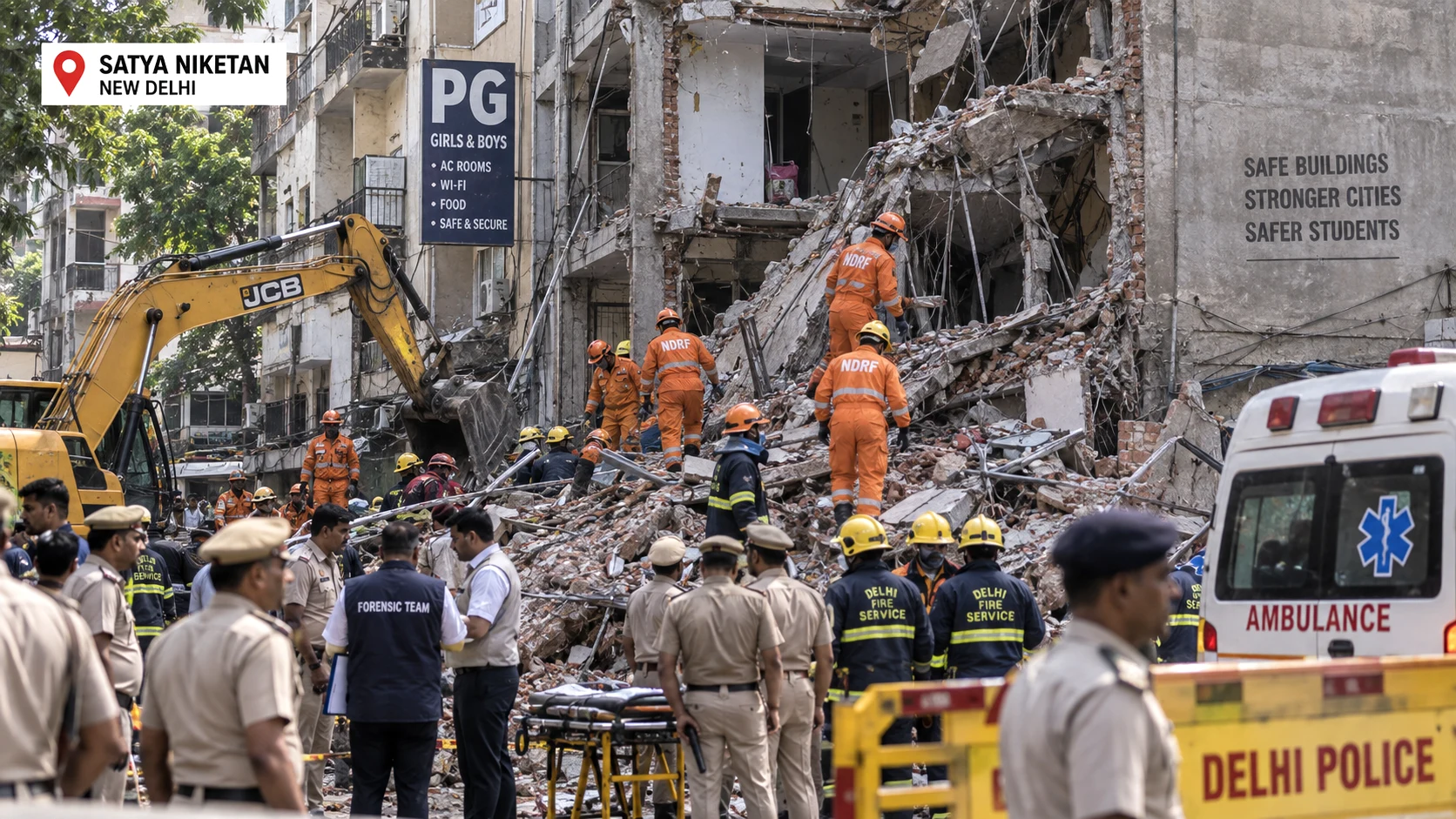
Delhi Police have arrested a PG operator and labour contractor as the Satya Niketan building collapse probe widens into repairs, structural alterations and management.
Registrations under the Bharatiya Nyaya Sanhita’s organised and petty organised crime provisions rose 16% in the first five months of 2026, while police separately arrested five people over an e-rickshaw driver’s killing and opened investigations into two unrelated body discoveries in outer Delhi.
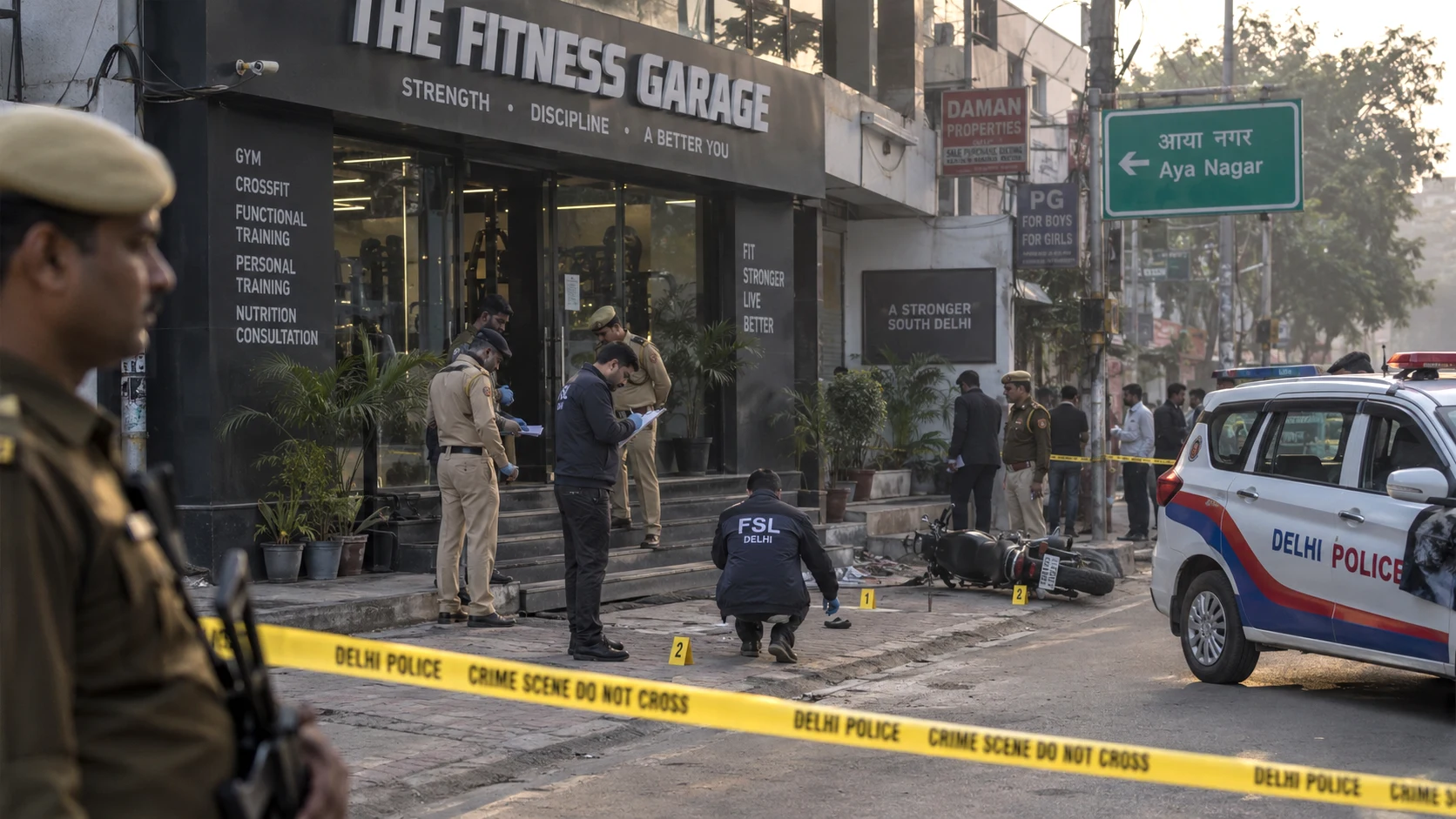
Vijay Kumar was called outside a gym near Hansa Chowk in south Delhi before gunmen opened fire on Monday morning. Police have formed multiple teams and are examining personal enmity and a possible connection to an older rivalry in the area.
Crime/ International Crime | Hate Crime Investigation11 min read
A 19-year-old Illinois man has been arrested over an alleged mass-shooting plan that investigators say may have targeted a Hindu place of worship in Aurora. Prosecutors say the suspect reported that his rifle malfunctioned, while police recovered weapons, ammunition, body armour and material express






0 Comments