Iran Says It Controls Strait of Hormuz: Will Petrol Cost More in India?
For an Indian motorist watching another round of tension in the Strait of Hormuz, the most practical question is simple: will the next visit to the petrol pump cost more? For now, the answer is not automatically.
Editorial illustration representing the Strait of Hormuz shipping route and its potential impact on Indian fuel prices
Table of Contents (19 sections)
For an Indian motorist watching another round of tension in the Strait of Hormuz, the most practical question is simple: will the next visit to the petrol pump cost more?
For now, the answer is not automatically.
Petrol and diesel prices at major state-run fuel outlets in India remained broadly unchanged on October 9, even after another sharp increase in international oil prices and a renewed fall in shipping activity around the Strait of Hormuz.
But that does not mean the risk has disappeared.
The latest developments have increased pressure on a global energy route that matters enormously to India. Iran says it has control of the Strait and has threatened to shut routes that it considers unauthorised. At the same time, independent shipping data show that vessels are still getting through, although traffic has fallen sharply and the cost and danger of moving oil through the region have increased.
Recommended Reading
Related Stories & In-Depth Guides
Curated editorial perspectives matching this topic.
Donald Trump says the United States will not resume military strikes on Iran before the November 3 midterm elections, but the blockade, sanctions and Hormuz dispute remain unresolved. Here is what the pause means for oil markets, diplomacy and India.
The GFS Pride and Cape Dao have sunk near the Strait of Hormuz as attacks on commercial shipping intensify. The two sinkings happened close together, but Cape Dao had been struck weeks earlier. Here is what is confirmed, what remains unclear and why the escalation matters for global trade and India.
That distinction matters.
The Strait of Hormuz is not completely empty of commercial shipping. What the world is dealing with is a heavily disrupted, dangerous and politically contested shipping corridor where substantially fewer vessels are moving than under normal conditions.
For Indian households, the immediate question is therefore not simply whether Iran can declare the Strait closed. It is whether the disruption lasts long enough, becomes severe enough and keeps international energy costs high enough to eventually reach retail petrol and diesel prices.
Key Takeaways
Iran has asserted control over the Strait of Hormuz and threatened to block unauthorised routes.
Independent data show shipping traffic has fallen sharply but not stopped completely.
Petrol and diesel prices at major Indian state-run outlets remained stable on October 9.
India has diversified a large share of crude imports away from Hormuz-dependent routes.
A prolonged period of high crude prices, elevated freight costs and a weaker rupee could eventually push retail fuel prices higher.
Short-term spikes in oil markets do not automatically translate into immediate petrol-pump increases.
What Has Changed in the Strait of Hormuz?
Iranian officials have increasingly asserted that Tehran controls passage through the Strait of Hormuz.
An adviser to the commander of Iran's Islamic Revolutionary Guard Corps said this week that routes Iran considers illegal would be blocked. Another adviser claimed that average daily ship traffic had fallen from around 125 vessels before the war to approximately 10.
Independent shipping information also confirms a severe reduction in traffic, although not a complete halt.
Data cited by Reuters from commodities analytics company Kpler showed only seven commodity vessels passing through the Strait on Tuesday, October 6 — the lowest level in more than two months.
Traffic recovered slightly to around 10 vessels on Wednesday.
Kpler estimated crude-oil movements through Hormuz at around 10.1 million barrels per day, approximately 74% of pre-war volumes.
Those figures are important because they show why the phrase "Hormuz is closed" needs context.
Iran may be asserting control and attempting to restrict particular routes, but commercial energy cargoes continue to move through the region.
The problem for oil markets is that they are moving through a much riskier system.
Why Are Oil Markets Still Nervous?
A tanker does not need to be physically prevented from sailing for disruption to become expensive.
Shipowners must consider the possibility of attacks. Insurers have to price greater war risk. Crews may demand additional compensation. Tankers can be delayed or rerouted. Oil producers may have to use alternative terminals, pipelines or ship-to-ship transfers.
All of those factors can increase the effective cost of getting a barrel of crude from a producer to a refinery.
The latest escalation illustrates that risk.
Attacks on vessels have increased, shipping traffic through Hormuz has dropped and crude markets have reacted sharply to each change in the military and diplomatic situation.
Brent crude closed at $104.28 a barrel on October 8 after gaining about 4% during the session.
By October 9, Brent had eased to around $102.91 after comments from US President Donald Trump reduced some fears of an immediate escalation and reports indicated that discussions with Iran were continuing.
Iran was also reported to be considering a US proposal that could lead to a broader reopening of the Strait.
That possibility has helped calm prices somewhat, but it should not be confused with a confirmed agreement.
Until shipping conditions become reliably safer and more predictable, the Strait will remain a major source of volatility for global energy markets.
Why Hormuz Matters So Much to India
India imports most of the crude oil needed by its large refining system and domestic economy.
That makes international crude prices important even when the oil itself comes from a country far away from Iran.
Before the current West Asia crisis, the Indian government said approximately 45% of India's imported crude passed through the Hormuz route.
India subsequently accelerated diversification, sourcing more oil through routes that do not depend on Hormuz.
During an official government briefing earlier in the crisis, non-Hormuz sourcing was reported to have increased to approximately 70% of crude imports, compared with around 55% before the conflict.
That diversification provides India with an important buffer.
Oil can come from Russia, the United States, Latin America and other suppliers. Gulf producers also have some alternative export infrastructure, while increasingly complex shipping arrangements have allowed more barrels to reach customers despite the disruption.
But diversification does not make India immune.
Oil is traded in a global market.
If disruption around Hormuz removes supply, increases freight rates or pushes international crude benchmarks higher, India can pay more even for crude that never physically passes through the Strait.
India Is Still Buying Large Volumes of Oil
India's crude imports rose strongly in September despite the security problems in West Asia.
Preliminary shipping data showed imports reaching about 5.26 million barrels per day during the month, the highest level recorded in 2026 at that stage.
Gulf supplies also strengthened.
That is evidence that the energy system has adapted considerably since the early months of the conflict.
Producers have used alternative routes, ship-to-ship transfers and other logistical arrangements to maintain exports.
It is therefore wrong to assume that a reduction in Hormuz traffic means India is about to run out of crude.
The more realistic risk for Indian consumers is price.
Oil may continue to reach Indian refineries, but keeping those flows moving can become considerably more expensive.
So, Will Petrol Become More Expensive in India?
Not necessarily immediately.
This is the most important distinction for consumers.
A rise in Brent crude does not produce an identical overnight rise in the price displayed at every Indian petrol pump.
Retail fuel pricing is influenced by several moving parts.
The international cost of crude is one of them, but so are the rupee-dollar exchange rate, international prices of refined petrol and diesel, freight, insurance, refinery economics, oil-marketing margins, central duties, dealer commissions and state taxes.
Oil-marketing companies can also absorb part of an international price movement for a period instead of immediately passing every change to customers.
That is what Indian motorists are seeing now.
Despite Brent remaining above $100 a barrel, regular petrol and diesel prices at state-controlled retailers had not seen another broad increase by October 9.
In Delhi, the latest PPAC-listed Indian Oil price was ₹102.12 a litre for petrol and ₹95.20 for diesel.
Reported October 9 prices included about ₹111.21 for petrol in Mumbai, ₹111.68 in Bengaluru and ₹115.69 in Hyderabad.
The higher Hyderabad price does not mean Telangana is more exposed to Hormuz. State-level taxes are an important reason retail fuel prices differ across India.
Telangana, for example, applies a substantially higher VAT rate on petrol than Delhi.
Current Petrol and Diesel Snapshot
City
Petrol
Diesel
Delhi
₹102.12/litre
₹95.20/litre
Mumbai
₹111.21/litre
₹97.83/litre
Kolkata
₹113.51/litre
₹99.82/litre
Chennai
₹107.76/litre
₹99.55/litre
Bengaluru
₹111.68/litre
₹99.56/litre
Hyderabad
₹115.69/litre
₹103.82/litre
These prices are a snapshot and can change when oil companies revise local rates.
Why Petrol Prices Can Stay Stable Even When Crude Jumps
Imagine crude oil rises sharply for two days because traders fear a major disruption.
If diplomatic developments then reduce that risk and prices fall again, passing the entire temporary spike to motorists would create unnecessary volatility.
Retail pricing therefore does not always track every hour-to-hour movement in Brent.
Oil companies also buy different types of crude under different contracts and at different prices. The Indian crude basket does not move in perfect lockstep with a single Brent futures quote.
Companies may have inventories purchased earlier at lower prices.
Refining margins can move separately from crude.
The rupee can strengthen or weaken.
Taxes can remain unchanged even while the underlying cost changes.
This is why a headline saying crude has risen 4% should not be interpreted as meaning petrol will automatically become 4% more expensive.
But There Are Signs of Pressure Inside India's Fuel Market
Stable state-run prices do not mean fuel retailers are unaffected.
Private fuel retailer Nayara Energy raised petrol prices by ₹5 a litre and diesel by ₹3 a litre from October 3 as higher international crude and refined-product costs put pressure on its retail economics.
State-owned Indian Oil, Bharat Petroleum and Hindustan Petroleum dominate India's fuel-retail network and have not followed that move with a comparable fresh nationwide increase.
The difference demonstrates how the pressure can build before it becomes visible everywhere.
If high crude and product prices persist, companies effectively face a choice between accepting weaker marketing margins and passing more of the cost to consumers.
The longer expensive oil persists, the more difficult it becomes to absorb.
The Rupee Is the Second Part of the Petrol-Price Equation
For India, looking only at the dollar price of crude is not enough.
Oil imports are largely paid for in foreign currency.
If crude becomes more expensive while the Indian rupee also weakens against the US dollar, Indian refiners face a double impact.
They need more dollars for every barrel and more rupees to purchase each dollar.
Conversely, a stronger rupee can soften part of an increase in international oil prices.
That is one reason the same Brent price can have a different effect on India's import bill at different times.
For consumers trying to understand whether petrol could get more expensive, watching both international oil prices and the rupee is more useful than watching Brent alone.
Freight and Insurance Are Becoming Increasingly Important
One unusual feature of the current crisis is that the price of physically moving oil has become almost as important as the availability of the oil itself.
Tankers operating around Hormuz face greater security risk.
Insurance costs rise when vessels enter conflict zones.
Owners may demand significantly higher freight rates.
Some cargoes may travel longer routes or require transfers between ships.
Those expenses eventually become part of the delivered cost of energy.
This helps explain why oil can remain expensive even when headline export volumes improve.
The market is not only asking, "Is there enough oil?"
It is also asking, "How safely and cheaply can that oil reach the refinery?"
Alternative Routes Are Helping Prevent a Bigger Shock
There is another reason Indian motorists have not seen an immediate new price shock.
Middle Eastern exporters have become increasingly successful at moving oil through alternative channels.
Recent shipping data showed crude exports from Gulf of Oman and Red Sea routes increasing as Hormuz traffic weakened.
That has helped compensate for some of the lost flow through the Strait.
Emergency oil-stock releases are providing another cushion.
The International Energy Agency has been accelerating previously agreed reserve releases, with particular attention to tight diesel markets.
These measures cannot permanently solve a prolonged disruption.
But they can reduce the immediate shortage and give refiners and governments more time to adjust.
What Could Make Petrol Prices Rise From Here?
For Indian consumers, the duration of the crisis matters more than any single day's headline.
A short-lived spike in crude that quickly reverses may have limited effect at the pump.
A prolonged period of Brent above $100, combined with higher freight costs, expensive refined fuels and a weaker rupee, would create much stronger pressure for retail adjustments.
A further collapse in Hormuz shipping would increase that risk.
So would attacks on alternative export infrastructure that Gulf producers are using to bypass the Strait.
On the other hand, a credible agreement that restores safer and more predictable passage could remove part of the geopolitical premium currently embedded in energy prices.
Additional supply from other producers, larger emergency releases or stronger non-Hormuz crude flows could also reduce pressure.
None of those outcomes is guaranteed.
What Indian Consumers May Feel Before Another Petrol Hike
Petrol is only one route through which expensive energy reaches a household budget.
Diesel is particularly important because trucks carry a large share of India's goods.
Higher transport costs can eventually affect vegetables, packaged food, construction material and manufactured goods.
Air travel can become more expensive when aviation turbine fuel costs rise. Airlines may respond through fares or fuel surcharges.
Businesses that use petroleum products as raw materials can face higher costs.
The rupee and inflation can also come under pressure when India's energy-import bill rises.
That means a household can feel the economic effect of Hormuz even before the number on the neighbourhood petrol pump changes again.
Should Drivers Rush to Fill Their Tanks?
There is no evidence supporting panic buying.
India has spent months adapting its energy sourcing to the West Asia disruption, and substantial crude continues to reach the country.
A reduction in vessel traffic through Hormuz should therefore not be confused with an imminent disappearance of fuel from Indian pumps.
Panic buying can itself create temporary local shortages by suddenly increasing demand.
For most motorists, the more useful approach is simply to watch official fuel prices and distinguish between international oil-market headlines and actual changes announced by fuel retailers.
Three Things to Watch Now
The first is actual ship traffic through the Strait of Hormuz.
Statements from governments and military officials matter, but physical tanker movements provide a clearer picture of how much oil is really getting through.
The second is whether Brent remains above $100 for an extended period or falls as diplomacy progresses.
A persistent price level matters more to India's fuel economics than one volatile trading session.
The third is what India's state-owned oil-marketing companies do.
If Indian Oil, Bharat Petroleum and Hindustan Petroleum begin another coordinated series of retail adjustments, motorists will see the international pressure translate much more directly into household fuel bills.
What Has Changed Since the Earlier Hormuz Scare?
The latest development is not simply that crude oil remains expensive.
The more important October 8–9 change is that tanker attacks have intensified and physical traffic through Hormuz has dropped sharply again after an earlier recovery.
At the same time, the diplomatic picture has moved in the opposite direction, with discussions that could potentially lead to wider reopening.
That combination explains the unusual market behaviour: serious shipping disruption is keeping risk high, while diplomatic signals are preventing the market from pricing in the worst possible scenario.
For India, that leaves petrol prices in an uncomfortable middle ground.
There is no automatic reason for an immediate new increase.
But the buffer between expensive international energy and the Indian consumer cannot be assumed to last indefinitely.
Bottom Line
Iran says it controls the Strait of Hormuz and shipping traffic has fallen dramatically, but the waterway is not completely closed to commercial oil traffic.
That distinction is important for India.
Crude continues to reach Indian refineries, and India has diversified a significant portion of its supply away from routes dependent on Hormuz. Petrol and diesel prices at major state-run outlets also remained broadly stable on October 9.
So a new nationwide petrol-price increase is not inevitable merely because Hormuz traffic has fallen.
The risk rises if disruption becomes prolonged.
If crude remains expensive, shipping and insurance costs stay elevated, the rupee weakens and oil companies cannot continue absorbing higher costs, more of the pressure could eventually reach Indian petrol and diesel prices.
For motorists, the most useful signal is therefore not an Iranian statement or a single Brent price spike on its own.
It is whether high oil costs persist long enough to change what India's fuel retailers charge at the pump.
Key Takeaway
Iran asserts control over Strait of Hormuz; shipping traffic has fallen sharply.
Indian petrol and diesel prices remain stable for now.
India has diversified crude imports away from Hormuz routes.
Prolonged high oil prices could eventually push retail fuel costs higher.
The Rajatheertha Team publishes news, explainers, guides and updates across India and the world. Our coverage follows Rajatheertha's editorial, verification and corrections standards.
Iranian military officials claim Tehran controls the Strait of Hormuz as ship traffic falls sharply and Iran warns it could launch pre-emptive operations. Here's what is actually happening and why the crisis matters for India's oil bill, rupee and inflation.
A Saudi Aramco administrative building in Dhahran was targeted on October 13, causing a limited fire but no casualties. Crude prices have risen as markets assess Saudi supply risks, but there is no confirmed disruption to Aramco oil production and India’s PSU petrol and diesel prices remain unchange
Eighteen days before the November 3 US midterms, Washington and Tehran remain without a comprehensive agreement. Iran says the latest US response on Hormuz is insufficient, the American blockade remains in force, attacks on shipping have intensified and oil prices remain above $100 a barrel.
Donald Trump says Russia and Ukraine have agreed to immediately stop attacks on energy infrastructure. Volodymyr Zelensky says he was not informed of such an agreement, while Ukraine has reported new Russian strikes since the announcement. Here is what is actually confirmed.
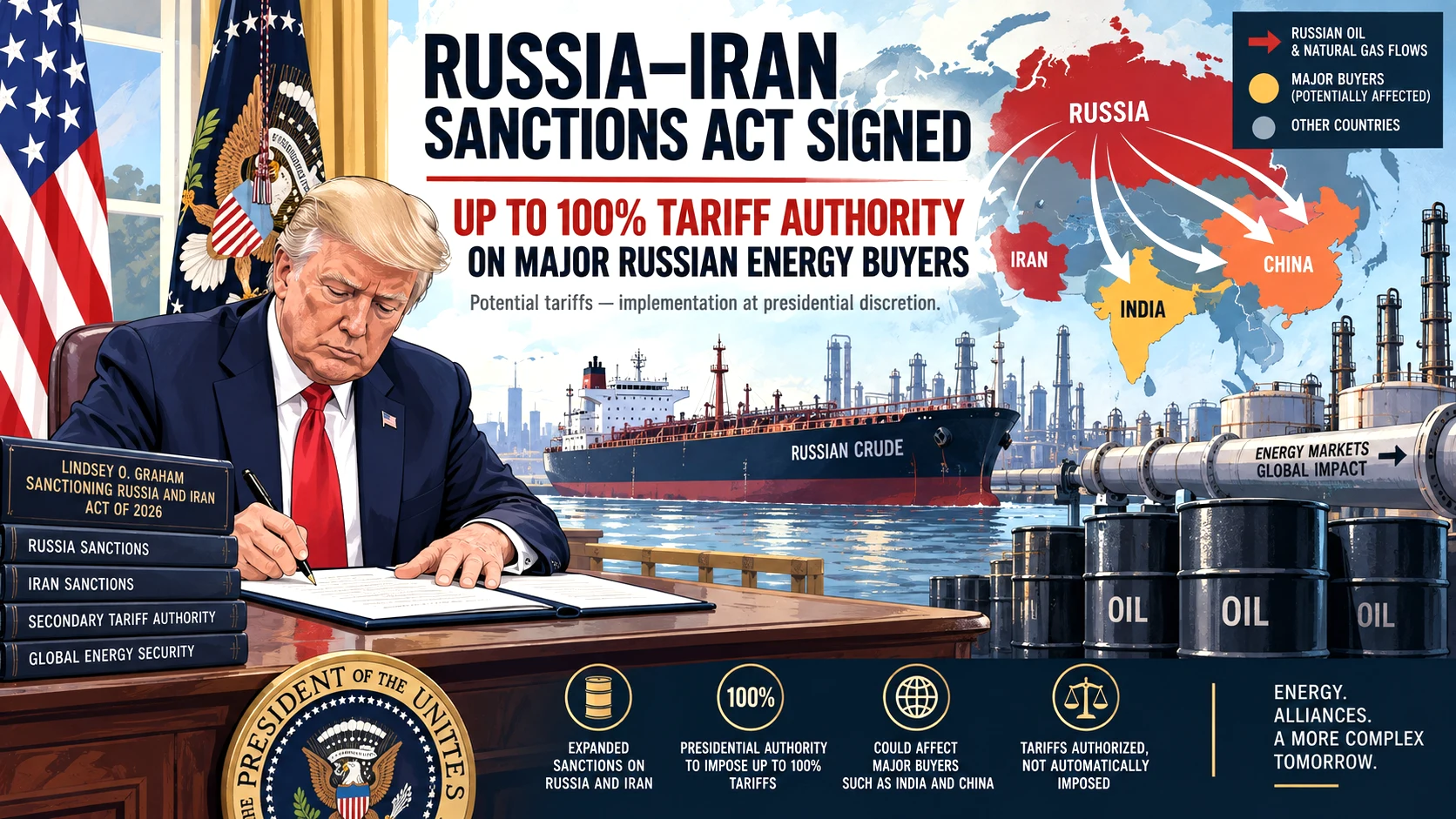
The new US law targets Russia’s energy, financial and defence networks and allows additional tariffs of up to 100% on goods from the largest buyers of Russian oil and gas. India faces significant exposure because of its large Russian crude imports, but a 100% tariff on Indian goods has not been impo
Donald Trump’s remarks naming Los Angeles and San Diego while discussing the Iran war and higher prices have drawn criticism from California officials. The White House says Trump was describing the threat a nuclear-armed Iran could pose, not encouraging an attack.






0 Comments