US-Iran War Latest: Talks Stall, Hormuz Risks Rise 18 Days Before the Midterms
Eighteen days before the November 3 US midterms, Washington and Tehran remain without a comprehensive agreement. Iran says the latest US response on Hormuz is insufficient, the American blockade remains in force, attacks on shipping have intensified and oil prices remain above $100 a barrel.
Editorial illustration of US-Iran conflict, Strait of Hormuz and midterm timeline
Table of Contents (16 sections)
WASHINGTON / NEW DELHI, October 16, 2026: Eighteen days before Americans vote in the November 3 midterm elections, the United States and Iran remain locked in a confrontation that has temporarily stopped short of renewed large-scale US strikes on Iranian territory but is far from either a ceasefire or a political settlement.
The clearest way to understand the current position is to separate four questions that are often blurred together.
Are negotiations producing a deal? Not yet.
Has the US blockade of Iran ended? No.
Is the Strait of Hormuz returning to normal? No.
Has President Donald Trump permanently ruled out another US military escalation? No. He has publicly said the United States will not resume strikes on Iran before November 3, which establishes a near-term political timetable rather than a permanent settlement.
Since that announcement, the situation at sea has actually become more dangerous.
Iran has said Washington's latest response to its conditions for reopening the Strait of Hormuz is insufficient. The United States has continued enforcing its naval blockade and tightening financial pressure. Commercial vessels have been attacked around the strait, two cargo ships have sunk in recent days under different circumstances, and oil remains expensive enough to keep governments, refiners and consumers watching every military and diplomatic development.
Recommended Reading
Related Stories & In-Depth Guides
Curated editorial perspectives matching this topic.
The GFS Pride and Cape Dao have sunk near the Strait of Hormuz as attacks on commercial shipping intensify. The two sinkings happened close together, but Cape Dao had been struck weeks earlier. Here is what is confirmed, what remains unclear and why the escalation matters for global trade and India.
Iranian military officials claim Tehran controls the Strait of Hormuz as ship traffic falls sharply and Iran warns it could launch pre-emptive operations. Here's what is actually happening and why the crisis matters for India's oil bill, rupee and inflation.
That makes the period before November 3 less a ceasefire than an uneasy interval in a much larger conflict.
Latest — October 16, 2026
No comprehensive US-Iran peace agreement has been announced.
Iran says the latest US response to its seven conditions for reopening Hormuz does not resolve all of Tehran's demands.
The US naval blockade remains active.
Iranian seaborne crude exports had fallen to zero and remained there through October 5, according to Vortexa data reported by Reuters.
Attacks on commercial shipping around Hormuz have intensified.
The US Treasury announced another sanctions action on October 15 targeting financial networks Washington says help Iran evade economic restrictions.
Brent crude was trading near $105 a barrel early on October 16.
Trump's public commitment not to resume direct strikes on Iran runs through the November 3 midterm election date. It does not establish what Washington will do afterward.
Where US-Iran Talks Stand
Diplomacy remains alive through intermediaries, but there is no evidence as of October 16 that Washington and Tehran have bridged the central disagreements.
Iran presented a proposal during the UN General Assembly under which normal passage through the Strait of Hormuz could resume within seven days if seven Iranian conditions were satisfied.
The United States later responded through Qatari intermediaries.
On October 11, however, Iranian security chief Mohsen Rezaei said the American response was insufficient. According to Reuters, he said Washington had accepted some Iranian conditions while other parts remained unclear.
He also indicated that Tehran was no longer engaged in a continuing exchange of responses with Washington at that stage.
That represents a harder diplomatic position than simply saying negotiations are progressing.
Mediators can continue transmitting messages, and neither side has formally closed the diplomatic route. But the available public information does not support describing a settlement as imminent.
The core problem is sequencing.
Iran wants major economic and maritime pressure eased as part of arrangements that would restore normal movement through Hormuz.
Washington wants broader security concessions while retaining leverage generated by sanctions, the blockade and its military presence.
Those positions can theoretically form the basis of a negotiated exchange. They have not yet produced an agreement.
The Blockade Has Not Been Lifted
Trump's promise not to resume direct strikes on Iran before November 3 did not end the naval blockade.
That distinction became particularly clear on October 10.
US Central Command said an American fighter aircraft used a precision munition to disable the propulsion of the Panama-flagged M/V Ocean Molica, also known as Arika Sun, in the Gulf of Oman after the ship allegedly ignored warnings and attempted to breach the blockade after leaving an Iranian port.
CENTCOM said the crew was not harmed.
The incident is significant because it demonstrates what the pre-election military pause does and does not mean.
Washington has said it will not restart direct military attacks on Iran before the election.
It has not said that US forces will stop enforcing the blockade.
It has not withdrawn naval forces.
It has not ended sanctions enforcement.
And it has not guaranteed that force will never be used against vessels that the US military says are attempting to breach the blockade.
Those are separate policies.
For shipping companies operating around the Gulf of Oman and Strait of Hormuz, that distinction is practical rather than theoretical.
Iran's Oil Exports Show How Powerful the Blockade Has Become
The blockade is also having measurable economic consequences.
Energy intelligence company Vortexa said Iranian seaborne crude exports fell to zero in the second week of September from a 14-day average of about 230,000 barrels a day at the start of that month.
Reuters reported on October 13 that exports had remained at zero through October 5.
Vortexa also estimated that about 43 million barrels of Iranian crude aboard tankers were trapped west of Hormuz because of the blockade.
These figures should not be interpreted as proof that every form of Iranian petroleum trade has stopped permanently.
Shipping data can change. Cargoes can move through opaque trading networks, ship-to-ship transfers and other mechanisms that are difficult to monitor in real time.
But the evidence points to an unusually severe restriction on Iran's ability to move crude by sea.
At the same time, other Gulf producers have recovered part of the export capacity lost earlier in the conflict.
Vortexa estimated that September oil flows from Gulf countries excluding Iran had recovered to more than 81 percent of pre-war levels, with Saudi exports contributing significantly.
The result is an increasingly uneven Gulf oil market: Iranian exports are under extreme pressure while other producers attempt to restore supply.
Hormuz Is Moving More Oil — But It Is Not Normal
The Strait of Hormuz remains the most important physical pressure point in the conflict.
Before the war, it was one of the most heavily used energy chokepoints in the world.
US Energy Information Administration data show total oil movements through Hormuz averaging about 21.6 million barrels a day in the fourth quarter of 2025.
During the most severe disruption, that collapsed to about 4.9 million barrels a day in the second quarter of 2026.
Flows later recovered as producers developed alternative arrangements and more vessels returned.
But October has brought another deterioration in security.
Kpler data reported by Reuters on October 16 showed total Hormuz clearance averaging 11.62 million barrels a day over the seven days through October 13. Kpler said that was about 68 percent of its 17.15-million-barrel-a-day baseline.
Different tracking services use different definitions and comparison periods, so those numbers should not be mechanically compared with every earlier EIA estimate.
The important point is simpler: substantially more oil is moving than during the worst months of the crisis, but the route remains well below normal capacity and vulnerable to renewed disruption.
Attacks on Commercial Shipping Have Intensified
The security deterioration is no longer theoretical.
Rajatheertha reported on October 15 that Singapore-registered container ship GFS Pride had sunk after being struck while transiting the Strait of Hormuz.
A second vessel, Cape Dao, also sank recently, although its timeline was different: it had been seriously damaged in a September attack rather than being hit in a new strike at the same time as GFS Pride.
Another Singapore-registered ship, GFS Giselle, was struck but reached safe anchorage.
Those distinctions matter.
Attribution for individual maritime incidents should be based on the evidence released for each vessel rather than assigning every explosion, projectile or mine incident to the same actor automatically.
At the broader strategic level, however, Iranian officials told Reuters that Tehran had changed tactics and increased pressure on vessels it believes are violating its restrictions.
That means Hormuz is simultaneously a military front, an economic bargaining tool and a diplomatic negotiating point.
Why Oil Is Still Above $100
The continued risk around Hormuz helps explain why Trump's pre-election strike pledge did not produce a lasting collapse in crude prices.
Early on October 16, Brent crude futures were around $105.21 a barrel, while US West Texas Intermediate was near $97.20.
Oil prices respond to much more than the probability of a direct US strike.
Markets are also pricing:
the safety of tankers and other merchant vessels;
the volume of oil actually clearing Hormuz;
Saudi and other Gulf export capacity;
freight and war-risk insurance costs;
Iranian retaliation;
US sanctions and blockade enforcement;
Houthi attacks and the wider Yemen conflict;
global inventories;
and whether diplomacy produces a durable political agreement.
That is why markets can remain expensive even during a period when Washington says it will not launch another direct attack before a particular date.
The Cost of the War: Why the $3 Billion-a-Month Figure Needs Context
Another figure frequently attached to the conflict is a reported cost of about $3 billion a month for the United States.
That requires an important qualification.
The Congressional Budget Office estimated that Department of Defense operational, logistical and sustainment costs associated with the conflict totalled approximately $38 billion through August 1.
CBO did not say the war is currently costing exactly $3 billion every month.
Its estimate was conditional.
If violence remained around the comparatively lower levels seen during May and June, CBO estimated another month could cost approximately $2 billion.
If fighting returned to approximately the intensity recorded in July, the monthly cost could reach about $3 billion.
A more severe escalation could cost still more.
The correct conclusion is therefore that the conflict has already imposed tens of billions of dollars in US military costs and that continued fighting could add billions each month depending on intensity.
The Third Aircraft Carrier Question
The military pause also should not be confused with a military withdrawal.
Associated Press has reported that the USS Theodore Roosevelt could arrive in the region by late October, potentially giving the United States a third aircraft carrier connected to the wider military posture.
An expected deployment is not the same thing as an order to attack.
Aircraft carriers can be used for deterrence, surveillance, air defence, maritime protection, contingency planning and diplomatic leverage as well as offensive operations.
But additional forces would give Washington more military options if the situation deteriorates.
That is one reason the days immediately after November 3 will receive close scrutiny.
What Actually Changes After the November 3 Midterms?
November 3 matters because Trump publicly attached his no-strike commitment to that date.
It does not mean the war automatically enters a new military phase on November 4.
No publicly announced order requires an American attack after voting ends.
Several outcomes remain possible.
Trump could extend the restraint.
Negotiations could produce a partial agreement.
The blockade could remain while direct strikes remain suspended.
A maritime incident could change the security calculation.
Or Washington could reconsider military options if diplomacy fails.
It is therefore more accurate to describe November 3 as the end of Trump's publicly stated pre-election restraint period rather than as a confirmed date for renewed war.
The Election Does Not Change Congress Overnight
There is another distinction that is frequently missed when foreign-policy decisions are linked to a US midterm election.
Americans vote on November 3, but newly elected members of Congress do not simply assume power the next morning.
Under the US Constitution's 20th Amendment, congressional terms begin on January 3.
That means even if control of the House, Senate or both chambers changes in the election, the institutional change takes effect when the new Congress begins.
The sitting Congress remains in place during the post-election period until the new terms start.
A differently constituted Congress could eventually change the political environment surrounding the war through hearings, oversight, appropriations, legislation, sanctions policy and debates over war powers.
But the November vote itself does not automatically cancel the blockade, change presidential military authority or produce a ceasefire.
Those questions remain subject to decisions by the executive branch, Congress, Iran and other actors in the conflict.
What This Means for India's Petrol and Diesel Prices
For India, the most important transmission mechanism remains energy cost rather than the US election itself.
India imports most of the crude oil it consumes.
When Brent remains above $100, tanker freight becomes more expensive and insurance premiums rise, Indian refiners can face pressure even if contracted crude continues arriving.
A weaker rupee can amplify the cost because international oil is generally priced in dollars.
Higher diesel and transport costs can then affect freight, manufacturing, agriculture and eventually consumer inflation.
That does not mean every $1 increase in Brent immediately appears at Indian petrol pumps.
Domestic retail prices also reflect refinery economics, exchange rates, taxes, inventories and pricing decisions by oil-marketing companies.
As a current official reference point, India's Petroleum Planning and Analysis Cell listed IOCL retail petrol in Delhi at ₹102.12 a litre and diesel at ₹95.20 a litre on October 15.
Those prices had remained unchanged across several earlier October dates in PPAC's published archive even while global crude markets continued moving.
The bigger risk for Indian consumers would be a prolonged period of crude above $100 combined with another major fall in Hormuz traffic, higher tanker costs and renewed pressure on the rupee.
Conversely, a credible US-Iran agreement that makes Gulf shipping safer could gradually reduce some of those pressures.
Short Timeline: From February to October
February 28:
The current war began with US and Israeli strikes on Iran. Shipping through Hormuz subsequently fell sharply.
June:
A US-Iran memorandum temporarily created expectations that the conflict could ease and Hormuz traffic began recovering.
July:
Military operations resumed and the United States reinstated its blockade on Iranian ports as the earlier diplomatic opening broke down.
September:
Washington and Tehran explored a phased arrangement under which Iran could restore normal Hormuz traffic while US economic and maritime pressure was eased.
October 8:
Trump said the United States would not resume direct military strikes on Iran before the November 3 midterms.
October 10-11:
US forces said they disabled a commercial vessel that allegedly attempted to breach the blockade. Iran then said Washington's response to Tehran's seven Hormuz conditions was insufficient.
October 13-15:
New data showed severe pressure on Iranian crude exports while attacks on commercial shipping intensified. The US Treasury announced another round of financial sanctions on October 15.
October 16:
Brent remained around $105 a barrel and Hormuz traffic was still materially below normal levels.
The Five Things to Watch Between Now and November 3
First is diplomacy.
Any confirmed movement on Iran's seven conditions, the US response or a mediated compromise would matter more than optimistic rhetoric without operational changes.
Second is Hormuz traffic.
A sustained rise in safe commercial passage would be one of the clearest signs that tensions are easing.
Third is maritime violence.
Another series of attacks on merchant ships could quickly reverse improvements in shipping volumes and raise oil and insurance costs.
Fourth is US force posture.
The possible arrival of another aircraft carrier would increase military capacity even while the public no-strike commitment remains in effect.
Fifth is the blockade.
Any formal easing, modification or lifting of the blockade would represent a much more substantial change than another round of indirect talks.
Bottom Line
The US-Iran conflict is not frozen while the United States waits for its midterm elections.
Direct American strikes on Iran are publicly paused until November 3, but other elements of the confrontation remain active.
The blockade continues.
Economic sanctions are still being expanded.
Iran's seaborne crude exports are under severe pressure.
Commercial shipping around Hormuz remains exposed to attack.
Oil is above $100 a barrel.
And diplomatic contacts have not yet produced an agreement acceptable to both Washington and Tehran.
November 3 is therefore an important political marker, not a scheduled end or restart date for the war.
What happens afterward will depend less on the election calendar itself than on whether diplomacy changes conditions on the water: safer ships, more predictable oil flows, a modified blockade and a credible mechanism for preventing renewed escalation.
Until those things happen, the Strait of Hormuz remains the clearest measure of whether the conflict is actually moving toward settlement or merely passing through another temporary pause.
Key Takeaway
US-Iran talks stalled; blockade remains; Hormuz attacks rising 18 days before midterms.
Oil stays above $100; no permanent settlement yet.
The Rajatheertha Team publishes news, explainers, guides and updates across India and the world. Our coverage follows Rajatheertha's editorial, verification and corrections standards.
US military planners have reportedly prepared options for renewed major operations against Iran, but no new large-scale campaign has been officially announced. Here is what is confirmed, what remains reported and why India is watching oil, the rupee and fuel costs.
Donald Trump says the United States will not resume military strikes on Iran before the November 3 midterm elections, but the blockade, sanctions and Hormuz dispute remain unresolved. Here is what the pause means for oil markets, diplomacy and India.
Donald Trump’s remarks naming Los Angeles and San Diego while discussing the Iran war and higher prices have drawn criticism from California officials. The White House says Trump was describing the threat a nuclear-armed Iran could pose, not encouraging an attack.
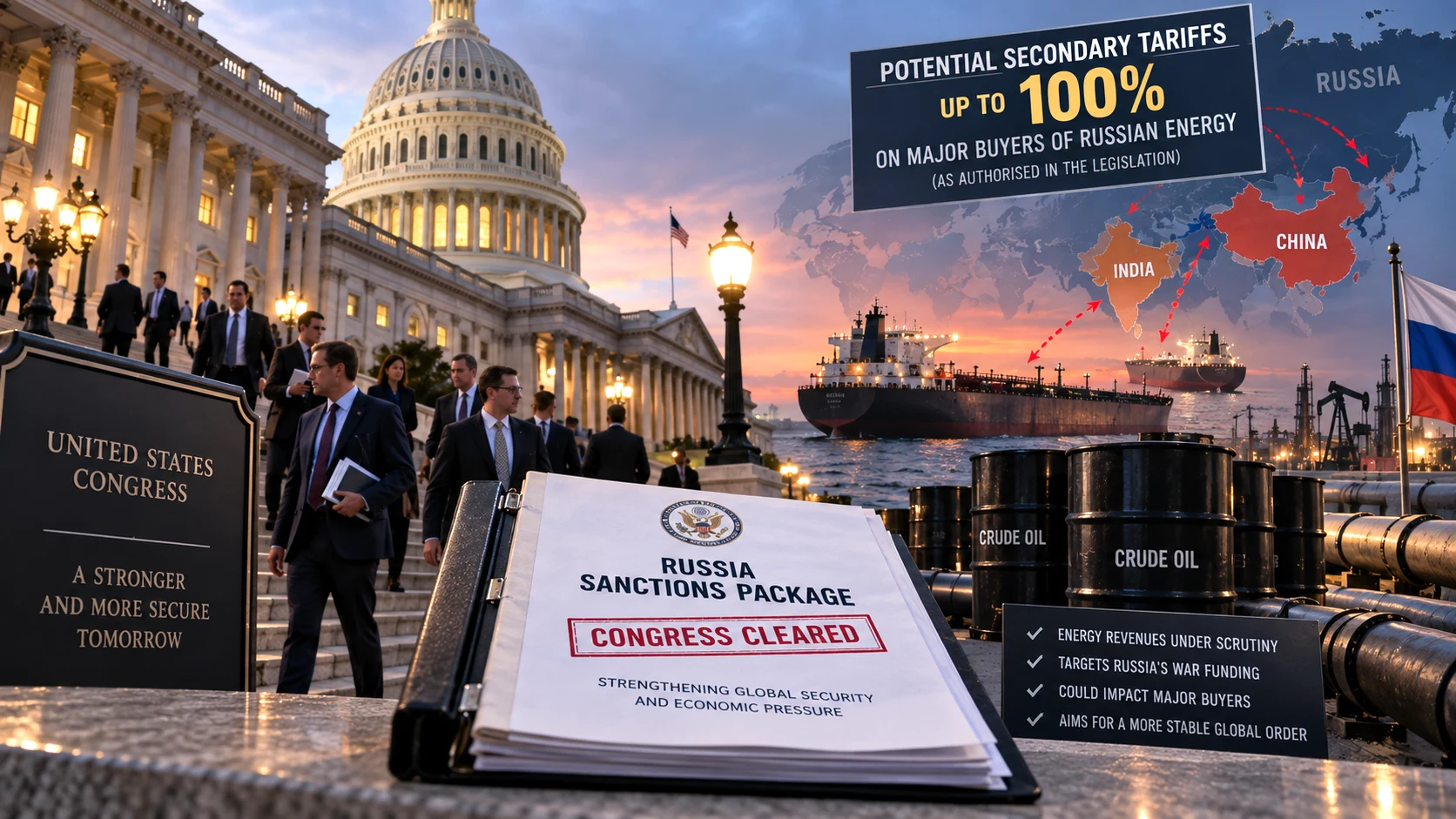
The House approved the Lindsey O. Graham Sanctioning Russia and Iran Act of 2026 by 262-159 after the Senate passed it 86-11. The measure now awaits President Donald Trump’s signature and could subject major buyers of Russian oil or gas to additional US tariffs of up to 100%, although India and Chin
A Saudi Aramco administrative building in Dhahran was targeted on October 13, causing a limited fire but no casualties. Crude prices have risen as markets assess Saudi supply risks, but there is no confirmed disruption to Aramco oil production and India’s PSU petrol and diesel prices remain unchange
Donald Trump says Russia and Ukraine have agreed to immediately stop attacks on energy infrastructure. Volodymyr Zelensky says he was not informed of such an agreement, while Ukraine has reported new Russian strikes since the announcement. Here is what is actually confirmed.






0 Comments