RBI Repo Rate Hike to 5.50%: What It Means for Your Home Loan EMI and FD Rates
The RBI has raised the repo rate by 25 basis points to 5.50%, its first hike since February 2023. Here's what the October 2026 decision could mean for home loan EMIs, loan tenures, fixed deposits and new borrowers.
RBI repo rate rises to 5.50% as Indian home loan borrowers assess the impact on floating-rate EMIs
Table of Contents (23 sections)
The Reserve Bank of India has raised the policy repo rate by 25 basis points to 5.50%, confirming the rate increase that financial markets had widely anticipated ahead of the October Monetary Policy Committee meeting.
The six-member Monetary Policy Committee unanimously approved the increase at its meeting held from October 5 to October 7, 2026, taking the repo rate up from 5.25%. The RBI also changed its monetary-policy stance from “neutral” to “calibrated tightening.”
For households, the most immediate question is simple: Will your home loan EMI now increase?
For many borrowers with floating-rate loans, borrowing costs could rise once their lender resets the applicable interest rate. But the effect will not necessarily appear immediately or be identical for every borrower.
Fixed-rate borrowers may see no immediate change, while floating-rate borrowers could face a higher EMI, a longer repayment tenure, or a combination of both depending on their loan terms and lender's reset mechanism.
Recommended Reading
Related Stories & In-Depth Guides
Curated editorial perspectives matching this topic.
Days after raising the repo rate to 5.50%, the RBI has tightened banks’ daily liquidity rules and announced a ₹25,000 crore bond sale. Here is what the measures mean—and do not mean—for home-loan borrowers and FD savers.
The 57th GST Council has recommended removing GST officers’ arrest power under Section 69 and raising the prosecution threshold from ₹1 crore to ₹5 crore. Here is what the proposals actually mean for small businesses—and what does not change yet.
Deposit holders could eventually benefit if banks increase fixed-deposit rates, although a higher repo rate does not require every bank to raise FD rates immediately.
RBI Repo Rate Today: Key Numbers
The RBI's official website showed the following policy rates on October 8:
RBI Policy Rate
New Rate
Repo Rate
5.50%
Standing Deposit Facility Rate
5.25%
Marginal Standing Facility Rate
5.75%
Bank Rate
5.75%
The RBI homepage confirms the policy repo rate at 5.50% following the October decision.
The 25-basis-point increase is also the first RBI repo-rate hike since February 2023. In February 2023, the MPC had raised the repo rate by 25 basis points to 6.50%.
One basis point is one-hundredth of a percentage point. Therefore:
25 basis points = 0.25 percentage point.
Why Did RBI Raise the Repo Rate?
Inflation is the central reason behind the October policy shift.
The RBI said consumer inflation had increased to 4.8% in August 2026 from 4.5% in July, with food and fuel prices contributing significantly to the increase. Core inflation also moved higher, which the central bank said indicated some broadening of price pressures.
The MPC identified several risks to the inflation outlook, including:
higher energy and commodity prices;
the deficient southwest monsoon;
El Niño conditions;
persistent food-price pressures;
geopolitical uncertainty;
and the possibility that supply shocks could spread into wider prices and inflation expectations.
The RBI now projects CPI inflation at 5.2% for 2026-27, including 6.0% in the third quarter and 5.7% in the fourth quarter. Core inflation is projected at 4.4%.
At the same time, the central bank said India's economy remains resilient and raised its real GDP growth projection for 2026-27 to 7.1%.
That combination—strong growth but rising inflation risks—gave the MPC greater room to increase interest rates.
What Does “Calibrated Tightening” Mean?
The change in policy stance may be almost as important as the 25-basis-point hike itself.
The RBI explicitly said that the shift to calibrated tightening means rate cuts are effectively off the table in the near term under current conditions.
According to the MPC resolution, future policy action under the present circumstances could be either:
another rate increase; or
a pause.
The RBI stressed that the duration and extent of any rate-hike cycle will depend on future growth and inflation data rather than following a predetermined path.
Two MPC members preferred retaining the neutral stance, although all six members voted for the 25-basis-point repo-rate increase.
Borrowers should therefore avoid assuming either that another increase is certain or that this will be the only hike.
Will Your Home Loan EMI Increase?
Floating-rate loans
If your home loan has a floating interest rate, the October RBI hike could eventually make the loan more expensive.
Many newer bank retail loans are linked to an external benchmark such as the RBI repo rate. RBI regulations require floating-rate retail and MSME bank loans under the external-benchmark framework to be reset at least once every three months.
That means the repo-rate increase could feed into the borrower's lending rate when the next reset occurs.
However, the transmission need not happen on the same day that the RBI changes the repo rate.
Your actual impact depends on:
the benchmark used by your lender;
your contractual spread;
the loan reset date;
the lender's pricing methodology;
the outstanding principal;
the remaining tenure; and
whether the lender adjusts EMI, tenure or both.
Fixed-rate loans
If your loan has a genuine fixed interest rate that remains fixed for the relevant period, the RBI repo-rate hike ordinarily does not immediately change your EMI.
Borrowers should still check whether their product is fully fixed or only fixed for an initial period before converting to a floating rate.
How Much Can a 25-Basis-Point Increase Raise Your EMI?
Consider a simple illustration.
Assume:
the borrower has a floating-rate home loan;
the entire 25-basis-point increase is transmitted;
the interest rate rises from 8.50% to 8.75%;
20 years remain on the loan; and
the EMI is recalculated while keeping the same repayment tenure.
The approximate impact would be:
Outstanding Loan
EMI at 8.50%
EMI at 8.75%
Approx. Monthly Increase
₹30 lakh
₹26,035
₹26,511
₹477
₹50 lakh
₹43,391
₹44,186
₹794
₹75 lakh
₹65,087
₹66,278
₹1,192
These are illustrative calculations, not bank quotes.
For a ₹50 lakh loan with 20 years remaining, a complete 25-basis-point increase from 8.50% to 8.75% would raise the EMI by roughly ₹794 per month if the tenure remains unchanged.
Actual borrower outcomes can differ substantially depending on the interest rate, outstanding balance and remaining term.
What If Your Bank Keeps the EMI Unchanged?
Banks do not always respond to an interest-rate increase simply by raising the monthly EMI.
They may instead increase the remaining loan tenure.
For example, on the same illustrative ₹50 lakh outstanding balance:
remaining tenure: 20 years;
old interest rate: 8.50%;
new rate: 8.75%;
EMI kept near the previous ₹43,391;
the repayment period could extend by roughly 12 additional months, assuming the lender permits that structure and other conditions remain unchanged.
This example demonstrates why borrowers should look at both the EMI and the number of instalments remaining.
A lower monthly payment does not necessarily mean the loan is cheaper if repayment continues for longer.
RBI Rules Give Floating-Rate Borrowers Choices
The RBI has specific consumer-protection requirements for EMI-based floating-rate personal loans, including housing loans covered by the framework.
When benchmark rates increase, regulated lenders must communicate the impact on the borrower's EMI, tenure or both.
Borrowers must also be given choices that can include:
increasing the EMI;
extending the loan tenure;
using a combination of higher EMI and longer tenure;
making a partial prepayment; or
repaying the loan in full.
Depending on the lender's board-approved policy, a borrower may also be offered the option to switch from a floating rate to a fixed rate.
The RBI further requires lenders to make quarterly information available showing items such as principal repaid, interest recovered, EMI amount, number of EMIs remaining and the annualised interest rate.
Should You Increase EMI or Extend the Tenure?
There is no single answer that works for every borrower.
A borrower with adequate monthly cash flow may prefer a higher EMI to prevent the loan tenure and total interest bill from expanding significantly.
Another household with limited monthly cash-flow flexibility may prefer some extension of tenure.
Before deciding, compare:
Current EMI → proposed EMI → remaining tenure → total projected interest.
Looking only at the monthly EMI can hide the long-term cost.
What About Prepayment?
A partial prepayment can reduce the outstanding principal and may help offset part of the additional interest burden from a rate hike.
For example, borrowers receiving a bonus or other surplus may compare:
making a partial prepayment;
increasing monthly EMI;
or retaining the existing repayment structure.
The appropriate choice depends on the borrower's emergency savings, other debts, taxes, investment goals and loan conditions.
A borrower should generally avoid exhausting emergency savings simply to reduce a home loan faster.
Will New Home Loans Become More Expensive?
Potentially, yes.
New floating-rate home loans may be priced at higher rates if lenders transmit the RBI increase into their external benchmark-linked lending rates.
However, competitive pressures between banks and housing-finance companies mean individual lenders may adjust pricing differently.
The advertised home-loan rate also depends on factors such as:
credit score;
loan-to-value ratio;
borrower income;
loan amount;
employment profile;
property type;
lender spread; and
promotional offers.
Therefore, a 25-basis-point RBI increase does not guarantee every advertised home-loan rate will rise by exactly 25 basis points.
What About Existing MCLR Loans?
Older loans may be linked to the Marginal Cost of Funds Based Lending Rate, or MCLR, rather than directly to an external benchmark.
For MCLR-linked loans, the effect depends on changes in the bank's applicable MCLR and the borrower's contractual reset date.
RBI rules provide that the MCLR reset periodicity is one year or less depending on the loan agreement, whereas external benchmark-linked interest rates must be reset at least once every three months.
This is why two home-loan borrowers at the same bank can experience a repo-rate hike differently.
Will Car and Personal Loan EMIs Increase?
Floating-rate car and personal loans can also become more expensive if the lending benchmark rises.
However, many personal and vehicle loans are issued at fixed rates, in which case an existing borrower's scheduled EMI would generally not change solely because the RBI raised the repo rate.
New borrowers may still encounter higher lending rates if banks raise pricing for fresh loans.
The borrower should check whether the sanction letter says:
fixed rate;
floating rate;
repo-linked rate;
EBLR;
MCLR; or
another benchmark.
What Happens to Fixed Deposit Rates?
For depositors, a rate-hike cycle can have the opposite effect.
Banks may increase fixed-deposit rates as they compete for funds and as broader market interest rates rise.
But an RBI repo hike does not automatically raise every bank FD rate by 0.25 percentage point.
Deposit pricing depends on factors including:
each bank's liquidity needs;
loan growth;
deposit competition;
maturity profile;
funding costs; and
expectations for future RBI policy.
The RBI website on October 8 showed term-deposit rates above one year across banks broadly in a 6.00%-6.75% range, although individual bank and tenure rates vary.
FD investors may therefore want to check fresh rates before committing a large amount for a long tenure.
Should FD Investors Wait for Higher Rates?
There is no certainty that deposit rates will continue rising.
If banks expect further monetary tightening, some institutions may increase rates. If inflation eases or liquidity conditions change, the adjustment could be different.
One approach used by some savers is FD laddering, where money is divided across different maturity periods rather than locking the entire amount into one long-term deposit.
That allows portions of the portfolio to mature at different times and potentially be reinvested at prevailing rates.
It does not guarantee better returns, however.
Why This RBI Decision Matters Beyond Your EMI
Repo-rate changes influence more than home loans.
They can affect:
business borrowing;
vehicle finance;
personal loans;
housing demand;
bank deposits;
bond yields;
equity valuations;
corporate investment;
the rupee;
and consumer spending.
Higher interest rates generally make borrowing more expensive and can help reduce demand-driven inflation pressures over time.
But monetary policy cannot directly produce more food, improve monsoon rainfall or reduce global crude-oil prices.
The RBI acknowledged this distinction, noting that monetary policy acts partly by limiting the second-round effects of supply-side inflation—such as broader price increases and rising inflation expectations.
Was the RBI Hike Expected?
Yes, expectations of a 25-basis-point increase had strengthened ahead of the meeting.
A Reuters poll published in late September showed economists expecting the RBI to raise the repo rate to 5.50% as inflation pressures broadened.
The final October 7 decision therefore broadly matched the market's central expectation.
What matters more now is the future path.
Is Another RBI Rate Hike Coming?
Possibly, but it is not confirmed.
The RBI has specifically said that under the calibrated-tightening stance, the next policy decision could be another hike or a pause.
Future decisions will depend on factors including:
actual CPI inflation;
core inflation;
food-price developments;
crude-oil prices;
inflation expectations;
domestic demand;
GDP growth;
global interest rates; and
geopolitical developments.
The RBI's next scheduled MPC meeting is December 2-4, 2026.
Borrowers should therefore avoid budgeting on the assumption that interest rates have already reached their peak.
What Home Loan Borrowers Should Check Now
Borrowers do not need to make a financial decision based only on the headline repo rate.
Instead, check the actual loan account for:
Current interest rate
Benchmark — repo/EBLR/MCLR or another rate
Next reset date
Outstanding principal
Remaining tenure
Current EMI
Proposed EMI after reset
Whether your lender plans to extend tenure
Prepayment rules
Fixed-rate conversion availability and charges
RBI rules require lenders to communicate relevant changes to the borrower when floating interest rates are reset.
Latest Verified RBI Position
As of October 8, 2026:
RBI repo rate: 5.50%
Previous rate: 5.25%
Increase: 25 basis points
Decision date: October 7, 2026
MPC vote on rate hike: Unanimous
Monetary-policy stance: Calibrated tightening
SDF rate: 5.25%
MSF rate: 5.75%
Bank Rate: 5.75%
FY2026-27 CPI inflation projection: 5.2%
FY2026-27 real GDP growth projection: 7.1%
Next MPC meeting: December 2-4, 2026
These figures are confirmed in the RBI's October 7 monetary-policy resolution and its current-rates page.
Bottom Line
The RBI's October 2026 decision marks a clear change in India's interest-rate environment.
The central bank has raised the repo rate by 25 basis points to 5.50%, its first increase since February 2023, and shifted to a calibrated-tightening stance as inflation risks increase.
For borrowers, that means floating-rate loans could become more expensive when their benchmark resets.
For a ₹50 lakh home loan with 20 years remaining, a full 25-basis-point increase from 8.50% to 8.75% would raise the illustrative EMI from about ₹43,391 to ₹44,186, or roughly ₹794 per month, if the tenure remains unchanged.
But no borrower should assume that example applies exactly to their loan.
Check your benchmark, reset date, outstanding principal, tenure and lender communication before calculating the actual impact.
For savers, higher FD rates may follow at some banks, but increases are neither automatic nor guaranteed to equal the RBI's 25-basis-point move.
Frequently Asked Questions
What is the RBI repo rate after the October 2026 MPC meeting?
The policy repo rate is 5.50%, up from 5.25%. The MPC unanimously approved the 25-basis-point increase on October 7, 2026.
Is this the first RBI rate hike since 2023?
Yes. The previous repo-rate increase took place on February 8, 2023, when the RBI raised the rate by 25 basis points to 6.50%.
Will my home loan EMI rise immediately?
Not necessarily. Floating-rate borrowers may see an increase when their applicable lending rate resets. Timing depends on the benchmark and loan agreement.
Which home loans are most directly affected?
Floating-rate loans linked to external benchmarks such as the repo rate are likely to reflect the policy change more directly. Bank external-benchmark rates must be reset at least once in three months.
Will fixed-rate home loan EMIs increase?
A genuine fixed-rate loan ordinarily does not change immediately because of a repo-rate increase during the fixed-rate period.
How much will EMI increase on a ₹50 lakh home loan?
In an illustrative case where a 20-year ₹50 lakh loan rises from 8.50% to 8.75%, EMI increases from approximately ₹43,391 to ₹44,186—about ₹794 per month. Actual rates and EMIs vary.
Can my bank extend the loan tenure instead of increasing EMI?
Yes. Depending on the loan and lender, an interest-rate reset can result in a higher EMI, a longer tenure or both. RBI rules require regulated entities to provide relevant choices to eligible floating-rate borrowers.
Can I make a prepayment instead?
RBI's floating-rate EMI reset framework provides borrowers with the choice to make part or full prepayment, subject to applicable rules.
Will fixed deposit interest rates increase?
They may increase at some banks, particularly if funding competition intensifies, but a repo-rate hike does not automatically require banks to raise FD rates by the same amount.
Will RBI raise rates again in December 2026?
That has not been decided. The RBI says its next move under current conditions could be a hike or a pause depending on inflation, growth and other economic developments. The next MPC meeting is scheduled for December 2-4.
Bottom Line
RBI has raised the repo rate by 25 bps to 5.50% and shifted to calibrated tightening. Floating-rate home-loan EMIs may rise at the next reset. FD rates could follow higher at some banks, but neither change is automatic.
The Rajatheertha Team publishes news, explainers, guides and updates across India and the world. Our coverage follows Rajatheertha's editorial, verification and corrections standards.
Banks have begun increasing repo-linked lending rates after the RBI raised the repo rate to 5.50%. Here is what borrowers should expect from their home loan EMI and why FD rates may take longer to rise.
RBI has raised the repo rate by 25 bps to 5.50%. Check how much your floating home-loan EMI could increase, with examples for ₹25 lakh to ₹1 crore loans and different remaining tenures.
India’s retail inflation rose to 5.54% in September, just days after the RBI increased the repo rate to 5.50%. Here is what the inflation surge means for another possible rate hike, home-loan EMIs and household budgets.
A new 0.4% merchant discount rate is scheduled for specified UPI merchant payments above ₹2,000, but consumers are not supposed to pay it. Here is what remains free, what merchants could pay, what the Supreme Court has questioned and why the October 15 rollout remains under watch.
Business/ Digital Payments | Personal Finance11 min read
India’s new UPI merchant fee framework was scheduled to begin on October 15, 2026, but reports now indicate that implementation could be pushed to January 2027. Customers are not required to pay the MDR. Here is what is confirmed, what may change and how ₹500, ₹2,000 and ₹5,000 payments are treated.
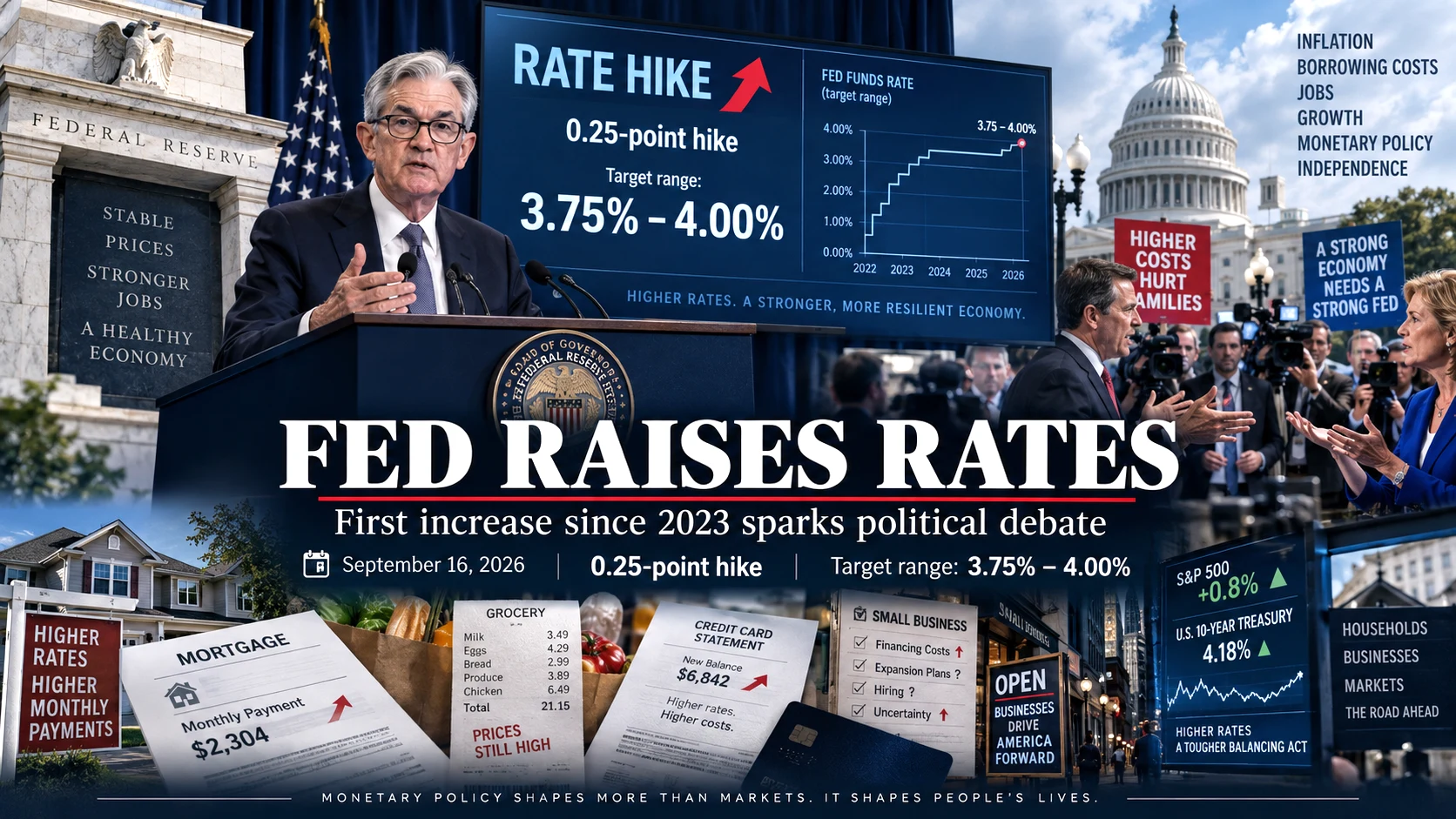
The Federal Reserve unanimously lifted its benchmark rate by 25 basis points to 3.75%-4.00% as inflation remained stubbornly above target. President Donald Trump demanded rates of 1% or lower and attacked the Fed board as political, although he said he still has confidence in Chair Kevin Warsh.






0 Comments