US Inflation Hits 3.7% as Nasdaq Slides and Fed Rate Fears Return
US inflation accelerated to 3.7% in September, triggering a sharp technology selloff and reviving speculation about another Federal Reserve rate hike. Here is what the CPI report showed, why the Nasdaq fell and what investors are watching next.
US inflation accelerated more than markets expected in September, sending technology shares sharply lower and reopening a question investors had hoped was beginning to fade: will the Federal Reserve have to raise interest rates again?
The US Consumer Price Index rose 0.6% in September from the previous month and 3.7% from a year earlier, according to the US Bureau of Labor Statistics. The annual inflation rate accelerated from 3.4% in August.
The immediate market reaction was severe. The technology-heavy Nasdaq Composite fell 1.88% on October 14, while the S&P 500 dropped 1.11%. The Dow Jones Industrial Average finished almost flat by comparison, declining 0.09%.
Technology and artificial-intelligence-related companies suffered some of the largest losses because higher interest rates can be particularly painful for businesses whose valuations depend heavily on expected profits far into the future or whose expansion plans require large amounts of financing.
But there is an important qualification to the rate-hike story.
The inflation report unquestionably increased concern about further Federal Reserve tightening, but financial markets were still not treating an October rate increase as certain by the following Asian trading session. Rate expectations swung sharply after the data before partially reversing.
That makes the latest inflation report important not because it guarantees another rate increase, but because it has made the Federal Reserve's next decision significantly more complicated.
Recommended Reading
Related Stories & In-Depth Guides
Curated editorial perspectives matching this topic.
India’s retail inflation rose to 5.54% in September, just days after the RBI increased the repo rate to 5.50%. Here is what the inflation surge means for another possible rate hike, home-loan EMIs and household budgets.
India’s new UPI merchant fee framework was scheduled to begin on October 15, 2026, but reports now indicate that implementation could be pushed to January 2027. Customers are not required to pay the MDR. Here is what is confirmed, what may change and how ₹500, ₹2,000 and ₹5,000 payments are treated.
Key Takeaways
US CPI rose 0.6% month-on-month and 3.7% year-on-year in September.
Energy (especially gasoline) drove more than half of the monthly increase.
Nasdaq fell 1.88%; S&P 500 down 1.11%; Dow almost flat.
Core CPI rose to 2.6% year-on-year.
Fed October rate hike revived as a debate, but not treated as certain.
What the September US inflation report showed
The headline number was the first warning sign.
Consumer prices increased 0.6% on a seasonally adjusted monthly basis in September after rising 0.4% in August. Over the previous 12 months, prices were 3.7% higher.
The acceleration matters because it moves inflation further away from the Federal Reserve's longer-term objective of 2%.
Energy was the largest immediate driver.
The US Bureau of Labor Statistics said the overall energy index climbed 5.2% during September. Gasoline prices rose 9.1% in just one month and accounted for more than half of the monthly increase in the overall CPI.
Energy prices were 20.4% higher than a year earlier, while gasoline was up 34.2% over the same period.
Those numbers explain a substantial part of the headline inflation surge, but they do not allow policymakers to simply dismiss the report as an energy-only problem.
Shelter costs rose 0.4% during September. Several other categories, including recreation, used cars and trucks, education, airline fares, medical care and apparel, also recorded increases.
Food prices were unchanged on a seasonally adjusted basis during the month. Food consumed at home declined slightly, while prices for food away from home increased.
Core inflation also moved higher
Economists and central bankers pay close attention to so-called core inflation because food and energy prices can move sharply from month to month.
Core CPI, which excludes food and energy, rose 0.3% in September, matching its monthly increase in August.
Over 12 months, however, core inflation accelerated to 2.6% from 2.4%.
That distinction is important.
If headline inflation had jumped entirely because of temporary fuel volatility while underlying inflation continued to cool, the Federal Reserve could have more reason to wait.
Instead, the latest report showed that some underlying price pressures remain persistent even after removing the most volatile categories.
It does not mean inflation is returning to the extreme levels seen earlier in the decade. It does mean the path back toward 2% has become less straightforward.
Why the Nasdaq was hit harder
The stock-market reaction was not evenly distributed.
The Nasdaq fell 1.88% to 26,692.87, its biggest daily decline since July 23. The S&P 500 closed at 7,718.94 after losing 1.11%, while the Dow ended at 51,621.48, down only 0.09%.
That gap reflects the market's sensitivity to interest rates.
High-growth technology stocks are commonly valued on the basis of substantial profits expected years into the future. When interest rates rise, the present value investors assign to those distant earnings can fall.
There is also a more direct financing issue.
The artificial-intelligence boom has led to enormous spending on data centres, computing infrastructure, servers, chips, networking equipment and energy capacity. Some companies involved in that expansion depend more heavily than others on debt and external financing.
If borrowing stays expensive for longer — or becomes more expensive again — investors have to reconsider how much they are willing to pay for future growth.
That reassessment was visible across the technology sector.
Oracle fell 8.8%, while AI infrastructure company CoreWeave dropped about 15% and Nebius lost around 10%. Dell Technologies declined 11.4%, and Hewlett Packard Enterprise fell 8.2%.
The Philadelphia Semiconductor Index dropped 4.3%, extending its losing streak to six sessions.
Apple was a major exception, gaining about 0.5%.
The result was therefore not simply an indiscriminate reaction to one inflation statistic. The CPI report landed in a market already questioning valuations, financing requirements and the sustainability of some of the most aggressive AI investment stories.
The Federal Reserve problem
The Federal Reserve raised its target interest-rate range by a quarter percentage point in September to 3.75%–4.00%, its first increase after an extended period without additional tightening.
Its next scheduled monetary-policy meeting is October 27–28.
Before the September CPI report was released, investors still had a plausible case for the Fed to wait.
Inflation was above target, but policymakers could argue that monetary policy was already restrictive and that another immediate increase might unnecessarily weaken parts of the economy.
The latest CPI data makes that decision harder.
A central bank worried about persistent inflation does not want households and businesses to conclude that rapidly rising prices will simply be tolerated. At the same time, interest-rate policy works with a lag, and raising rates too aggressively carries risks for employment, credit markets, housing, corporate investment and economic growth.
That is why one inflation report, however uncomfortable, should not automatically be translated into a guaranteed rate increase.
Rate-hike probabilities swung sharply
The market's changing reaction illustrates that uncertainty.
During the October 14 US session, futures pricing showed traders increasing the probability of an October Federal Reserve rate hike. At one stage after the inflation shock, expectations rose sharply.
But the move did not hold in full.
As Treasury markets reversed part of their initial reaction and investors shifted toward safer assets, rate-hike expectations also retreated. By Asian trading on October 15, market pricing again indicated that keeping rates unchanged remained the more likely outcome for the October meeting.
In other words, the inflation report revived the rate-hike debate without settling it.
That is a more accurate description than saying the Federal Reserve is now certain to raise rates again.
The central bank still has additional economic information to consider before its October decision, including data on producer prices, consumer activity and the broader labour market, as well as comments from Federal Reserve officials.
Why bond yields matter almost as much as the Fed decision
For markets, the official Federal Reserve rate is only part of the story.
Government bond yields influence borrowing costs throughout the economy. Mortgage rates, corporate financing, business investment decisions and the relative attractiveness of stocks can all be affected by changes in Treasury yields.
US yields initially jumped after the inflation report before reversing part of the move as risk aversion encouraged demand for government bonds.
That reversal is significant.
It suggests investors were weighing two competing risks at the same time: inflation might require tighter monetary policy, but sustained high borrowing costs could also weaken parts of the economy and financial markets.
Those forces can produce volatile markets even if the Federal Reserve ultimately leaves rates unchanged in October.
AI stocks face a new cost-of-capital test
The technology selloff also highlighted an issue that extends beyond the CPI report.
Investors are increasingly examining the cost of financing the global AI infrastructure build-out.
The strongest technology companies have enormous cash flows and balance sheets capable of funding major investment. Other companies participating in the data-centre boom rely more heavily on borrowing.
That difference becomes much more important when rates are high.
A project that looks highly attractive when capital is cheap can look considerably less appealing when interest costs rise. Companies also need future revenue and margins to justify increasingly large capital expenditure.
This does not mean demand for artificial intelligence has disappeared. Nor does a sharp one-day market decline prove that an AI investment cycle is ending.
It does mean investors are becoming more discriminating about which companies can finance growth sustainably and which valuations depend on unusually favourable assumptions.
Selloff spreads into Asian technology markets
The impact was not confined to Wall Street.
Asian technology stocks suffered heavy losses on October 15 as investors reassessed interest-rate risk and exposure to the AI investment cycle.
A broad index of Asia-Pacific shares outside Japan fell sharply, while technology-heavy markets in South Korea and Japan came under particularly strong pressure.
South Korean chip companies were among those hit hardest, illustrating how deeply the AI supply chain now connects US monetary-policy expectations with markets around the world.
The transmission mechanism is relatively straightforward.
Hotter US inflation can increase expectations for tighter Federal Reserve policy. Higher US rates can lift global financing costs, strengthen the dollar and make high-growth assets less attractive. That can then affect technology shares from New York to Seoul and Tokyo even when the individual companies themselves have announced no new fundamental deterioration.
What it means for Indian markets
India did not simply follow the global technology selloff lower.
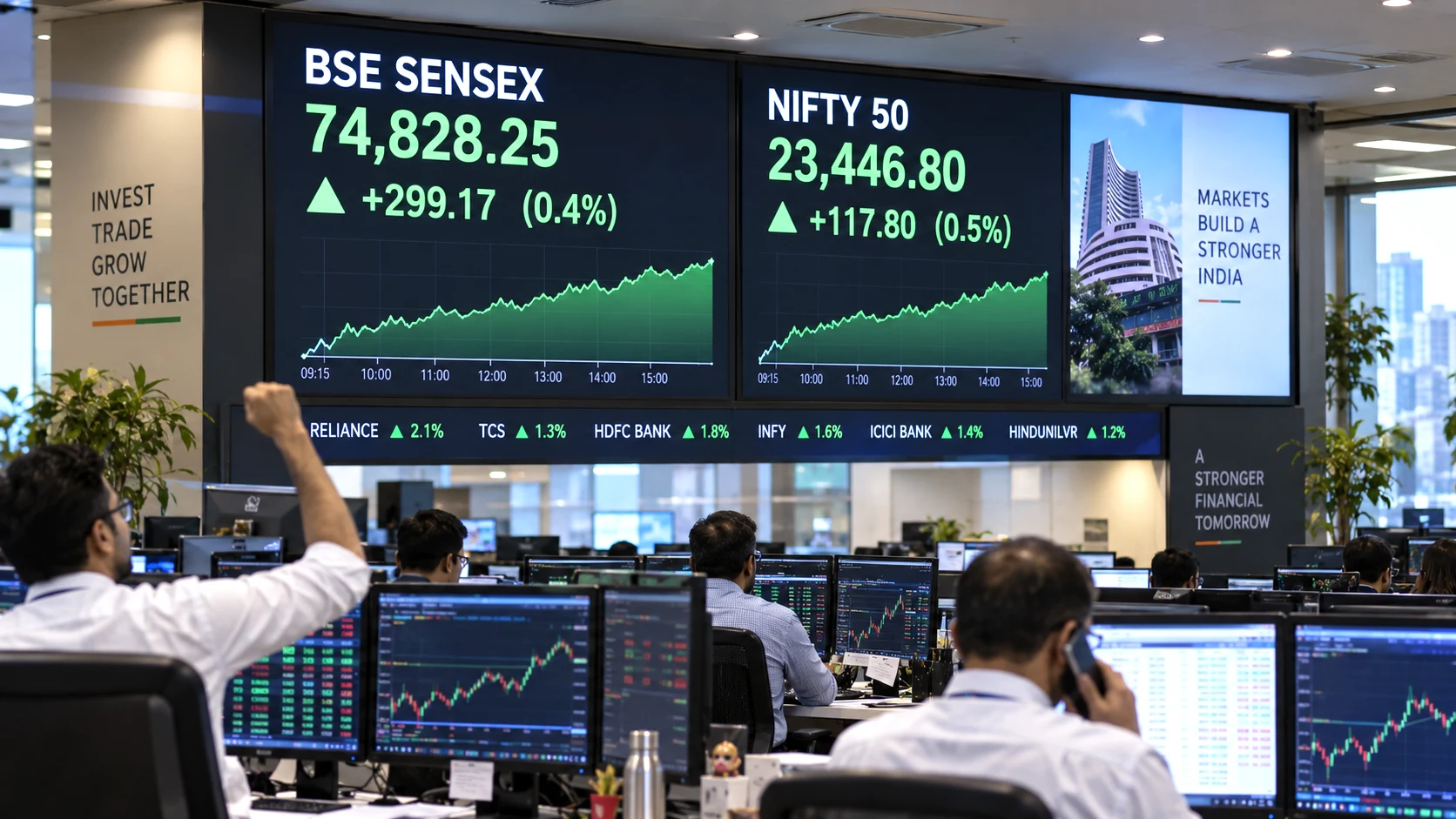
In morning trading on October 15, Indian benchmark indices advanced as domestic earnings optimism and gains in heavyweight technology, financial and energy companies outweighed some of the negative global signals.
At around 10:12 a.m. IST, the Nifty 50 was up 1.15% at 22,881.90 and the BSE Sensex had gained 1.21% to 73,656.40.
India's information-technology index was also higher.
That divergence is a reminder that US inflation is important for Indian investors, but it is not the only market driver. Domestic earnings, foreign institutional flows, crude oil, the rupee, Reserve Bank of India policy and company-specific developments can all offset or amplify global moves.
The US inflation report still matters for India through several channels.
Higher-for-longer US interest rates can make dollar assets more attractive and influence foreign capital flows. They can affect the dollar-rupee exchange rate and global bond yields. They can also change the valuation investors are willing to assign to Indian technology and other growth-oriented companies.
Energy inflation is another concern because India remains a major importer of crude oil. Persistent strength in global energy prices can affect the trade balance, currency, corporate costs and domestic inflation.
What households should take from the 3.7% figure
The CPI report is not only a market story.
Annual inflation of 3.7% means the average price level represented by the index was 3.7% higher than a year earlier. Individual households can experience inflation very differently depending on what they buy.
The particularly sharp rise in gasoline and other energy costs can have a disproportionate impact on households that drive frequently, businesses with high transport expenses and sectors where fuel costs are passed through to customers.
Shelter remains another important component because housing-related expenses occupy a large share of household budgets.
At the same time, not every category was rising at the same pace. Food at home edged lower during the month, demonstrating why a headline inflation number should not be interpreted as meaning every price rose by exactly 3.7%.
What happens next
The next two weeks will be critical for the Federal Reserve and global markets.
Investors will watch incoming US economic reports for evidence that September's inflation acceleration was temporary or part of a broader trend.
Federal Reserve officials' public comments will also be scrutinised closely for clues about whether policymakers see the latest inflation data as serious enough to justify another immediate rate increase.
The October 27–28 Federal Open Market Committee meeting is the next major decision point.
For equity markets, the question is slightly broader than whether the Fed raises rates by another quarter percentage point.
Investors need to judge how long borrowing costs are likely to remain elevated, whether inflation continues to exceed the Fed's comfort level, how much higher financing costs will affect corporate investment and whether the extraordinary spending behind the AI boom can continue to support current valuations.
Those questions will not be answered by a single CPI release.
But September's inflation report has made them harder to ignore.
The Bottom Line
US inflation accelerated to 3.7% in September, with a sharp increase in gasoline prices driving more than half of the monthly CPI rise and underlying inflation also remaining above the Federal Reserve's goal.
Wall Street responded by selling many of the stocks most exposed to high borrowing costs and long-term growth expectations. The Nasdaq fell nearly 1.9%, semiconductor shares dropped sharply and some heavily financed AI-related companies suffered much larger losses.
The report has clearly revived the possibility of additional Federal Reserve tightening. It has not, however, made an October rate increase inevitable. Market expectations whipsawed after the release and later returned to favouring no change at the October meeting.
That distinction matters.
The most important development is not that the Federal Reserve has already decided to raise rates again. It is that persistent inflation has narrowed the central bank's room for manoeuvre just as investors are becoming more sensitive to the cost of financing the technology and AI investment boom.
The next inflation signals, Federal Reserve communication and the October 27–28 policy meeting will determine whether the latest market shock becomes a temporary repricing or the beginning of a more prolonged period of pressure on high-growth assets.
Key Takeaway
US inflation accelerated to 3.7% in September; Nasdaq fell 1.88% on Fed rate fears.
Energy drove the surge; core inflation also rose. October rate hike debate revived but not settled.
The Rajatheertha Team publishes news, explainers, guides and updates across India and the world. Our coverage follows Rajatheertha's editorial, verification and corrections standards.
Days after raising the repo rate to 5.50%, the RBI has tightened banks’ daily liquidity rules and announced a ₹25,000 crore bond sale. Here is what the measures mean—and do not mean—for home-loan borrowers and FD savers.
Sensex and Nifty opened higher and extended gains on September 23, led by metals, FMCG and realty stocks as crude oil eased and global cues improved. Bajaj Finance, Hindalco and Tata Steel were among the strongest Nifty gainers.
The RBI has raised the repo rate by 25 basis points to 5.50%, its first hike since February 2023. Here's what the October 2026 decision could mean for home loan EMIs, loan tenures, fixed deposits and new borrowers.
Banks have begun increasing repo-linked lending rates after the RBI raised the repo rate to 5.50%. Here is what borrowers should expect from their home loan EMI and why FD rates may take longer to rise.
Indian stock markets ended sharply lower on Thursday as the Sensex fell 1,045 points and the Nifty closed below 22,250. Tighter RBI policy, elevated crude oil prices and foreign fund outflows weighed on sentiment.
A new 0.4% merchant discount rate is scheduled for specified UPI merchant payments above ₹2,000, but consumers are not supposed to pay it. Here is what remains free, what merchants could pay, what the Supreme Court has questioned and why the October 15 rollout remains under watch.






0 Comments