UPI Charges From October 15? Who Pays, What Stays Free and Why the Rollout May Be Delayed
India’s new UPI merchant fee framework was scheduled to begin on October 15, 2026, but reports now indicate that implementation could be pushed to January 2027. Customers are not required to pay the MDR. Here is what is confirmed, what may change and how ₹500, ₹2,000 and ₹5,000 payments are treated.
Editorial illustration representing UPI merchant charges and MDR framework for October 2026
Table of Contents (21 sections)
Will you have to pay an extra charge when using UPI? No. The announced Merchant Discount Rate applies on the merchant side of specified UPI transactions, not as a transaction fee charged to ordinary customers.
What has become less certain, just days before the scheduled rollout, is whether the new merchant charging framework will actually begin on October 15, 2026.
India announced in September that a Merchant Discount Rate, or MDR, of 0.4% would apply to specified person-to-merchant UPI transactions above ₹2,000. The government simultaneously protected person-to-person transfers, payments up to ₹2,000 and qualifying small merchants from the new charge.
October 15 was announced as the implementation date.
However, that timeline is now under review.
Reports this week said merchant groups and payment-industry participants have sought more preparation time and that postponing implementation until January 2027 is being considered. Reuters reported on October 8 that a final decision on the proposed delay had not yet been taken by the National Payments Corporation of India.
Recommended Reading
Related Stories & In-Depth Guides
Curated editorial perspectives matching this topic.
A new 0.4% merchant discount rate is scheduled for specified UPI merchant payments above ₹2,000, but consumers are not supposed to pay it. Here is what remains free, what merchants could pay, what the Supreme Court has questioned and why the October 15 rollout remains under watch.
The RBI has raised the repo rate by 25 basis points to 5.50%, its first hike since February 2023. Here's what the October 2026 decision could mean for home loan EMIs, loan tenures, fixed deposits and new borrowers.
That creates an important distinction for UPI users and businesses:
The fee structure itself has been formally announced. The uncertainty concerns when it will start.
As of October 12, the safest position is therefore not to say that the new MDR has definitely been cancelled or definitely postponed. Unless NPCI or the government formally changes the date, October 15 remains the previously announced implementation date, while a possible deferment is actively being discussed.
Key Takeaways
Customers do not pay the 0.4% MDR.
Standard MDR of 0.4% applies to eligible P2M transactions above ₹2,000 (capped at ₹300 for higher amounts).
P2P transfers and payments up to ₹2,000 remain free.
Qualifying small merchants stay exempt.
October 15 is the announced start date, but a delay to January 2027 is under discussion.
What Is Actually Changing With UPI?
The change concerns the cost of accepting certain merchant UPI payments.
MDR is a payment-processing charge within the merchant payment system. It is not a tax imposed on the person making the UPI payment.
Under the framework announced by the Ministry of Finance, a standard MDR of 0.4% applies to specified person-to-merchant, or P2M, transactions above ₹2,000.
For standard transactions of ₹75,000 and above, the MDR is capped at ₹300.
The government says the money is shared within the payments ecosystem among participants such as banks, payment service providers and UPI application providers rather than being collected as government tax revenue.
For an ordinary UPI customer, this means the amount deducted from the customer's bank account should remain the purchase amount.
A ₹5,000 purchase should not become ₹5,020 simply because UPI was selected.
UPI Payment Examples: ₹500, ₹2,000 and ₹5,000
Here is the simplest way to understand the announced framework.
Payment
Standard Merchant MDR
What Customer Pays
₹500
₹0
₹500
₹2,000
₹0
₹2,000
₹5,000
₹20 if the standard 0.4% MDR applies
₹5,000
The ₹5,000 example assumes the recipient is a merchant covered by the standard P2M MDR category.
It does not mean every ₹5,000 UPI transaction automatically produces a ₹20 charge.
If the payment is a person-to-person transfer, it remains outside the MDR framework.
A qualifying small merchant may also remain exempt.
Certain sectors have their own separate fee structure rather than the standard 0.4% rate.
Will Customers Pay the 0.4% UPI Charge?
No, under the announced framework.
The Ministry of Finance has specifically described MDR as a charge within the merchant payment ecosystem and not a charge on the customer making the payment.
Banks have also been advised to make sure merchants do not pass MDR directly to customers.
UPI application providers are not supposed to impose a platform fee or hidden UPI transaction charge on individuals under the framework.
This is why phrases such as “customers will pay 0.4% on every UPI payment above ₹2,000” are misleading.
The ₹2,000 threshold concerns the classification of eligible merchant-side transactions.
It does not create a 0.4% fee payable by the customer.
What Happens With a ₹5,000 UPI Purchase?
Suppose a customer buys an appliance for ₹5,000 from a merchant covered by the standard MDR category.
At 0.4%, the MDR would be:
₹5,000 × 0.4% = ₹20.
The merchant-side payment ecosystem would account for that ₹20 charge.
The customer should still pay ₹5,000.
Under the announced safeguards, the merchant should not add ₹20 to the bill and tell the customer that it is a mandatory government UPI charge.
It is also incorrect to describe the ₹20 as a government tax.
Exactly ₹2,000 Versus More Than ₹2,000
The wording of the framework matters.
Person-to-merchant transactions up to ₹2,000 remain free from MDR.
That means:
₹1,999: zero MDR under the standard threshold.
₹2,000: zero MDR under the standard threshold.
₹2,001: may fall within the standard MDR framework if it is an eligible P2M transaction and no exemption or special category applies.
This threshold has attracted attention from merchants because businesses accepting many transactions just above ₹2,000 could face a new recurring payment-processing expense once the framework takes effect.
Person-to-Person UPI Transfers Remain Free
Sending money to another individual is treated differently from paying a merchant.
Person-to-person, or P2P, UPI transfers remain free irrespective of whether the transfer is below or above ₹2,000, subject to the normal operational transaction limits applicable to the user's bank and transaction category.
So sending ₹5,000 to a family member does not become subject to a 0.4% MDR merely because the amount exceeds ₹2,000.
The new framework concerns specified merchant transactions.
That difference between P2P and P2M payments is essential to understanding the policy.
Small Merchants Have an Important Exemption
The new framework also protects qualifying small merchants.
According to the Finance Ministry, small merchants such as street vendors receiving up to ₹1 lakh per month through UPI QR codes under the Person-to-Person-Merchant, or P2PM, category will continue to receive zero-MDR treatment.
This means the statement “all shopkeepers will pay 0.4% above ₹2,000” is also too broad.
Merchant classification matters.
The government estimates that about 96% of merchant UPI transactions will remain unaffected because they are either within the ₹2,000 threshold or covered by the small-merchant zero-MDR framework.
Some Sectors Do Not Follow the Standard 0.4% Rate
Another reason the rules should not be reduced to a single headline is that the standard rate does not apply uniformly to every type of transaction.
The announced structure provides a flat ₹5 MDR for eligible transactions above ₹2,000 in certain essential or relatively thin-margin categories.
These include sectors such as:
railways,
telecommunications,
insurance,
fuel, and
agricultural inputs.
Capital-market transactions also receive separate treatment.
Payments relating to areas such as mutual funds, securities, stockbrokers and dealers are subject to an announced MDR of 0.02%, capped at ₹300 per transaction.
These classifications mean users should be cautious about calculators or social-media posts that simply multiply every UPI payment above ₹2,000 by 0.4%.
Why Was October 15 Chosen?
The framework was announced in September with October 15, 2026 as its scheduled start date.
Payment companies, banks, merchant acquirers, accounting platforms and businesses need technical systems capable of identifying merchant categories and applying the correct rate or exemption.
That becomes more complicated when there are several categories:
zero-MDR payments,
standard 0.4% transactions,
small-merchant exemptions,
flat-fee sectors, and
special rates for financial-market payments.
October is also part of India's major festive-shopping season, when transaction volumes and retail activity increase substantially.
That timing is now one of the reasons behind demands for a delay.
Why Could the UPI MDR Be Delayed Until January 2027?
The latest development is not a change in the 0.4% rate itself.
It is a possible change in the implementation date.
Reports say merchant associations, fintech companies and payments-sector participants have requested additional preparation time.
The concerns include the complexity of merchant classifications, different MDR rates for different transaction types, operational readiness and the impact of introducing a new merchant cost during the festive retail season.
Reuters reported that India was considering delaying the rollout by several months and that January was one possible starting point.
Other reports have specifically identified January 1, 2027 as the date under consideration.
The important qualification is that these reports describe an implementation decision under consideration.
They should not be presented as evidence that the delay is already final unless NPCI or the government formally confirms it.
So Will the 0.4% MDR Start on October 15?
The correct answer as of October 12 is:
October 15 is the officially announced implementation date, but a postponement is being considered.
Readers should be cautious about two opposite claims circulating online.
“UPI will definitely become chargeable for customers on October 15” is wrong because customers are not the party charged MDR.
“UPI MDR has definitely been cancelled until January” also goes further than the publicly verified position unless a fresh official notice confirms the postponement.
A formal NPCI or government announcement would settle the implementation-date question.
Why Are Merchants Concerned if the Customer Does Not Pay?
For larger merchants and businesses with significant UPI turnover, even a small percentage can become a meaningful operating expense over time.
Consider a merchant with ₹10 lakh of monthly UPI receipts that fall entirely within the standard MDR category.
At 0.4%, the theoretical processing cost would be ₹4,000 before considering transaction-level caps, exemptions, classifications and any payments that remain outside the MDR framework.
Actual costs would depend on the merchant's transaction mix.
Businesses with very thin margins argue that payment-processing costs can affect profitability even if customers are not directly charged.
This concern has been particularly visible among merchant groups that had become accustomed to India's zero-MDR UPI environment.
Why Introduce MDR at All?
The government's argument is that India's UPI infrastructure needs a sustainable funding mechanism as transaction volumes, cybersecurity requirements, technology costs and service demands continue to grow.
The Finance Ministry says revenue generated from eligible higher-value merchant transactions will support banks, payment-service providers and UPI application providers involved in operating and expanding the system.
The framework attempts to balance that objective with exemptions for individuals and smaller businesses.
That is why P2P transfers remain outside the MDR structure and most merchant transactions are expected to remain zero-MDR.
A dedicated mechanism has also been announced under which an amount equivalent to 5% of MDR collections would support wider UPI adoption among small merchants.
Can a Merchant Add the MDR to Your Bill?
The official framework says customers should not bear the MDR.
If a purchase price is ₹5,000, the fact that the merchant may incur a processing cost does not make a separate ₹20 “UPI government fee” payable by the customer.
That distinction will be important after implementation because customer confusion could otherwise create opportunities for unsupported surcharges.
Consumers should check the final bill before authorising a UPI payment and ask for clarification if a merchant adds a separate amount described as a mandatory UPI fee.
Normal product pricing decisions are separate from adding an explicit payment surcharge, but businesses should not misrepresent MDR as a government tax imposed on the customer.
Does This Mean UPI Is No Longer Free?
That depends on whose side of the transaction is being discussed.
For individuals using UPI to send money to another person, UPI remains free under the announced policy.
For customers paying merchants, the MDR is not imposed on the customer.
For qualifying small merchants, zero-MDR treatment continues.
For larger or otherwise eligible merchants accepting specified P2M payments above ₹2,000, the new framework introduces a processing charge once it takes effect.
So describing the entire UPI network as either “completely free” or “now chargeable” misses the distinction the new framework creates.
What Should UPI Users Do From October 15?
For ordinary consumers, there is no reason to stop using UPI merely because of the MDR announcement.
Before paying, check the amount shown on the payment screen just as you normally would.
For a ₹500 purchase, you should authorise ₹500.
For a ₹2,000 purchase, you should authorise ₹2,000.
For an ordinary ₹5,000 merchant purchase, you should still authorise the actual ₹5,000 purchase amount rather than assuming a 0.4% customer surcharge must be added.
If the implementation date is formally postponed, the merchant-side change will simply begin later.
The basic consumer protection remains the same: MDR is not supposed to become an additional customer transaction fee.
What Merchants Should Watch Now
Businesses have more reason than consumers to follow the next official announcement closely.
Merchant acquirers and payment providers will need to know whether October 15 remains the effective date or whether implementation moves into 2027.
Businesses should also determine their merchant classification rather than assuming the 0.4% rate automatically applies to every UPI receipt above ₹2,000.
The relevant questions include whether the merchant qualifies for the small-merchant exemption, whether a payment falls into a special sector, and whether the transaction is actually categorised as P2M.
What Happens Next?
The immediate development to watch is a formal announcement from NPCI or the government on the implementation date.
If October 15 is retained, eligible merchants will need to begin operating under the announced structure.
If the rollout is pushed to January 1, 2027 or another date, the underlying MDR framework may remain substantially unchanged while businesses receive additional preparation time.
The possible deferment should therefore be understood as a timing issue unless regulators announce broader changes to the policy.
Bottom Line
UPI customers are not being charged 0.4% for making a payment above ₹2,000.
The announced 0.4% MDR applies to specified merchant-side P2M transactions above ₹2,000.
P2P transfers remain free.
Merchant payments up to ₹2,000 remain zero-MDR.
Qualifying small merchants continue to receive an exemption.
Some sectors use separate MDR rates.
And although October 15, 2026 was announced as the start date, credible reports now say the rollout could be postponed, potentially until January 2027.
Until an official announcement settles that question, October 15 should be described as the announced implementation date under review, not as a customer UPI fee deadline and not as a rollout that has already been definitively cancelled.
Key Takeaway
Customers do not pay the 0.4% MDR.
It applies only to eligible merchant-side P2M transactions above ₹2,000.
P2P, small merchants and payments ≤ ₹2,000 stay free.
October 15 is the announced date; a January 2027 delay is under discussion.
The Rajatheertha Team publishes news, explainers, guides and updates across India and the world. Our coverage follows Rajatheertha's editorial, verification and corrections standards.
Days after raising the repo rate to 5.50%, the RBI has tightened banks’ daily liquidity rules and announced a ₹25,000 crore bond sale. Here is what the measures mean—and do not mean—for home-loan borrowers and FD savers.
US inflation accelerated to 3.7% in September, triggering a sharp technology selloff and reviving speculation about another Federal Reserve rate hike. Here is what the CPI report showed, why the Nasdaq fell and what investors are watching next.
The 57th GST Council has recommended removing GST officers’ arrest power under Section 69 and raising the prosecution threshold from ₹1 crore to ₹5 crore. Here is what the proposals actually mean for small businesses—and what does not change yet.
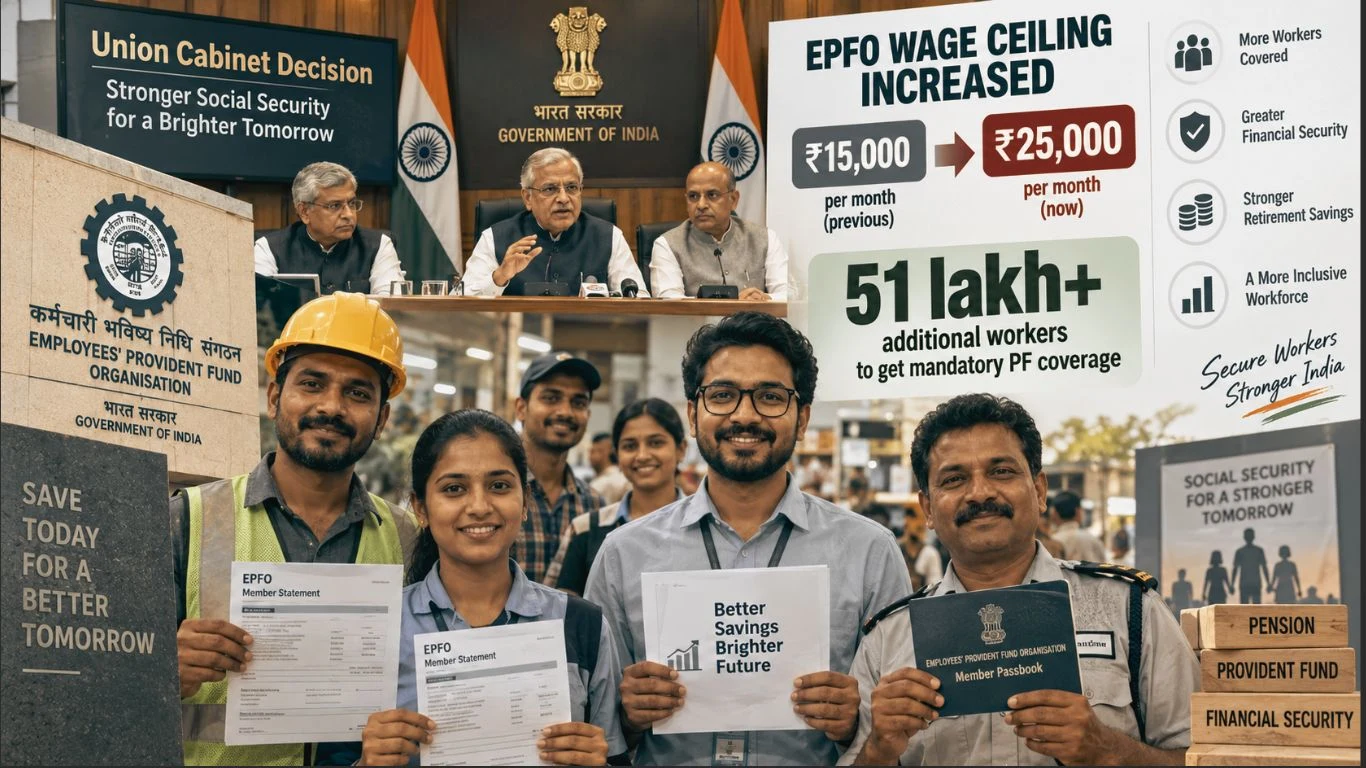
The Union Cabinet has approved the first increase in the EPFO wage ceiling since 2014, raising it from ₹15,000 to ₹25,000 a month. The change expands mandatory provident fund coverage, but it does not mean every employee earning above ₹25,000 loses EPF eligibility or that ₹25,000 will be deducted fr
IndiGo has revised fuel charges for new bookings from October 6, 2026, after ATF prices jumped more than 14% month-on-month. Domestic charges now range from ₹375 to ₹1,300 per sector, while international charges go up to ₹10,000.
India’s retail inflation rose to 5.54% in September, just days after the RBI increased the repo rate to 5.50%. Here is what the inflation surge means for another possible rate hike, home-loan EMIs and household budgets.






0 Comments