Smartphone Price Hikes in India: Samsung Galaxy S25 May Get Costlier by ₹10,000, Xiaomi 17T Price Rises
Samsung Galaxy S25 models may become ₹10,000 costlier while Xiaomi has already raised the 17T by ₹5,000. Here’s what the reports mean for festive buyers comparing Amazon and Flipkart deals.
Samsung Galaxy S25 and Xiaomi 17T face price increases as India’s festive smartphone sales begin
Table of Contents (15 sections)
Smartphone buyers in India are facing an unusual pricing situation at the start of the October 2026 festive shopping season. While major online retailers are advertising discounts on premium handsets, reports suggest that Samsung could increase prices of select Galaxy flagship models by ₹10,000. Meanwhile, Xiaomi has already revised prices of its Xiaomi 17T smartphone, making both available storage variants ₹5,000 more expensive than they were in September.
The reported Samsung price changes concern the Galaxy S25, Galaxy S25 Ultra and Galaxy Z Fold8 series. Technology reports published on September 29 indicated that the Galaxy S25 models could become ₹10,000 costlier during the first week of October, while the Fold8 series might receive a similar increase by October 10.
However, those projections originated from industry tipster information. They should not be treated as an official announcement or proof that all the increases have taken effect.
The Xiaomi 17T development is more definite. Its October 1 price revision has been reported by several technology publications, and Xiaomi India's online catalogue lists the device from ₹69,999.
For consumers planning to upgrade during the Amazon Great Indian Festival or Flipkart Big Billion Days 2026 sales, the distinction matters. A higher regular price does not necessarily mean that the final checkout price will increase by the same amount. Bank offers, promotional discounts, exchange benefits and retailer-specific pricing may still reduce the amount buyers actually pay.
Recommended Reading
Related Stories & In-Depth Guides
Curated editorial perspectives matching this topic.
Days after raising the repo rate to 5.50%, the RBI has tightened banks’ daily liquidity rules and announced a ₹25,000 crore bond sale. Here is what the measures mean—and do not mean—for home-loan borrowers and FD savers.
The RBI has raised the repo rate by 25 basis points to 5.50%, its first hike since February 2023. Here's what the October 2026 decision could mean for home loan EMIs, loan tenures, fixed deposits and new borrowers.
Samsung Galaxy S25 Price Hike: What Has Been Reported?
Samsung's Galaxy S25 and Galaxy S25 Ultra have been named in reports suggesting a possible ₹10,000 price increase in India.
According to information attributed to tipster Abhishek Yadav and published by The Tech Outlook on September 29, Samsung was preparing to revise pricing for the two Galaxy S25 models during the first week of October.
The Galaxy Z Fold8 series was also mentioned, with a possible ₹10,000 increase reportedly expected by October 10.
Importantly, the reports did not establish that every storage configuration would receive an identical increase. They also did not clearly specify whether the expected revision would affect the listed selling price, maximum retail price or promotional discounts.
These distinctions are significant because Samsung's online store frequently shows a selling price below the stated maximum retail price for certain models.
For example, a smartphone can have an MRP of ₹94,999 but be offered at ₹84,999. If a promotion ends, the customer may see the selling price rise even though the MRP remains unchanged.
Consequently, consumers should avoid interpreting the reported ₹10,000 increase as a confirmed change to every Galaxy S25 model.
An official revised price list, a clear announcement from Samsung or consistent new prices across authorised channels would provide stronger evidence of a permanent pricing change.
Samsung Galaxy S25 Prices: What Buyers Can Compare
Samsung India's online store provides an important reference point when assessing the reported price increases.
The Galaxy S25 has been listed at ₹74,999 for the 12GB RAM and 128GB storage version. Its 12GB RAM and 256GB variant has appeared at ₹84,999, compared with an MRP of ₹94,999.
The 12GB RAM and 512GB storage configuration has also been listed at ₹1,04,999, against an MRP of ₹1,14,999.
These are useful reference prices, but availability and promotions may differ by model, colour, location and purchase date.
Samsung Galaxy S25 variant
Referenced Samsung India price
12GB + 128GB
₹74,999
12GB + 256GB
₹84,999
12GB + 512GB
₹1,04,999
The reported ₹10,000 increase should not simply be added to these figures and presented as an official new price.
For buyers, the most reliable approach is to compare the current official store listing with the final payable amount on Amazon, Flipkart and authorised offline retailers.
The difference can become substantial during festive campaigns, particularly when an additional card discount is available.
Galaxy S25 Ultra: Could the Premium Model Become More Expensive?
The Galaxy S25 Ultra is another model included in the price-hike reports.
The premium device has been offered in multiple storage configurations, and its selling price has varied according to retailer promotions and available discounts.
Before the reported revision, Samsung's Indian online pricing was cited at ₹1,19,999 for the 12GB RAM and 256GB storage model, compared with an MRP of ₹1,29,999.
A ₹10,000 increase from that referenced selling price would mathematically bring it to ₹1,29,999. However, that figure must be understood as a hypothetical calculation rather than a confirmed revised price.
The final price depends on the particular variant, retailer, active offers and whether the reported increase is actually implemented.
Buyers considering the Ultra model should also compare its effective festive-sale price with other premium smartphones rather than judging value solely by the percentage discount advertised.
The relevant question is not how large the discount appears, but how much the consumer must actually pay for the desired device.
Xiaomi 17T Price Hike: New Prices in India
Unlike the Samsung reports, the Xiaomi 17T price revision has already been reflected in widely reported Indian pricing.
The Xiaomi 17T received a ₹5,000 increase on October 1, 2026, across its two storage configurations.
The 12GB RAM and 256GB storage version increased from ₹64,999 to ₹69,999. The 12GB RAM and 512GB storage model increased from ₹69,999 to ₹74,999.
Xiaomi 17T variant
Previous price
Revised price
Increase
12GB + 256GB
₹64,999
₹69,999
₹5,000
12GB + 512GB
₹69,999
₹74,999
₹5,000
The increase comes only a few months after the device's June 2026 introduction in India.
At launch, the base Xiaomi 17T model was priced at ₹59,999, while the higher-storage model carried a price of ₹64,999.
An earlier price increase in July had already added ₹5,000 to both variants.
As a result, the October revision means the two models are now ₹10,000 more expensive than their original launch prices.
That is a meaningful change for consumers comparing launch-day value with present-day pricing.
However, promotional discounts during major online sales can still change the effective purchase cost.
Why the Xiaomi 17T Price Increase Matters
A smartphone launched at ₹59,999 competes in a somewhat different price environment from the same device priced at ₹69,999.
At the higher price, buyers may consider a wider range of premium alternatives, including discounted models from Samsung, OnePlus and other manufacturers.
The Xiaomi 17T's hardware remains an important part of that comparison.
The smartphone features a 6.59-inch AMOLED display, MediaTek Dimensity 8500-Ultra processor, Leica-associated rear camera system and a 6,500mAh battery.
Those specifications help explain its position in the premium segment, but an increase in price does not automatically make the device a poor purchase.
Its value depends on competing phones available at similar prices, the performance customers need, camera preferences, battery requirements and the extent of any festive discount.
For example, buyers who prioritise battery capacity may value the Xiaomi 17T differently from customers seeking a particular camera system, compact design or software ecosystem.
The additional ₹5,000 nevertheless raises the importance of comparing alternatives before placing an order.
Why Are Smartphone Prices Rising in India?
The recent pricing reports highlight how smartphone prices can change even after a product has been available for several months.
There are several possible explanations for such changes, although no single cause should be attributed to Samsung or Xiaomi without a verified company statement.
Component and Manufacturing Costs
Premium smartphones depend on processors, memory, storage, displays, camera components and batteries sourced through complex supply chains.
Changes in component prices or manufacturing costs can affect profitability and future selling prices.
Memory and storage costs can be particularly relevant because smartphones are sold in different capacity configurations.
However, a general increase in industry costs does not independently prove why a particular company has revised the price of a particular model.
Currency Exchange Rates
Smartphone manufacturing and component procurement frequently involve international transactions.
When a company's purchasing costs are denominated in foreign currencies, exchange-rate movements can influence expenses.
The eventual effect on Indian retail prices depends on sourcing arrangements, inventory, hedging, taxes and commercial decisions.
A price increase should therefore not automatically be described as the result of currency depreciation unless the manufacturer has supplied supporting information.
Promotions and Discount Adjustments
Manufacturers and retailers regularly alter promotional prices.
A reduction in discounts can make a product more expensive even when its official MRP stays the same.
This is especially important for premium devices, where discounts of several thousand rupees are common.
Consumers should distinguish between a permanent revision of the manufacturer's listed price and the withdrawal of a temporary promotional offer.
Product Positioning
Brands may also adjust pricing to maintain distinctions between different products within a portfolio.
Older flagships, newer premium devices and foldable smartphones may overlap in price after seasonal discounts.
A manufacturer can revise offers or prices to manage these differences.
These are possible commercial considerations, not verified explanations for the specific October Samsung or Xiaomi developments.
Festive Sales 2026: Can Smartphones Still Be Cheaper?
The timing of these pricing developments is important because India's major October online shopping campaigns are underway.
Amazon's Great Indian Festival begins on October 8, while Flipkart's Big Billion Days campaign begins on October 9, with early-access opportunities around the opening period.
Both campaigns bring promotional offers across smartphones and other electronics.
Published festive-sale coverage has highlighted attractive Galaxy S25 and S25 Ultra offers, although consumers must verify the latest price shown at checkout.
For example, reports have advertised the Galaxy S25 around ₹57,999 on Flipkart and the Galaxy S25 Ultra around ₹84,999 on Amazon as part of festive promotions.
Such figures may be associated with specific storage configurations, promotional conditions, bank offers or limited availability. They should not be interpreted as guaranteed prices for every customer.
A sale price can be substantially lower than a manufacturer's regular listed price even during a period of wider pricing pressure.
Therefore, the existence of a reported price increase does not necessarily mean buyers should abandon their planned festive purchases.
The key is to calculate the complete transaction cost.
Should You Buy a Smartphone Now or Wait?
For consumers searching whether they should buy a smartphone before further price hikes, the answer depends on the current deal rather than a prediction about future prices.
A purchase may make sense now when the required model is available at a verified discount, the buyer needs an upgrade and the final cost is comfortably within budget.
Waiting may be more sensible when a phone is functioning well, the available deal is ordinary or the desired storage variant is not competitively priced.
Check the Actual Selling Price
Do not rely only on a promotional banner showing a large discount.
Open the product listing and record the price of the exact memory variant.
Compare that amount with the official brand store and at least one other authorised retailer.
Prices for different storage capacities should not be compared as if they represent the same product.
Separate Bank Offers From Regular Discounts
An advertised smartphone price may require a particular credit card, debit card or payment arrangement.
The customer without the eligible payment method could pay more.
Verify whether the discount is instant, provided as delayed cashback or subject to transaction limits.
Also check whether the promotional benefit can be combined with other offers.
Calculate Exchange Benefits Carefully
Exchange programmes can reduce the upfront payment for buyers replacing an older smartphone.
However, advertised exchange values frequently represent maximum potential benefits.
The final amount depends on the old phone's model, physical condition, eligibility and retailer assessment.
Buyers should avoid treating an estimated exchange benefit as guaranteed savings.
Compare the Price With Previous Offers
A lower price than the MRP does not necessarily mean the product is at its lowest selling price.
Review previous sale prices where reliable records are available.
A product advertised at ₹69,999 with a large stated discount may still cost more than it did several months earlier.
The Xiaomi 17T illustrates why historical prices matter: its new ₹69,999 base price is ₹10,000 above its original launch price.
Consider the Complete Purchase Cost
The purchase budget may include accessories, charging equipment, extended warranty coverage and financing charges.
An EMI plan can make monthly payments manageable, but buyers should still check the full repayment amount, processing fees and applicable interest.
A seemingly affordable monthly payment does not by itself establish that a smartphone is good value.
How a ₹10,000 Price Change Affects Buyers
A ₹10,000 increase can significantly alter purchasing decisions, particularly when a consumer has set a strict budget.
Consider a hypothetical premium smartphone priced at ₹80,000 before a revision.
If the regular selling price rises to ₹90,000, the customer faces an additional ₹10,000 cost without receiving new hardware or features.
However, suppose a retailer independently offers a ₹7,000 promotional discount and an eligible customer receives a further ₹3,000 bank discount.
In that hypothetical example, the effective price would return to ₹80,000.
This does not mean such discounts are currently available on a particular model. It demonstrates why regular price, promotional selling price and final checkout cost are different figures.
Buyers who focus only on the headline price increase may overlook legitimate savings.
Conversely, buyers attracted by a large percentage discount may miss the fact that the underlying selling price increased before the sale.
Both possibilities make careful price comparisons essential.
What About Offline Smartphone Stores?
Online shopping platforms are not the only places where consumers can purchase premium smartphones.
Authorised offline retailers may offer competitive deals, exchange valuations, financing arrangements or bundled accessories.
In some cases, buyers may prefer a physical store because they can inspect the device, compare sizes and receive assistance with transferring data.
However, the final payable price should be compared on an equivalent basis.
An offline quote that includes a charger or other accessory should not automatically be considered cheaper than an online offer without checking the accessories' actual value and whether they are needed.
Buyers should also insist on a proper invoice and verify that the device carries the appropriate India warranty.
What Buyers Should Watch During October
The next important development will be whether Samsung officially implements or clarifies the reported pricing changes.
The Galaxy S25 and Galaxy S25 Ultra were expected, according to late-September reports, to face possible revisions during the first week of October.
Because that period has already passed, buyers should examine current authorised listings instead of assuming that an increase remains scheduled for a future date.
The Galaxy Z Fold8 series was separately mentioned in reports referring to October 10.
That remains a reported possibility unless Samsung issues confirmation or updated authorised pricing establishes the change.
For Xiaomi, the situation is clearer. The Xiaomi 17T's October price increase is already reflected in reported prices, with the base variant listed at ₹69,999.
Consumers should monitor the effective prices offered during festive promotions and compare them with earlier purchase options.
The coming days may also bring changes in stock availability, retailer discounts and financing arrangements.
None of these possibilities guarantees that smartphone prices will move in a particular direction.
What the Price Hikes Mean for India's Smartphone Buyers
The October developments underline an important distinction in the Indian smartphone market: a product's regular price and its effective selling price can move in different directions.
Xiaomi's 17T has become more expensive at the listed-price level, while festive promotional discounts may still influence its competitiveness.
Samsung's Galaxy S25 and S25 Ultra are facing reports of possible price increases, but these reports should remain clearly distinguished from confirmed price revisions.
For anyone planning to purchase a smartphone in October 2026, the most practical approach is to compare the same model and storage capacity across authorised sellers, verify all offer conditions and evaluate the total payable amount.
A genuinely competitive deal can be worth considering, but buying a smartphone solely because of an unconfirmed price-hike warning creates unnecessary pressure.
The best buying decision is one based on an actual need, an affordable budget and a verified price rather than speculation about what a phone might cost tomorrow.
Frequently Asked Questions
Has Samsung officially raised Galaxy S25 prices?
No official company announcement confirming a ₹10,000 increase across Galaxy S25 models has been verified. Reports cited tipster information and remain subject to confirmation through authorised pricing.
How much has the Xiaomi 17T price increased?
Xiaomi raised both 17T variants by ₹5,000 on October 1, 2026. The 12GB + 256GB model is now ₹69,999 and the 12GB + 512GB model is ₹74,999.
Will festive sale discounts still be available?
Yes. Amazon Great Indian Festival and Flipkart Big Billion Days promotions can still reduce the final payable amount even if regular listed prices rise. Always check the live checkout price.
Should I buy before a possible Samsung price hike?
Base the decision on the actual current deal, your need for an upgrade and your budget rather than an unconfirmed future price change.
What is the best way to compare smartphone prices during sales?
Compare the exact same storage and colour variant, separate bank and exchange benefits, and calculate the total amount you will actually pay.
Bottom Line
Xiaomi has already raised the 17T by ₹5,000. Samsung Galaxy S25 and S25 Ultra face reported (but unconfirmed) ₹10,000 increases. Festive discounts may still lower the final checkout price — always verify the live deal.
The Rajatheertha Team publishes news, explainers, guides and updates across India and the world. Our coverage follows Rajatheertha's editorial, verification and corrections standards.
Amazon’s Great Indian Festival is live and Flipkart’s Big Billion Days opens October 9. Compare the best smartphone deals, Galaxy S25 Ultra and iPhone 16 prices, and bank offers before you buy.
Business/ Digital Payments | Personal Finance11 min read
India’s new UPI merchant fee framework was scheduled to begin on October 15, 2026, but reports now indicate that implementation could be pushed to January 2027. Customers are not required to pay the MDR. Here is what is confirmed, what may change and how ₹500, ₹2,000 and ₹5,000 payments are treated.
The 57th GST Council has recommended removing GST officers’ arrest power under Section 69 and raising the prosecution threshold from ₹1 crore to ₹5 crore. Here is what the proposals actually mean for small businesses—and what does not change yet.
India’s retail inflation rose to 5.54% in September, just days after the RBI increased the repo rate to 5.50%. Here is what the inflation surge means for another possible rate hike, home-loan EMIs and household budgets.
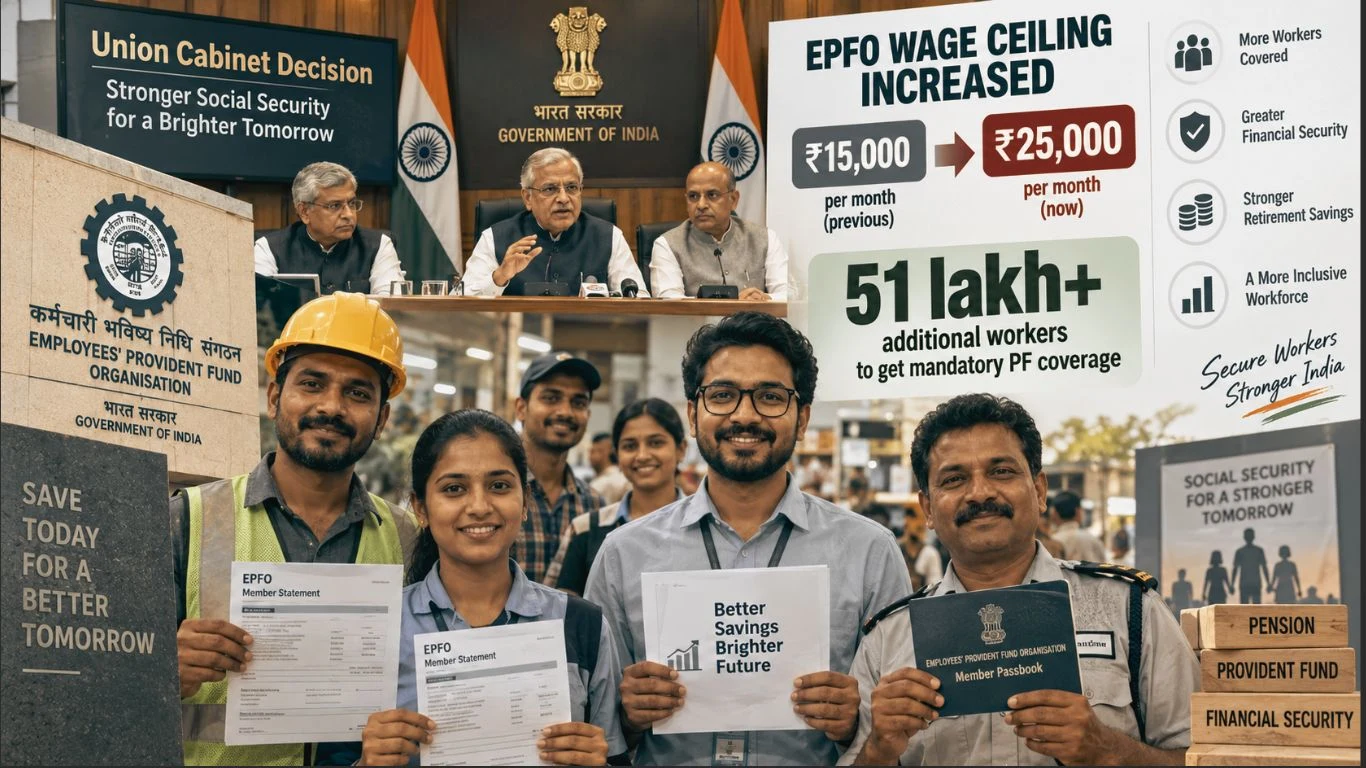
The Union Cabinet has approved the first increase in the EPFO wage ceiling since 2014, raising it from ₹15,000 to ₹25,000 a month. The change expands mandatory provident fund coverage, but it does not mean every employee earning above ₹25,000 loses EPF eligibility or that ₹25,000 will be deducted fr
US inflation accelerated to 3.7% in September, triggering a sharp technology selloff and reviving speculation about another Federal Reserve rate hike. Here is what the CPI report showed, why the Nasdaq fell and what investors are watching next.






0 Comments