Sensex, Nifty End Higher on September 23 as Metals Rally and Crude Oil Eases: Top Gainers & Market Drivers
Sensex and Nifty opened higher and extended gains on September 23, led by metals, FMCG and realty stocks as crude oil eased and global cues improved. Bajaj Finance, Hindalco and Tata Steel were among the strongest Nifty gainers.
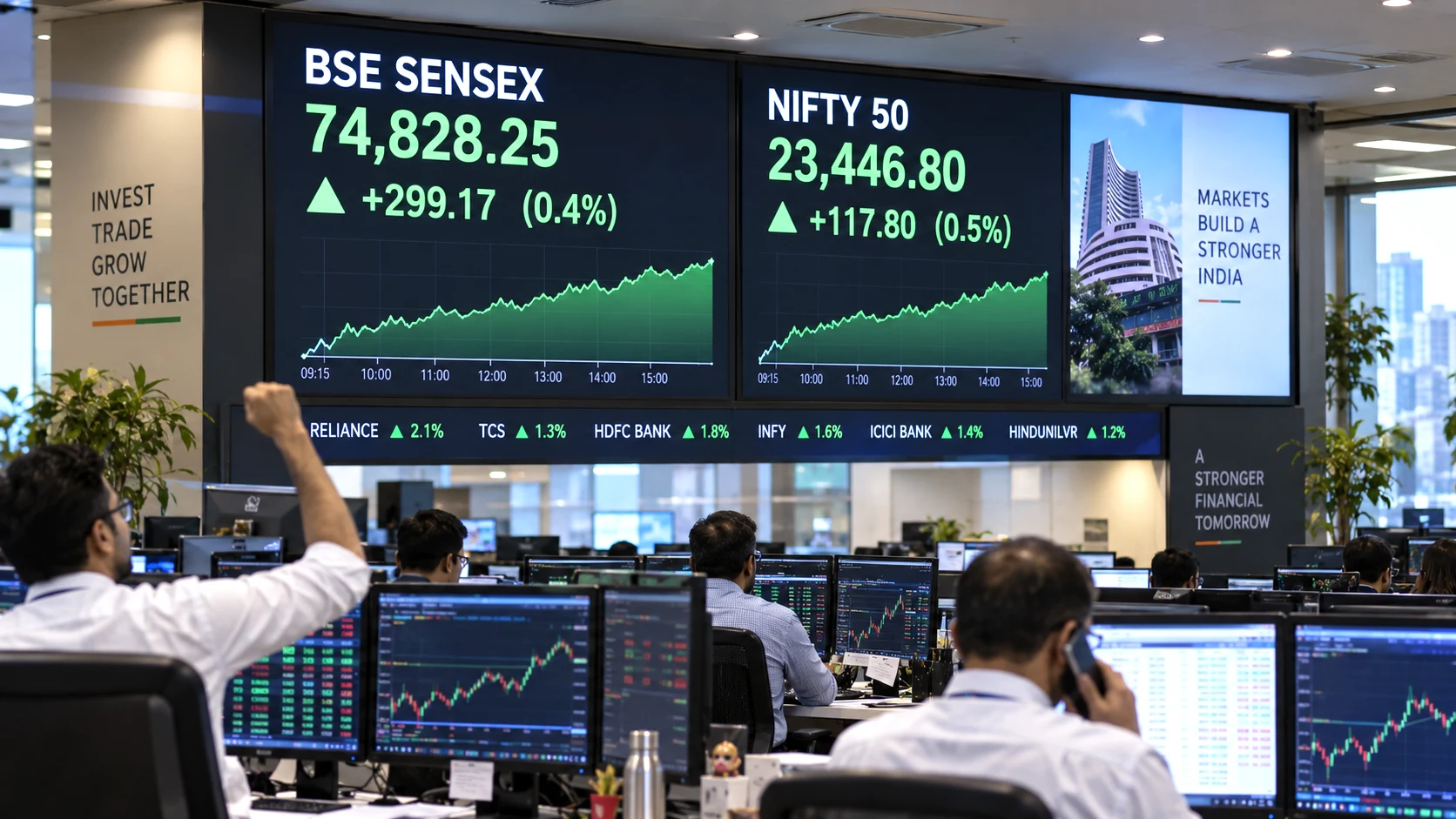
Indian stock market screens during a positive Sensex and Nifty trading session on September 23, 2026
Table of Contents (24 sections)
Indian equity benchmarks ended higher on Wednesday, September 23, extending their recovery as metal stocks rallied, crude oil prices eased and global risk sentiment improved.
The BSE Sensex closed at 74,838.25, up 299.17 points, or 0.40%, while the Nifty 50 ended at 23,446.80, gaining 117.80 points, or 0.50%.
The session had begun on a positive but relatively cautious note.
The Sensex opened at 74,648.32, compared with its previous close of 74,529.08. The Nifty opened at 23,352.15. By 9:27 a.m., the Sensex was up around 149 points and the Nifty about 44 points higher.
The gains broadened later in the session as metals, FMCG, PSU banks, realty and pharmaceutical shares advanced.
Key Takeaways
Sensex: 74,838.25, up 299.17 points or 0.40%
Recommended Reading
Related Stories & In-Depth Guides
Curated editorial perspectives matching this topic.
Sensex and Nifty rebounded on September 25 after Thursday's sharp selloff. At 2:35 PM IST, Sensex was up 328 points at 73,908 while Nifty gained 68 points to 23,131, helped by value buying and softer crude.
India received a record $94.53 billion in total FDI in FY2025-26, up about 17% from the previous year. Singapore led equity investment, software and hardware was the top sector, while Maharashtra attracted the most FDI equity.
Nifty 50: 23,446.80, up 117.80 points or 0.50%
Sensex opening: 74,648.32
Nifty opening: 23,352.15
Top Nifty gainers: Bajaj Finance, Hindalco, Tata Steel, Apollo Hospitals and JSW Steel
Strongest sector: Nifty Metal, up about 2.4%
Key positive drivers: lower crude oil, stronger metal prices, positive global equities and improved India GDP forecasts
Main restraint: continued foreign institutional selling and weakness in IT stocks
Market breadth: broadly positive
India VIX: fell around 6.4%, indicating lower implied near-term market volatility
How Did Sensex and Nifty Open?
The market began Wednesday modestly higher.
At the opening:
Index
Opening level
BSE Sensex
74,648.32
Nifty 50
23,352.15
By around 9:27 a.m.:
Sensex was at 74,677.91, up 148.83 points;
Nifty was at 23,372.60, up 43.60 points.
The early advance was supported by lower crude-oil prices and positive cues from several overseas equity markets.
However, investors remained cautious because of continuing foreign institutional selling and geopolitical uncertainty linked to the Middle East.
Where Did Sensex and Nifty Close?
The market strengthened during the session.
At the close:
Index
Closing level
Change
Sensex
74,838.25
+299.17 points / +0.40%
Nifty 50
23,446.80
+117.80 points / +0.50%
The Nifty therefore finished well above its opening level, suggesting that buying broadened as the session progressed.
On the Nifty 50, 38 stocks advanced while 14 declined by the end of trading.
Top Nifty 50 Gainers on September 23
The strongest Nifty 50 performers included:
Stock
Approx. gain
Bajaj Finance
+3.41%
Hindalco Industries
+3.17%
Tata Steel
+3.16%
Apollo Hospitals
+2.64%
JSW Steel
+2.43%
The presence of Hindalco, Tata Steel and JSW Steel among the strongest gainers reflects the strength in the metal sector during Wednesday's session.
Which Stocks Fell?
Among the weaker Nifty stocks were:
HCL Technologies;
Titan Company;
TCS;
Infosys; and
Coal India.
Upstox reported HCL Technologies down about 1.08%, Titan around 0.98%, TCS around 0.93%, Infosys around 0.86% and Coal India around 0.81%.
The weakness in major IT companies limited the benchmark indices' gains even as metals and other domestic sectors performed strongly.
Why Did the Indian Stock Market Rise Today?
Several factors supported the September 23 rally.
1. Crude Oil Prices Eased
Lower crude prices were one of the most important positive factors for Indian equities.
Crude had fallen for a second consecutive session and traded below the psychologically important $100-a-barrel level during parts of Wednesday's session as investors assessed the possibility of diplomatic progress in the US-Iran conflict.
India imports a large proportion of the crude oil it consumes.
As a result, persistently high oil prices can add pressure to:
inflation;
the current-account balance;
the rupee;
corporate input costs; and
government finances.
A decline in oil therefore tends to reduce some of these concerns, although the relationship between crude prices and Indian equities is not mechanical.
Oil can reverse quickly if geopolitical tensions worsen.
2. Metals Were the Strongest Sector
The Nifty Metal index rose around 2.4%, making it the strongest major sector of the session.
Hindalco, Tata Steel and JSW Steel were among the Nifty's largest gainers.
The sector was supported by strength in global industrial-metal prices, including copper.
Upstox reported that copper had climbed to a fresh record and extended its winning run amid concerns involving supply and continuing demand.
Higher commodity prices can improve the earnings outlook for some producers, although the effect varies by company, product mix and input costs.
3. Global Markets Provided Support
Several Asian markets traded higher following gains in technology shares on Wall Street and easing energy prices.
Japan's Nikkei closed about 1.36% higher, while South Korea's KOSPI gained around 0.89%. Hong Kong and mainland China were weaker.
In the United States, technology-related optimism had supported the Nasdaq, while the S&P 500 remained close to record territory.
Positive overseas markets can support sentiment in India, but domestic markets do not necessarily follow Wall Street or Asian indices in the same direction every day.
4. India GDP Forecasts Were Upgraded
Another supportive development came from global institutions raising their forecasts for India's economic growth.
Fitch Ratings raised its FY27 India GDP growth forecast to 6.9% from 6.4%.
S&P Global Ratings raised its forecast to 7% from 6.6%.
The upgrades followed stronger-than-expected growth in the April-June quarter and reflected factors including domestic demand, investment and industrial activity.
Other institutions have also revised India forecasts upward, though they continue to flag risks from inflation, oil prices, geopolitical tensions and weaker weather conditions.
The forecast changes may have supported investor confidence, but economic forecasts are projections and can be revised again as new data emerge.
Foreign and domestic institutional investors have recently taken different positions in Indian equities.
Exchange data for Tuesday showed foreign institutional investors sold approximately ₹3,809.99 crore of equities on a net basis, while domestic institutional investors bought around ₹4,120.07 crore.
Persistent foreign selling remains a potential restraint on the market.
Domestic institutions—including mutual funds, insurers and other large investors—have helped offset part of those outflows.
Institutional flows can influence short-term market direction, but one day's buying or selling should not by itself be treated as a reliable forecast of future index performance.
Which Sectors Performed Best?
Most major sectoral indices ended higher.
Reported moves included:
Sector
Approx. move
Nifty Metal
+2.4%
Nifty FMCG
+1.32%
Nifty PSU Bank
+1.14%
Nifty Realty
+1.10%
Nifty Pharma
+0.90%
The main exceptions were:
Nifty IT, down approximately 0.87%; and
Nifty Media, down around 0.5%.
This suggests the day's rally was more closely associated with cyclical, consumption and domestic sectors than with large technology exporters.
Why Did IT Stocks Fall?
Major IT stocks including HCL Technologies, TCS and Infosys were among the weaker Nifty constituents.
The technology sector can react to several factors, including:
US economic expectations;
bond yields;
currency movements;
client technology budgets;
AI-related capital spending;
and company-specific outlooks.
Wednesday's market nevertheless showed that weakness in IT was not enough to prevent the broader indices from advancing because buying was stronger elsewhere.
Broader Markets Also Advanced
The rally was not confined to the Sensex and Nifty 50.
The Nifty Midcap 100 rose around 0.7%, while the Nifty Smallcap 100 gained approximately 0.89%.
This broader participation is important because an index gain driven by only a handful of heavyweight stocks can sometimes mask weakness across the rest of the market.
On Wednesday, overall market breadth was positive.
How Broad Was the Market Rally?
About 3,689 stocks traded on the NSE during the session.
Of these:
2,344 advanced;
1,232 declined; and
113 were unchanged.
That means advancing shares substantially outnumbered declining stocks.
Around 135 stocks reached 52-week highs, while 52 touched 52-week lows.
These figures indicate relatively broad buying interest on the day, although they do not by themselves establish a sustained market trend.
India VIX Falls
The India VIX, commonly used as a measure of expected near-term volatility in the Indian equity market, fell roughly 6.4% to 10.29.
A falling VIX generally indicates that options markets are pricing less near-term volatility.
However, a low VIX does not guarantee that markets will remain calm.
Unexpected geopolitical, economic or corporate events can change volatility rapidly.
Why Lower Oil Matters So Much for India
India's sensitivity to energy prices makes crude oil an especially important market variable.
When international oil prices rise sharply, investors may worry about:
higher fuel and transport costs;
pressure on inflation;
a larger import bill;
corporate-margin pressure;
and possible changes in monetary policy.
When crude falls, some of these pressures may ease.
That helps explain why Indian equities have reacted noticeably to oil-price movements during the continuing West Asia conflict.
The September 23 rise therefore appears partly linked to expectations that diplomatic developments could reduce pressure in energy markets.
Whether that support persists will depend on actual geopolitical developments rather than market expectations alone.
Are Markets Back in a Strong Uptrend?
One positive session does not establish a durable bull trend.
Indian benchmarks have experienced substantial volatility in recent weeks amid:
elevated crude prices;
the US-Iran conflict;
foreign investor selling;
inflation concerns;
changing interest-rate expectations; and
uncertainty around global growth.
The September 23 advance improves short-term sentiment but does not eliminate those risks.
Investors and readers should therefore distinguish between a daily market rally and a confirmed longer-term trend.
What Should Investors Watch Next?
Several factors could influence the next trading sessions.
Crude oil
A further decline could support sentiment, while renewed escalation in the Middle East could push prices higher again.
US-Iran diplomacy
Markets are watching whether talks produce concrete de-escalation rather than only positive statements.
Foreign investor flows
Continued FII selling could limit rallies despite strong domestic institutional buying.
RBI expectations
Fitch and S&P both expect that persistent inflation pressure could eventually lead to higher policy rates. Fitch currently expects a possible 25-basis-point RBI increase in October, while S&P also sees scope for tightening during FY27.
These are forecasts, not RBI decisions.
Corporate earnings
Company-specific earnings and guidance remain important as investors assess whether valuations are supported by profit growth.
Global technology stocks
Indian IT shares may continue reacting to US technology spending and Wall Street sentiment.
Commodity prices
Copper and other metals will be important for companies including Hindalco, Tata Steel and JSW Steel.
Sensex & Nifty September 23: Session at a Glance
Indicator
September 23
Sensex open
74,648.32
Sensex close
74,838.25
Sensex daily move
+299.17 / +0.40%
Nifty open
23,352.15
Nifty close
23,446.80
Nifty daily move
+117.80 / +0.50%
Nifty Metal
+2.4% approx.
Nifty Midcap 100
+0.7% approx.
Nifty Smallcap 100
+0.89% approx.
India VIX
10.29, down 6.41%
Biggest Market Drivers on September 23
Positive
easing crude oil prices;
strong metal stocks;
record copper prices;
positive global equity cues;
upward revisions to India's FY27 growth forecasts;
domestic institutional buying;
broader mid-cap and small-cap participation.
Negative or Cautionary
continued FII selling;
weakness in IT stocks;
unresolved Middle East geopolitical risk;
potential inflation pressure;
possibility of tighter RBI monetary policy later in FY27.
Did Falling Crude Alone Cause the Rally?
No.
Lower crude appears to have been an important contributor, but market moves rarely have only one cause.
Wednesday's advance coincided with:
strong metals;
positive overseas cues;
GDP forecast upgrades;
broad domestic buying; and
lower market volatility.
It is therefore more accurate to say that easing oil prices supported the rally rather than claiming they single-handedly caused it.
Were All Stocks Higher?
No.
Although market breadth was positive, more than 1,200 NSE-listed shares declined and major IT companies were among the weaker large-cap stocks.
The benchmark indices represent a basket of large companies and do not mean every listed share moved in the same direction.
Did Foreign Investors Return to Buying?
Not based on the latest prior-session institutional data cited during Wednesday's trade.
FIIs had sold approximately ₹3,810 crore of Indian equities on Tuesday, while DIIs purchased about ₹4,120 crore.
Fresh institutional data should be checked after the exchange releases the September 23 figures before concluding whether foreign flows changed direction.
Are Bajaj Finance or Metal Stocks Now Guaranteed to Keep Rising?
No.
Wednesday's gains describe past market performance, not future returns.
Stock prices can change because of:
earnings;
valuations;
commodity prices;
interest rates;
company announcements;
institutional flows;
economic data; and
geopolitical developments.
Daily gainers should therefore not be interpreted automatically as investment recommendations.
Latest Verified Position
At the end of trading on September 23, 2026:
Sensex closed at 74,838.25, up 299.17 points.
Nifty 50 closed at 23,446.80, up 117.80 points.
Bajaj Finance, Hindalco and Tata Steel were among the strongest Nifty gainers.
Metals led the sectoral advance.
IT was among the few sectors to decline.
Lower crude oil supported sentiment.
Global equity markets were broadly constructive.
S&P and Fitch raised their India FY27 GDP forecasts to 7% and 6.9%, respectively.
Prior-session data still showed FII selling being offset by DII buying.
Market breadth was positive, but geopolitical and inflation risks remain.
Frequently Asked Questions
Why did Sensex and Nifty rise on September 23?
The gains were supported by easing crude oil prices, a strong rally in metal stocks, positive global cues and upward revisions to India's economic-growth forecasts. Domestic institutional buying also continued to provide support against foreign selling.
What was the Sensex closing level today?
The Sensex closed at 74,838.25, gaining 299.17 points or about 0.40%.
What was the Nifty closing level on September 23?
The Nifty 50 closed at 23,446.80, up 117.80 points or about 0.50%.
What were the Sensex and Nifty opening levels?
The Sensex opened at 74,648.32, while the Nifty opened at 23,352.15.
Which stocks were the biggest Nifty gainers?
Bajaj Finance, Hindalco, Tata Steel, Apollo Hospitals and JSW Steel were among the leading Nifty 50 gainers.
Which sector performed best?
The Nifty Metal index, up about 2.4%, was the strongest major sector reported for the session.
Why did metal stocks rise?
Metal shares were supported by strength in global commodity prices, including copper reaching a fresh high amid supply and demand concerns.
Did IT stocks rise?
No. Nifty IT declined about 0.87%, with HCL Technologies, TCS and Infosys among the weaker large-cap shares.
Are FIIs buying Indian stocks again?
The prior-session data showed FIIs remained net sellers, while DIIs were net buyers. September 23's final institutional-flow figures should be checked separately once released.
Is this an investment recommendation?
No. Daily market moves and lists of gainers or losers are informational and do not predict future returns.
Bottom Line
Sensex and Nifty closed higher on September 23, with the Sensex gaining 299 points and the Nifty rising 118 points. Metals led the advance, supported by easing crude oil, positive global cues and upgraded India GDP forecasts.
IT stocks lagged, and foreign institutional selling remained a restraint. One positive session improves short-term sentiment but does not remove geopolitical or inflation risks.
The Rajatheertha Team publishes news, explainers, guides and updates across India and the world. Our coverage follows Rajatheertha's editorial, verification and corrections standards.
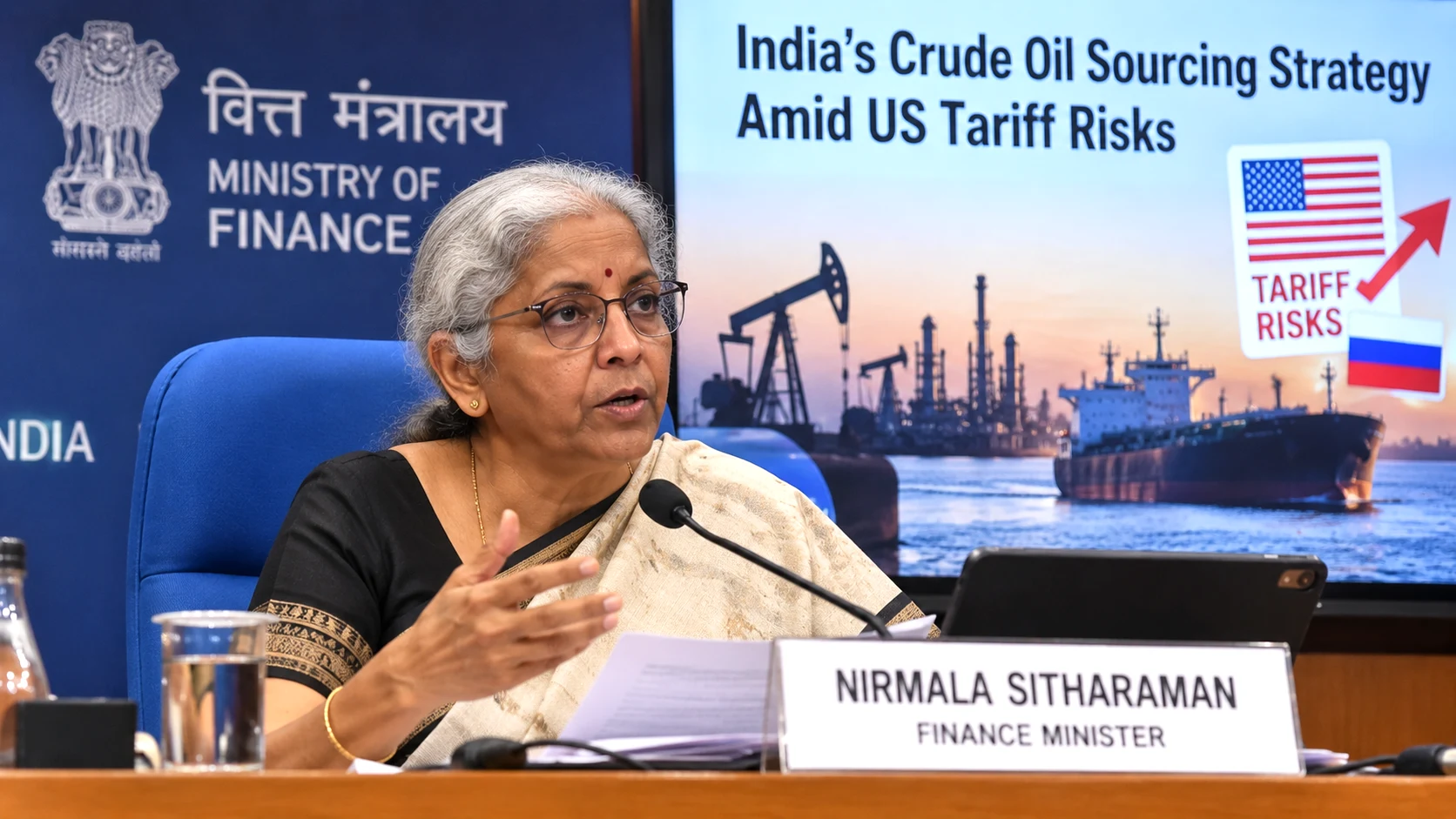
Finance Minister Nirmala Sitharaman says India cannot abruptly abandon Russian crude and will base oil purchases on availability, price and refinery suitability as a new US law raises the risk of tariffs of up to 100% on major Russian-energy buyers.
Global crude oil prices fell sharply on September 21, 2026, with Brent dropping toward $102 a barrel and US West Texas Intermediate slipping below $99, as recovering Saudi Arabian export flows and hopes for renewed US-Iran diplomacy outweighed immediate fears from Houthi missile and drone attacks on
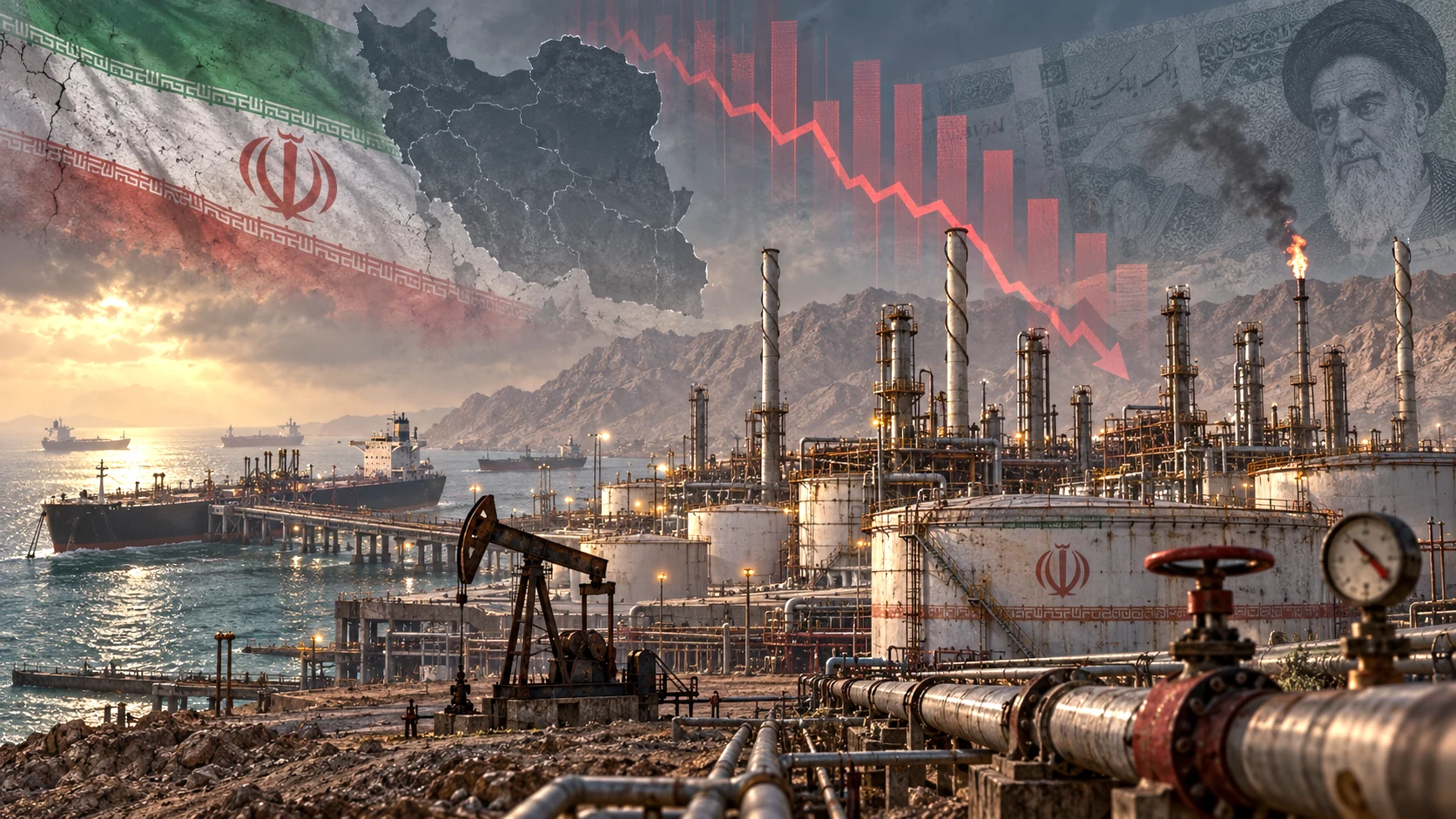
Iran’s economy contracted by 10.1% year-on-year during the first quarter of its current Persian calendar year, according to official data, with a collapse in oil and natural-gas activity driving much of the decline. The figures cover the first months of the US-Israel conflict with Iran, although the
SBI, PNB and other public-sector banks have issued advisories ahead of the proposed September 28-30 nationwide bank strike. PSBs and RRBs will open on Sunday, September 27, while branch-dependent services could face disruption during the strike.
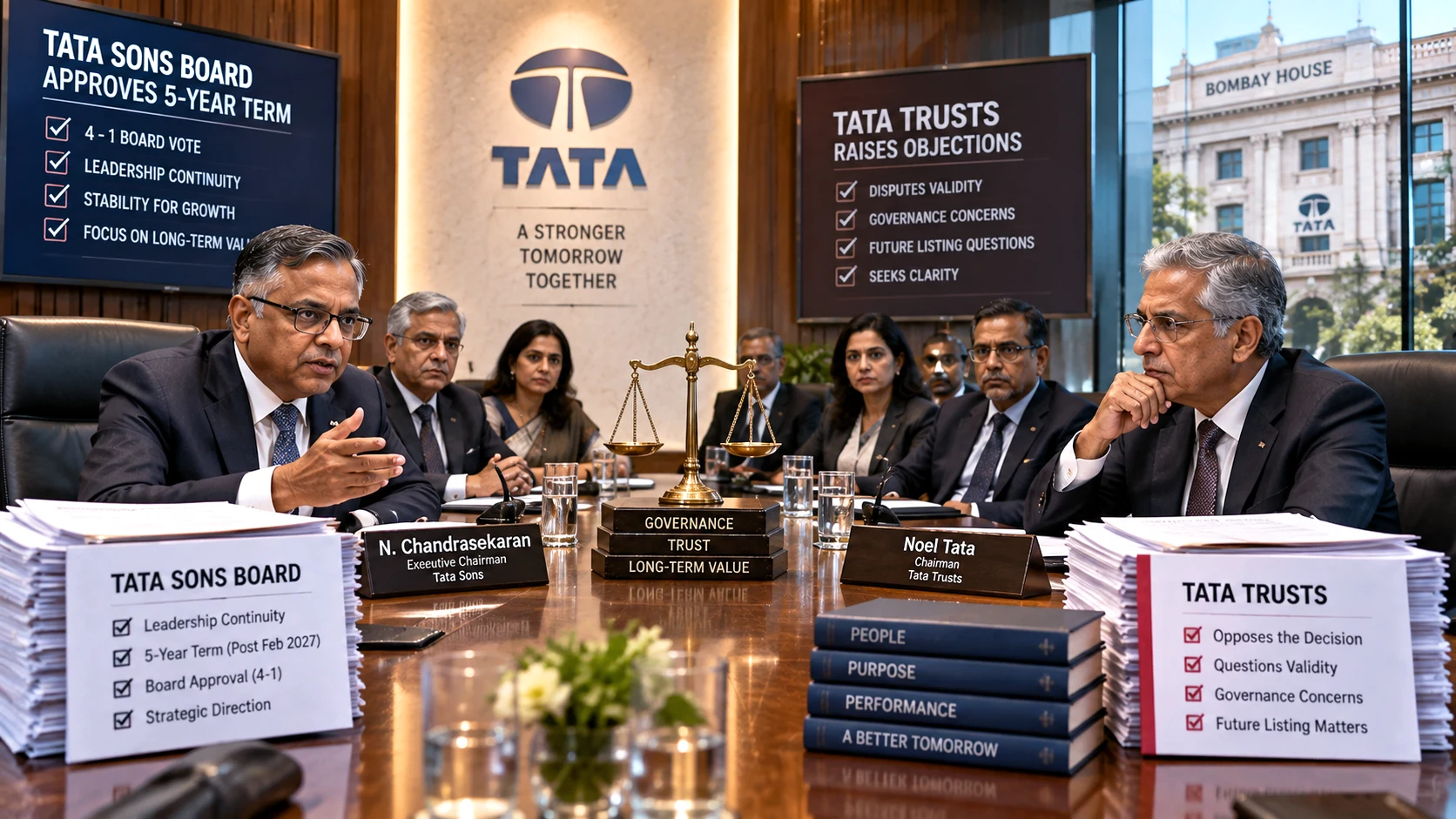
The Tata Sons board voted 4-1 to give N. Chandrasekaran another five years as executive chairman after his current term ends in February 2027. Noel Tata opposed the proposal, while Tata Trusts has formally argued that the resolution is invalid under Tata Sons’ Articles of Association.
Brent crude remains above $100 as Iran says normal Strait of Hormuz passage will not resume until its conditions are met. A 100-million-barrel G7 emergency stock release and stronger Middle East exports are limiting further oil-price gains.





0 Comments