Supreme Court Says Written Grounds of Arrest Mandatory Across Laws, Including PMLA and UAPA
The Supreme Court has reaffirmed that arrested persons must receive the grounds of arrest in writing and in a language they understand, holding that Article 22(1) applies across criminal laws, including special statutes such as PMLA and UAPA.
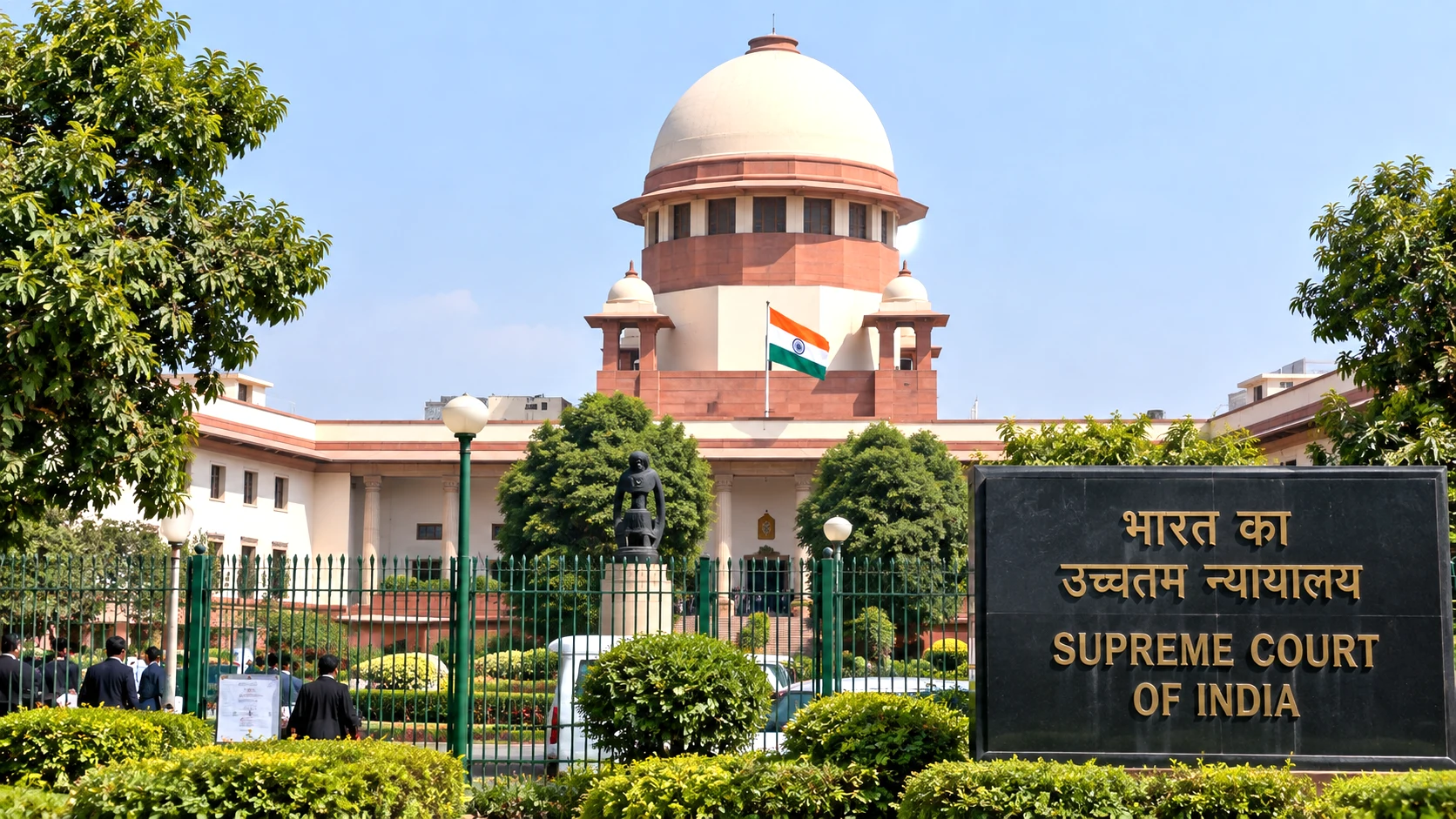
Supreme Court of India in New Delhi, which ruled on written grounds of arrest under Article 22(1)
Table of Contents (19 sections)
NEW DELHI, September 22, 2026: The Supreme Court has reinforced a major constitutional safeguard governing arrests in India, holding that an arrested person must ordinarily be given the grounds of arrest in writing and in a language they understand, regardless of the seriousness of the alleged offence or the law under which the arrest is made.
A bench of Justices Ujjal Bhuyan and Atul S Chandurkar delivered the judgment on September 21, 2026, while examining a case from Punjab in which an earlier arrest had been declared illegal because written grounds of arrest were not furnished.
The Court said the protection under Article 22(1) of the Constitution is not limited to ordinary criminal offences. It applies across statutes and cannot be diluted merely because an allegation involves a serious offence or a special law. The judgment discussed earlier Supreme Court rulings involving the Prevention of Money Laundering Act, or PMLA, and the Unlawful Activities (Prevention) Act, or UAPA, while reaffirming the broader constitutional rule.
Recommended Reading
Related Stories & In-Depth Guides
Curated editorial perspectives matching this topic.
The Jagdalpur court imposed capital punishment on all 10 people convicted in the 2013 Maoist ambush on a Congress convoy in Chhattisgarh. Two women are among those sentenced. The death sentences must still go through the High Court confirmation process, and the defence can appeal.
Vice President JD Vance says Washington is shifting from degrading Iran’s capabilities to preventing Tehran from rebuilding them, while President Donald Trump says the conflict may be nearing an end. Separately, a UN-mandated fact-finding mission says there are reasonable grounds to believe two US s
The ruling also strengthens safeguards governing any attempt to re-arrest someone whose earlier arrest was found unconstitutional. Police cannot simply repeat the arrest at their own discretion. The Court laid down requirements involving written grounds, approval within the police hierarchy and judicial scrutiny before fresh custody can be obtained.
Key Takeaways
Grounds of arrest must ordinarily be given in writing and in a language the arrested person understands.
Article 22(1) applies across criminal laws, including special statutes such as PMLA and UAPA.
Violation can render the arrest and resulting detention illegal.
Re-arrest after an unconstitutional arrest requires written grounds, superior endorsement and Magistrate approval.
Investigation may need to be transferred to another officer in such cases.
Disciplinary inquiry can follow serious Article 22(1) lapses.
What Did the Supreme Court Rule?
The central principle is straightforward: a person whose liberty is being taken away must meaningfully understand why they are being arrested.
The Supreme Court held that the grounds of arrest must be communicated in writing and in a language understood by the arrested person.
The Court described this obligation as a mandatory constitutional safeguard rather than a technical formality.
Article 22(1) provides that an arrested person cannot be detained without being informed, as soon as may be, of the grounds of the arrest. It also protects the person's right to consult and be defended by a legal practitioner of their choice.
The latest judgment connects that constitutional guarantee directly with the protection of personal liberty under Article 21.
If the requirement is violated, the defect goes to the legality of the arrest itself rather than merely creating an irregularity that can automatically be ignored later.
Does the Rule Apply to PMLA and UAPA Cases?
Yes. The constitutional protection is not confined to arrests under ordinary criminal law.
The Supreme Court reviewed its earlier decisions involving both PMLA and UAPA while explaining how Article 22(1) operates.
In the PMLA context, the Court referred to Pankaj Bansal, where it had held that an arrested person needs meaningful knowledge of the grounds relied upon by the Enforcement Directorate, particularly because PMLA contains stringent bail conditions.
Knowing the actual grounds allows an accused to consult a lawyer, challenge the arrest and address the case against them while seeking bail.
The Court also referred to Prabir Purkayastha, a case involving UAPA, in which it had held that a person arrested under UAPA — or for any other offence — has a fundamental and statutory right to receive the grounds of arrest in writing.
The latest judgment therefore reinforces that constitutional protections do not disappear because Parliament has enacted a special criminal statute or because the allegations are particularly serious.
What Does Article 22(1) Actually Protect?
Article 22 contains important protections for people who are arrested.
Under Article 22(1), an arrested person must be informed of the grounds for the arrest and must be allowed to consult and be defended by a legal practitioner of their choice.
This information has practical consequences.
Without knowing why an arrest has been made, a person may be unable to effectively:
understand the allegations underlying the arrest;
consult a lawyer on the specific case;
oppose a request for police custody;
challenge the legality of the arrest;
seek bail;
identify factual or legal errors in the arrest grounds;
use other remedies available under law.
The Supreme Court has repeatedly treated these protections as part of the constitutional framework surrounding life and personal liberty rather than as paperwork that investigating agencies may disregard.
Must the Grounds Always Be Handed Over Immediately?
Written communication is the general rule, but the Supreme Court's legal framework recognises a narrow practical exception.
Where police already possess documentary material forming the basis of an arrest, written grounds should be supplied when the arrest is made.
However, the Court has recognised that exceptional circumstances may make immediate written communication impracticable — for example, certain situations in which an alleged offence has just occurred and police are acting immediately.
In such a situation, the arresting officer may initially communicate the grounds orally.
But that does not eliminate the requirement for written grounds.
A written copy must still be provided within a reasonable time and, in any event, at least two hours before the arrested person is produced before a Magistrate for remand proceedings.
If there has been a delay, the remand papers should record the reason.
This distinction matters because the judgment should not be understood as saying that every arrest becomes unlawful merely because a printed document could not physically be handed over at the exact second of arrest.
The constitutional test is whether the safeguards laid down by the Court have actually been followed.
What Happens If Police Fail to Provide Written Grounds?
Failure to comply with the constitutional requirement can render the arrest illegal.
The Supreme Court has held that violation of Article 22(1) affects the validity of both the arrest and the resulting custody.
A later chargesheet does not retrospectively cure an arrest that was unconstitutional at the outset.
The Court has also rejected the proposition that an arrested person must separately prove that the failure caused them prejudice before Article 22 protection becomes enforceable. The constitutional safeguard itself must be respected.
Where a court finds that an arrest is illegal because these requirements were breached, the arrested person is entitled to be released from that unconstitutional detention.
That release, however, does not mean the criminal case disappears.
Does an Illegal Arrest Mean the Accused Can Never Be Arrested Again?
No.
This is one of the most important practical parts of the September 21 judgment.
The Supreme Court distinguished release from an unconstitutional arrest from the grant of permanent immunity against arrest.
An accused released because Article 22(1) was violated is not automatically being acquitted, nor does the underlying FIR or investigation cease to exist.
If investigators believe custody is still genuinely necessary, they may seek re-arrest — but they must follow stronger safeguards.
What Are the New Safeguards for Re-Arrest?
The Supreme Court said the authority that committed the constitutional breach should not simply be allowed to exercise the power of re-arrest again without supervision.
If investigators seek custody again after an accused has been released because written grounds were not properly supplied, the investigating agency must approach the concerned Magistrate.
The application must explain:
why re-arrest or custodial interrogation is considered necessary;
why the written grounds were not supplied during the original arrest;
that written grounds have since been furnished to the accused.
The application must also carry the endorsement of the immediate superior of the investigating officer.
The Magistrate must then independently decide whether re-arrest should be permitted. The Supreme Court said such an application should be decided expeditiously and, following the framework previously laid down, preferably within a week.
Investigation May Have to Be Transferred to Another Officer
The judgment also contains an important administrative safeguard.
When the superior police authority receives an application seeking fresh custody after an Article 22(1) violation, the Supreme Court said the investigation should be handed over to another officer.
This is intended to prevent the same officer responsible for the unconstitutional arrest from controlling the next stage without additional oversight.
Can Police Officers Face Disciplinary Action?
Yes, but the precise process matters.
The Supreme Court directed that a departmental inquiry should be initiated in the re-arrest framework where an accused had been released because of a serious Article 22(1) lapse.
If that inquiry results in an adverse finding against the responsible officer or officers, departmental action can follow, including an entry in the officer's service record.
This means the judgment should not be simplified into a claim that every procedural mistake automatically results in immediate punishment.
There is an inquiry process, and disciplinary consequences depend on the findings.
In the Punjab case itself, the State informed the Supreme Court that disciplinary proceedings had already been initiated against officers involved in the original arrest.
What Case Led to the September 21 Ruling?
The case before the Supreme Court was Jaskaran Jeet Singh Deol v. State of Punjab.
It arose from an FIR in Punjab involving serious allegations under provisions of the Bharatiya Nyaya Sanhita and the Protection of Children from Sexual Offences Act.
The accused was arrested on May 17, 2026.
When he was produced before a Magistrate the following day, the Magistrate found that written grounds of arrest had not been supplied.
The arrest was consequently held illegal and the accused was ordered to be released, while leaving the investigating agency free to proceed again in accordance with law.
The dispute eventually reached the Supreme Court over how the authorities could lawfully seek his custody again after the initial constitutional violation.
The Supreme Court used the case to explain both the importance of Article 22 safeguards and the procedure that authorities must follow if they seek re-arrest.
Why the Ruling Matters Beyond One Case
The judgment has significance well beyond the particular Punjab investigation because arrest powers are exercised across a wide range of laws.
Investigating agencies cannot treat constitutional safeguards differently merely because one case involves an ordinary offence and another involves money laundering, terrorism allegations or another special statute.
The core principle remains the same: deprivation of personal liberty must follow constitutionally valid procedure.
The Court said Article 22(1) is not statute-specific and is not merely procedural. It forms part of the fundamental constitutional safeguards governing the State's power to arrest an individual.
For police departments and other investigating agencies, this places greater emphasis on properly documenting grounds of arrest before seeking remand.
For Magistrates, it reinforces the need to examine whether constitutional arrest requirements have actually been followed rather than treating remand as an automatic administrative step.
For an arrested person, it gives practical meaning to the right to understand the case against them before their liberty is further restricted.
Written Grounds Are Different from General Accusations
The requirement is not satisfied merely by telling someone that they are being arrested "in connection with a case."
Grounds of arrest must communicate enough of the factual basis for the person to understand why the power of arrest is being exercised against them.
This does not necessarily mean handing over the entire investigation file or every item of evidence.
The purpose is to meaningfully communicate the basis of arrest so that the person can exercise legal rights, including challenging custody and seeking bail.
That distinction becomes especially important under laws such as PMLA and UAPA, where bail provisions and investigative procedures can be more restrictive than those applicable in ordinary criminal cases.
Article 22 Protection Does Not Decide Guilt or Innocence
The Supreme Court's ruling concerns the legality of arrest and detention procedure.
It does not determine whether an accused person committed the alleged offence.
An arrest may be unconstitutional because proper grounds were not supplied even where an investigation into serious allegations continues.
Conversely, compliance with Article 22 does not establish that the allegations are true.
The constitutional safeguard governs how the State may lawfully deprive someone of liberty, while guilt or innocence is determined through the criminal justice process based on evidence and applicable law.
What Changes for Investigating Agencies?
The ruling reinforces a practical checklist for agencies carrying out arrests:
Determine and record the actual grounds justifying arrest.
Communicate those grounds meaningfully to the person being arrested.
Provide them in writing and in a language the person understands.
Where an exceptional situation prevents immediate written communication, convey the grounds orally and provide them in writing within the permitted period.
Ensure written grounds are supplied no later than two hours before production for remand.
Document any exceptional delay.
If an earlier arrest has been invalidated for breach of Article 22(1), do not simply re-arrest the accused without following the judicial process prescribed by the Supreme Court.
These requirements turn constitutional safeguards into concrete steps that must be reflected in arrest and remand procedure.
What Happens Next?
The September 21 ruling is likely to be cited in challenges involving arrest procedure across different criminal statutes.
Lower courts dealing with remand applications will also have to examine whether investigating agencies complied with the constitutional requirements concerning communication of arrest grounds.
The ruling does not prevent lawful arrests or investigations.
Instead, it requires agencies to exercise arrest powers within constitutional boundaries and ensures that a person whose liberty is being restricted receives meaningful information about why that action is being taken.
For the public, the practical takeaway is equally clear: the right to know the grounds of arrest is a constitutional protection, and the Supreme Court has reaffirmed that the protection applies irrespective of the seriousness of the accusation or the statute involved.
Frequently Asked Questions
Did the Supreme Court make written grounds of arrest mandatory?
Yes. The Court reaffirmed that grounds of arrest must ordinarily be provided in writing and in a language understood by the arrested person.
Does this rule apply to PMLA cases?
Yes. The Supreme Court's jurisprudence under Article 22(1), including the Pankaj Bansal decision, requires meaningful written communication of the grounds of arrest in PMLA cases.
Does it also apply to UAPA arrests?
Yes. The Supreme Court referred to its earlier Prabir Purkayastha ruling, which established the right to written grounds of arrest for persons arrested under UAPA and reiterated that the constitutional safeguard is not statute-specific.
Can grounds ever be communicated orally first?
In exceptional circumstances where immediate written communication is impracticable, grounds may initially be communicated orally. They must subsequently be provided in writing within a reasonable time and no later than two hours before the person is produced before the Magistrate for remand.
What happens if Article 22(1) is violated?
Non-compliance can render the arrest and resulting detention illegal, requiring the person's release from that unconstitutional custody.
Can police re-arrest a person after an illegal arrest?
Potentially, yes. Release for an unconstitutional arrest does not create permanent immunity. However, written grounds must be supplied and the investigating agency must follow the judicial safeguards laid down by the Supreme Court before seeking fresh custody.
Bottom Line
The Supreme Court has reaffirmed that grounds of arrest must ordinarily be provided in writing and in a language understood by the arrested person.
The protection under Article 22(1) applies across criminal laws, including special statutes such as PMLA and UAPA. Violation can render an arrest illegal. Re-arrest after such a violation requires written grounds, hierarchical endorsement, transfer of investigation in appropriate cases and independent Magistrate approval.
Key Takeaway
Written grounds of arrest are mandatory under Article 22(1).
Rule applies to PMLA, UAPA and other statutes.
Illegal arrest does not bar future custody under strict safeguards.
Constitutional liberty protections remain non-negotiable.
The Rajatheertha Team publishes news, explainers, guides and updates across India and the world. Our coverage follows Rajatheertha's editorial, verification and corrections standards.
The Home Ministry has formally added the Shahzad Bhatti Network to the First Schedule of the UAPA, citing alleged cross-border arms, explosives and narcotics smuggling, recruitment of local criminals and the use of digital platforms for terror-related activity. The designation follows a multi-state
Ukraine has confirmed striking the Moscow Oil Refinery during an extraordinary long-range drone and missile operation against Russia, while Russian authorities say hundreds of drones targeted the capital and more than 1,000 were intercepted across the country. At least three people were reported kil
Revenue authorities are examining survey records and government-land classifications around former Chief Minister K. Chandrashekar Rao’s Erravalli property after Chief Minister A. Revanth Reddy raised allegations in the Assembly. The BRS rejects the allegations and has demanded an independent judge-
Hurricane Polo has rapidly intensified into a powerful Category 4 storm off southwestern Mexico and is approaching Category 5 strength. Heavy rain, flooding, landslides and dangerous coastal conditions remain the main threats even if the storm's core stays offshore.
Three infants have died following a fire in the Special Newborn Care Unit at RIMS Adilabad. Officials are investigating a suspected AC-related electrical malfunction, while the Telangana government has ordered an inquiry and stronger hospital safety measures.
Tropical Storm Fay has strengthened to 70 mph over the eastern Atlantic, putting it just below hurricane intensity southwest of the Azores. Despite its strengthening overnight, forecasters now expect increasing wind shear to weaken Fay beginning Monday, while the rest of the Atlantic basin is foreca












0 Comments