Tropical Storm Fay has strengthened to 70 mph over the eastern Atlantic, putting it just below hurricane intensity southwest of the Azores. Despite its strengthening overnight, forecasters now expect increasing wind shear to weaken Fay beginning Monday, while the rest of the Atlantic basin is foreca
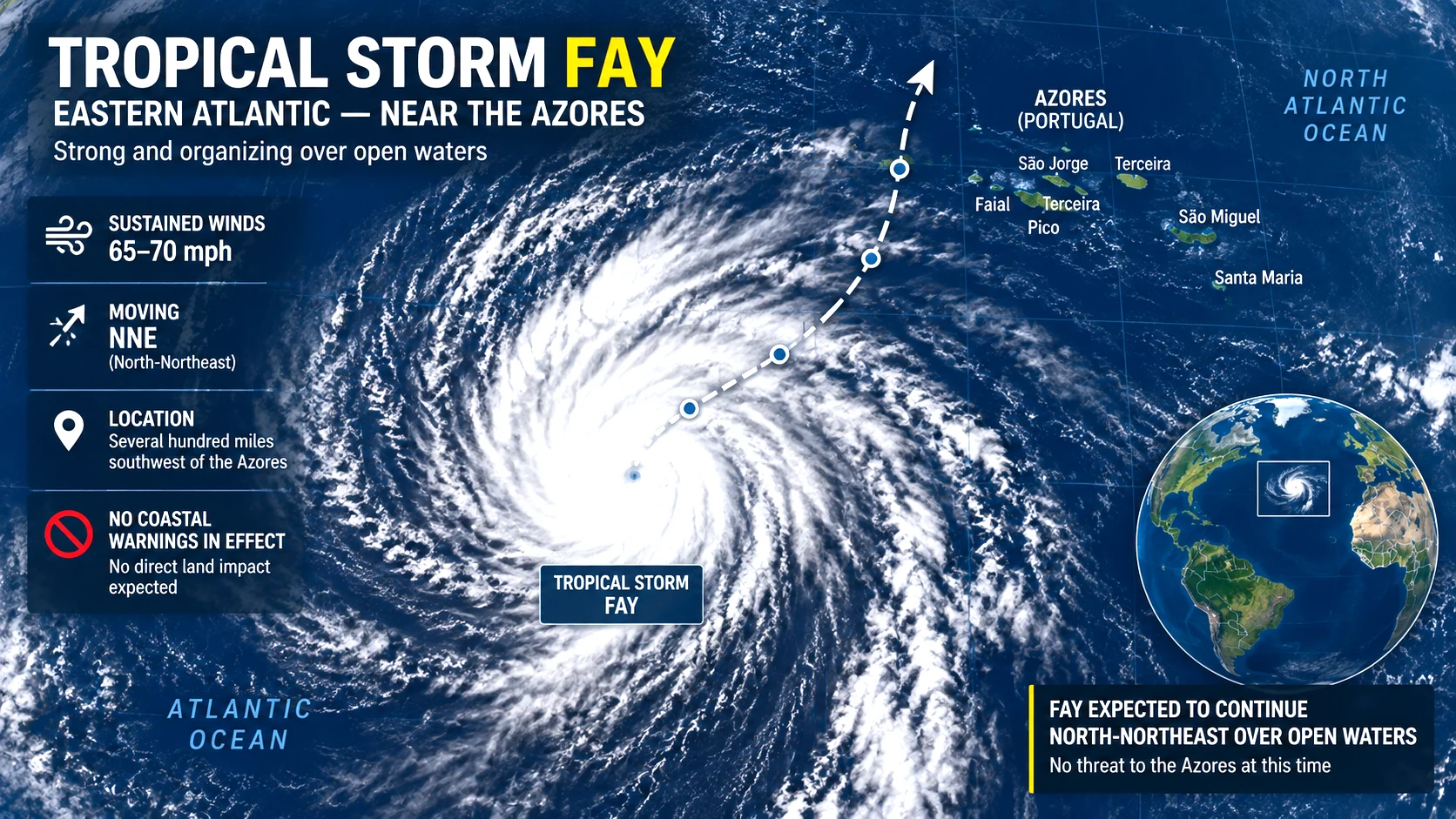
Tropical Storm Fay over the eastern Atlantic near the Azores
Table of Contents (16 sections)
MIAMI, September 21, 2026: Tropical Storm Fay is approaching hurricane strength over the open Atlantic Ocean, but the latest forecast from the U.S. National Hurricane Center indicates that its opportunity for further strengthening is becoming limited.
At 0300 UTC on Monday, September 21, Fay had maximum sustained winds of 70 mph, or 110 km/h, with higher gusts.
The centre of the storm was located near 34.1 degrees north latitude and 31.9 degrees west longitude, approximately 385 miles, or 620 kilometres, southwest of the Azores.
Fay was moving toward the east-southeast at approximately 5 mph, while its estimated minimum central pressure had fallen to 995 millibars.
Key Takeaways
Tropical Storm Fay has maximum sustained winds of 70 mph, just below hurricane strength.
The storm is located about 385 miles southwest of the Azores.
Increasing wind shear is expected to cause weakening beginning Monday.
Fay is forecast to turn southward and then southwestward over the open Atlantic.
Recommended Reading
Related Stories & In-Depth Guides
Curated editorial perspectives matching this topic.
Hurricane Polo has rapidly intensified into a powerful Category 4 storm off southwestern Mexico and is approaching Category 5 strength. Heavy rain, flooding, landslides and dangerous coastal conditions remain the main threats even if the storm's core stays offshore.
At least nine passengers died after an AC sleeper bus caught fire on the Yamuna Expressway near Jewar in Greater Noida. Police are investigating the cause, while a survivor’s complaint alleges warnings about a burning smell were ignored.
No coastal watches or warnings are in effect.
The National Hurricane Center expects no additional tropical cyclone formation in the Atlantic basin for the next seven days.
Tropical Storm Fay Latest Status
The latest confirmed information from the National Hurricane Center is:
Storm: Tropical Storm Fay
Maximum sustained winds: 70 mph / 110 km/h
Location: About 385 miles southwest of the Azores
Movement: East-southeast at 5 mph / 7 km/h
Central pressure: 995 mb
Hurricane threshold: 74 mph
Coastal watches or warnings: None
Direct land hazards: None currently identified
Fay's tropical-storm-force winds extend outward as far as approximately 80 miles, or 130 kilometres, from its centre.
Will Tropical Storm Fay Become a Hurricane?
Fay is currently extremely close to hurricane intensity.
A tropical cyclone becomes a hurricane when its maximum sustained winds reach at least 74 mph, or 119 km/h.
At 70 mph, Fay is only four miles per hour below that threshold.
Earlier forecasts allowed for the possibility that Fay could briefly become a hurricane.
However, the latest National Hurricane Center advisory has shifted toward weakening.
Forecasters said little change in intensity was expected in the immediate period before Fay begins weakening during Monday.
The reason is increasingly hostile atmospheric conditions.
The NHC said northwesterly vertical wind shear has begun affecting Fay's circulation.
Satellite observations showed that the storm's upper-level outflow was becoming restricted, an early indication that the surrounding atmosphere was becoming less favourable for continued strengthening.
Wind shear can disrupt a tropical cyclone by separating its thunderstorms from the storm's low-level centre.
That means Fay may have reached, or be very close to, its peak intensity.
Tropical Storm Fay Forecast Path
Fay's track is somewhat unusual because the system is not forecast to continue steadily toward the Azores.
After moving east-southeast, the storm is expected to begin turning southward and then southwestward during Monday and the early part of the week.
A strengthening ridge of high pressure to Fay's northwest is expected to steer the cyclone in that direction.
That forecast keeps the centre of Fay over the open Atlantic rather than taking it directly into the Azores.
The National Hurricane Center therefore has no tropical storm or hurricane watches or warnings in effect.
Is Fay Expected to Hit the Azores?
Based on the current official forecast, a direct landfall in the Azores is not expected.
Fay remains several hundred miles southwest of the island chain and is forecast to turn away while weakening.
Forecast tracks can change, particularly when tropical systems move slowly, so residents and marine interests in the region should continue following official updates.
However, there is currently no NHC warning indicating that destructive winds from Fay are expected on land.
Fay Intensified Rapidly on Sunday
Fay formed from Tropical Depression Six during the weekend and strengthened steadily throughout Sunday.
At 0900 UTC Sunday, Fay had maximum sustained winds of approximately 45 mph.
By 1500 UTC, winds had increased to 60 mph.
At 2100 UTC, the storm strengthened further to 65 mph.
By early Monday, sustained winds had reached 70 mph.
The storm therefore gained roughly 25 mph in maximum sustained wind speed in less than a day.
Despite that increase, atmospheric conditions are now expected to become less favourable.
Fay Expected to Become Post-Tropical
The NHC forecasts Fay to gradually lose its tropical characteristics as the week progresses.
Current guidance indicates the system could become a post-tropical cyclone by the middle of the week.
A post-tropical transition does not necessarily mean winds disappear immediately.
Former tropical cyclones can continue producing strong winds and rough seas even after losing the organized warm-core structure required to be classified as tropical storms.
For Fay, however, the overall intensity trend is expected to be downward.
Atlantic Hurricane Forecast Today: No New Development Expected
Outside Tropical Storm Fay, the Atlantic basin is unusually quiet for late September.
The National Hurricane Center's 2 a.m. EDT Tropical Weather Outlook on September 21 states that:
“Tropical cyclone formation is not expected during the next 7 days.”
That outlook covers the:
North Atlantic Ocean
Caribbean Sea
Gulf of America
Fay is currently the only active Atlantic tropical cyclone being monitored by the National Hurricane Center.
This means there are currently no separate disturbances with an official chance of becoming a tropical depression or named storm during the coming week.
Fay Is the Sixth Named Atlantic Storm of 2026
Fay follows five earlier named tropical storms during the 2026 Atlantic hurricane season:
Arthur
Bertha
Cristobal
Dolly
Edouard
Fay
According to National Hurricane Center records, the first five systems remained tropical storms rather than becoming hurricanes.
That makes Fay particularly notable.
If its winds had crossed the 74 mph threshold, Fay would have become the Atlantic season's first hurricane.
The current forecast, however, increasingly suggests it may fall just short of doing so.
2026 Atlantic Hurricane Season Remains Below Normal
NOAA entered the season expecting less activity than normal, largely because of atmospheric conditions associated with developing El Niño.
Its updated seasonal outlook, issued in August, became even more conservative than the original May forecast.
NOAA currently gives the 2026 Atlantic season:
75% probability of below-normal activity
20% probability of near-normal activity
5% probability of above-normal activity
The updated forecast calls for:
7 to 13 named storms
2 to 6 hurricanes
0 to 2 major hurricanes
The named-storm total includes storms that had already formed when the updated forecast was issued.
That represents a reduction from NOAA's original May outlook of 8–14 named storms, 3–6 hurricanes and 1–3 major hurricanes.
Why Has the Atlantic Been Relatively Quiet?
The main factor is El Niño.
El Niño conditions typically increase upper-level winds across parts of the tropical Atlantic.
That creates stronger vertical wind shear, which can make it difficult for tropical disturbances to organize vertically and develop into powerful hurricanes.
Warmer-than-normal Atlantic water temperatures can work in the opposite direction because warm ocean water supplies energy to tropical cyclones.
But during 2026, NOAA expects El Niño's suppressing influence to remain an important factor.
This does not mean dangerous hurricanes cannot occur in a below-normal season.
Seasonal outlooks describe the expected overall amount of activity, not whether an individual community will experience a damaging hurricane.
September Remains an Important Hurricane Month
The Atlantic hurricane season officially runs from June 1 through November 30.
Historically, August, September and October account for a large proportion of the basin's tropical cyclone activity.
An average Atlantic season produces approximately:
14 named storms
7 hurricanes
3 major hurricanes
based on the 1991–2020 climatological period.
So even though the seven-day Atlantic outlook is currently quiet, hurricane season is not over.
Conditions can change later in September or during October.
Tropical Storm Fay: What to Watch Next
There are three main developments to monitor.
The first is whether Fay briefly reaches hurricane strength before hostile atmospheric conditions take full control.
At 70 mph, only a small increase would technically make Fay a Category 1 hurricane.
However, that possibility now appears increasingly limited.
The second is Fay's southwestward turn.
Forecast confidence will improve as the storm completes its change in direction.
The third is the speed at which Fay weakens and becomes post-tropical.
If the National Hurricane Center forecast holds, Fay should gradually deteriorate over the open Atlantic and pose little direct threat to populated areas.
Latest Atlantic Tropical Outlook
As of the latest available National Hurricane Center advisory on September 21:
Tropical Storm Fay is the only active Atlantic tropical cyclone.
Fay has 70 mph sustained winds and is just below hurricane strength.
The storm is about 385 miles southwest of the Azores.
Fay is forecast to turn southwest.
Weakening is expected beginning Monday.
Fay should become post-tropical around the middle of the week.
There are no coastal watches or warnings in effect.
The NHC expects no additional tropical cyclone formation anywhere in the Atlantic basin during the next seven days.
For now, Fay remains a powerful but primarily ocean-based storm rather than a major land threat.
Bottom Line
Tropical Storm Fay has strengthened to 70 mph over the eastern Atlantic, just below hurricane intensity, and is located about 385 miles southwest of the Azores.
Increasing wind shear is expected to cause weakening beginning Monday as the storm turns southward and then southwestward over open water. No coastal watches or warnings are in effect, and the National Hurricane Center forecasts no additional tropical cyclone formation in the Atlantic basin for the next seven days.
Key Takeaway
Tropical Storm Fay near hurricane strength at 70 mph.
Located southwest of the Azores; forecast to weaken and turn southwest.
No land threats currently expected.
Atlantic basin quiet with no new development forecast for seven days.
The Rajatheertha Team publishes news, explainers, guides and updates across India and the world. Our coverage follows Rajatheertha's editorial, verification and corrections standards.
The Home Ministry has formally added the Shahzad Bhatti Network to the First Schedule of the UAPA, citing alleged cross-border arms, explosives and narcotics smuggling, recruitment of local criminals and the use of digital platforms for terror-related activity. The designation follows a multi-state
Ukraine has confirmed striking the Moscow Oil Refinery during an extraordinary long-range drone and missile operation against Russia, while Russian authorities say hundreds of drones targeted the capital and more than 1,000 were intercepted across the country. At least three people were reported kil
The Jagdalpur court imposed capital punishment on all 10 people convicted in the 2013 Maoist ambush on a Congress convoy in Chhattisgarh. Two women are among those sentenced. The death sentences must still go through the High Court confirmation process, and the defence can appeal.
The Supreme Court has reaffirmed that arrested persons must receive the grounds of arrest in writing and in a language they understand, holding that Article 22(1) applies across criminal laws, including special statutes such as PMLA and UAPA.
Three infants have died following a fire in the Special Newborn Care Unit at RIMS Adilabad. Officials are investigating a suspected AC-related electrical malfunction, while the Telangana government has ordered an inquiry and stronger hospital safety measures.
The Pentagon says all U.S. bombers deployed to RAF Fairford have returned to the United States following a suspected terrorism incident near the UK base. British investigators are examining possible foreign-state involvement, while Iran denies any role.













0 Comments