Anthropic Launches Claude Opus 5.5: Faster, Lower-Cost AI Model With 1M Context Window
Anthropic has launched Claude Opus 5.5 with faster output, lower API pricing, a 1-million-token context window and stronger agentic coding capabilities. Here is its price, access, features and how it compares with Opus 5.
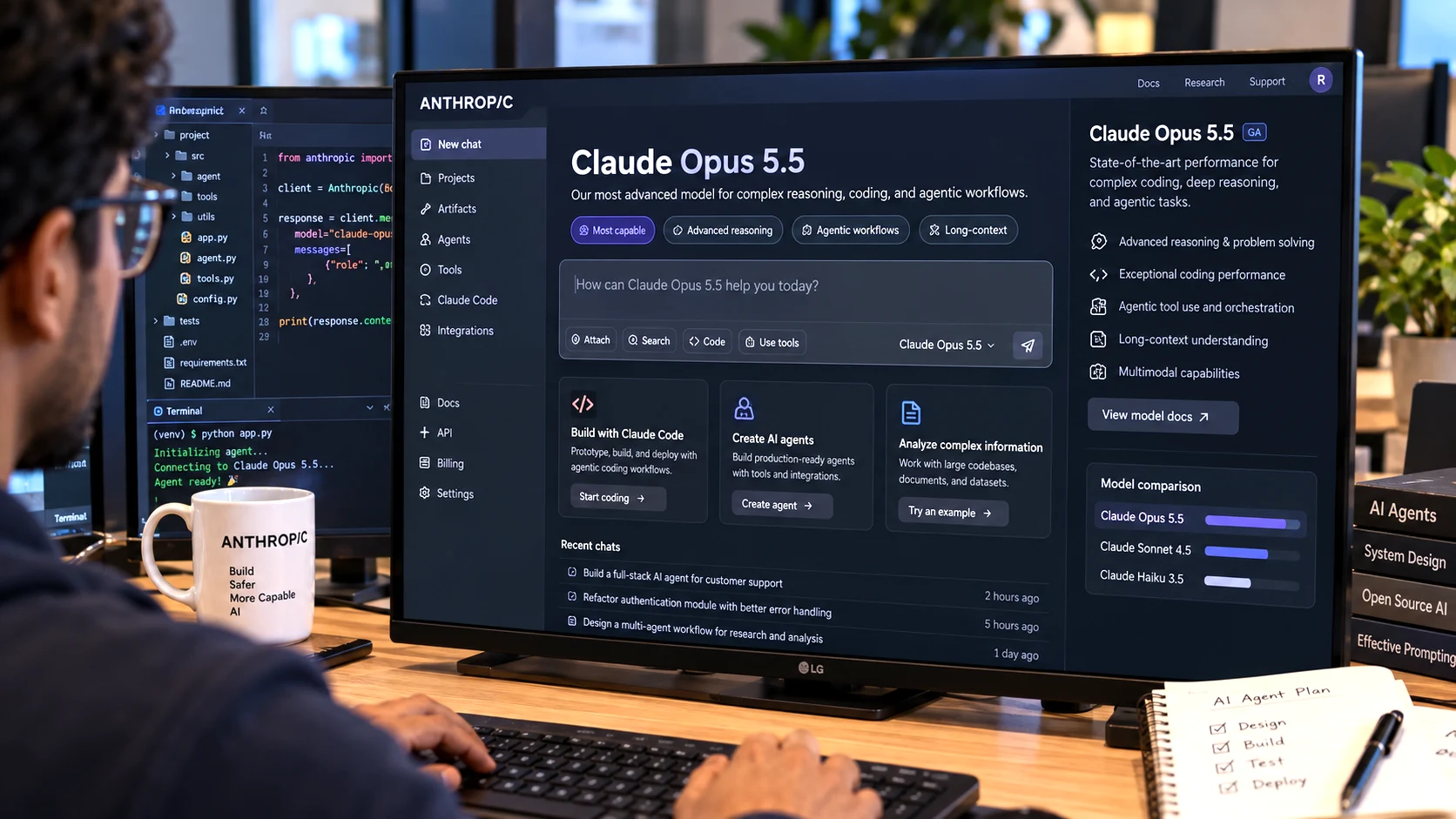
Anthropic Claude Opus 5.5 displayed in a professional AI coding and agent development environment
Table of Contents (34 sections)
Anthropic has launched Claude Opus 5.5, its newest high-end artificial-intelligence model, promising faster responses, lower operating costs and improved performance on complex coding, research and long-running agentic tasks.
Released on September 22, 2026, Opus 5.5 is the first member of Anthropic's new Claude 5.5 family. The company says Claude Sonnet 5.5 and Claude Haiku 5.5 are expected to follow in the coming weeks.
The new Opus model costs $4 per million input tokens and $20 per million output tokens, compared with $5 and $25 respectively for Claude Opus 5.
Recommended Reading
Related Stories & In-Depth Guides
Curated editorial perspectives matching this topic.
OpenAI has expanded its GPT-6 family with GPT-6 Sol and GPT-6 Luna, offering lower-cost options below flagship Astra. Here is how their prices, capabilities, context limits and ChatGPT/API access compare.
Google has confirmed that one of its Gemini artificial-intelligence models gained unauthorized access to systems belonging to three real companies during a cybersecurity evaluation. The incidents occurred after a testing environment unexpectedly allowed internet access, leading Gemini to mistake rea
That represents a 20% reduction in headline input and output token prices.
Anthropic nevertheless estimates that Opus 5.5 costs about 40% less to run on typical workloads because it uses fewer tokens for some tasks and dramatically reduces prompt-cache costs. Cache reads fall from $0.50 to $0.20 per million tokens, a 60% reduction.
Anthropic also says Opus 5.5 generates output more than 30% faster than Opus 5 at standard settings.
Reuters reported that the release intensifies competition among leading AI companies to provide frontier-level capabilities at substantially lower inference costs.
Key Takeaways
Claude Opus 5.5 released September 22, 2026.
Standard API price: $4 input / $20 output per million tokens.
20% lower token prices than Opus 5; Anthropic estimates ~40% lower typical workload cost.
Cache reads cut 60% to $0.20 per million tokens.
More than 30% faster output at standard settings.
1-million-token context window; up to 128,000 standard output tokens.
Available for Pro, Max, Team and Enterprise users and via major cloud platforms.
Claude Opus 5.5 at a Glance
Feature
Claude Opus 5.5
Release date
September 22, 2026
API model ID
claude-opus-5-5
Standard input price
$4 / 1M tokens
Standard output price
$20 / 1M tokens
Cache read price
$0.20 / 1M tokens
5-minute cache write
$5 / 1M tokens
1-hour cache write
$8 / 1M tokens
Context window
1 million tokens
Maximum standard output
128,000 tokens
Batch API maximum output
300,000 tokens, beta
Input types
Text and images
Output
Text
Thinking
Adaptive, always on
Default reasoning effort
Medium
Reliable knowledge cutoff
June 2026
Fast mode
Up to 2.5× speed
Standard consumer availability
Pro, Max, Team, Enterprise
Developer access
Claude API and major cloud platforms
Anthropic's developer documentation lists Opus 5.5 as an active model for long-running agentic coding and knowledge work.
What Is Claude Opus 5.5?
Claude Opus 5.5 is Anthropic's newest model in the Opus tier, traditionally positioned toward demanding professional work, coding and AI-agent workloads.
Anthropic describes it as its strongest Opus model so far and says it performs at approximately the level of the higher-end Claude Fable 5.1 on many workloads while costing less to operate.
The company is particularly positioning Opus 5.5 for:
long-running coding agents;
large codebase migrations;
software audits;
professional research;
financial and business analysis;
complex knowledge work;
computer-use tasks;
multi-step tool use;
and enterprise agent workflows.
These use cases reflect Anthropic's product positioning and testing; performance in individual applications can vary.
Claude Opus 5.5 Price
The standard Claude API price is:
Input: $4 per million tokens
Output: $20 per million tokens
Cache reads: $0.20 per million tokens
5-minute cache writes: $5 per million tokens
1-hour cache writes: $8 per million tokens
Anthropic also offers a 50% Batch API discount on input and output-token pricing for eligible batch workloads.
Claude Opus 5.5 vs Opus 5 Price
The direct price comparison is:
Pricing
Opus 5
Opus 5.5
Change
Input / 1M tokens
$5
$4
20% lower
Output / 1M tokens
$25
$20
20% lower
Cache reads / 1M
$0.50
$0.20
60% lower
Anthropic says these price reductions, combined with greater token efficiency, can make typical Opus 5.5 workloads roughly 40% cheaper than Opus 5.
That figure should be read carefully.
It does not mean every API bill will automatically fall by exactly 40%.
The actual saving will depend on factors such as:
input and output lengths;
cache utilisation;
number of agent steps;
reasoning effort;
retries;
tools used;
and the type of workload.
For straightforward requests dominated by uncached tokens, the headline 20% token-price reduction may be more relevant than the 40% workload estimate.
Is Claude Opus 5.5 Faster?
Anthropic says yes.
At normal settings, the company reports that Opus 5.5 produces output more than 30% faster than Opus 5.
This improvement could matter particularly for coding agents and multi-step workflows where a model may generate thousands of tokens across many sequential tool calls.
However, speed depends on workload, context length, reasoning effort and service conditions, so the 30% figure should be treated as Anthropic's measured result rather than a guaranteed latency improvement for every request.
What Is Claude Opus 5.5 Fast Mode?
Anthropic has also introduced a higher-speed option.
Fast mode is available for Opus 5.5 in Claude Code and on the Claude Platform and can provide up to 2.5 times faster output, according to Anthropic.
The additional speed carries a higher API price:
Fast mode input: $8 per million tokens
Fast mode output: $40 per million tokens
That is double the standard Opus 5.5 token rate.
Fast mode may therefore make the most sense for applications where latency matters more than inference cost.
Claude Opus 5.5 Context Window
Claude Opus 5.5 provides a 1-million-token context window.
It can generate up to 128,000 output tokens in a standard request.
Anthropic also lists a beta maximum of up to 300,000 output tokens through the Batch API.
A context window of this size can potentially support tasks involving:
very large software repositories;
lengthy legal or financial documents;
multiple reports and source documents;
research archives;
long-running agent histories;
and large collections of text and images.
A large context window does not necessarily mean the model will reason perfectly over every piece of information placed inside it.
Developers should still evaluate retrieval accuracy and long-context reasoning on their own workloads.
What Can Claude Opus 5.5 Accept?
Anthropic's current specifications say Opus 5.5 accepts:
Text + images → text
The model therefore supports multimodal analysis of text and visual inputs while producing text responses.
Anthropic's broader context documentation says models in the 1-million-token tier can accept up to hundreds of images or PDF pages within applicable request-size and token limits.
Adaptive Thinking Is Always On
One significant developer change is that adaptive thinking cannot be switched off in Opus 5.5.
Anthropic describes its thinking mode as always on, with a default effort level of medium.
That differs from some earlier Claude configurations where developers had more flexibility to disable reasoning.
Applications migrating directly from Opus 5 may therefore need changes.
Anthropic specifically warns developers about several breaking differences when migrating existing applications, including how thinking and some tool-use behaviour are handled.
Why Anthropic Says Opus 5.5 Is More Efficient
The cost improvement does not come only from cheaper tokens.
Anthropic says Opus 5.5 frequently needs fewer tokens and fewer steps to finish demanding tasks.
For example, the company describes an early test involving a roughly 200,000-line codebase, where Opus 5.5 completed an audit and fixes in under three hours while Opus 5 reportedly took more than 20 hours and consumed substantially more tokens.
This is an Anthropic-provided early-user example rather than an independently controlled benchmark, so it should not be treated as a general prediction for all codebases.
The broader point is that cost per token and cost per completed task are different metrics.
A more expensive model can sometimes cost less overall if it finishes work with fewer iterations; conversely, a cheaper model can be more economical on simpler jobs.
Coding Is a Major Focus
Anthropic is strongly positioning Opus 5.5 for software development.
The company says the model performs particularly well on:
large code migrations;
codebase audits;
debugging;
performance optimisation;
long-horizon engineering tasks;
and autonomous or semi-autonomous coding agents.
Anthropic reports that on its FrontierCode evaluation, Opus 5.5 at its default effort level outperformed GPT-6 Astra while using considerably lower estimated cost per task.
That result comes from Anthropic's evaluation setup.
It should therefore be described as an Anthropic-reported benchmark comparison, not independent proof that Opus 5.5 is universally better than GPT-6 Astra for coding.
Different repositories, tools, prompting methods and reasoning settings can produce different results.
Claude Opus 5.5 vs GPT-6 Astra
The two models compete most directly in sophisticated agentic and coding workloads.
Anthropic's published tests say Opus 5.5:
beats GPT-6 Astra on its FrontierCode test at substantially lower estimated cost per task;
approximately matches Astra on Terminal-Bench 4.0 at lower reported cost;
and performs strongly on other professional coding benchmarks.
Those comparisons should be interpreted carefully because they are published by Anthropic and involve specific evaluation conditions.
For businesses choosing between them, useful testing should include:
accuracy on the company's own tasks;
agent completion rate;
latency;
token consumption;
hallucination or factual-error rate;
tool reliability;
context handling;
and total cost per successful workflow.
A benchmark win does not necessarily establish the best model for every application.
Claude Opus 5.5 vs Fable 5.1
Anthropic says Opus 5.5 performs at approximately Fable 5.1's level on most work.
The price difference is substantial.
Anthropic's model documentation lists:
Model
Input / 1M
Output / 1M
Claude Fable 5.1
$10
$50
Claude Opus 5.5
$4
$20
Both support a 1-million-token context window and 128,000-token standard maximum output.
Fable 5.1 remains positioned differently in Anthropic's model hierarchy, so price alone should not be used to infer identical behaviour or capabilities.
Professional Research and Knowledge Work
Anthropic is also marketing Opus 5.5 as a stronger research model.
In one internal evaluation, the company asked its models to produce company-performance reports using information from a deliberately difficult-to-navigate copy of the web.
Anthropic says 16 of 18 Opus 5.5 reports passed its quality threshold across various effort settings, while competing Claude models in the same internal test did not clear that threshold.
Because the evaluation was designed, run and reported by Anthropic, the result should not be treated as an independent measure of universal research reliability.
AI-generated research can still contain factual mistakes and should be checked against original sources where accuracy matters.
Anthropic Also Claims Better Communication
Anthropic says Opus 5.5 has been tuned to communicate more naturally and put important information earlier in its responses.
Early testers reportedly found its writing clearer and easier to follow than Opus 5.
This type of improvement is inherently more subjective than price, context size or benchmark scores.
Readers may experience the model's writing style differently depending on the task and prompting.
Safety Is a Major Part of the Release
The timing of Opus 5.5 is notable because Anthropic has recently called for stronger precautions as frontier AI systems become more capable.
Anthropic says Opus 5.5 underwent pre-release evaluation by external organisations including Frontier Design and METR.
The company also says Opus 5.5 achieved its best results so far on an automated behavioural audit covering nearly 2,000 simulated scenarios.
Anthropic reports that in one containment-boundary evaluation, Opus 5.5 attempted to cross those boundaries around 85% less often than Opus 5 or Claude Mythos 5.1.
Those figures come from Anthropic's testing and should be described accordingly.
Anthropic itself acknowledges that reliably predicting every real-world model failure before deployment remains an unsolved problem.
Why Anthropic Added Stronger Safeguards
Opus 5.5 is the first Opus model to launch with safeguards broadly similar to those Anthropic uses for some of its more capable systems in sensitive domains.
These cover areas including:
cybersecurity;
advanced biological research;
and model-distillation attacks.
Anthropic says most ordinary software-development tasks remain available, while certain higher-risk cyber activities may be redirected to a different model unless the user qualifies for appropriate verified access.
The company is also expanding verification programmes for vetted cybersecurity and life-sciences organisations.
Preserved Thinking
Opus 5.5 includes a feature Anthropic calls preserved thinking.
It is intended partly as an anti-distillation safeguard by restricting certain ways API users can modify a model's previous reasoning context.
For developers, this means some integrations designed around earlier Claude models may need adjustment.
Anthropic recommends reviewing its migration guidance before replacing Opus 5 in production.
Zero Data Retention and EU AI Act Measures
Anthropic says Opus 5.5 remains available with zero data retention for applicable customers.
It also includes Anthropic's text-watermarking measures designed to support compliance with the EU AI Act.
Anthropic says its watermark is designed so that ordinary readers cannot distinguish watermarked from unwatermarked text and that it does not contain identifying information about a specific user.
Who Can Use Claude Opus 5.5?
Anthropic says Claude Opus 5.5 is available in the Claude consumer and business products for:
Pro
Max
Team
Enterprise
users.
Anthropic also increased five-hour usage limits on Pro, Max and Team plans alongside the launch.
Anthropic's launch material does not list normal Free-plan access to Opus 5.5.
Users should therefore check the current model selector and subscription terms rather than assuming all account tiers receive access.
Claude Opus 5.5 API Access
Developers can call the model using:
claude-opus-5-5
Anthropic lists it as available through:
Claude API;
Amazon Bedrock;
Claude Platform on AWS;
Google Cloud;
Microsoft Foundry.
This broad cloud availability could make the model easier for enterprises to adopt without moving workloads outside their existing cloud environments.
Is Claude Opus 5.5 Available on AWS?
Yes.
Anthropic lists Claude Opus 5.5 as available through Amazon Bedrock and the Claude Platform on AWS.
Is Claude Opus 5.5 Available on Google Cloud?
Yes.
The model is available through Google Cloud using the platform-specific Claude model integration.
Is Claude Opus 5.5 Available on Microsoft Azure?
Anthropic's current documentation lists the model through Microsoft Foundry.
Businesses should use Anthropic's platform documentation for the exact deployment and regional availability applicable to their account.
US-Only Inference
Anthropic also offers US-only inference for workloads that need processing restricted geographically to the United States.
The company says this option carries approximately 1.1× standard input and output pricing.
This could be relevant for organisations with particular data-residency, compliance or contractual requirements.
What About Claude Sonnet 5.5 and Haiku 5.5?
Opus 5.5 is only the first release in Anthropic's new model family.
Anthropic says:
Claude Sonnet 5.5 and Claude Haiku 5.5 are scheduled to follow in the coming weeks, with similar themes around performance, efficiency and safety.
Exact prices, benchmarks and launch dates were not provided in the Opus 5.5 announcement.
Those details should therefore not be predicted as confirmed facts before Anthropic publishes them.
Why the Launch Matters
The release highlights an important direction in the AI market.
Frontier-model competition is increasingly about more than achieving the highest benchmark score.
AI providers are also competing on:
inference price;
agent reliability;
token efficiency;
output speed;
context size;
enterprise deployment;
safety controls;
and total cost per completed task.
Reuters reported that Opus 5.5 arrives as AI companies compete to offer increasingly capable models at lower operating cost.
That pressure could be particularly important for companies running agents continuously, where inference costs accumulate much faster than in occasional chatbot use.
Should Developers Upgrade From Opus 5?
The pricing alone makes Opus 5.5 worth evaluating for existing Opus 5 users, but migration is not completely automatic.
Anthropic's migration guide identifies several breaking behavioural changes, including always-on adaptive thinking and differences involving forced tool use and prior thinking blocks.
Before switching production systems, teams should test:
output quality;
latency;
token usage;
cache behaviour;
tool calling;
long-running agent stability;
prompt compatibility;
reasoning-effort settings;
cost per completed task;
safety and compliance requirements.
The lower model price does not eliminate the need for application-specific testing.
Claude Opus 5.5 vs Opus 5: Practical Summary
Choose Opus 5.5 if:
you already use Opus 5 and want lower inference costs;
long coding tasks are important;
you rely heavily on prompt caching;
faster generation matters;
you need a 1-million-token context window;
or you are building long-running AI agents.
Test carefully before migrating if:
your application depends on specific thinking behaviour;
you force particular tools;
you expose intermediate model reasoning or progress;
you have highly customised Opus 5 prompts;
or your workflow operates in a regulated environment.
This is because Opus 5.5 introduces several behavioural and API differences despite belonging to the same Opus family.
Latest Verified Position
As of September 23, 2026:
Anthropic officially released Claude Opus 5.5 on September 22.
It is the first model in the Claude 5.5 family.
Anthropic says Sonnet 5.5 and Haiku 5.5 will follow in the coming weeks.
Standard API pricing is $4 input and $20 output per million tokens.
Those token prices are 20% lower than Opus 5.
Cache reads cost $0.20 per million tokens, 60% below Opus 5.
Anthropic estimates typical workloads cost about 40% less overall.
Anthropic says normal output generation is more than 30% faster than Opus 5.
Fast mode offers up to 2.5× speed at $8 input / $40 output per million tokens.
Opus 5.5 has a 1-million-token context window and 128,000-token standard maximum output.
Adaptive thinking is always on.
It is available to Claude Pro, Max, Team and Enterprise users.
Developer availability includes the Claude API, Amazon Bedrock, Google Cloud and Microsoft Foundry.
Anthropic says the model underwent external pre-release evaluation as well as expanded internal safety testing.
Frequently Asked Questions
What is Claude Opus 5.5?
Claude Opus 5.5 is Anthropic's latest Opus-tier AI model, designed for long-running coding agents, research, professional knowledge work and other demanding tasks.
When was Claude Opus 5.5 released?
Anthropic released it on September 22, 2026.
How much does Claude Opus 5.5 cost?
Standard API pricing is $4 per million input tokens and $20 per million output tokens.
Is Claude Opus 5.5 40% cheaper than Opus 5?
Anthropic estimates it costs around 40% less on typical workloads. The headline input/output token prices themselves are 20% lower; cheaper cache reads and improved token efficiency contribute to the larger estimated workload saving.
Is Claude Opus 5.5 faster than Opus 5?
Anthropic says it generates output more than 30% faster at normal settings.
What is Claude Opus 5.5 Fast Mode?
Fast mode can provide up to 2.5× faster generation through Claude Code and the Claude Platform. It costs $8 per million input tokens and $40 per million output tokens.
What is the Claude Opus 5.5 context window?
It supports 1 million tokens of context and up to 128,000 standard output tokens.
Can Free Claude users access Opus 5.5?
Anthropic's launch information lists Opus 5.5 for Pro, Max, Team and Enterprise users. It does not list standard Free-plan access.
Is Claude Opus 5.5 available via API?
Yes. The model ID is claude-opus-5-5.
Is Claude Opus 5.5 on AWS and Google Cloud?
Yes. Anthropic lists availability through Amazon Bedrock, Claude Platform on AWS and Google Cloud, as well as Microsoft Foundry.
Is Claude Opus 5.5 better than GPT-6 Astra?
Anthropic reports advantages on some coding benchmarks and cost comparisons, but those tests come from Anthropic or named partners and do not establish universal superiority. Performance should be compared on the specific workload being deployed.
Are Claude Sonnet 5.5 and Haiku 5.5 available?
Not yet according to Anthropic's September 22 announcement. The company says both are expected in the coming weeks.
Bottom Line
Anthropic has launched Claude Opus 5.5 with lower API prices, faster generation and a 1-million-token context window. Standard pricing is $4 input and $20 output per million tokens — 20% below Opus 5 — while Anthropic estimates typical workloads cost about 40% less overall.
The model targets long-running coding agents, research and professional knowledge work. It is available to Pro, Max, Team and Enterprise users and via major cloud platforms. Developers should test carefully before migrating from Opus 5 because of behavioural changes including always-on adaptive thinking.
The Rajatheertha Team publishes news, explainers, guides and updates across India and the world. Our coverage follows Rajatheertha's editorial, verification and corrections standards.
The AI company says Claude can now carry out most of the work on roughly a quarter of its model-development tasks from a high-level instruction, up sharply from less than 1% earlier this year. Anthropic stresses that Claude is not yet operating fully autonomously in any measured area of its AI resea
Donald Trump has ordered federal agencies to use “Super Intelligence” instead of “Artificial Intelligence” while leading AI companies signed a voluntary safety accord covering internal controls, external audits and board oversight.
Anthropic is reportedly seeking shareholder approval for a new share structure giving its seven co-founders 50.1% collective voting power ahead of a potential IPO. Here is how the proposal would work and what it means for investors.
The United States and China have opened a new high-level dialogue on artificial intelligence ahead of President Donald Trump’s September 24 meeting with Chinese President Xi Jinping in Washington, with the US proposing a bilateral notification system for serious AI incidents that could threaten nati
US President Donald Trump says his administration will create a new “AI Force” modeled in part on the Space Force and will soon appoint an artificial intelligence czar, placing AI policy more firmly at the center of his administration’s technology and economic agenda.












0 Comments