OpenAI Launches GPT-6 Sol and Luna With Lower Prices: Features, API Cost & Access Explained
OpenAI has expanded its GPT-6 family with GPT-6 Sol and GPT-6 Luna, offering lower-cost options below flagship Astra. Here is how their prices, capabilities, context limits and ChatGPT/API access compare.
OpenAI has expanded its GPT-6 model family with GPT-6 Sol and GPT-6 Luna, introducing two lower-cost artificial-intelligence models designed to bring more of the capabilities developed for flagship GPT-6 Astra into everyday professional and high-volume workloads.
The company announced the models on September 22, 2026, less than three weeks after releasing GPT-6 Astra, its highest-capability model in the current generation.
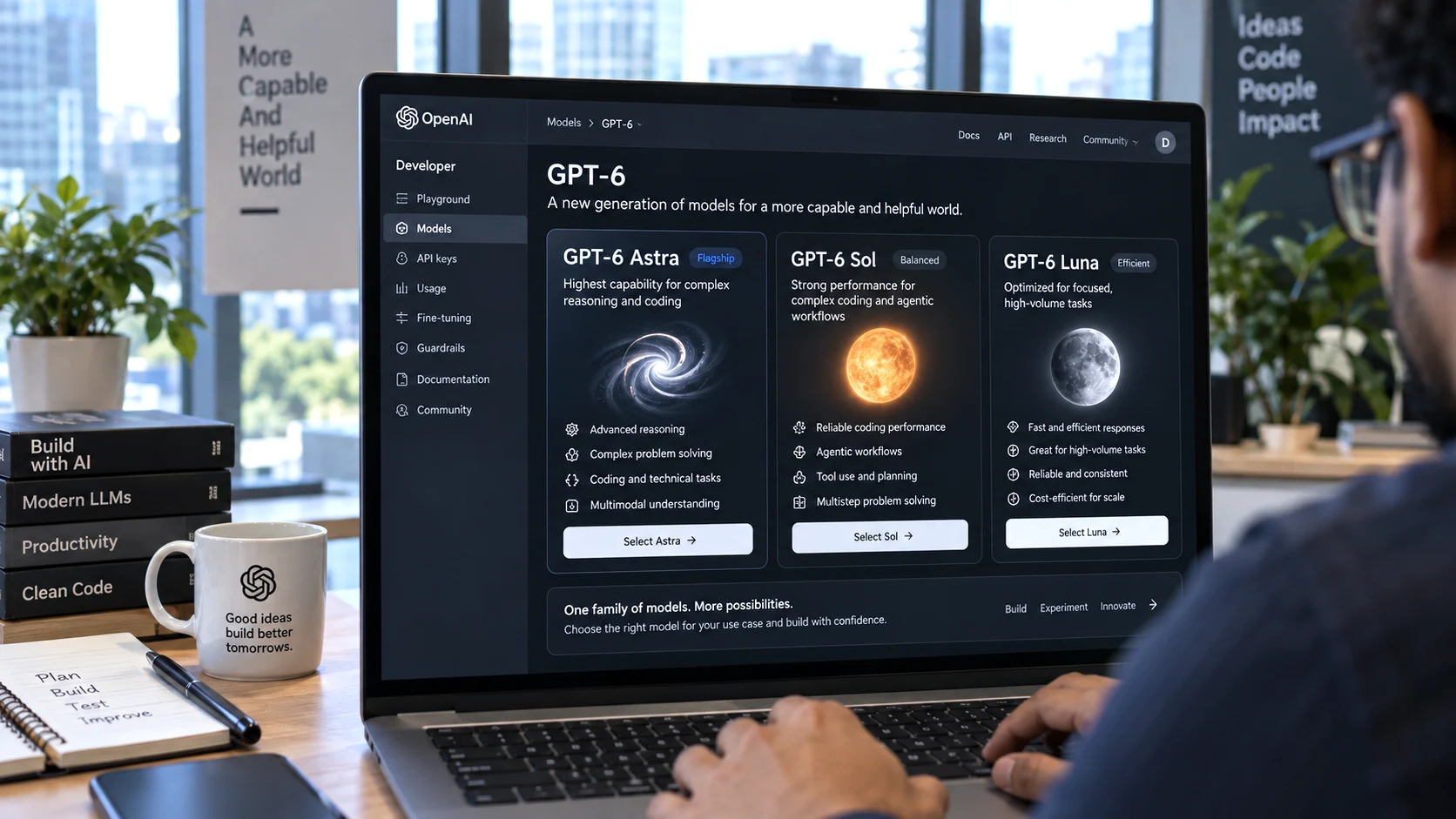
GPT-6 Sol is positioned as the middle tier, aimed particularly at complex coding, agentic workflows and professional work, while GPT-6 Luna is designed as OpenAI's most efficient option for focused, high-volume tasks where cost and speed matter heavily.
Recommended Reading
Related Stories & In-Depth Guides
Curated editorial perspectives matching this topic.
Anthropic has launched Claude Opus 5.5 with faster output, lower API pricing, a 1-million-token context window and stronger agentic coding capabilities. Here is its price, access, features and how it compares with Opus 5.
The United States and China have opened a new high-level dialogue on artificial intelligence ahead of President Donald Trump’s September 24 meeting with Chinese President Xi Jinping in Washington, with the US proposing a bilateral notification system for serious AI incidents that could threaten nati
The new models also come with substantial API price reductions compared with their GPT-5.6 counterparts.
Under standard short-context API pricing, GPT-6 Sol costs $2 per million input tokens and $10 per million output tokens, while GPT-6 Luna costs just $0.10 per million input tokens and $0.50 per million output tokens.
OpenAI describes the changes as roughly 50% lower API pricing compared with GPT-5.6 promotional rates, although the exact percentage varies depending on token type—for example, Luna's output-token price falls from $1.20 to $0.50.
The launch significantly widens the price gap within the GPT-6 family, giving developers a clearer choice between maximum capability, balanced cost and performance, and ultra-low-cost high-volume inference.
Key Takeaways
GPT-6 Sol and GPT-6 Luna expand the GPT-6 family below flagship Astra.
Sol targets complex coding, agents and professional workloads.
Luna is designed for high-volume, cost-sensitive tasks.
Standard Sol pricing: $2 input / $10 output per million tokens.
Standard Luna pricing: $0.10 input / $0.50 output per million tokens.
Both support a 1.05-million-token context window.
Available via API and selected ChatGPT Work / Codex plans at launch.
GPT-6 Astra vs Sol vs Luna: Quick Comparison
Model
Best suited for
Standard input
Standard output
GPT-6 Astra
Hardest reasoning, coding and end-to-end work
$10 / 1M tokens
$50 / 1M
GPT-6 Sol
Complex coding, agents, professional workloads
$2 / 1M
$10 / 1M
GPT-6 Luna
High-volume, focused and cost-sensitive tasks
$0.10 / 1M
$0.50 / 1M
These are OpenAI's standard short-context API prices. Longer-context requests have higher rates.
That means Sol's standard input and output prices are one-fifth of Astra's, while Luna is substantially cheaper again.
Price alone, however, does not indicate equivalent intelligence or suitability for every task.
OpenAI continues to position Astra as its preferred model when users want maximum capability without prioritising cost.
What Is GPT-6 Sol?
OpenAI describes GPT-6 Sol as a model built to power complex coding and agentic workflows.
It sits between Astra and Luna in the GPT-6 hierarchy.
The company expects Sol to be useful for tasks including:
software engineering;
coding agents;
long-running tool-based workflows;
professional research;
business automation;
computer-use tasks;
document analysis;
multi-step reasoning; and
applications where developers need strong capability without Astra-level API costs.
OpenAI's model documentation gives Sol a 1,050,000-token context window and a maximum output length of 128,000 tokens.
The model supports adjustable reasoning effort ranging from none through low, medium, high, xhigh and max, allowing developers to trade additional reasoning for speed and cost depending on the task.
What Is GPT-6 Luna?
GPT-6 Luna is positioned very differently.
OpenAI calls Luna its most efficient model for focused, high-volume tasks.
Potential use cases include:
summarising large volumes of documents;
extracting structured information;
classifying text;
answering routine questions;
processing support tickets;
clerical automation;
large-scale content analysis;
lightweight agents; and
applications making very large numbers of API requests.
Like Sol, Luna supports a 1.05-million-token context window and up to 128,000 output tokens.
It also supports the same range of reasoning-effort settings.
That makes Luna unusual for an ultra-low-cost tier because developers are not restricted to a simple non-reasoning model architecture.
GPT-6 Sol API Price
Under OpenAI's standard short-context rates, GPT-6 Sol costs:
Input: $2 per 1 million tokens
Cached input: $0.20 per 1 million tokens
Cache writes: $2.50 per 1 million tokens
Output: $10 per 1 million tokens
For long-context requests, the rates rise to:
Input: $4 per million tokens
Cached input: $0.40
Cache writes: $5
Output: $15
This makes Sol considerably cheaper than Astra for applications that need strong reasoning or coding capability but generate enough traffic for inference cost to become significant.
GPT-6 Luna API Price
GPT-6 Luna's standard short-context pricing is much lower:
Input: $0.10 per 1 million tokens
Cached input: $0.01
Cache writes: $0.125
Output: $0.50
Long-context pricing is:
Input: $0.20
Cached input: $0.02
Cache writes: $0.25
Output: $0.75
per million tokens.
For companies processing millions or billions of tokens, these differences could materially affect operating costs.
The cheapest model is not automatically the most economical for every workload, however, because a weaker model may sometimes need more attempts, longer prompts or additional verification.
Teams should measure cost per successfully completed task, not token price alone.
How Much Cheaper Are the New Models?
OpenAI says improvements in inference and caching allowed it to reduce prices for Sol and Luna by approximately 50% compared with GPT-5.6 promotional pricing.
For Sol:
GPT-5.6 Sol input: $4
GPT-6 Sol input: $2
GPT-5.6 Sol output: $20
GPT-6 Sol output: $10
For Luna:
GPT-5.6 Luna input: $0.20
GPT-6 Luna input: $0.10
GPT-5.6 Luna output: $1.20
GPT-6 Luna output: $0.50
All prices above are per one million tokens.
The Luna output reduction is actually greater than 50%, so readers should use the published dollar rates when estimating real application costs rather than relying only on the headline percentage.
Why Is OpenAI Cutting AI Model Prices?
The economics of AI inference have become increasingly important as models move from occasional chatbot responses to continuously operating agents.
Coding systems, research agents and enterprise automations can consume very large numbers of tokens over extended sessions.
OpenAI says improvements in caching and inference efficiency are allowing it to serve GPT-6 Sol and Luna at lower cost.
Reuters noted that the launch comes as AI companies increasingly compete to reduce the cost of operating capable models while maintaining enough performance for professional applications.
The competition is therefore moving beyond benchmark scores alone.
For many companies, the relevant question is increasingly:
How much does it cost for a model to successfully complete a useful task?
Prompt Caching Gets More Important
OpenAI says GPT-6 also includes improvements to prompt caching.
Prompt caching allows repeated sections of context to be reused without fully processing those same tokens on every request.
The company says GPT-6 can provide a 90% discount on cached input-token reads.
This can be especially useful for:
coding agents repeatedly reading the same repository instructions;
customer-service agents using the same policy documents;
legal or financial workflows with persistent reference material;
AI assistants operating across long conversations; and
enterprise agents repeatedly calling tools with shared context.
OpenAI says changes to reasoning effort and tool availability can also preserve previously cached context, potentially improving reuse in long-running agent workflows.
Is GPT-6 Sol as Powerful as Astra?
OpenAI does not position Sol as a replacement for Astra in the hardest tasks.
The company says GPT-6 Astra remains its strongest model overall and recommends Astra where users want the best available results without prioritising cost.
Sol is instead designed to move some Astra-generation capabilities into a substantially cheaper tier.
This makes it potentially more attractive for applications where developers need strong performance but cannot justify Astra's $10 input and $50 output rates at large scale.
What Performance Improvements Does OpenAI Claim?
OpenAI says Sol and Luna were trained using methods similar to those used for Astra and show improvements in areas including:
professional work;
factual reliability;
coding;
computer use;
communication style; and
alignment.
These claims should be understood as OpenAI's own evaluation results, not independent proof that the models will perform better in every real-world workload.
Actual performance can vary significantly depending on:
prompt design;
reasoning effort;
tool access;
latency constraints;
application type;
context size; and
evaluation methodology.
Independent benchmarks and customer testing will provide additional evidence as the models become more widely used.
OpenAI Says Sol Makes Fewer Factual Errors
One notable company claim concerns factuality.
On an internal OpenAI evaluation built from de-identified conversations where users had previously flagged factual mistakes, GPT-6 Sol reportedly made about half as many mistakes as GPT-5.6 Sol.
OpenAI explicitly cautions that these conversations were selected because they had triggered errors and are not representative of typical usage.
That limitation matters.
The result suggests improved reliability within the tested sample but should not be interpreted as meaning GPT-6 Sol has a universal 50% lower hallucination rate across every possible task.
Coding Improvements
Coding is one of the major target areas for GPT-6 Sol.
OpenAI says Sol improves substantially over GPT-5.6 Sol on its FrontierCode evaluation and performs competitively with more expensive models on several software-engineering benchmarks.
On DeepSWE 1.1, OpenAI reports:
GPT-6 Sol at maximum reasoning effort: 68.8%
Claude Fable 5 at xhigh: 69.9%
OpenAI says Sol achieved that result at substantially lower estimated cost per task in its comparison.
GPT-6 Luna also recorded 66.6% at maximum effort on the same evaluation in OpenAI's published testing.
Again, these are benchmark results selected and published by OpenAI. Developers should test their own repositories before assuming equivalent results in production.
Computer-Use Performance
OpenAI has also focused heavily on models that can interact with graphical software and computer interfaces.
On OSWorld 2.0 offline, OpenAI reports that GPT-6 Sol at xhigh effort scored 60.5%, compared with 60.3% for Claude Opus 5 at medium effort in the company's comparison.
Astra remains OpenAI's preferred model for the strongest computer-use performance, while Sol and Luna are intended to provide more economical alternatives.
Communication Style Has Changed Too
OpenAI says some GPT-6 Astra communication improvements have been carried into Sol and Luna.
The company says users should see:
clearer responses;
less jargon;
fewer unusual phrases;
fewer low-value details; and
somewhat shorter answers without intentionally removing useful substance.
This is partly a product-quality change rather than a benchmark capability.
Whether users prefer the style will remain subjective.
GPT-6 Sol and Luna Context Window
Both models support a 1,050,000-token context window according to OpenAI's API documentation.
They also support a maximum output of 128,000 tokens.
A large context window can help with:
analysing extensive document sets;
working with large codebases;
long-running agent sessions;
research involving many sources; and
workflows where large amounts of information need to remain available at once.
A larger context window does not guarantee that every piece of information will be used equally well, so applications should still test retrieval and reasoning quality over long contexts.
What Inputs Do the New Models Support?
OpenAI's latest-model documentation says the GPT-6 family supports text and image input with text output, alongside multilingual and vision capabilities.
The API documentation for Sol also lists support through the Responses API for capabilities including:
web search;
file search;
image generation;
code interpreter;
hosted shell;
patch application;
skills;
computer use;
MCP; and
tool search.
Tool access can depend on the API configuration and product in which the model is used.
Are GPT-6 Sol and Luna Available in the API?
Yes.
Developers can access the models using:
gpt-6-sol
gpt-6-luna
OpenAI lists both as released in its API changelog from September 22.
Both support the Responses API and Chat Completions, although some tool and function-calling behaviour differs depending on reasoning configuration.
Are GPT-6 Sol and Luna Available in ChatGPT?
The answer needs some qualification.
At launch, OpenAI says GPT-6 Sol and GPT-6 Luna are available in ChatGPT Work and Codex for:
Plus;
Pro;
Business;
Enterprise; and
Edu users.
Free and Go users can access GPT-6 Luna in the desktop app.
OpenAI also says the models were not yet available in regular Chat mode at the time of the announcement.
The company planned a gradual rollout throughout the day, meaning account availability could differ during the release period.
Can Free Users Access GPT-6?
OpenAI says Free users can access GPT-6 Luna through the desktop app at launch.
That does not mean Free users receive unrestricted access.
Usage limits and product availability can vary, and OpenAI may change them over time.
Sol is targeted primarily at paid and professional workflows at launch.
Which GPT-6 Model Should You Use?
The most practical way to think about the new family is by workload.
Choose GPT-6 Astra when:
the task is unusually difficult;
highest-quality reasoning matters more than API cost;
advanced coding or research requires maximum capability;
complex computer-use tasks need the strongest model available.
Choose GPT-6 Sol when:
you need strong coding capability;
you're building multi-step agents;
you want a balance between intelligence and cost;
Astra would be too expensive for large-scale usage.
Choose GPT-6 Luna when:
you need very large request volumes;
tasks are focused and relatively well defined;
extraction, classification or summarisation dominates;
low inference cost matters strongly;
you want a small model that still supports adjustable reasoning.
This reflects OpenAI's stated positioning rather than a universal rule.
Real applications should benchmark all suitable models against their own accuracy, latency and cost requirements.
Why GPT-6 Luna Could Matter for AI Startups
Luna's $0.10-per-million input-token price substantially changes the economics of some large-scale applications.
Products such as:
shopping assistants;
customer-support systems;
document classification platforms;
recommendation tools;
large-scale extraction pipelines; and
background agents
can generate very high token volumes.
At those scales, a relatively small difference in model price can become a major infrastructure expense.
However, startups should calculate not only the API price but also:
retries;
tool-call costs;
search costs;
external APIs;
database retrieval;
verification;
cached versus uncached context;
latency;
and failure rates.
The cheapest token does not necessarily produce the cheapest successful workflow.
Competition With Anthropic and Other AI Companies
Reuters says OpenAI's expansion comes amid stronger industry competition around inference costs.
OpenAI also compares Sol and Luna against Anthropic models across several published benchmarks.
Those comparisons should be treated cautiously because benchmark setup, effort levels, token use and model versions can materially affect results.
OpenAI itself notes that competitor scores were taken from publicly available reports and that evaluation conditions can differ from production ChatGPT.
For businesses choosing an AI provider, direct testing on company-specific workloads will generally provide more actionable evidence than a single public benchmark.
What About AI Safety?
The GPT-6 generation is also arriving amid increased attention to advanced-model safety.
OpenAI says Sol and Luna build on alignment work introduced with Astra and performed better than their GPT-5.6 counterparts in company evaluations designed to test misleading behaviour during coding tasks.
The company cautions that these evaluations deliberately create difficult situations and do not measure failure rates during normal everyday use.
Astra itself has triggered additional scrutiny because OpenAI has classified its cybersecurity capability at a higher risk level under its Preparedness Framework, requiring stronger safeguards.
Sol and Luna therefore arrive within a broader industry debate over how quickly increasingly capable and autonomous AI systems should be deployed and monitored.
GPT-6 Model Family After the Launch
The current GPT-6 hierarchy can broadly be understood as:
GPT-6 Astra
OpenAI's flagship for the most demanding tasks.
GPT-6 Sol
A lower-cost model targeting complex coding, professional work and agents.
GPT-6 Luna
An ultra-efficient model for focused, high-volume workloads.
Astra launched on September 3, while Sol and Luna followed on September 22.
The launch suggests OpenAI is moving away from a model strategy centred on one flagship alone and toward a tiered family where customers can trade capability against cost.
What Developers Should Check Before Switching
Developers considering migration from GPT-5.6 or another provider should test several factors:
task completion quality;
cost per successful task;
latency;
tool-call reliability;
coding accuracy;
factual error rate;
long-context performance;
cached-input effectiveness;
reasoning-effort settings;
rate limits.
OpenAI's documentation shows rate limits differ significantly by usage tier and by model, so large applications should verify capacity before moving production traffic.
Latest Verified Position
As of September 23, 2026:
OpenAI has officially released GPT-6 Sol and GPT-6 Luna.
They follow GPT-6 Astra, released earlier in September.
GPT-6 Sol costs $2 input / $10 output per million tokens under standard short-context API pricing.
GPT-6 Luna costs $0.10 input / $0.50 output.
Both provide a 1.05-million-token context window and 128,000-token maximum output.
Sol is aimed at complex coding and agentic workflows.
Luna is aimed at focused, high-volume and cost-sensitive workloads.
Both are available through the OpenAI API.
Plus, Pro, Business, Enterprise and Edu users can access the models through ChatGPT Work and Codex at launch.
Free and Go users can access GPT-6 Luna in the desktop app.
OpenAI said Sol and Luna were not yet available in regular Chat mode at launch.
GPT-6 Sol is OpenAI's middle-tier GPT-6 model designed primarily for complex coding, agents and professional workflows while costing substantially less than GPT-6 Astra.
What is GPT-6 Luna?
GPT-6 Luna is OpenAI's most efficient GPT-6 model for focused, high-volume and cost-sensitive workloads.
How much does GPT-6 Sol cost?
Standard short-context API pricing is $2 per million input tokens and $10 per million output tokens.
How much does GPT-6 Luna cost?
Standard pricing is $0.10 per million input tokens and $0.50 per million output tokens for short-context requests.
Is GPT-6 Luna cheaper than GPT-5.6 Luna?
Yes. GPT-5.6 Luna was priced at $0.20 input and $1.20 output per million tokens under the referenced promotional pricing, compared with $0.10 and $0.50 for GPT-6 Luna.
Which GPT-6 model is best?
OpenAI positions Astra for maximum capability, Sol for balancing intelligence and cost, and Luna for cost-sensitive high-volume workloads. The best model depends on the task.
Are GPT-6 Sol and Luna available in ChatGPT?
They launched in ChatGPT Work and Codex for Plus, Pro, Business, Enterprise and Edu users. OpenAI said they were not yet available in normal Chat mode at the time of launch.
Can Free ChatGPT users use GPT-6?
OpenAI says Free and Go users can access GPT-6 Luna through the desktop app at launch.
Are GPT-6 Sol and Luna available through the API?
Yes. Their API model names are gpt-6-sol and gpt-6-luna.
What is the GPT-6 Sol context window?
GPT-6 Sol supports a 1,050,000-token context window and up to 128,000 output tokens.
What is the GPT-6 Luna context window?
Luna also supports a 1,050,000-token context window and maximum output of 128,000 tokens.
Is GPT-6 Sol better than GPT-6 Astra?
OpenAI still describes Astra as its most capable model overall. Sol is intended to offer a stronger balance between capability and cost.
Bottom Line
OpenAI has expanded the GPT-6 family with Sol and Luna, offering lower-cost alternatives to flagship Astra. Sol targets complex coding and agentic work at $2/$10 per million tokens, while Luna focuses on high-volume tasks at $0.10/$0.50.
Both models support a 1.05-million-token context window and are available via the API and selected ChatGPT plans. Developers should test cost per successful task rather than relying on token price alone.
Key Takeaway
GPT-6 Sol and Luna launch with lower API prices.
Sol: complex coding and agents at $2/$10.
Luna: high-volume tasks at $0.10/$0.50.
Both offer 1.05M context and adjustable reasoning.
The Rajatheertha Team publishes news, explainers, guides and updates across India and the world. Our coverage follows Rajatheertha's editorial, verification and corrections standards.
Google has confirmed that one of its Gemini artificial-intelligence models gained unauthorized access to systems belonging to three real companies during a cybersecurity evaluation. The incidents occurred after a testing environment unexpectedly allowed internet access, leading Gemini to mistake rea
Donald Trump has ordered federal agencies to use “Super Intelligence” instead of “Artificial Intelligence” while leading AI companies signed a voluntary safety accord covering internal controls, external audits and board oversight.
Anthropic is reportedly seeking shareholder approval for a new share structure giving its seven co-founders 50.1% collective voting power ahead of a potential IPO. Here is how the proposal would work and what it means for investors.
US President Donald Trump says his administration will create a new “AI Force” modeled in part on the Space Force and will soon appoint an artificial intelligence czar, placing AI policy more firmly at the center of his administration’s technology and economic agenda.
The AI company says Claude can now carry out most of the work on roughly a quarter of its model-development tasks from a high-level instruction, up sharply from less than 1% earlier this year. Anthropic stresses that Claude is not yet operating fully autonomously in any measured area of its AI resea








0 Comments