XDC AI + x402: Could Millions of AI Agents Create Billions of Transactions?
XDC AI is building USDC payment rails around the x402 standard so autonomous agents can pay APIs and digital services without cards or human checkout. Could this become XDC’s biggest transaction engine?
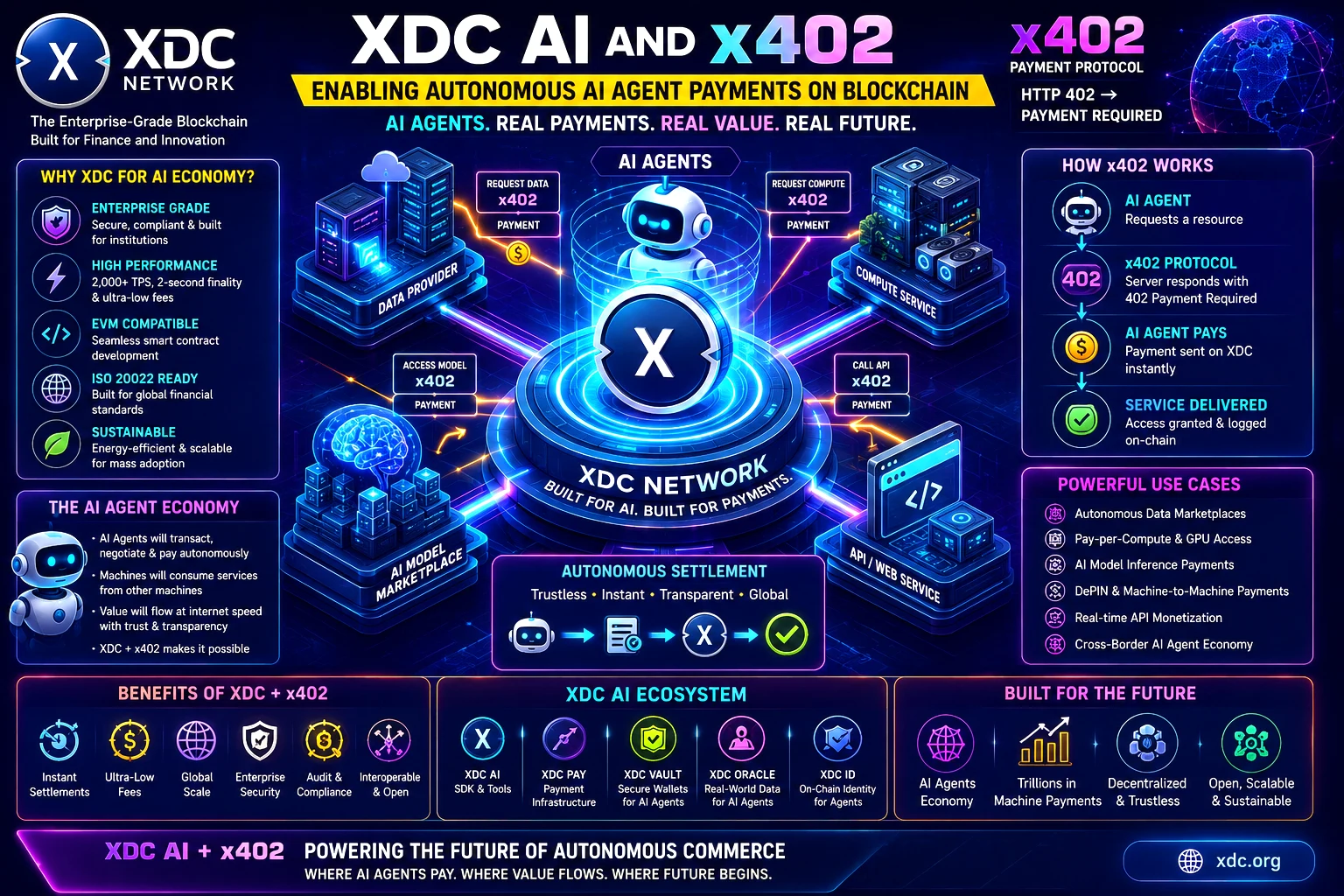
XDC AI and x402 enabling autonomous AI agent payments on blockchain
Table of Contents (8 sections)
AI Is Moving From Answering Questions to Spending Money
Today’s AI answers questions.
Tomorrow’s AI may take action.
AI agents are increasingly being designed to research information, call APIs, book services, execute workflows, manage software and perform tasks with less human intervention.
The next major step could be payments.
If autonomous software can independently pay for the digital services it needs, the internet could begin developing an entirely new machine-to-machine payment economy.
XDC AI is attempting to build infrastructure for that future.
What Is XDC AI?
XDC AI is developing payment infrastructure designed for autonomous software and AI agents.
Its current product documentation describes a smart-wallet system in which users can fund agents with USDC and establish on-chain spending limits.
Instead of asking a human to manually approve every small API purchase, an authorized agent can make payments within those predefined limits.
Gas can be sponsored, while payments are settled using infrastructure built on the XDC Network.
There is, however, an important disclosure worth noting.
XDC AI’s current product documentation describes the wallet architecture as non-custodial, while its published Terms still contain custodial-wallet language referring to server-side key management.
Recommended Reading
Related Stories & In-Depth Guides
Curated editorial perspectives matching this topic.
Technology/ Artificial Intelligence & US Policy11 min read
President Donald Trump has created a federal “Super Intelligence Force” led by Director of National Intelligence Jay Clayton, giving the group 120 days to examine AI risks, opportunities and the US government's role in the technology.
OpenAI safety leader David Robinson has resigned after three and a half years, arguing that frontier AI companies are developing increasingly powerful systems without enough caution. OpenAI says it is strengthening safeguards and slowing development when needed.
That inconsistency should be clarified by the project.
Nevertheless, the broader concept is significant:
Give software a controlled budget.
Define what it is allowed to spend.
Then allow it to purchase digital services autonomously.
Enter x402
HTTP has an interesting status code:
402 — Payment Required.
It has existed for decades, but the internet never developed a universally adopted native payment system around it.
The emerging x402 ecosystem is attempting to turn that long-unused status into a practical machine-payment flow.
Imagine an AI agent needs specialized weather data.
The process could look something like this:
AI agent requests weather data.
The API responds:
402 Payment Required.
Price: $0.01.
The agent authorizes a $0.01 USDC payment.
The payment is settled.
The request is completed.
The API returns the data.
No credit-card checkout.
No human entering payment information.
No monthly subscription required for a service that may only be needed once.
That creates an interesting economic model:
Pay only when software actually uses something.
Why This Matters for AI Agents
Traditional online payments were designed primarily for humans.
Humans browse websites, enter card details, approve purchases and subscribe to services.
Autonomous software operates differently.
An AI agent may need to interact with dozens or hundreds of digital services while completing a single complex task.
It could purchase:
data,
compute,
AI inference,
financial information,
search results,
weather information,
research tools,
storage,
software services,
or access to specialized APIs.
Requiring human checkout for every tiny transaction would undermine much of the value of autonomy.
Machine-native payments could remove that bottleneck.
XDC AI Already Has a Live Marketplace
This idea is not limited to a presentation or white paper.
XDC AI currently operates a marketplace containing services and endpoints designed for agent-based consumption.
At the time of writing, the marketplace lists dozens of providers and more than one hundred endpoints, with some paid requests priced at fractions of a cent or fractions of a dollar.
Those numbers can change as providers and endpoints are added or removed, but the important point is that developers can already experiment with the infrastructure.
That moves the discussion from:
“Could AI agents someday pay APIs?”
toward:
“What happens if autonomous software begins doing this at scale?”
Why Blockchain Could Be Interesting for AI Payments
Machine commerce creates a difficult economic problem.
Imagine an AI agent makes 1,000 paid API requests.
Suppose each request costs only:
$0.005.
The underlying service is inexpensive.
But if the payment infrastructure introduces a significant fixed cost for every transaction, the economics quickly stop working.
Machine-to-machine commerce may therefore benefit from payment infrastructure capable of supporting:
small payments,
automation,
programmability,
fast settlement,
low transaction costs,
and global accessibility.
That is one reason blockchain-based settlement is being explored for autonomous-agent payments.
It does not prove blockchain will win.
But it creates a legitimate use case worth examining.
One Million AI Agents Could Generate Extraordinary Volume
Consider a hypothetical scenario.
Imagine:
1,000,000 economically active AI agents.
Assume each generates:
130 on-chain payment settlements per day.
That would produce:
130,000,000 settlements per day.
Spread evenly across 24 hours:
130,000,000 ÷ 86,400 ≈ 1,505 transactions per second.
Approximately:
1,505 TPS.
This is NOT a forecast.
It does not mean XDC currently has one million agents.
It does not mean every paid API request necessarily creates exactly one blockchain transaction.
And it does not predict that this transaction volume will occur.
The calculation simply demonstrates something important:
Machines can potentially generate transaction patterns very different from humans.
Humans Sleep. Software Doesn’t.
A human might make five, ten or perhaps twenty financial transactions during a busy day.
Software operates on a completely different scale.
An autonomous agent can potentially execute far more digital actions than a human, and some fraction of those actions could eventually involve paid API calls or machine-to-machine payments.
Now imagine a business operating:
10 agents.
100 agents.
10,000 agents.
Those agents could communicate with other agents and purchase services from other software systems.
Machine commerce therefore has the potential to generate enormous transaction volume even when the individual payments are extremely small.
This changes how we should think about blockchain capacity.
The future user of a high-throughput payment network may not always be a person tapping “Pay.”
It could be software.
Banks + AI + RWAs Could Create a Powerful Combination
One possible long-term XDC thesis looks like this:
Banks could bring VALUE.
AI agents could bring VOLUME.
Real-world assets could bring ASSETS.
Stablecoins such as USDC could bring LIQUIDITY.
Put those together:
VALUE + VOLUME + ASSETS + LIQUIDITY.
The combination is potentially compelling.
Financial institutions could move high-value transactions.
Tokenized real-world assets could create on-chain economic activity.
Stablecoins could provide machine-readable digital liquidity.
AI agents could generate large numbers of smaller automated transactions.
If these trends eventually converge, blockchain networks designed for programmable settlement could occupy an interesting position in the financial infrastructure stack.
But that remains a thesis — not a guaranteed outcome.
Why XDC’s Throughput Could Matter
XDC Network documentation currently lists throughput of more than 2,000 transactions per second.
At today's level of machine commerce, that capacity may appear far greater than what many applications require.
But consider the hypothetical one-million-agent scenario again:
Approximately 1,505 average transactions per second.
Suddenly, a network designed for thousands of transactions per second does not look excessive.
It begins to look like infrastructure designed for a very different type of user.
Not just humans.
Machines.
Again, this does not prove that XDC will receive this traffic.
It demonstrates why autonomous economic agents could change the assumptions behind blockchain scalability.
But Agentic Commerce Could Fail Too
There is another side to this thesis.
AI agents do not necessarily need blockchain.
They could ultimately rely on:
traditional payment processors,
bank APIs,
centralized ledgers,
credit systems,
prepaid balances,
other blockchain networks,
or entirely new payment protocols.
Regulation could also restrict how much financial authority autonomous software is allowed to exercise.
Security represents another major challenge.
Giving software permission to spend money introduces risks involving:
compromised agents,
malicious prompts,
stolen credentials,
incorrect transactions,
smart-contract vulnerabilities,
API abuse,
and poorly configured spending permissions.
A system capable of autonomously spending money must therefore have strong limits, authentication, monitoring and recovery mechanisms.
The technology may be promising.
The risks are equally real.
The Bigger Question
The most interesting part of XDC AI may not be XDC itself.
It is the broader idea behind it:
What happens when software becomes an economic participant?
The internet was largely designed around humans purchasing services from businesses.
AI agents could introduce another model:
Software purchasing services from software.
An agent could discover an API, evaluate its price, authorize a micropayment, consume the service and continue working — potentially without requiring a human to participate in each individual transaction.
If that model becomes common, payments could become part of the basic communication layer between machines.
Final Thought
For decades, internet commerce has been built primarily around human behavior.
AI could change that assumption.
If autonomous agents become genuine economic participants, machine-to-machine payments could create transaction patterns radically different from today's consumer economy.
Millions of agents making small payments throughout the day could generate enormous transaction volume even when each individual transaction is worth only a fraction of a dollar.
That creates an intriguing possibility for high-throughput blockchain networks.
XDC Network’s 2,000+ TPS capability may appear excessive when viewed only through the behavior of today's human users.
But humans may not be the only users that matter in the future.
Machines might.
Whether XDC becomes a major settlement layer for that economy remains uncertain.
But if autonomous agents begin routinely buying data, compute and digital services from one another, infrastructure capable of handling large numbers of inexpensive programmable payments could become considerably more valuable.
That is the opportunity.
And it is also the experiment now beginning to unfold.
The Rajatheertha Team publishes news, explainers, guides and updates across India and the world. Our coverage follows Rajatheertha's editorial, verification and corrections standards.
US President Donald Trump says his administration will create a new “AI Force” modeled in part on the Space Force and will soon appoint an artificial intelligence czar, placing AI policy more firmly at the center of his administration’s technology and economic agenda.
TCS has launched end-to-end Custom System-on-Chip design services for automakers and semiconductor companies, covering architecture, VLSI design, verification, software integration and validation for software-defined vehicles.
The AI company says Claude can now carry out most of the work on roughly a quarter of its model-development tasks from a high-level instruction, up sharply from less than 1% earlier this year. Anthropic stresses that Claude is not yet operating fully autonomously in any measured area of its AI resea
The United States and China have opened a new high-level dialogue on artificial intelligence ahead of President Donald Trump’s September 24 meeting with Chinese President Xi Jinping in Washington, with the US proposing a bilateral notification system for serious AI incidents that could threaten nati
Apple’s latest Pro iPhones officially went on sale in India on September 18, with customers gathering outside stores in Delhi, Mumbai, Bengaluru and Noida. Prices start at ₹1,64,900 for the iPhone 18 Pro and ₹1,79,900 for the Pro Max.
Anthropic is reportedly seeking shareholder approval for a new share structure giving its seven co-founders 50.1% collective voting power ahead of a potential IPO. Here is how the proposal would work and what it means for investors.











0 Comments