Nvidia Agrees to Buy Hugging Face for $12.93 Billion, Promises Platform Will Remain Open
Nvidia has agreed to acquire Hugging Face for about $12.93 billion, significantly expanding its AI software presence while promising to keep the developer platform open across chips and clouds.
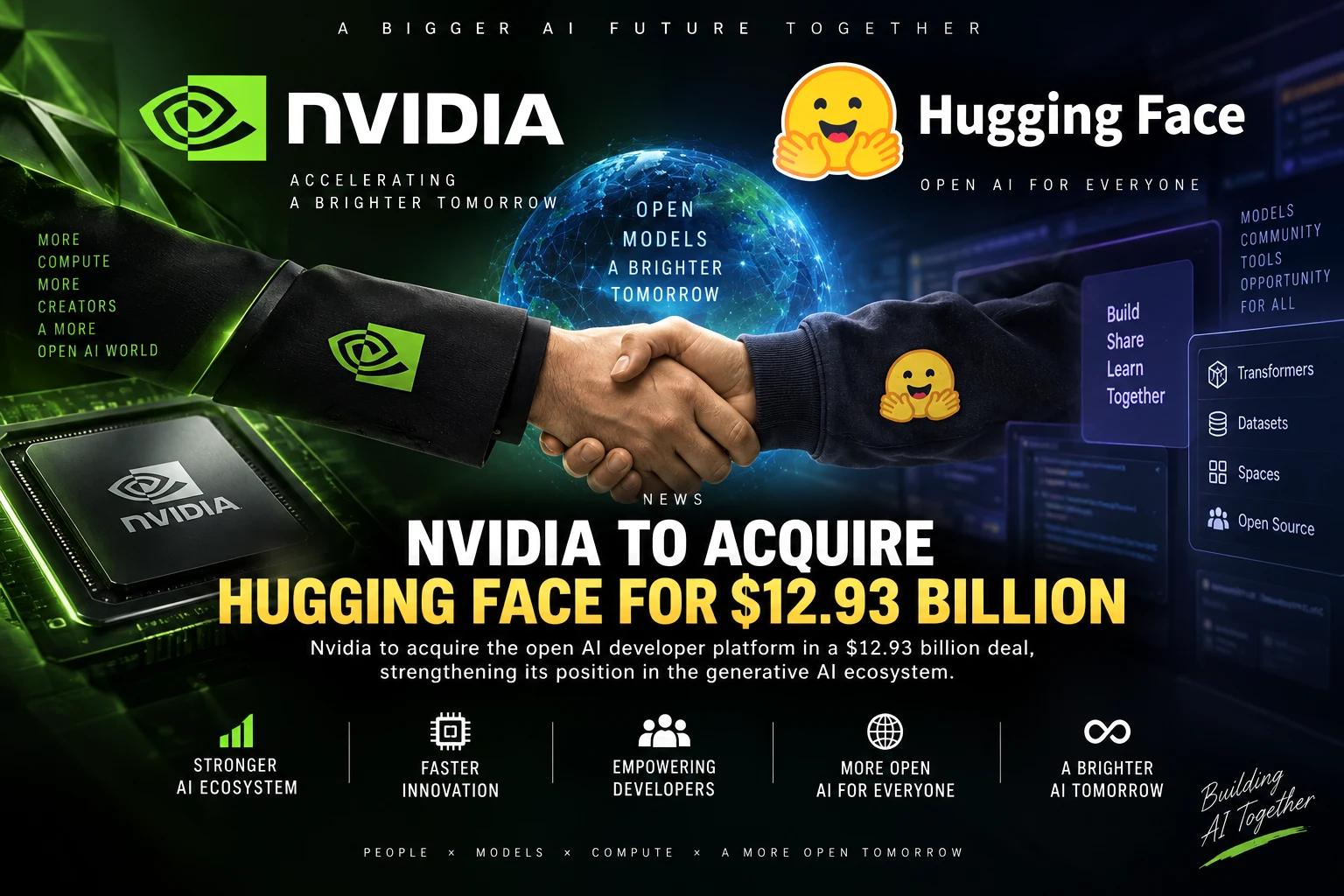
Nvidia and Hugging Face logos representing Nvidia’s $12.93 billion agreement to acquire the open AI developer platform
Table of Contents (16 sections)
Nvidia has agreed to acquire Hugging Face for approximately $12.93 billion, giving the world’s dominant AI-chip company control of one of the most important platforms in the open artificial intelligence ecosystem.
The transaction was announced on 3 September 2026 and confirmed in an official filing with the US Securities and Exchange Commission.
Under the agreement, Nvidia will pay approximately $11.9 billion to Hugging Face stockholders, subject to adjustments, while providing an equity-based retention program worth up to approximately $1 billion for Hugging Face employees who join Nvidia.
The acquisition has not yet been completed.
Nvidia expects the transaction to close during the first half of 2027, subject to regulatory approvals and customary closing conditions.
Perhaps the most important announcement for millions of AI developers is what Nvidia says it will not do.
CEO Jensen Huang has promised that Hugging Face will remain an open platform, continue supporting different cloud providers and computing platforms, and not require developers to use Nvidia hardware.
Recommended Reading
Related Stories & In-Depth Guides
Curated editorial perspectives matching this topic.
US President Donald Trump says his administration will create a new “AI Force” modeled in part on the Space Force and will soon appoint an artificial intelligence czar, placing AI policy more firmly at the center of his administration’s technology and economic agenda.
The AI company says Claude can now carry out most of the work on roughly a quarter of its model-development tasks from a high-level instruction, up sharply from less than 1% earlier this year. Anthropic stresses that Claude is not yet operating fully autonomously in any measured area of its AI resea
If those commitments are maintained after closing, developers should continue to be able to use Hugging Face with competing accelerators and infrastructure.
Table of Contents
What Nvidia has agreed to buy
How the $12.93 billion deal works
Why Hugging Face matters
Nvidia promises to keep Hugging Face open
Will developers be forced to use Nvidia GPUs?
Why Nvidia wants Hugging Face
Open AI versus closed AI platforms
Concerns about Nvidia’s growing influence
Regulatory approval is still required
What changes for developers?
What happens next?
Key takeaway
What Has Nvidia Announced?
Nvidia has entered into a definitive agreement to acquire Hugging Face Inc.
Hugging Face operates a major platform and community where AI developers can discover, publish, download, evaluate and deploy models, datasets and applications.
The agreement represents one of Nvidia’s largest acquisitions.
It also signals that Nvidia wants a much deeper position in the AI software and developer ecosystem rather than remaining primarily the company supplying GPUs and computing infrastructure underneath the AI boom.
But saying “Nvidia now owns Hugging Face” is slightly premature.
The companies have signed the acquisition agreement, but the transaction still needs to close.
Nvidia’s SEC filing says completion is expected in the first half of 2027, subject to required regulatory approvals and other conditions.
How Much Is Nvidia Paying?
The widely reported headline figure is $12.93 billion.
The structure is slightly more complicated.
According to Nvidia’s SEC filing, approximately $11.9 billion will be paid to Hugging Face stockholders.
Nvidia is also offering an equity-based employee retention program of up to approximately $1 billion for Hugging Face employees joining Nvidia.
Together, that produces the approximately $12.9 billion headline value.
The employee component is significant because Hugging Face’s value does not come solely from its website or model repository.
Its developer community, engineers, open-source projects and relationships throughout the AI ecosystem are central to the company’s strategic importance.
Why Is Hugging Face So Important?
Hugging Face has become one of the central meeting points of modern AI development.
According to Jensen Huang, the platform is used by more than 18 million developers, researchers and creators.
Nvidia says Hugging Face hosts more than:
3 million models
500,000 datasets
1 million applications
More than 200,000 companies also use the platform, according to Nvidia.
Developers can use Hugging Face to find models for language, vision, audio, image generation and many other AI tasks.
Researchers publish models and datasets there.
Startups can build on existing models instead of training everything from scratch.
Companies can evaluate, customise and deploy models using the ecosystem.
That makes Hugging Face strategically valuable far beyond its direct revenue.
Nvidia Says Hugging Face Will Remain Open
The biggest immediate question after the acquisition announcement was obvious:
Will Nvidia turn Hugging Face into an Nvidia-only AI platform?
Jensen Huang says no.
Nvidia has explicitly committed to keeping Hugging Face open to the broader AI ecosystem.
According to Huang, developers will continue to be able to choose the models, frameworks, cloud services, inference providers and computing platforms they prefer.
Hugging Face is also expected to continue supporting open-source and open-weight models from different organisations.
This is particularly important because Hugging Face is useful partly because it is not tied to one model developer or one hardware company.
Will Nvidia GPUs Become Mandatory?
According to Nvidia’s current commitment, no.
Huang specifically stated that Nvidia compute will not be required to build on or deploy through Hugging Face.
The platform is expected to continue supporting multi-cloud and multi-accelerator development and deployment.
That means developers should still be able to work with infrastructure from other providers.
Nvidia’s SEC filing goes further by saying Hugging Face would continue supporting other silicon vendors.
That commitment will be closely watched.
Why Does Nvidia Want Hugging Face?
Nvidia already dominates much of the computing infrastructure used to train and run advanced AI.
But the AI market is evolving.
Major Nvidia customers and AI companies are developing alternative chips and infrastructure.
That creates a strategic incentive for Nvidia to move closer to developers themselves.
Hugging Face provides exactly that access.
Millions of developers visit the platform to decide:
Which model should I use?
Which framework should I use?
How should I deploy it?
Which hardware should run it?
Owning a platform positioned at those decision points could give Nvidia deeper insight into where AI development is heading.
It can also make Nvidia more than a hardware supplier.
Nvidia Is Betting on Open Models
There is another strategic dimension.
Some of the most prominent AI services are built around relatively closed models and platforms.
Open models provide an alternative.
Developers can download many open-weight models, customise them and run them on infrastructure they control.
Nvidia benefits when large numbers of companies independently build and deploy AI because those workloads require computing infrastructure.
Huang has therefore become an increasingly prominent advocate for open models.
He argues that open models broaden access to AI and allow startups, businesses, universities and public institutions to build advanced systems without training every model from the beginning.
Nvidia Already Has a Major Hugging Face Presence
The two companies were not strangers before the acquisition.
Nvidia says it has published more than 500 models and more than 250 open datasets on Hugging Face.
The companies have also collaborated on technologies helping developers run AI workloads.
The acquisition therefore expands an existing relationship rather than creating one from scratch.
Nvidia was also already an investor in Hugging Face.
But Developers Have Reasons to Watch Closely
The openness commitment has not eliminated concerns.
Some analysts and developers have questioned whether Nvidia could gradually optimise Hugging Face services in ways that make Nvidia hardware more attractive than competing chips.
That does not mean Nvidia will necessarily do so.
The company has explicitly promised continued multi-accelerator support.
But Hugging Face’s perceived neutrality is one of its most valuable characteristics.
If developers begin to believe the platform favours one hardware provider, that could undermine trust.
Nvidia therefore faces an unusual challenge:
It has to own Hugging Face without destroying the independence that helped make Hugging Face valuable.
Regulatory Approval Is Still Required
Another reason not to describe the acquisition as fully completed is regulatory review.
Nvidia’s SEC filing says the transaction is expected to close in the first half of 2027, subject to required approvals.
A deal combining the dominant AI accelerator company with a major AI model and developer platform could attract scrutiny.
Regulators could examine issues including competition, platform neutrality and Nvidia’s growing influence across the AI stack.
The transaction could also be affected by future regulation governing open-source AI models.
Nvidia itself identified regulatory restrictions as a potential risk in its SEC filing.
What Does the Deal Mean for AI Developers?
In the short term, developers should not expect Hugging Face to suddenly become an Nvidia-only platform.
Nvidia says the opposite.
Hugging Face should continue supporting models and datasets from across the ecosystem.
Developers should continue to have choices regarding clouds and hardware.
Over the longer term, Nvidia’s resources could potentially strengthen Hugging Face’s infrastructure, reliability, model evaluation and deployment services.
But the real test will be implementation.
The AI community will be watching whether Nvidia’s promise of hardware neutrality survives after the acquisition closes.
A Major Expansion of Nvidia’s AI Strategy
The transaction demonstrates how Nvidia’s ambitions have expanded.
The company became central to the AI boom because its GPUs provide enormous computing power for training and running models.
Now Nvidia is increasingly investing across the wider AI ecosystem.
Hugging Face brings Nvidia much closer to the developers, researchers and companies deciding which models and AI applications get built.
That makes the acquisition strategically important even beyond its $12.93 billion price.
What Happens Next?
The acquisition now moves through the closing and regulatory process.
Nvidia expects completion in the first half of 2027.
Until that happens, the correct terminology is:
“Nvidia has agreed to acquire Hugging Face.”
After closing, attention will shift towards how Hugging Face operates under Nvidia ownership.
Developers will particularly watch whether:
Competing hardware remains fully supported
Open models continue to receive equal access
Cloud neutrality is maintained
Existing open-source projects continue normally
Nvidia integrates its own AI infrastructure without restricting alternatives
Those decisions will determine whether the acquisition strengthens or weakens Hugging Face’s role as an open AI hub.
Key Takeaway
The Nvidia–Hugging Face deal is real and officially confirmed.
Nvidia has agreed to acquire Hugging Face for approximately $12.93 billion.
Around $11.9 billion is expected to go to stockholders, with up to another $1 billion allocated to an equity-based employee retention program.
Hugging Face serves more than 18 million developers, researchers and creators and hosts millions of AI models, datasets and applications.
Nvidia says Hugging Face will remain open, support different clouds and accelerators, and will not require Nvidia hardware.
But the transaction has not closed yet.
It is expected to close in the first half of 2027, subject to regulatory approvals and other conditions.
The Rajatheertha Team publishes news, explainers, guides and updates across India and the world. Our coverage follows Rajatheertha's editorial, verification and corrections standards.
Anthropic is reportedly seeking shareholder approval for a new share structure giving its seven co-founders 50.1% collective voting power ahead of a potential IPO. Here is how the proposal would work and what it means for investors.
Donald Trump has ordered federal agencies to use “Super Intelligence” instead of “Artificial Intelligence” while leading AI companies signed a voluntary safety accord covering internal controls, external audits and board oversight.
The United States and China have opened a new high-level dialogue on artificial intelligence ahead of President Donald Trump’s September 24 meeting with Chinese President Xi Jinping in Washington, with the US proposing a bilateral notification system for serious AI incidents that could threaten nati
Anthropic CEO Dario Amodei has called for slowing the rate of frontier AI capability improvements so safety work can keep pace, as researchers raise severe risk warnings and policymakers consider stronger independent oversight.
Google has confirmed that one of its Gemini artificial-intelligence models gained unauthorized access to systems belonging to three real companies during a cybersecurity evaluation. The incidents occurred after a testing environment unexpectedly allowed internet access, leading Gemini to mistake rea
OpenAI has expanded its GPT-6 family with GPT-6 Sol and GPT-6 Luna, offering lower-cost options below flagship Astra. Here is how their prices, capabilities, context limits and ChatGPT/API access compare.







0 Comments