PM Modi Hosts Semiconductor Leaders Ahead of SEMICON India 2026, Calls for Bigger Role in India’s Next Growth Phase
Executives and senior representatives from ASML, Micron, Applied Materials, Intel, AMD, Lam Research, NXP, Foxconn, Tata Electronics and other global semiconductor companies met Prime Minister Narendra Modi in New Delhi as India seeks to deepen manufacturing, R&D, skills and supply-chain capabilitie
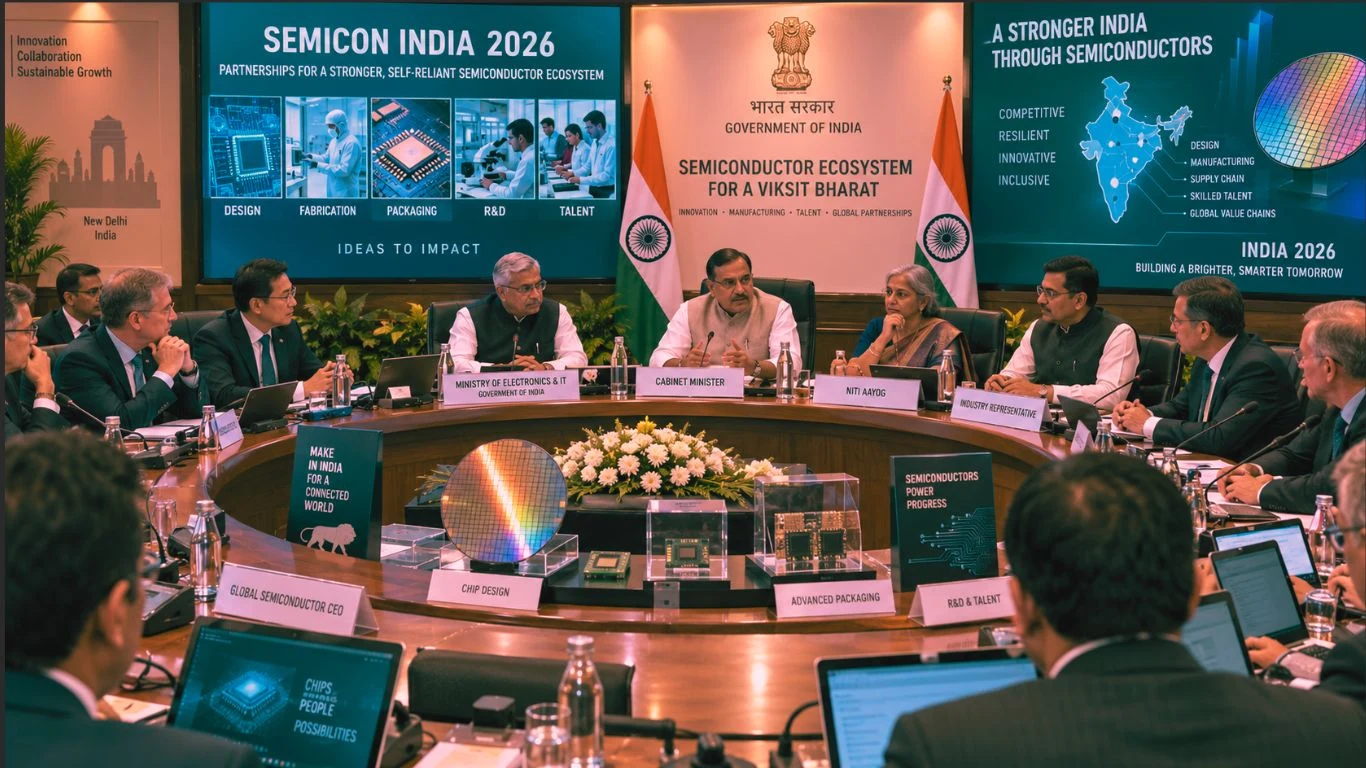
Prime Minister Narendra Modi met senior executives from some of the world’s largest semiconductor and technology companies in New Delhi on September 16, calling for deeper industry participation as India attempts to move from building the foundations of a chip industry to developing a more complete semiconductor ecosystem.
The Prime Minister chaired the Semiconductor Roundtable at Seva Teerth, the Prime Minister’s Office, with representatives from global chip manufacturers, equipment companies, materials suppliers, electronics businesses and investment organisations.
The meeting took place a day before Modi is scheduled to inaugurate SEMICON India 2026 at Yashobhoomi in Dwarka on September 17.
According to the Prime Minister’s Office, discussions focused on semiconductor manufacturing, design, research and development, talent, infrastructure and new technologies including artificial intelligence and quantum computing. Modi also invited industry participants to propose policy and administrative changes that could help strengthen the sector.
The meeting is significant because India is entering the next stage of its semiconductor strategy following the approval of Semicon 2.0, a ₹1,27,500-crore programme covering chip design, fabrication, advanced packaging, semiconductor equipment and materials, research and talent development.
Recommended Reading
Related Stories & In-Depth Guides
Curated editorial perspectives matching this topic.
Anthropic is reportedly seeking shareholder approval for a new share structure giving its seven co-founders 50.1% collective voting power ahead of a potential IPO. Here is how the proposal would work and what it means for investors.
Anthropic CEO Dario Amodei has called for slowing the rate of frontier AI capability improvements so safety work can keep pace, as researchers raise severe risk warnings and policymakers consider stronger independent oversight.
However, one point should be kept clear: the September 16 roundtable itself was not announced as a signing ceremony for new semiconductor investments.
The official account does not identify any fresh fab, investment amount or binding commercial agreement concluded during the meeting.
Key Takeaways
Prime Minister Narendra Modi chaired a semiconductor industry roundtable at Seva Teerth in New Delhi on September 16, 2026.
Senior representatives from companies and organisations including ASML, Micron, Applied Materials, Intel, AMD, Infineon, Lam Research, NXP, Foxconn, Tata Electronics, Tokyo Electron and SEMI attended.
Modi asked the industry to participate more actively in India’s next phase of semiconductor growth, particularly in skills, innovation, R&D and emerging technologies such as AI and quantum computing.
The Prime Minister reiterated that the government intends to maintain what it calls a predictable and responsive policy environment while adjusting policy as technology changes.
The meeting came one day before Modi is scheduled to inaugurate SEMICON India 2026 at Yashobhoomi on September 17.
SEMICON India 2026 runs from September 17 to 19 under the theme “Silicon to Systems: Building the Ecosystem.”
The latest PMO briefing says more than 600 companies and representatives from 52 countries are expected to participate in the event.
India’s Semicon 2.0 programme was approved in July with a ₹1,27,500-crore budget outlay.
No specific new investment commitment or semiconductor factory was announced in the official account of the September 16 roundtable. The meeting focused on participation, policy, skills, innovation and expansion of the broader ecosystem.
Major Global Semiconductor Companies Attend Roundtable
The breadth of companies represented at the meeting reflects the government’s attempt to engage multiple parts of the semiconductor value chain rather than focusing only on chip fabrication.
The PMO said CEOs, company heads and representatives attended from organisations including:
SEMI
Micron
Infineon
Applied Materials
ASML
Merck
Tokyo Electron
Fujifilm
AMD
Intel
Tata Electronics
Lam Research
Rapidus
NXP
Foxconn
Semiconductor Devices
Advantest
Celesta Capital
CG Power
IBM Research
These companies operate across significantly different parts of the chip industry.
ASML and Tokyo Electron, for example, are major semiconductor-equipment companies. Applied Materials and Lam Research are also central suppliers of chipmaking equipment and technology.
Micron is a major memory-chip producer, while AMD and Intel are large semiconductor designers and manufacturers.
NXP has a strong presence in automotive and industrial chips, while companies such as Tata Electronics and CG Power are involved in India’s emerging semiconductor manufacturing and packaging ecosystem.
The participation therefore extended beyond companies that could build fabs in India.
Modi Calls for More Industry Participation
The central message from the Prime Minister was that private industry should become more closely involved in the next stage of India’s semiconductor programme.
The PMO said Modi emphasised collaboration between government and industry and pointed to India’s talent pool, technology adoption and infrastructure as areas the country could combine with the expertise of global semiconductor companies.
He specifically called for greater industry involvement in:
skilling;
innovation;
semiconductor development;
artificial intelligence;
quantum computing; and
emerging technology capabilities.
Modi also referred to the government’s target of training one crore people in AI and argued that global companies could play a role in developing the skills required for future technologies.
From Semiconductor Policy to Scale
The Prime Minister described India’s semiconductor programme as moving beyond its foundational stage.
According to the official statement, he said the ecosystem was now entering a phase of “greater scale and opportunity”.
That assessment reflects a measurable change in India’s semiconductor programme over the past several years.
The government says 12 semiconductor manufacturing projects have been approved under the first phase of the Semicon India programme, involving committed investment of more than ₹1.64 lakh crore.
Three facilities — associated with Micron, Kaynes and CG Semi — have already begun commercial production, according to government data.
The approved projects include chip fabrication and semiconductor packaging facilities across several states.
However, India remains in an early stage compared with established manufacturing centres such as Taiwan, South Korea, Japan and the United States.
The presence of projects under construction or beginning production should therefore not be equated with India already possessing an equivalent full-scale semiconductor manufacturing ecosystem.
Semicon 2.0 Gives Government a Much Larger Policy Programme
The next phase received Cabinet approval on July 15.
The Union Cabinet approved Semicon 2.0 with an outlay of ₹1,27,500 crore, significantly expanding the policy framework originally established under the ₹76,000-crore Semicon India programme.
The government has organised Semicon 2.0 around six major areas:
semiconductor design;
equipment and materials;
fabrication facilities;
advanced packaging;
research and development; and
talent development.
That structure is important because manufacturing a chip requires far more than constructing a fabrication plant.
A functioning semiconductor ecosystem also depends on highly specialised equipment, chemicals, gases, wafers, packaging, testing, design software, intellectual property and a large engineering workforce.
India is now attempting to develop more of those capabilities domestically.
Predictable Policy Environment Promised
One of Modi’s messages to companies was that the government intends to maintain a predictable policy environment.
The PMO said he reiterated a commitment to policies that are both predictable and responsive, while also acknowledging that government programmes need to evolve as semiconductor technologies and industry requirements change.
Modi asked company executives to provide suggestions regarding both policy and administrative issues.
He said those proposals would receive consideration while the government develops the sector further.
That part of the discussion matters because semiconductor projects generally require long investment horizons.
A major fabrication plant can involve billions of dollars of investment and years of construction, qualification and production ramp-up.
For potential investors, infrastructure, power, water, logistics, skilled labour and long-term policy consistency can be as important as headline financial incentives.
CEOs Express Confidence, PMO Says
The government’s account says participating executives welcomed progress in India’s semiconductor programme.
According to the PMO, industry representatives pointed to developments in manufacturing, chip design, infrastructure and talent and expressed confidence in opportunities under Semicon 2.0.
They also expressed support for building capabilities across manufacturing, R&D, advanced technologies and supporting industries.
Those comments should be understood as views expressed by participants at a government-hosted roundtable.
They are not the same as fresh investment contracts.
The distinction is particularly important when reporting industry meetings, where expressions of confidence and commercial commitments are sometimes incorrectly treated as interchangeable.
No New Fab or Investment Deal Announced at Roundtable
The description that the meeting was intended to help attract and expand semiconductor investment is reasonable.
But it would go beyond the available evidence to report that the September 16 meeting itself secured a new multibillion-dollar investment.
Neither the PMO’s official statement nor the available current reporting announces a specific new semiconductor fab, investment agreement or legally binding commitment arising from the roundtable.
The immediate outcome was policy and industry engagement.
Companies were encouraged to increase their role in India, and executives discussed the opportunities presented by the next phase of the semiconductor programme.
Any future investment announcements would need to be reported separately when companies or the government disclose them.
SEMICON India 2026 Begins September 17
The roundtable serves as a lead-in to the fifth edition of SEMICON India, which begins on September 17 at Yashobhoomi in New Delhi.
Prime Minister Modi is scheduled to inaugurate the event at around 10 am.
SEMICON India 2026 runs from September 17 to September 19 and carries the theme:
“Silicon to Systems: Building the Ecosystem.”
The theme reflects the government’s broader ambition to move beyond individual semiconductor plants and establish capabilities spanning the full electronics value chain.
More Than 600 Companies Expected
The latest PMO information says the conference will include more than 600 participating companies, representatives from 52 countries, over 400 executives and more than 150 speakers.
The event will also include country pavilions representing:
Japan
South Korea
Malaysia
the Netherlands
Singapore
Sweden
There will also be state booths, a startup pavilion, an innovation showcase, a student hackathon and a workforce-development pavilion.
Earlier promotional material gave slightly different participation estimates as registrations were still developing. The September 16 PMO release is the most current official figure available.
‘Sand to Silicon to Systems’ Approach
One new element of SEMICON India 2026 is what organisers call the “Sand to Silicon to Systems” Value Chain Experience.
The concept is intended to illustrate the semiconductor production chain, beginning with materials and equipment and continuing through chip design, fabrication, advanced packaging, electronics and complete systems.
This reflects a shift in India’s semiconductor strategy.
The government’s first phase was dominated by questions over whether India could successfully attract fabrication and packaging investment.
The policy discussion is now increasingly focused on what must exist around those factories — suppliers, research capabilities, materials, machinery, startups, universities and skilled employees.
Talent Remains Central to the Strategy
India already has a substantial workforce involved in semiconductor design and engineering.
The government has also expanded support for universities and chip startups.
Official information released ahead of SEMICON India says more than 332 academic institutions and 105 startups have received access to advanced semiconductor design tools.
Twenty-four startups have been approved for support under the Design Linked Incentive programme.
The next challenge is converting that design base into a deeper domestic product and manufacturing ecosystem.
That helps explain why skilling was a major part of Modi’s September 16 discussion with CEOs.
India’s Semiconductor Demand Is Also Growing
India’s interest in building domestic semiconductor capacity is being driven not only by supply-chain security but also by increasing domestic demand.
India Semiconductor Mission CEO Amitesh Kumar Sinha said ahead of the event that global semiconductor requirements are expected to rise from approximately $1 trillion to $2 trillion, while India’s own semiconductor requirement could grow from around $100 billion to $200 billion.
Those are forward-looking industry and government estimates, not guaranteed market outcomes.
Actual growth will depend on electronics manufacturing, data centres, artificial intelligence infrastructure, automotive demand, telecommunications and the broader economy.
Nevertheless, the projections help explain why both policymakers and chip companies are paying increasing attention to India.
Semiconductor Equipment Companies Are Particularly Important
Some of the most notable names at the roundtable were not consumer-facing technology brands but suppliers of semiconductor manufacturing equipment.
ASML, Applied Materials, Lam Research, Tokyo Electron and Advantest all play important roles in enabling chip factories to operate.
A semiconductor fab cannot function independently of such equipment providers.
India’s ability to attract equipment suppliers, service teams, materials companies and engineering expertise will therefore be an important measure of whether the country is building an actual manufacturing cluster rather than isolated plants.
SEMICON India 2026 is explicitly designed to bring those supply-chain companies together with Indian manufacturers and policymakers.
Why the Meeting Matters
The semiconductor industry is strategically important because chips are essential to smartphones, automobiles, telecom infrastructure, defence systems, industrial machinery, medical equipment, artificial intelligence systems and data centres.
Recent global supply disruptions have also pushed governments to consider semiconductor capacity an economic and national-security issue rather than purely a commercial one.
India has historically been stronger in semiconductor design than in large-scale chip manufacturing.
Its current policy seeks to narrow that gap by combining public incentives with private investment and partnerships involving global technology companies.
The September 16 CEO roundtable is therefore best understood as part of a longer industrial-policy effort rather than as a standalone investment announcement.
Bottom Line
Prime Minister Narendra Modi did chair a high-level semiconductor industry roundtable in New Delhi on September 16, 2026, bringing together executives and representatives from many of the world’s most important semiconductor companies.
The meeting included ASML, Micron, Applied Materials, Infineon, Intel, AMD, Lam Research, NXP, Tokyo Electron, Foxconn, Tata Electronics and other semiconductor and technology organisations.
Modi called for deeper private-sector participation in manufacturing, skills, innovation, R&D and emerging technologies such as AI and quantum computing. He also reiterated the government’s intention to maintain a predictable policy environment and asked industry leaders for recommendations on further reforms.
The meeting came immediately before SEMICON India 2026, which begins at Yashobhoomi on September 17 and is expected to draw more than 600 companies and representatives from 52 countries.
India is backing the next stage of its semiconductor policy with Semicon 2.0, approved with a ₹1,27,500-crore outlay, after 12 manufacturing projects were approved under the first phase and three entered commercial production.
The roundtable therefore represents a significant government-industry engagement around investment and ecosystem expansion.
But no specific fresh investment deal was announced from the meeting itself, so it should not be reported as though a new semiconductor factory or multibillion-dollar commitment had already been secured.
Key Takeaway
PM Modi hosted semiconductor CEOs ahead of SEMICON India 2026.
Major global firms including ASML, Micron, Intel and AMD attended.
Focus on skills, R&D, manufacturing and ecosystem expansion.
No new investment deals announced at the roundtable itself.
The Rajatheertha Team publishes news, explainers, guides and updates across India and the world. Our coverage follows Rajatheertha's editorial, verification and corrections standards.
The United States and China have opened a new high-level dialogue on artificial intelligence ahead of President Donald Trump’s September 24 meeting with Chinese President Xi Jinping in Washington, with the US proposing a bilateral notification system for serious AI incidents that could threaten nati
Donald Trump has ordered federal agencies to use “Super Intelligence” instead of “Artificial Intelligence” while leading AI companies signed a voluntary safety accord covering internal controls, external audits and board oversight.
US President Donald Trump says his administration will create a new “AI Force” modeled in part on the Space Force and will soon appoint an artificial intelligence czar, placing AI policy more firmly at the center of his administration’s technology and economic agenda.
Google has confirmed that one of its Gemini artificial-intelligence models gained unauthorized access to systems belonging to three real companies during a cybersecurity evaluation. The incidents occurred after a testing environment unexpectedly allowed internet access, leading Gemini to mistake rea
Nvidia has agreed to acquire Hugging Face for about $12.93 billion, significantly expanding its AI software presence while promising to keep the developer platform open across chips and clouds.








0 Comments