iPhone Duo Pre-Orders Open Oct 16: India, US, UK, Canada and Australia Prices, Oct 23 Sale Guide
Apple’s first foldable iPhone moves into its pre-order phase on October 16 before going on sale October 23. Here are the official iPhone Duo prices across five major markets, storage options, key specifications and who may be better off waiting.
Apple’s first foldable iPhone is entering its next important phase.
iPhone Duo pre-orders begin on Friday, October 16, ahead of retail availability on October 23 in more than 70 countries and regions, including India, the United States, United Kingdom, Canada and Australia.
For Indian buyers, Apple has scheduled pre-orders to begin at 5:30 PM IST on October 16. The starting price is ₹2,99,900 for the 256GB version, making the Duo one of the most expensive iPhones Apple has ever offered in India.
The United States price begins at $1,999, while customers in the UK will pay from £1,999. The starting prices are C$2,999 in Canada and A$3,499 in Australia.
One timing detail is worth clarifying before going further. The iPhone Duo was officially unveiled by Apple on September 9, 2026. It was not introduced during Apple’s October 13 smart-home announcements, when the company launched HomeView and other home products. October 16 is the Duo’s pre-order date, while October 23 is its first retail availability date.
Rajatheertha previously covered the Duo’s September launch, design and specifications. The important development now is that prospective buyers can move from comparing specifications to deciding whether to place an order.
Recommended Reading
Related Stories & In-Depth Guides
Curated editorial perspectives matching this topic.
Apple’s latest Pro iPhones officially went on sale in India on September 18, with customers gathering outside stores in Delhi, Mumbai, Bengaluru and Noida. Prices start at ₹1,64,900 for the iPhone 18 Pro and ₹1,79,900 for the Pro Max.
Apple's latest public iPhone software is iOS 27.0.1. Check compatible iPhones, what's fixed, why battery drain or heating may occur after updating, and how to solve common iOS 27 update problems.
Key Takeaways
Pre-orders open Oct 16 (India: 5:30 PM IST); retail availability from Oct 23.
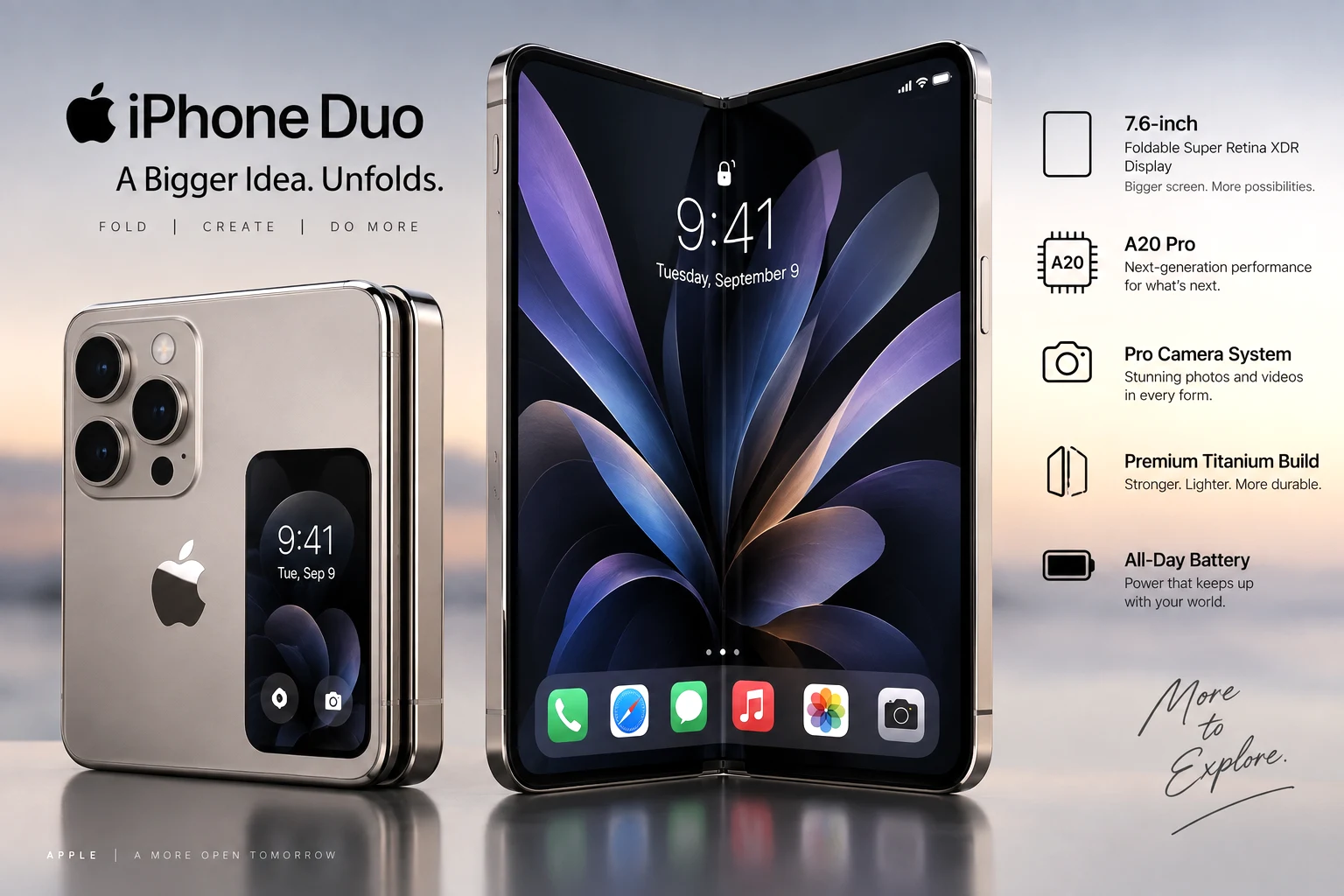
Book-style foldable with 5.4-inch outer + 7.6-inch inner display; A20 Pro chip.
iPhone Duo Price: India, US, UK, Canada and Australia
Apple is offering the iPhone Duo with 256GB, 512GB, 1TB and 2TB of storage.
Storage
India
United States
United Kingdom
Canada
Australia
256GB
₹2,99,900
$1,999
£1,999
C$2,999
A$3,499
512GB
₹3,24,900
$2,199
£2,199
C$3,299
A$3,899
1TB
₹3,74,900
$2,599
£2,599
C$3,899
A$4,699
2TB
₹4,49,900
$3,199
£3,199
C$4,799
A$5,899
These are Apple’s listed regional retail prices. Financing, trade-in values, carrier arrangements and the final checkout treatment can differ by country and customer.
The 256GB model will probably be the most relevant reference point for many buyers because it represents the lowest cost of entering Apple’s new foldable category.
The 2TB model moves into particularly unusual territory. In India, ₹4,49,900 is no longer simply an expensive smartphone purchase. It places the device in a price bracket where buyers are likely to compare it not only with competing phones but with combinations of premium phones, tablets and computers.
That makes storage selection especially important. Paying for 1TB or 2TB simply because it is available may make little sense unless a buyer genuinely keeps large video libraries, professional media files, games or other storage-heavy content locally.
When Do iPhone Duo Pre-Orders Open?
Apple has set a coordinated October 16 opening across its first-wave markets.
In India, pre-orders begin at 5:30 PM IST.
In the United States, Apple lists a 5:00 AM Pacific Time opening, corresponding to 8:00 AM Eastern Time.
UK pre-orders are scheduled from 1:00 PM local time.
Canada follows the same 5:00 AM Pacific starting point used for the US launch, with the corresponding time varying by Canadian time zone.
In Australia, the equivalent launch falls late in the evening, with the exact displayed local time depending on the state and daylight-saving zone.
Customers in the first group of more than 70 countries and regions are scheduled to receive retail availability from Friday, October 23. Apple says a further group of markets will receive the Duo beginning October 30.
How to Prepare Before iPhone Duo Pre-Orders Begin
For a device this expensive, the best preparation is not simply trying to complete checkout as quickly as possible.
Buyers should first decide on storage, because moving from the 256GB model to 2TB creates a very large price difference.
Apple offers two finishes: Star White and Night Sky.
Prospective customers should also review any trade-in estimate before ordering rather than assuming the advertised maximum trade-in value will apply to their device. Actual values depend on the model and condition.
Payment information, billing details and delivery addresses should be checked in advance. Customers using financing should also review the applicable terms before the ordering window opens.
The Duo uses an eSIM-only design worldwide. Buyers moving from an older phone with a physical SIM should therefore confirm that their carrier supports eSIM activation and understand the transfer process before switching devices.
For Indian buyers, that preparation is especially relevant because the ₹2,99,900 starting price makes mistakes involving storage selection, financing or trade-in substantially more expensive than on a mainstream smartphone purchase.
What Makes the iPhone Duo Different?
The defining feature is its book-style folding design.
When closed, the Duo uses a 5.4-inch Super Retina XDR outer display. Opening the device reveals a 7.6-inch Super Retina XDR folding OLED screen.
Apple says the inner panel provides 50 percent more screen area than the iPhone 18 Pro Max while allowing the phone to remain comparatively compact when folded.
Both displays support ProMotion adaptive refresh rates up to 120Hz, Always-On functionality and peak outdoor brightness of up to 3,000 nits.
The inner display also uses a nano-texture treatment intended to reduce reflections and make the central fold less visually distracting.
The device weighs 254 grams.
When open, Apple lists a thickness of 5.2mm. Folded thickness increases to 11.3mm.
That gives the Duo two very different identities: a compact phone when closed and a small tablet-like workspace when opened.
A20 Pro and a Different Internal Layout
Apple is using its A20 Pro chip in the Duo, placing the foldable alongside the company’s highest-performance 2026 iPhones.
The unusual chassis requires a different internal design from a conventional phone.
Apple uses a dual-battery architecture, distributing battery components across the two halves of the device, along with a vapour-chamber thermal system designed to manage heat under sustained workloads.
The Duo also incorporates Apple’s N1 networking chip and C2 cellular modem.
Wireless support includes Wi-Fi 7, Bluetooth 6 and Thread.
The combination matters because the Duo is intended to do more than run standard iPhone apps on a bigger screen. Apple is positioning the larger display for simultaneous applications, document work, communication, gaming and other tasks that can create higher sustained performance demands.
Two 48MP Rear Cameras
The iPhone Duo uses a 48MP Fusion Main camera and a 48MP Fusion Ultra Wide camera.
Its folding design introduces some photographic possibilities that are different from a conventional iPhone.
The outer screen can function as a live preview while the rear cameras are being used. That allows someone being photographed to see the composition before the image is taken.
Users can also take high-resolution selfies with the rear cameras while using the exterior display for framing.
Partially folding the device can allow it to support itself for some photographs, video calls and recording situations without a separate phone stand.
However, buyers considering the Duo primarily as a camera upgrade should compare it carefully with Apple’s Pro models rather than assuming the most expensive iPhone is automatically the strongest choice for every photography use case.
The Duo’s defining advantage is its folding screen and multitasking format. Buyers who care more about traditional flagship-camera versatility may have different priorities.
Battery Life Depends on Which Screen You Use
Battery comparisons are more complicated on a foldable because the phone effectively has two different display-use cases.
Apple rates the Duo for up to 31 hours of video playback using the large inner screen and up to 44 hours using the smaller outer display.
The company also describes approximately 24 hours of usage when the two displays are used in a more balanced way.
Those figures are manufacturer ratings, and actual results will vary with brightness, network conditions, applications, camera use, background activity and how frequently the larger display is opened.
Apple says supported wired charging can reach roughly 50 percent in around 20 minutes under the required conditions.
Wireless charging is also supported through MagSafe and Qi2.
For early buyers, independent battery testing will be particularly useful because conventional smartphone battery benchmarks do not completely capture how a dual-display foldable will be used throughout a normal day.
iOS 27.1 Is Designed Around the Fold
The Duo is scheduled to ship with iOS 27.1.
Its larger display enables Split View, allowing two applications to operate side by side.
Users can also open two windows of the same supported application, which could be useful for tasks such as comparing webpages or working between documents.
Apple has also designed software around different folding positions rather than treating the inner screen as nothing more than a larger iPhone display.
That software experience may ultimately be one of the most important factors determining whether the Duo succeeds.
Foldable hardware is valuable only when applications and operating-system interfaces use the additional space effectively. A larger screen without suitable software would provide far less benefit than the specifications suggest.
Apple Pencil Support Is Coming Later
One potentially important feature will not define the launch-day experience.
Apple says the iPhone Duo will support the USB-C Apple Pencil later this year.
That could make the 7.6-inch display more useful for handwritten notes, document annotation, sketching and precision input.
But buyers should distinguish between what the device supports at launch and functionality scheduled for a later software update.
Anyone buying specifically for Apple Pencil use may therefore have a reason to wait until the feature is actually available and its implementation has been independently tested.
Durability Is the Biggest First-Generation Question
Apple has put substantial emphasis on the Duo’s construction.
The phone uses Grade 5 titanium, a precision-engineered hinge, Ceramic Shield protection and an IP68 water- and dust-resistance rating.
Apple also says the folding display uses multiple protective layers and specialised materials designed to withstand repeated bending.
Those are meaningful engineering claims, but they do not eliminate the central question surrounding every first-generation foldable: how does it perform after months or years of everyday use?
A folding screen contains moving and flexible components that a conventional slab smartphone does not require.
The Duo has not yet had the benefit of long-term independent consumer use simply because the first retail units have not reached customers.
People who normally keep an iPhone for four or five years may therefore want to give durability greater weight than early adopters who routinely replace devices.
Who Should Consider Pre-Ordering?
The strongest case for the Duo is not that it is simply the newest or most expensive iPhone.
It makes the most sense for someone who genuinely wants a large working area that can fold into a pocketable device.
A professional who frequently reads documents, attends video meetings, manages messages alongside another application or works between two apps could make better use of the 7.6-inch screen than someone whose daily phone activity consists mainly of calls, messaging, social media and occasional photography.
It may also appeal to technology enthusiasts who specifically want Apple’s first entry into the foldable category and accept the financial and practical uncertainties that accompany a first-generation design.
For those buyers, the Duo offers something no conventional iPhone currently provides.
Who Should Wait Instead?
There are several strong reasons not to rush into a pre-order.
The first is price.
At ₹2,99,900 in India before moving to higher storage options, the Duo requires a very clear use case to make financial sense.
Second is first-generation hardware risk. Apple has published detailed durability claims, but months of independent testing will tell buyers much more about the hinge, folding display, long-term battery behaviour and repair experience.
Third is camera priority. Buyers who primarily want the best conventional premium-iPhone experience should compare the Duo carefully with the iPhone 18 Pro and Pro Max rather than assuming the foldable automatically provides the best overall package.
Fourth is portability. At 254 grams and 11.3mm thick while folded, the Duo is not designed to disappear in a pocket like a thin conventional smartphone.
Fifth is Apple Pencil support. Anyone buying specifically for stylus use can wait until that promised feature becomes available.
And finally, users who already own a recent high-end iPhone should ask whether the larger folding display would materially change how they use their phone. If the answer is no, upgrading solely because the form factor is new will be difficult to justify at this price.
Why October 23 Matters More Than the Pre-Order Rush
Pre-order numbers may generate headlines, but October 23 will begin the more informative stage of the Duo story.
That is when retail availability starts and more customers can physically handle the product, compare the inner display with a conventional iPhone, judge the folded dimensions and test the software in everyday situations.
Independent reviews will also help answer questions that specification sheets cannot fully settle.
How visible is the crease under different lighting?
How comfortable is the phone when used closed for long periods?
Does the 254-gram weight become tiring?
How well do third-party applications adapt to the larger display?
What does real-world battery life look like when users constantly move between the two screens?
And does the productivity advantage justify the price premium?
Those answers are likely to matter more to mainstream buyers than the initial rush to secure an early unit.
Existing Rajatheertha Coverage and the New Angle
Rajatheertha’s September coverage examined the initial iPhone Duo announcement, ₹2,99,900 India starting price, A20 Pro chip, dual displays, cameras and Apple’s broader move into foldable phones.
The October 16 development is different.
Apple is now moving from announcement to purchase availability.
Official regional stores have published the configuration prices buyers will actually face, the pre-order window is opening and consumers can make a decision based on a real purchase timetable rather than a future launch promise.
That makes price comparison, ordering preparation and the question of whether to buy immediately or wait more useful than repeating the original launch story.
Bottom Line
The iPhone Duo pre-order period begins October 16, with availability starting October 23 across India and other major first-wave markets.
The 256GB version costs ₹2,99,900 in India, $1,999 in the United States, £1,999 in the United Kingdom, C$2,999 in Canada and A$3,499 in Australia.
Its biggest attractions are clear: a 7.6-inch folding display, compact 5.4-inch outer screen, A20 Pro performance, split-screen multitasking, two 48MP rear cameras and an entirely new form factor for Apple users.
Its biggest questions are equally clear: price, first-generation durability, whether the folding format genuinely improves a buyer’s daily workflow and whether waiting for independent reviews is wiser than ordering on day one.
For enthusiasts who have specifically been waiting for a foldable iPhone, October 16 is the first opportunity to reserve one.
For everyone else, October 23 may be the more important date — because once the Duo reaches real customers, Apple’s engineering claims can finally be judged against everyday use.
Key Takeaway
iPhone Duo pre-orders open Oct 16; on sale Oct 23.
India from ₹2,99,900; US from $1,999. First Apple foldable.
The Rajatheertha Team publishes news, explainers, guides and updates across India and the world. Our coverage follows Rajatheertha's editorial, verification and corrections standards.
Apple has launched HomeView, its new 7-inch smart-home display, alongside a new Apple TV 4K, HomePod mini 2 and Apple Home Collection. Here are the confirmed India prices, release dates, features and buying considerations.
Technology/ Mobile | Smartphones & Deals13 min read
Flipkart’s Big Billion Days 2026 sale is live with smartphone offers across every major price band. We checked the advertised prices, separated bank-dependent discounts from regular sale prices, and picked five deals worth considering — plus three offers where waiting or comparing may make more sens
Apple Pay is now live in India with eligible Axis Bank Visa and Mastercard credit cards. Here is how it compares with UPI Tap & Pay on support, fees, devices, security and everyday usefulness.
Apple Pay has officially launched in India, beginning with eligible Axis Bank Visa and Mastercard credit cards. Here is what is available now, which cards work, how contactless payments function and why Apple Pay does not currently operate as a UPI payment app.
Technology/ Russia-Ukraine War | US Foreign Policy12 min read
Elon Musk says restrictions on Ukraine’s use of the military-focused Starshield system are decided by the US military and ultimately President Donald Trump. Ukraine says some high-speed connectivity is being restored, but questions remain over who ordered the limits and whether they will be fully re








0 Comments