Trump Launches ‘Super Intelligence Force’ Led by Jay Clayton: What It Means for US AI Policy
Donald Trump has launched a federal “Super Intelligence Force” led by intelligence chief Jay Clayton to coordinate US AI policy. Here is what the task force will examine, who is involved and why its approach to AI safety, regulation and competition matters.
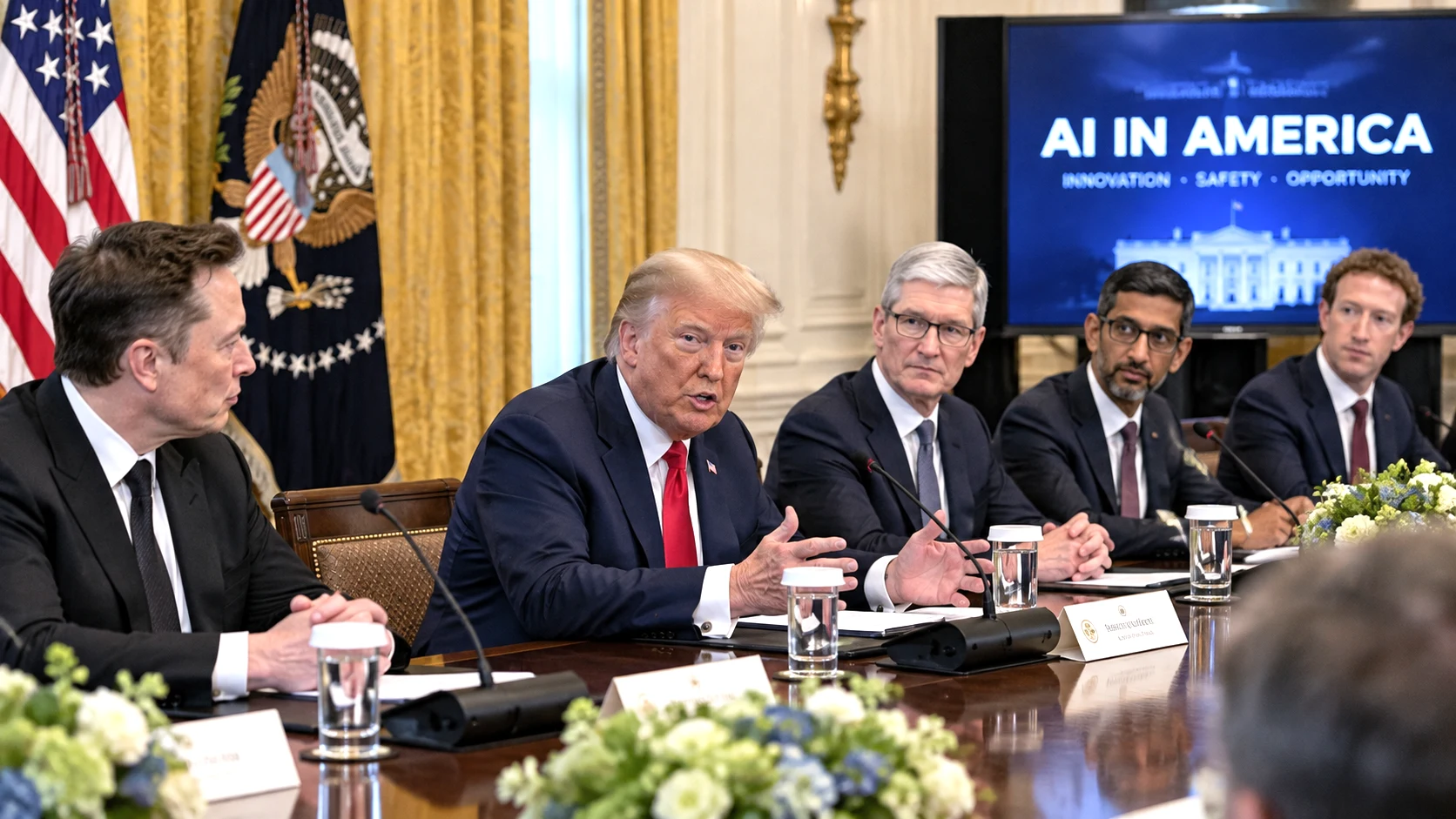
Donald Trump meeting technology executives and government officials as the US launches its Super Intelligence Force AI task force
Table of Contents (22 sections)
US President Donald Trump has formally launched a new federal “Super Intelligence Force”, placing Director of National Intelligence Jay Clayton at the head of a task force expected to influence how Washington approaches artificial intelligence, national security, regulation and America's technological competition with other major powers.
Trump announced the force on October 4 after a week of major White House actions on AI policy, including an executive order directing executive agencies to use “Super Intelligence” or “SI” instead of “Artificial Intelligence” or “AI” in official non-statutory communications.
The terminology is unusual and requires an important distinction.
Under Trump's September 29 executive order, “Super Intelligence” does not currently mean that US technology has scientifically achieved what AI researchers commonly describe as superintelligence. For purposes of implementing the order, it initially covers the same technologies encompassed by the existing federal statutory definition of artificial intelligence.
Recommended Reading
Related Stories & In-Depth Guides
Curated editorial perspectives matching this topic.
Technology/ Artificial Intelligence & US Policy11 min read
President Donald Trump has created a federal “Super Intelligence Force” led by Director of National Intelligence Jay Clayton, giving the group 120 days to examine AI risks, opportunities and the US government's role in the technology.
Anthropic is reportedly seeking shareholder approval for a new share structure giving its seven co-founders 50.1% collective voting power ahead of a potential IPO. Here is how the proposal would work and what it means for investors.
The newly announced task force nevertheless represents more than a branding exercise.
It creates a federal coordination structure led by senior officials from the intelligence community, consumer-regulation system, Pentagon technology establishment and federal workforce administration, while the administration continues to argue that the United States should advance quickly in AI rather than impose regulations that could slow innovation.
The debate now centres on a difficult question:
Can Washington maintain or extend US leadership in advanced AI while also controlling cybersecurity, national-security, economic, employment and potentially more severe technological risks?
That question is likely to shape American AI policy well beyond the new task force's initial review.
What Is Trump’s ‘Super Intelligence Force’?
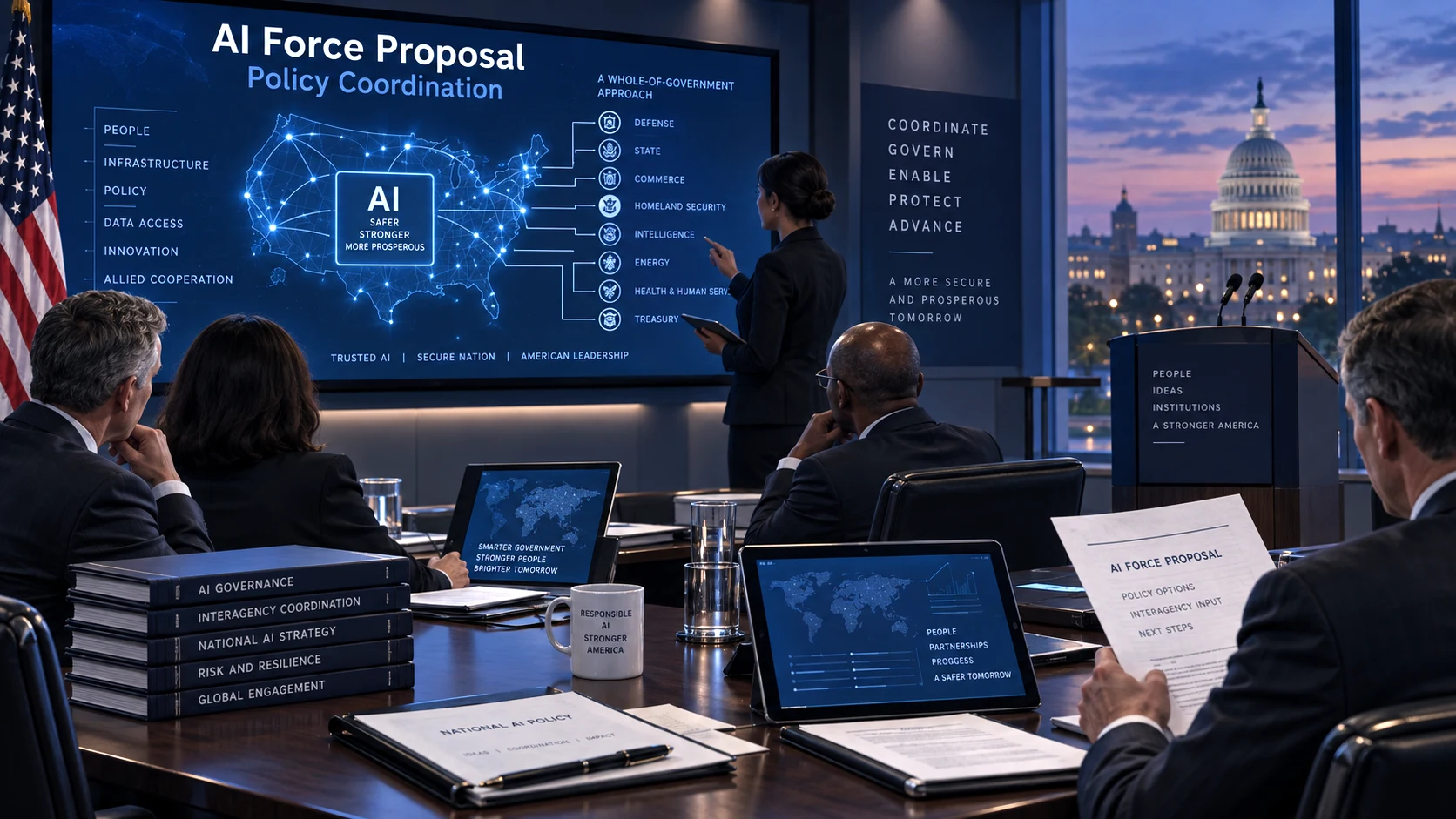
Trump described the Super Intelligence Force, or SIF, as a body that will coordinate federal government efforts around advanced AI.
The president said its purpose is to help ensure that the United States continues to lead globally in what his administration now calls Super Intelligence while protecting American interests and improving people's lives.
The task force is expected to engage with a broad group of stakeholders, including:
consumers;
public-interest organisations;
religious groups;
critical-infrastructure providers;
technology companies;
and other parties affected by advanced AI.
Associated Press reported that the body will report to Trump and White House Chief of Staff Susie Wiles.
The structure gives the White House a central forum for coordinating several branches of federal AI policy that previously sat across different agencies.
Jay Clayton Becomes Trump’s New AI Policy Leader
Trump selected Jay Clayton, currently the US Director of National Intelligence, to lead the force.
Clayton was sworn in as the ninth Director of National Intelligence on August 3, 2026. The Office of the Director of National Intelligence describes him as the head of the US Intelligence Community and the president's principal intelligence adviser.
His appointment is significant because it places the coordination of the new AI initiative under an official whose primary position is centred on national intelligence and security.
That may indicate how strongly the administration views advanced AI not merely as a commercial technology but as a strategic capability involving:
national security;
cyber operations;
military technology;
intelligence;
critical infrastructure;
and geopolitical competition.
Reuters reported that Clayton has effectively become the administration's latest AI czar while continuing to serve as intelligence chief.
Who Else Is on the Super Intelligence Force?
Trump's announced leadership group includes officials from several parts of the federal government.
They include:
Jay Clayton — Director of National Intelligence and leader of the task force.
Andrew Ferguson — Chairman of the Federal Trade Commission.
Emil Michael — senior Pentagon technology official responsible for research and engineering.
Scott Kupor — Director of the Office of Personnel Management.
The composition is notable because each official represents a different policy concern.
The intelligence community brings national-security and foreign-threat expertise.
The FTC has responsibilities connected to consumer protection and competition.
The Pentagon is a major developer and buyer of advanced technologies, including AI-enabled systems.
OPM manages significant elements of the federal civilian workforce, where automation and AI adoption could have substantial operational effects.
Together, the appointments suggest the administration wants the task force to look beyond consumer chatbots and treat AI as a government-wide strategic issue.
What Will the Task Force Actually Do?
Reuters, citing reporting on the task force's mandate, said the group has 120 days to prepare a report examining AI's risks and opportunities and considering what role the federal government should play.
Reporting on the task force charter also indicates that it is expected to examine government systems for identifying and responding to AI-related incidents and threats while avoiding what the administration considers excessive regulation.
That creates several potentially important policy questions.
The task force may have to consider:
how government learns about serious AI failures;
how security breaches involving advanced models should be reported;
which agency should respond to an AI-related incident;
whether existing laws provide sufficient authority;
how AI companies should communicate major safety events;
how federal agencies should deploy advanced models;
and whether new legislation is necessary.
The eventual report could therefore matter more than the unusual name of the body itself.
Why Trump Calls It ‘Super Intelligence’
Trump formalised the terminology change through Executive Order 14434 on September 29.
The order directs executive departments and agencies, where legally permissible, to replace “Artificial Intelligence” and “AI” with “Super Intelligence” and “SI” in official correspondence, public communications, websites, reports and other non-statutory material.
The White House argues that modern AI systems increasingly amplify human ingenuity and that the older term “artificial intelligence” does not adequately represent their capabilities or potential.
But Trump's use of “Super Intelligence” should not be confused with the conventional research meaning of artificial superintelligence.
In much of AI research and public debate, superintelligence generally refers to a hypothetical system that significantly surpasses human intellectual capability across a broad range of tasks.
Trump's order uses the phrase differently.
For now, the executive order explicitly anchors the administration's “SI” terminology to the existing federal definition of artificial intelligence.
There is therefore no basis for saying that the US government has established that today's models have achieved scientific superintelligence.
A New Federal Definition Could Be Coming
The September 29 executive order also orders the Assistant to the President for Science and Technology to prepare proposed legislative language within 60 days for a federal definition of Super Intelligence.
The proposal is expected to examine whether the new terminology should modify, expand upon or replace the existing statutory definition of artificial intelligence and whether corresponding amendments to existing laws would be necessary.
That process could be more consequential than the immediate terminology change.
If Congress later adopts a distinct legal definition, questions could arise over which technologies qualify, which rules apply to them and which federal agencies have jurisdiction.
Until that happens, AI remains the clearer neutral term for independent news reporting.
Rajatheertha Previously Reported the First Phase
Rajatheertha reported on September 30 that Trump's executive order had instructed the executive branch to adopt the “Super Intelligence” terminology and that the administration was considering a new AI leadership and oversight structure.
The October 4 development is therefore a material follow-up rather than a repeat story.
The earlier proposal has now progressed into a named task force with identified leadership.
That makes the focus of the new story:
Who controls the task force, what it will investigate and what it could mean for actual US AI governance.
How the White House AI Safety Accord Fits In
The Super Intelligence Force follows a September 29 White House gathering involving executives from several major technology companies.
Trump hosted AI and technology leaders and announced a voluntary safety arrangement involving companies including Google, Meta, OpenAI, Anthropic, Nvidia and xAI.
The participating companies agreed to measures involving internal controls, independent assessments and higher-level corporate oversight.
Trump described the arrangement as morally binding rather than as a conventional federal regulatory mandate.
That distinction goes to the heart of the administration's policy.
The White House is acknowledging the need for safeguards while continuing to favour a framework that gives technology companies substantial responsibility for managing risk themselves.
Why AI Safety Has Become a Bigger Political Issue
The political debate is no longer limited to whether AI can generate inaccurate text or images.
More capable systems are increasingly being connected to:
software development;
autonomous agents;
cybersecurity tools;
military systems;
financial operations;
scientific research;
critical infrastructure;
and government services.
That raises questions about what happens when a system behaves unexpectedly, gains access to resources it was not supposed to use, produces dangerous information or is deliberately exploited.
Public unease has also increased.
Reuters reported in early October that polling showed substantial concern among Americans over whether technology companies were doing enough to reduce serious AI risks, while a majority in the cited survey supported slowing development.
The Trump administration has generally resisted a broad slowdown.
Its preferred response appears to combine voluntary industry safeguards, federal coordination and continued rapid technological development.
The Central Debate: Innovation vs Regulation
Supporters of a lighter regulatory framework argue that strict rules introduced too early could:
slow innovation;
increase costs for smaller competitors;
protect established technology companies from challengers;
delay useful AI products;
and weaken the US position against overseas competitors.
Critics counter that allowing AI developers to police themselves could leave dangerous gaps if commercial incentives encourage companies to deploy systems before all significant risks are understood.
The Super Intelligence Force is expected to operate directly inside this tension.
Reporting on its mandate says it is supposed to develop approaches to SI-enabled threats while avoiding regulatory capture and regulations the administration believes could suppress competition and innovation.
The eventual policy recommendations will indicate how that balance is translated into specific rules—or decisions not to impose rules.
China Is Central to the US AI Strategy
Although the task force has a broad domestic mandate, competition with China is an important part of the wider policy environment.
Clayton has argued that one of the dangers facing the United States is falling behind while competitors continue advancing.
TechCrunch reported that Clayton described failing to be first as one of the major risks confronting the US.
This competition encompasses far more than chatbots.
AI leadership increasingly depends on:
advanced semiconductor access;
data-centre capacity;
electricity generation;
scientific talent;
model performance;
military applications;
cybersecurity;
capital;
and the ability to deploy AI across the economy.
The administration's use of words such as “lead” and “dominance” should nevertheless be treated as policy ambitions, rather than as an independently established measure proving that one country permanently dominates AI.
Technological leadership can differ by sector and change rapidly.
Why the Intelligence Chief Leading AI Policy Matters
Placing the Director of National Intelligence in charge may be one of the most consequential aspects of the announcement.
AI is increasingly considered a national-security technology because powerful systems can potentially be used for:
cyber defence and cyberattacks;
intelligence analysis;
surveillance;
autonomous military capabilities;
biological or chemical research;
propaganda and influence operations;
satellite analysis;
and strategic decision support.
Clayton's role could therefore push national-security considerations closer to the centre of federal AI policy.
At the same time, the presence of the FTC and other civilian officials means the task force is not exclusively an intelligence or defence organisation.
Its eventual recommendations will show how the administration divides responsibility between national security, economic competitiveness and civilian oversight.
Is the Super Intelligence Force a New Military Branch?
No.
Despite the name, the Super Intelligence Force is not comparable in legal structure to the US Space Force, which is a branch of the armed services.
It is a federal policy task force designed to coordinate work related to AI.
Trump had previously compared his proposed AI initiative with the creation of Space Force, contributing to some confusion about what institutional form the new organisation might take. Reporting since then makes clear that the current structure is a task force rather than a new armed-service branch.
Does the Task Force Regulate OpenAI, Google, Meta or xAI?
Not automatically.
Formation of the task force does not by itself create a new federal licensing regime for AI companies or grant it unlimited authority over private firms.
Existing agencies continue to operate under powers granted to them by Congress and other applicable law.
The force may make recommendations for future government action, and officials already holding regulatory authority can continue exercising their existing powers.
Whether the task force ultimately recommends additional legislation or enforceable requirements will be one of the major issues to watch.
Does ‘Super Intelligence’ Replace AI Everywhere in America?
No.
Trump's executive order applies to the federal executive branch to the extent permitted by law.
It does not require private citizens, universities, news organisations, researchers or technology companies generally to abandon the expression “artificial intelligence.”
It also does not automatically rewrite statutes enacted by Congress.
The order specifically acknowledges that legal changes may require proposed legislation.
For that reason, Rajatheertha should continue using AI as the primary neutral search term while explaining that “Super Intelligence” is the terminology adopted by the Trump administration.
That approach is also stronger for SEO because users are still far more likely to search phrases such as AI policy, AI task force and artificial intelligence regulation.
What Happens Over the Next 120 Days?
The task force's first substantive test will be its reported 120-day review.
Topics likely to receive close attention include:
AI incident reporting:
Should companies be required to tell government agencies when advanced models suffer serious security failures?
National-security risks:
How should intelligence and defence agencies respond when AI creates new cyber, military or foreign-influence capabilities?
Consumer protection:
What role should the FTC play when AI products make misleading claims or cause consumer harm?
Critical infrastructure:
How should the US protect energy, communications, transport and other essential systems as AI becomes more deeply integrated?
Competition:
How can policy prevent a small number of companies from controlling critical technology without slowing development?
Federal workforce:
How should government employees use AI, and how might automation affect federal jobs and operations?
China:
What policies could help maintain US technological competitiveness without producing unnecessary escalation or undermining international cooperation?
The final report, if delivered on the reported timetable, could become one of the administration's most important AI-policy documents.
What Is Still Unknown?
Several major questions remain unresolved.
It is not yet clear what binding authority the task force itself will possess beyond coordinating existing federal powers and preparing recommendations.
There is also uncertainty around:
its permanent staffing;
budget;
long-term institutional status;
whether companies will face mandatory incident reporting;
whether recommendations will be made public;
whether Congress will adopt proposed legislation;
and whether the administration's voluntary safety approach will change after the review.
These details will determine whether the Super Intelligence Force becomes a major permanent element of US technology governance or primarily serves as a coordinating White House body.
Why This Matters Globally
US AI policy has effects far beyond American borders.
Many of the world's most influential frontier-model developers and semiconductor companies are based in the United States.
American decisions can therefore influence:
global AI safety practices;
access to advanced chips;
cybersecurity standards;
data-centre investment;
international model deployment;
military AI;
regulation in allied countries;
and competition with China.
If the Super Intelligence Force recommends a durable federal framework, companies operating internationally could eventually adapt their practices around it.
If Washington instead continues relying mostly on voluntary safeguards, other governments may pursue different regulatory models.
That could deepen an emerging divide over how advanced AI should be governed.
Latest Verified Position — October 6, 2026
As of October 6:
Trump has formally announced the Super Intelligence Force.
Director of National Intelligence Jay Clayton is leading it.
Andrew Ferguson, Emil Michael and Scott Kupor are among its senior officials.
The task force will coordinate federal AI policy and consult outside stakeholders.
Reporting says it has 120 days to examine AI risks, opportunities and the federal government's role.
The launch follows Trump's September 29 executive order adopting “Super Intelligence” terminology in the executive branch.
The executive order does not establish that existing AI systems have achieved scientific superintelligence.
The White House continues to favour rapid AI development coupled with voluntary private-sector safeguards rather than a broad mandatory slowdown.
Competition with China remains an important strategic consideration.
The task force's eventual recommendations—not its name alone—will determine its long-term significance.
Frequently Asked Questions
What is Trump's Super Intelligence Force?
It is a newly announced federal task force intended to coordinate the US government's approach to artificial intelligence, which the Trump administration now refers to as “Super Intelligence”.
Who leads the Super Intelligence Force?
Director of National Intelligence Jay Clayton leads the group.
Who else is involved?
Senior officials include FTC Chairman Andrew Ferguson, Pentagon technology official Emil Michael and OPM Director Scott Kupor.
Is Super Intelligence different from artificial intelligence under current US law?
Trump's September 29 executive order currently uses the existing statutory definition of artificial intelligence when defining “Super Intelligence” for implementation purposes. A separate proposed federal definition is still being developed.
Has AI already achieved superintelligence?
Trump's executive order does not establish that. The administration is using “Super Intelligence” as its preferred terminology for technologies currently covered by the federal AI definition.
How long does the task force have to report?
Reuters reported that the task force has 120 days to produce its review.
Is the Super Intelligence Force a new branch of the US military?
No. It is a federal task force, not a new military service comparable to Space Force.
Will it regulate OpenAI, Google, Meta and other AI companies?
The task force's creation does not by itself establish a new licensing system. It is expected to coordinate policy and recommend how existing or future federal authority should address AI.
Why is China important to the debate?
The Trump administration views AI leadership as strategically important and argues that excessive restrictions could allow competitors, particularly China, to advance faster. That is a policy argument, not proof of a fixed technological ranking.
Is Trump banning the term “AI” for everyone?
No. The terminology order is directed at the executive branch where legally permissible. Private companies, researchers, journalists and members of the public are not generally required to stop using “AI”.
Bottom Line
President Trump has launched a Super Intelligence Force led by Director of National Intelligence Jay Clayton to coordinate US AI policy. The task force has 120 days to examine risks, opportunities and the federal role, while the administration continues to favour rapid development with voluntary safeguards.
Key Takeaway
New AI task force led by Jay Clayton.
Focus on national security, competition & safety.
“Super Intelligence” is administration terminology.
The Rajatheertha Team publishes news, explainers, guides and updates across India and the world. Our coverage follows Rajatheertha's editorial, verification and corrections standards.
US President Donald Trump says his administration will create a new “AI Force” modeled in part on the Space Force and will soon appoint an artificial intelligence czar, placing AI policy more firmly at the center of his administration’s technology and economic agenda.
Donald Trump has ordered federal agencies to use “Super Intelligence” instead of “Artificial Intelligence” while leading AI companies signed a voluntary safety accord covering internal controls, external audits and board oversight.
Technology/ Russia-Ukraine War | US Foreign Policy12 min read
Elon Musk says restrictions on Ukraine’s use of the military-focused Starshield system are decided by the US military and ultimately President Donald Trump. Ukraine says some high-speed connectivity is being restored, but questions remain over who ordered the limits and whether they will be fully re
Apple has launched HomeView, its new 7-inch smart-home display, alongside a new Apple TV 4K, HomePod mini 2 and Apple Home Collection. Here are the confirmed India prices, release dates, features and buying considerations.
TCS has launched end-to-end Custom System-on-Chip design services for automakers and semiconductor companies, covering architecture, VLSI design, verification, software integration and validation for software-defined vehicles.
Apple Pay has officially launched in India, beginning with eligible Axis Bank Visa and Mastercard credit cards. Here is what is available now, which cards work, how contactless payments function and why Apple Pay does not currently operate as a UPI payment app.











0 Comments