
Table of Contents (32 sections)
Customers of India's Public Sector Banks and Regional Rural Banks will get an additional branch-banking day before the proposed three-day nationwide bank strike scheduled for September 28–30, 2026.
Public Sector Banks and Regional Rural Banks will operate on Sunday, September 27, after RBI approval, ahead of a proposed nationwide bank strike from September 28 to 30. Here is what customers should know.

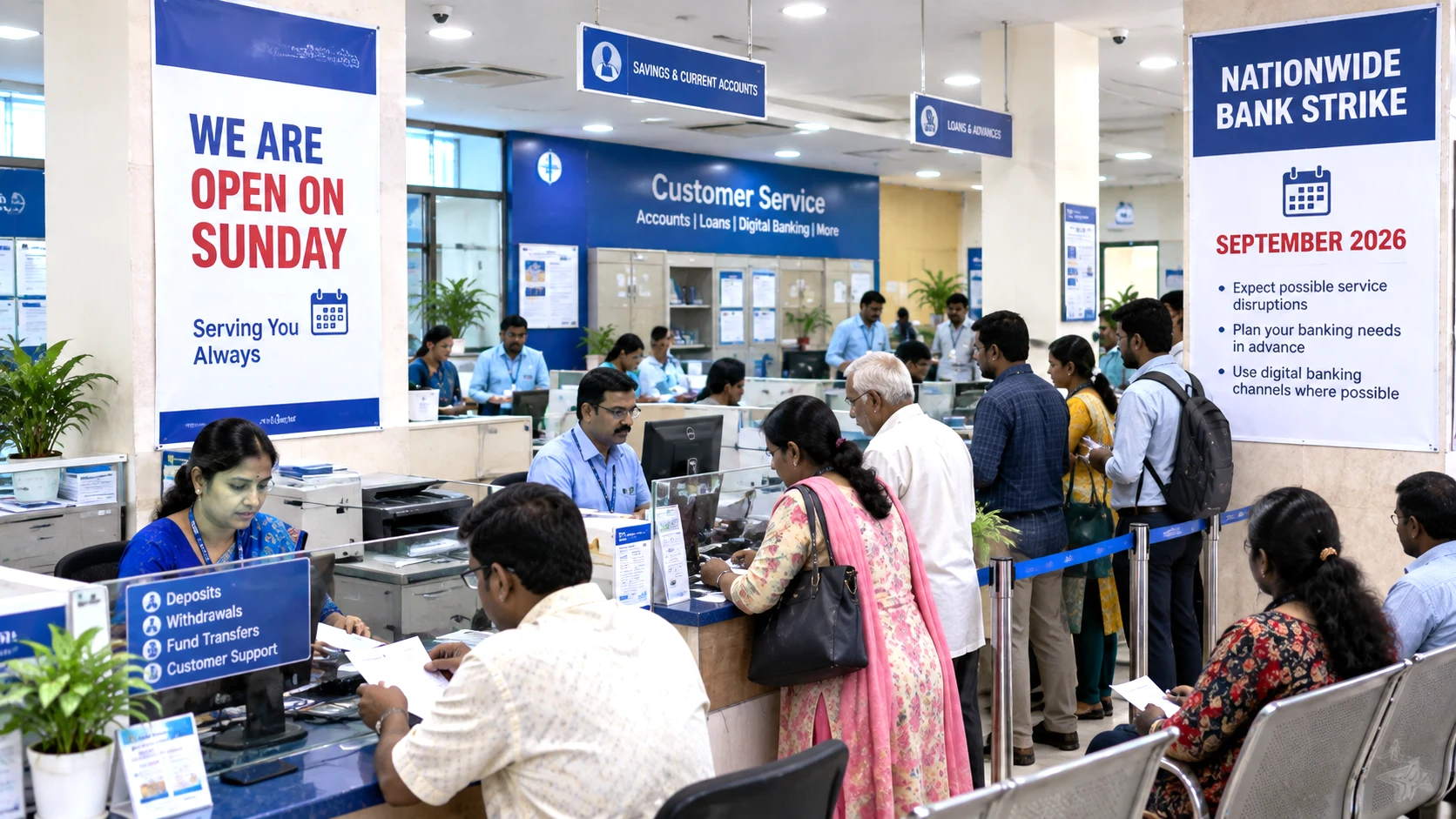
Customers of India's Public Sector Banks and Regional Rural Banks will get an additional branch-banking day before the proposed three-day nationwide bank strike scheduled for September 28–30, 2026.
Curated editorial perspectives matching this topic.
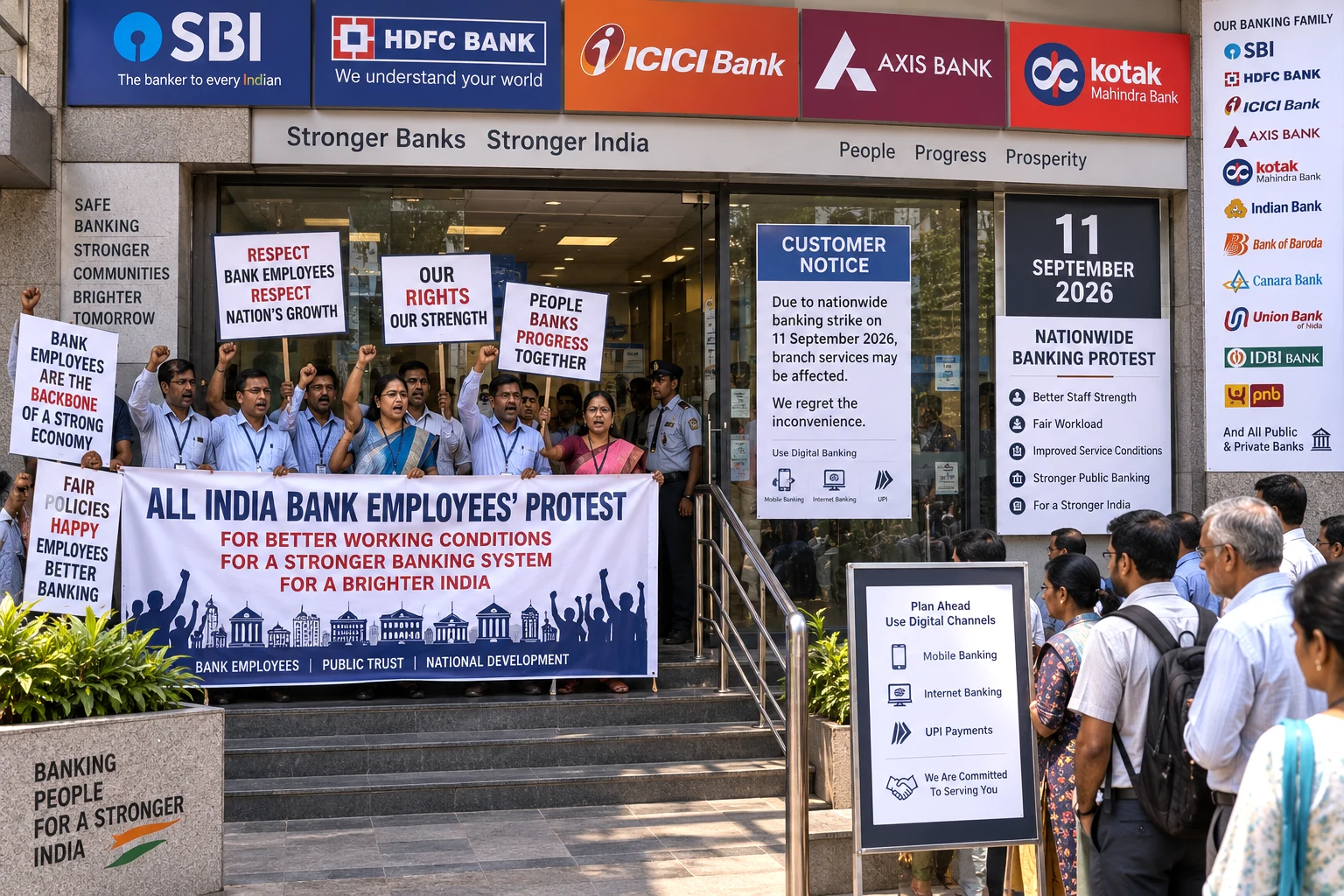
Bank unions will strike nationwide on September 11 over five-day banking and other demands. Here is why employees are protesting, what banks say, how customers may be affected and what happens next.

RBI's MPC meets October 5–7 with economists increasingly expecting a 25 bp repo-rate hike to 5.50%. Here's what that could mean for floating-rate home loans, EMIs and borrowers.
The Ministry of Finance said on Wednesday, September 23, that all Public Sector Banks, or PSBs, and Regional Rural Banks, or RRBs, will function normally on Sunday, September 27. The Reserve Bank of India has approved the opening of branches, offices, ATM-linked branches and currency chests for the day.
The unusual Sunday opening is intended to reduce inconvenience to customers ahead of the strike called by the United Forum of Bank Unions, or UFBU, which is scheduled for Monday, September 28, through Wednesday, September 30.
The development is particularly important because Saturday, September 26, is a fourth Saturday, when scheduled bank branches are ordinarily closed, while September 27 is normally a Sunday holiday.
Without the special Sunday opening, the weekend followed immediately by the proposed three-day strike could have caused a much longer interruption to branch-based banking.
Yes—for Public Sector Banks and Regional Rural Banks covered by the government's announcement.
The Finance Ministry said these banks will function normally on Sunday, September 27, 2026.
The announcement covers:
The RBI has granted approval for these facilities to remain operational on September 27.
Not necessarily.
The official Finance Ministry statement specifically refers to:
Public Sector Banks and Regional Rural Banks.
That includes the government-owned banking network and RRBs.
The statement should not automatically be interpreted as an instruction requiring every private-sector, cooperative or other bank branch in India to open on Sunday.
Customers of private banks should check their own bank's official branch information if they plan to visit on September 27.
Because the government's statement covers all Public Sector Banks, customers of major government-owned lenders such as:
should expect normal Sunday operations on September 27 under the Finance Ministry announcement.
Regional Rural Banks are also included.
Customers may still wish to verify the exact opening hours of their local branch, particularly for specialised counters or services.
The decision is linked directly to the proposed nationwide bank strike.
UFBU has called for a three-day strike on:
The strike follows the weekend of September 26 and 27.
The government said the Sunday opening is intended to ensure that legitimate banking needs are not adversely affected for an extended period.
The Finance Ministry and bank managements have also appealed to the unions to defer the proposed strike while discussions continue.
| Date | Current branch-banking position |
|---|---|
| September 26, Saturday | Fourth Saturday; normally a bank holiday |
| September 27, Sunday | PSBs and RRBs to open under special arrangement |
| September 28, Monday | Proposed UFBU strike |
| September 29, Tuesday | Proposed UFBU strike |
| September 30, Wednesday | Proposed UFBU strike |
The September 28–30 dates remain a proposed strike period.
Union leaders have said the strike will proceed unless there is concrete progress on their demands, but the situation could still change if negotiations produce an agreement.
The United Forum of Bank Unions has maintained its call for a nationwide strike on September 28, 29 and 30.
Following a conciliation meeting involving union representatives, the Indian Banks' Association, the Department of Financial Services and labour authorities, UFBU said it had not received sufficient progress on its central demand for a five-day banking week and would continue with the strike programme.
However, because negotiations and government appeals are continuing, customers should treat the strike as scheduled but still capable of being deferred or modified before September 28.
That distinction is important.
A strike call does not guarantee that every branch will be completely closed.
Actual disruption depends on employee participation, staffing arrangements and contingency measures at individual banks.
The central issue raised by UFBU is implementation of a five-day banking week.
Under the unions' proposal, bank employees would work from Monday to Friday, with all Saturdays becoming holidays.
At present, the second and fourth Saturdays are holidays for scheduled banks, while other Saturdays are generally working days.
UFBU has argued that a five-day banking arrangement was agreed in principle during the 2024 wage-settlement process but has not yet been implemented.
Other employee issues have also been raised during the wider protest programme, including pension-related matters and concerns surrounding the Performance Linked Incentive framework.
The government has said discussions are continuing and has appealed to employees to avoid disruption while unresolved issues are addressed through dialogue.
A conciliation meeting was held on September 22 with representatives of:
UFBU said the talks did not produce the concrete progress it wanted on five-day banking.
According to the union's account, the government said the issue remained under consideration and that the views of multiple stakeholders had to be taken into account.
The unions therefore maintained the September 28–30 strike call.
Yes.
It remains possible that the unions could defer the strike if negotiations produce an acceptable development before September 28.
UFBU has indicated that it would consider a change if there were concrete progress on the five-day-week demand.
Customers should therefore watch for:
Headlines saying banks “will definitely remain closed for three days” may be too absolute while discussions are continuing.
The Finance Ministry's directive applies to all Public Sector Banks, which includes State Bank of India.
SBI branches therefore fall within the September 27 Sunday-opening announcement.
SBI had earlier advised customers to complete important transactions ahead of the proposed strike and to use alternative channels for routine banking if disruption occurs.
Customers with specialised branch requirements may still wish to confirm service availability with their branch.
These are Public Sector Banks and therefore fall within the Finance Ministry's announcement that PSBs will function on September 27.
Several public-sector lenders have also appealed to employees to maintain services and have issued customer advisories ahead of the proposed strike.
Yes.
Regional Rural Banks are specifically included in the Finance Ministry announcement.
RRB branches are expected to function normally on Sunday, September 27, under the special arrangement approved by RBI.
This is particularly important in rural and semi-urban areas where customers may rely more heavily on physical branches for deposits, withdrawals and assisted banking services.
The government says PSBs and RRBs will function normally.
RBI has approved the operation of:
That indicates the Sunday opening is intended to be a regular working day rather than only a limited emergency arrangement.
However, customers needing a specialised service should still consider confirming availability with the relevant bank.
The Finance Ministry has separately asked banks to ensure adequate cash availability through ATMs and related channels ahead of the proposed strike.
Banks have been asked to prepare contingency arrangements intended to minimise disruption if employees participate in the September 28–30 action.
ATM access may therefore continue during the strike period, although local cash availability can still vary depending on demand and replenishment.
UPI is expected to remain available because it is primarily a digital payment system and does not depend on customers entering a bank branch for each transaction.
Banks have advised customers to use digital channels such as:
for routine needs if branch operations are affected.
However, no payment system is guaranteed to be completely free of technical or operational disruption.
Customers with time-sensitive, high-value or documentation-heavy transactions should consider completing them before the strike period.
Banks have indicated that digital banking channels are expected to remain available.
This includes services such as:
SBI and other banks have specifically encouraged customers to use digital channels during the proposed strike period.
If significant numbers of employees participate, services requiring branch staff or manual processing may face delays.
Potentially affected services could include:
Financial Express reported that cheque clearing, settlements and some branch-dependent services could face disruption if the strike proceeds.
The actual impact will depend on participation and the contingency arrangements at individual institutions.
Cheque-related services could face delays if staff participation affects processing operations.
Digital transfers such as UPI and many online bank transfers are less dependent on physical branch staffing, but customers should avoid assuming every payment channel will operate without delay.
Anyone with an important cheque payment, property transaction, business settlement or other time-sensitive branch process may benefit from completing it before September 28.
The proposed strike is centred on unions with significant representation in the public-sector banking system.
Private-sector banks may therefore be less affected overall, although the precise effect can vary depending on employee participation and interconnected banking processes.
Importantly, the Finance Ministry's special Sunday-opening announcement specifically names PSBs and RRBs.
Customers should not assume that every private bank branch will open on September 27.
The proposed strike also coincides with the banking sector's half-yearly closing on September 30.
That date is important for functions including reconciliation, accounting, provisioning and treasury operations.
The timing has therefore increased concern about operational disruption if the strike proceeds.
This is another reason the government and bank managements have appealed to unions to reconsider the action.
Earlier reports warned of the possibility of a five-day stretch of branch disruption:
That scenario has now changed for PSBs and RRBs because September 27 has been converted into a working Sunday.
The Sunday-opening decision breaks what otherwise could have been a five-day run without normal public-sector branch access.
Customers who have important branch-dependent work may consider using the special Sunday opening rather than waiting until the strike dates.
Tasks that may be worth completing include:
Customers should carry the documents normally required for their particular transaction.
People with important financial deadlines during September 28–30 may consider completing branch-dependent tasks early.
Examples include:
This is precautionary planning.
It does not mean every branch will necessarily be closed during the strike.
ATMs are expected to remain available, and the Finance Ministry has asked banks to ensure adequate cash in ATMs and business-correspondent outlets.
However, unusually high withdrawal demand could place pressure on individual machines.
Customers who know they will require significant cash during the strike period may wish to plan ahead rather than depend on one ATM.
If UFBU withdraws or postpones the strike, banks would be expected to issue updated customer advisories.
The September 27 Sunday opening has already been announced by the Finance Ministry, but customers should continue monitoring official updates because arrangements can change.
Any agreement on five-day banking or strike deferral would constitute a significant new development.
UFBU has also announced the possibility of an indefinite strike beginning October 26 if its central demands remain unresolved after the September action.
That is currently a future strike plan rather than a certainty that branches will close indefinitely.
Its status will depend on negotiations and developments after September 30.
The most important current facts are:
As of September 23, 2026:
Customers should rely on their bank's official communication for any final change before the strike begins.
Are banks open on Sunday, September 27, 2026?
Public Sector Banks and Regional Rural Banks will open and function normally on Sunday, September 27, according to the Ministry of Finance.
Is SBI open on September 27?
Yes. SBI is a Public Sector Bank and falls within the government's September 27 Sunday-opening announcement.
Are Regional Rural Banks open on September 27?
Yes. RRBs are specifically included in the Finance Ministry's announcement.
Are private banks open on September 27?
The government's special announcement specifically covers PSBs and RRBs. Customers of private banks should check their own bank's official branch schedule.
When is the bank strike in September 2026?
UFBU has called a nationwide strike for September 28, 29 and 30, 2026.
Is the September 28 bank strike cancelled?
No cancellation had been announced at the latest verification. UFBU has said it intends to proceed unless there is concrete progress on its demands.
Why are bank employees going on strike?
The main unresolved demand is implementation of a five-day banking week. Other employee-related issues have also formed part of the broader union campaign.
Will UPI work during the bank strike?
Digital channels such as UPI, internet banking and mobile banking are expected to remain available, and banks have encouraged customers to use them. Some operational disruption is still possible, so time-sensitive transactions should be planned carefully.
Will ATMs work during the strike?
Banks have been asked to keep ATMs adequately stocked and maintain alternative channels. ATM availability may still vary locally depending on demand and replenishment.
Should I complete banking work on September 27?
If you have important branch-dependent work due around September 28–30, using the special Sunday opening may reduce the risk of inconvenience if the strike proceeds.
Public Sector Banks and Regional Rural Banks will open on Sunday, September 27, after RBI approval. This special arrangement comes ahead of the proposed UFBU nationwide strike from September 28 to 30.
Customers with important branch work should consider using the Sunday opening. Digital channels and ATMs are expected to remain available if the strike goes ahead.
PSBs and RRBs open on Sunday, September 27.
Proposed strike still scheduled for September 28–30.
UPI, mobile banking and ATMs expected to work.
Strike could still be deferred.
The Rajatheertha Team publishes news, explainers, guides and updates across India and the world. Our coverage follows Rajatheertha's editorial, verification and corrections standards.
Rajatheertha follows strict editorial standards. If you have corrections, updates or editorial queries, contact our desk.
Submit an Editorial Correction →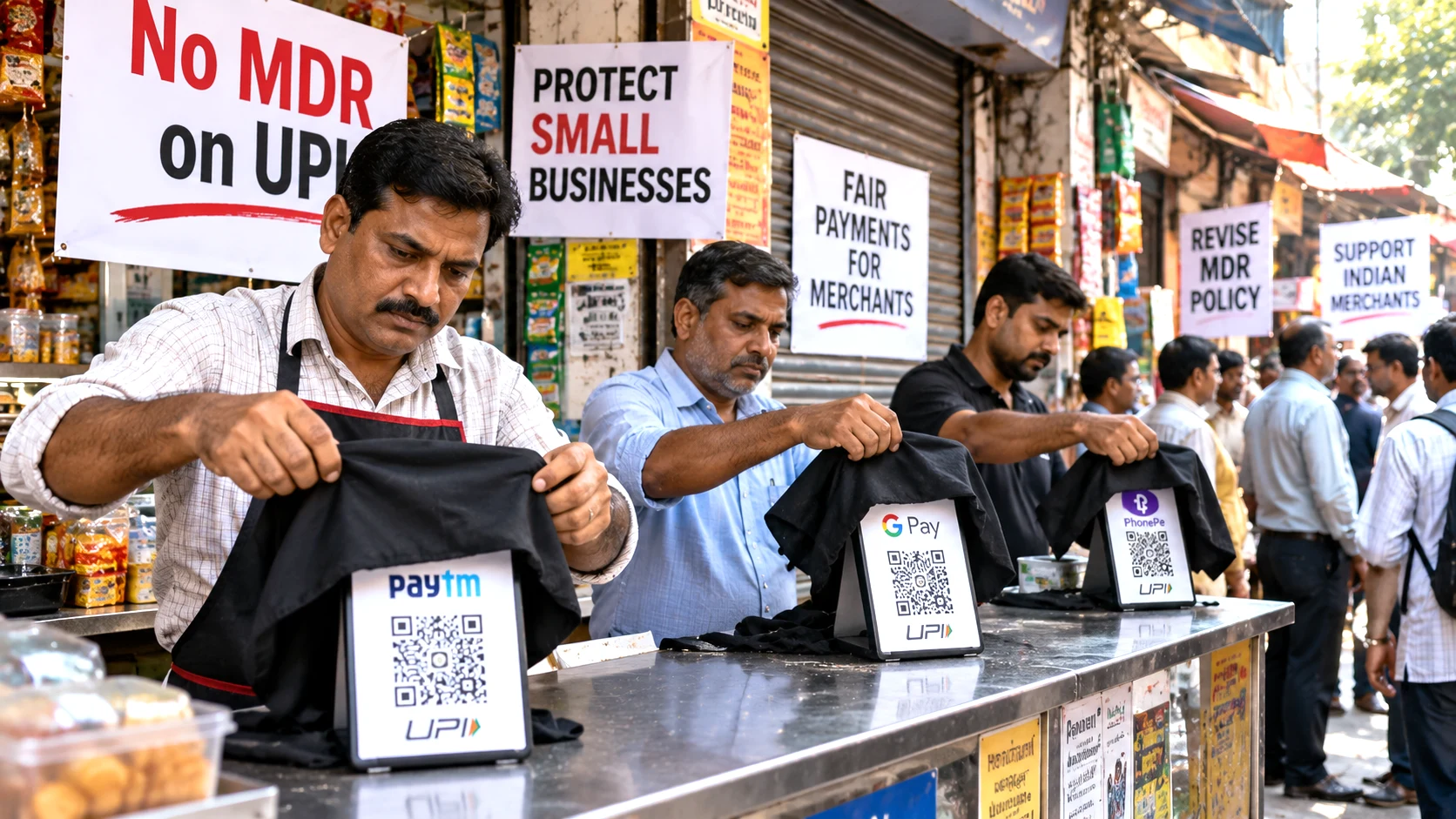
Several trader associations have called for a voluntary “No UPI Day” on October 2 against the new MDR on some merchant UPI payments above ₹2,000. UPI itself will not shut down, customers will not pay the MDR, and most transactions remain free.
Delhi's winter anti-pollution rules will cap physical attendance at 50% in Delhi government and private offices from November 1 to January 31. Essential services are exempt. Parking charges will double, while a separate no-PUCC-no-fuel rule starts across NCR from October 1.

Finance Minister Nirmala Sitharaman says the new UPI MDR is not a tax and cannot be passed on to customers. Here is who actually pays, what changes from October 15 and which UPI transactions remain free.
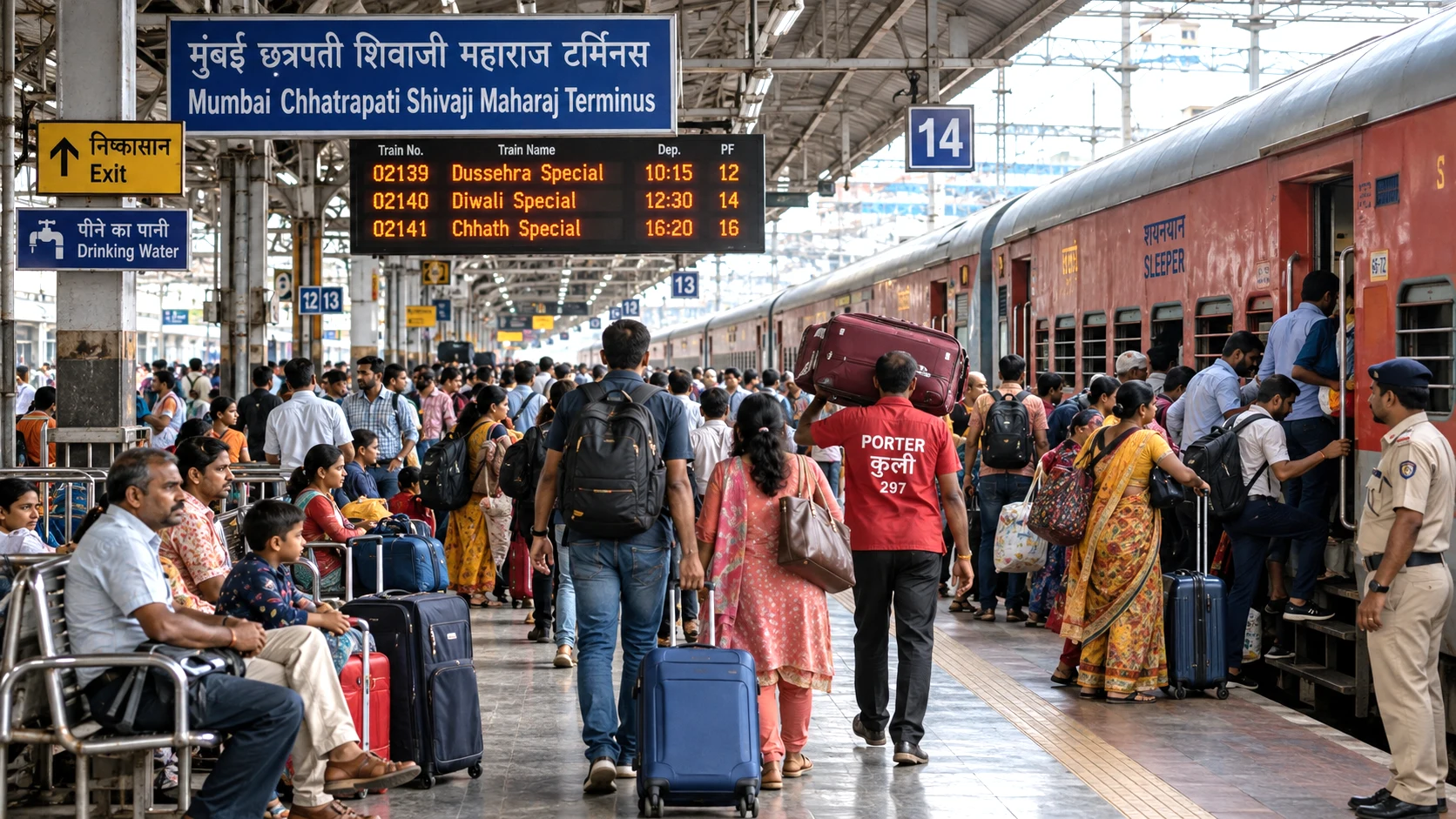
Central Railway has announced 418 festival-special services for Puja, Dussehra, Diwali and Chhath 2026. The first reservation batch opened September 27, with another opening September 28. Check train numbers, routes, dates and official booking options.

S&P Global Ratings has raised India’s FY2026-27 GDP growth forecast to 7% from 6.6% after stronger industrial activity, consumption, exports and government investment. It also sees inflation averaging 5.1% and a possible 25-bps RBI rate hike.
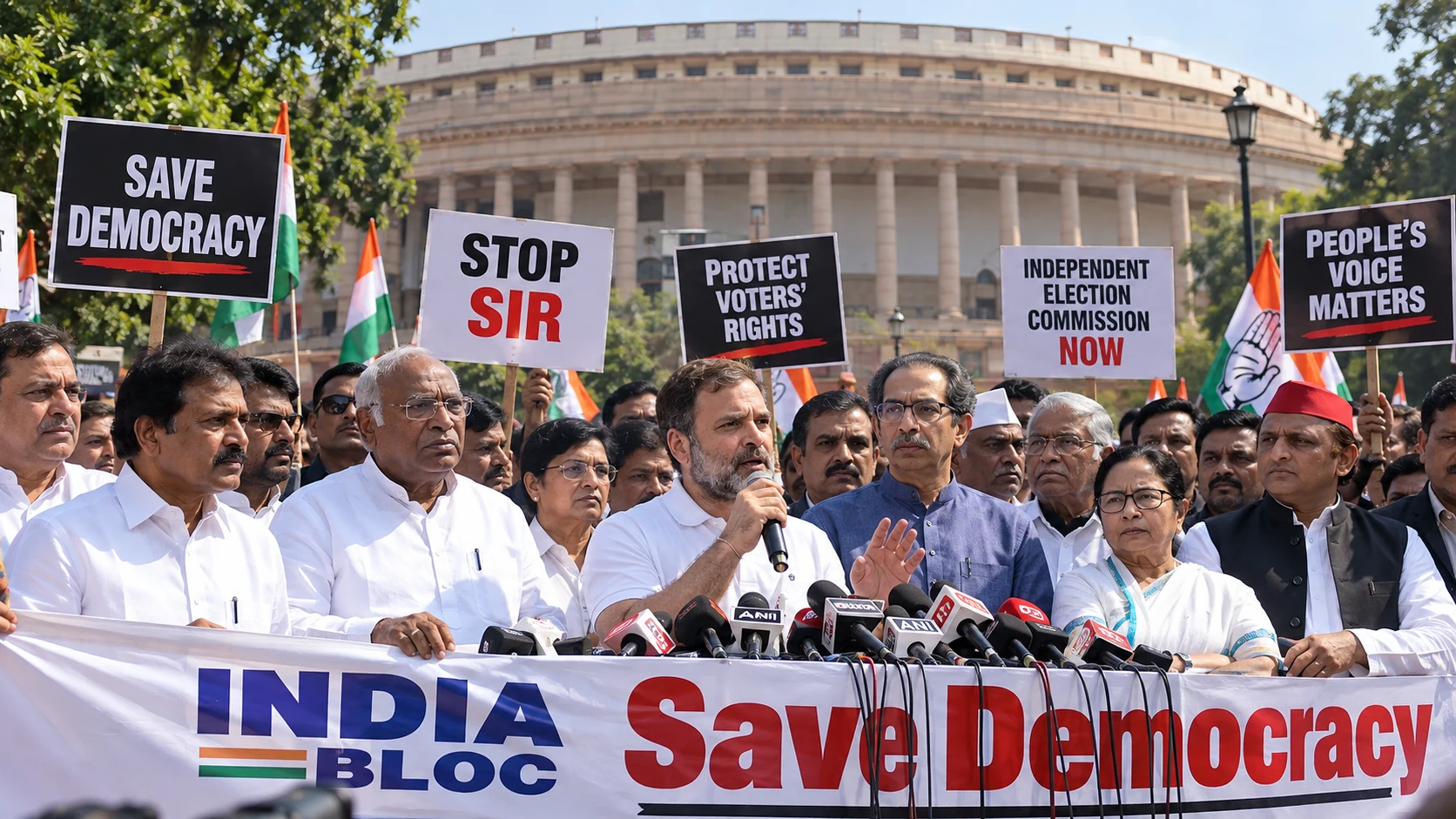
The INDIA bloc has announced nationwide “Save Democracy” marches from Oct. 2–8 over the Election Commission and SIR controversy, with MPs planning an Oct. 6 march to the EC. The BJP has rejected the allegations as political frustration after electoral defeats.

0 Comments