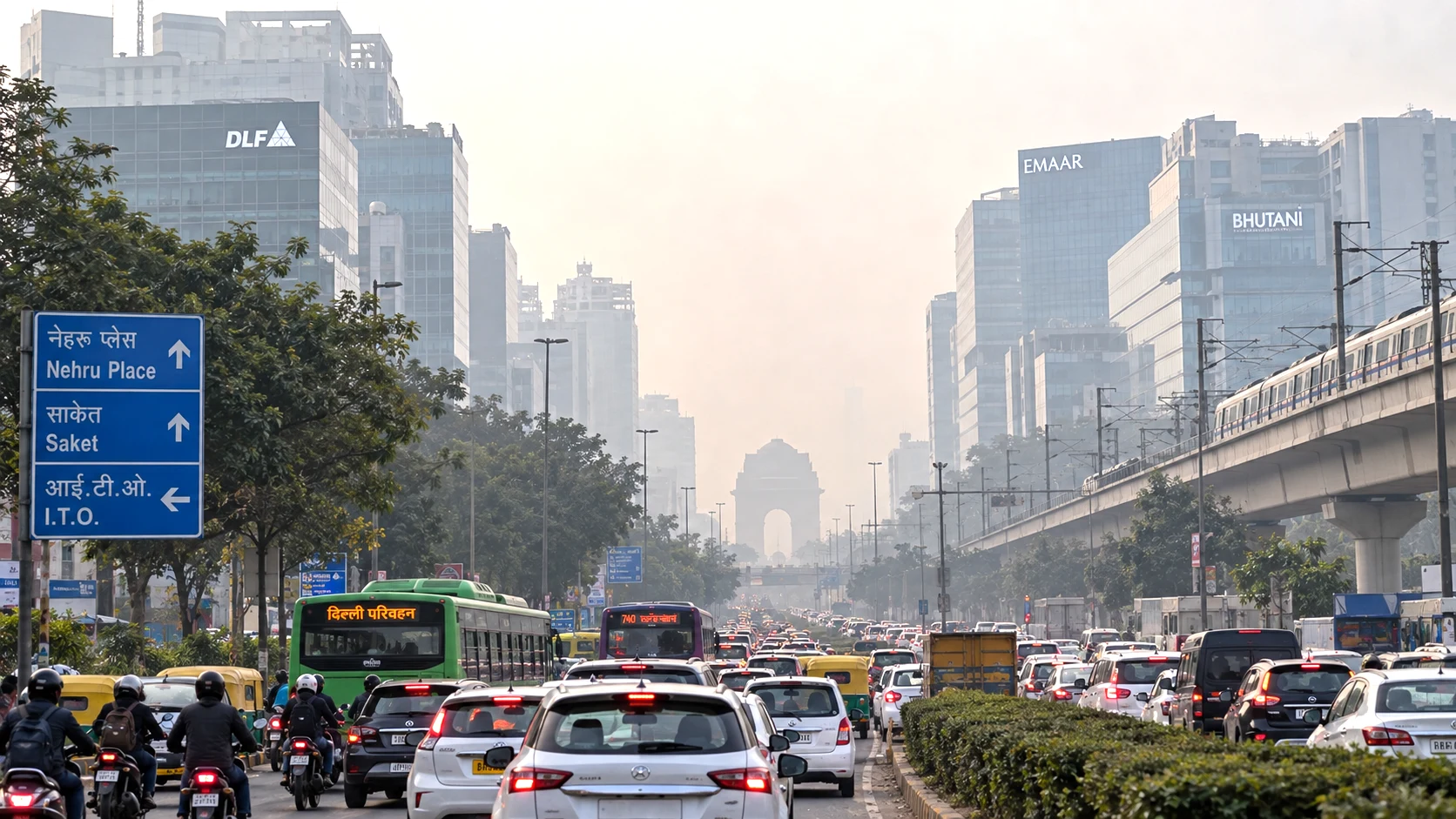
Delhi will impose a 50% physical-attendance limit in Delhi government and private offices from November 1, 2026, to January 31, 2027 as part of a pre-notified winter air-pollution control framework.
Under the rule, no more than half of the applicable workforce should normally be physically present at the workplace, while the remaining employees work from home. Hospitals, emergency services, public transport, power and water services, sanitation, disaster-management operations and several pollution-control functions are exempt.
The workplace measure is only one part of a wider pollution-control package. Delhi will also double charges at most authorised parking facilities from November 1 through February 28, introduce staggered government-office timings and impose seasonal restrictions on some construction activities and older vehicles.
Separately, a much broader “No PUCC, No Fuel” rule takes effect across the entire National Capital Region from October 1, 2026. Under that Commission for Air Quality Management measure, vehicles need a valid Pollution Under Control Certificate to be supplied fuel.
For employees and employers, however, the most immediate question is simpler:
Who exactly has to work from home from November 1?
Delhi WFH Rule at a Glance
| Rule | Applies from | Applies until | Main coverage |
|---|
| 50% physical office attendance | Nov. 1, 2026 | Jan. 31, 2027 | Delhi government and private offices in NCT Delhi |
| Staggered MCD/GNCTD office timings | Nov. 1, 2026 | Feb. 28, 2027 | MCD and Delhi government offices |
| Double authorised parking fees | Nov. 1, 2026 | Feb. 28, 2027 | Delhi parking sites, except DMRC-managed parking |
| No PUCC, No Fuel | Oct. 1, 2026 | Continuing | Entire Delhi-NCR |
| Dust-generating demolition/outdoor construction curbs | Nov. 1, 2026 | Jan. 31, 2027 | Delhi, subject to stated exemptions |
The dates and scope come from Delhi's June 23 pollution-control directions and subsequent government announcements.
Who Is Covered by Delhi's 50% Work-From-Home Rule?
The notification divides the workplace rule into two major categories.
1. Delhi Government Employees
For government offices under the Government of the National Capital Territory of Delhi, Administrative Secretaries and Heads of Departments are required to attend office regularly while ensuring that no more than 50% of staff are physically present.
The remaining 50% are to work from home.
However, the rule gives department heads operational flexibility.
Administrative Secretaries and Heads of Departments can require particular officers or employees to attend the workplace when their physical presence is needed to maintain uninterrupted delivery of essential or emergency public services.
That means an employee should not assume that being part of the nominal work-from-home half guarantees remote work on every day of the period. Departments can organise rosters and call personnel in when operational requirements justify it.
Does the Rule Cover Central Government Employees in Delhi?
The June 23 Delhi direction specifically refers to “Government Offices under GNCTD” when describing the 50% staff rule.
It therefore should not be read as a blanket order automatically placing all Central government ministries, departments and offices located in Delhi under the same Delhi-government attendance mandate.
Central government departments may be subject to separate directions, institutional policies or additional measures if authorities issue them.
For employees, the safest approach is to follow the roster or circular issued by their own department rather than assuming that every government office in the capital is governed identically.
Are Private Companies Covered?
Yes.
The Delhi notification is unusually explicit on this point.
It states that all private offices functioning within the National Capital Territory of Delhi should operate with not more than 50% of staff physically attending the workplace from November 1 through January 31.
The remaining staff are required to work from home.
Private employers are also directed to reduce commuting-related traffic through measures such as:
- staggered working hours;
- car-pooling;
- ride-sharing;
- common employee buses; and
- greater use of public transport.
This makes the rule broader than a voluntary work-from-home advisory for the private sector.
Does the Rule Apply to Gurugram, Noida, Ghaziabad and Other NCR Offices?
Not under this particular Delhi 50% WFH direction.
The June 23 workplace provision specifically applies to offices functioning within the NCT of Delhi.
That means a private office in Gurugram, Noida, Greater Noida, Ghaziabad, Faridabad or another NCR district is not automatically brought under Delhi's 50% workplace-attendance direction simply because it is part of the NCR.
Those areas may be governed by their respective state governments, local authorities and CAQM directions.
This distinction is particularly important because another measure — No PUCC, No Fuel — does apply across the entire NCR from October 1.
In other words:
WFH rule: Delhi-specific.
No-PUCC fuel rule: NCR-wide.
What If You Live in Noida or Gurugram but Work in Delhi?
The location of the office, rather than merely the employee's home address, is the important factor under the Delhi private-office provision.
If a private company's workplace functions within NCT Delhi, it falls within the language of the Delhi direction even if some employees commute from neighbouring NCR cities.
Employers will still need to decide individual rosters and remote-work arrangements.
What If You Live in Delhi but Work in Gurugram or Noida?
Delhi's notification does not by itself impose the 50% workplace rule on an office located outside NCT Delhi.
An employee living in Delhi but commuting to Gurugram, for example, would need to follow the rules applicable to the employer's workplace and any orders issued by Haryana, CAQM or other competent authorities.
Which Services Are Exempt From the WFH Rule?
The notification exempts essential and emergency services.
The listed exemptions include:
- hospitals;
- other public and private healthcare establishments;
- fire services;
- prisons;
- public transport;
- electricity services;
- water supply;
- sanitation and allied municipal services;
- disaster-management services;
- emergency-response agencies;
- forest departments and teams;
- environment and air-pollution control agencies;
- pollution-monitoring and enforcement teams;
- biomass-burning prevention teams;
- dust-mitigation teams; and
- personnel involved in implementing or enforcing GRAP pollution measures.
The Environment Department can also designate other essential or emergency services as exempt when required.
Are Hospitals and Private Healthcare Companies Required to Keep 50% Staff at Home?
Not under the general mandate.
The exemption explicitly includes public and private healthcare establishments, because staffing hospitals and other healthcare facilities is considered essential.
Individual healthcare organisations may still allow remote work for administrative roles where practical, but that is different from being compelled by the 50% attendance rule.
Does It Mean Every Employee Gets Alternate-Day WFH?
Not necessarily.
The legal requirement concerns the overall limit on physical attendance.
Employers may design compliant rosters in different ways depending on operational requirements.
For example, a company could divide employees into rotating teams, assign different remote-working days or use another arrangement that keeps workplace attendance within the permitted ceiling.
Recent government reporting has also referred to a possible two-days-per-week work-from-home model as part of implementation, but the underlying notification's central requirement is that no more than 50% of applicable staff be physically present.
Employees should therefore wait for their employer's formal roster rather than assuming a specific alternate-day pattern.
When Does Delhi's WFH Rule Start?
The rule begins on:
November 1, 2026.
It continues through:
January 31, 2027.
This is an important distinction because some other parts of Delhi's winter pollution framework continue until February 28.
Does 50% WFH Continue Until February 28?
Under the June 23 notification, no.
The 50% physical-attendance provision runs from November 1 to January 31.
The measures that continue through February 28 include the seasonal doubling of authorised parking charges and the staggered timings prescribed for certain Delhi government offices.
Some early news summaries have grouped all winter measures under the wider November-to-February framework, which can make the WFH period appear longer than the detailed notification specifies.
What Are the New Delhi Government Office Timings?
Separate from the 50% attendance rule, Delhi has prescribed staggered working hours to reduce peak-hour congestion.
From November 1 through February 28:
- MCD offices: 8:30 am to 5:00 pm
- GNCTD offices: 10:00 am to 6:30 pm.
The purpose is to spread commuting demand over a longer period rather than having large groups of employees travel simultaneously.
Private entities have also been directed to introduce staggered working hours.
Delhi Parking Charges Will Double From November 1
Existing charges at authorised parking sites in Delhi will be doubled from November 1 through February 28.
There is an important exception:
Parking spaces owned and managed by Delhi Metro Rail Corporation are exempt from the doubling rule.
The exemption reflects the government's attempt to discourage private-car use without making park-and-ride access to the Metro more expensive.
Does Every Parking Lot in Delhi Automatically Charge Double?
The notification refers to authorised parking sites.
Consumers should therefore avoid assuming that every privately operated or informal parking area necessarily falls under the same pricing mechanism without checking the site's status and applicable local authority rules.
The specific exemption for DMRC-owned and managed parking is expressly written into the notification.
No PUC, No Fuel Starts October 1 — Not November 1
Vehicle owners should distinguish the workplace rules from the fuel rule.
The Commission for Air Quality Management approved Direction No. 101 requiring valid Pollution Under Control certification for fuel dispensing across the entire National Capital Region from October 1, 2026.
That means motorists should not wait until November 1 to renew an expired PUCC.
Does the No-PUC Rule Apply Only in Delhi?
No.
CAQM's direction extends the fuel restriction to the entire NCR, not merely the NCT of Delhi.
This is broader geographically than Delhi's 50% WFH rule.
In Delhi itself, authorities have said enforcement will operate in “mission mode” at about 500 fuel stations equipped with Automatic Number Plate Recognition cameras.
Does a Vehicle Need PUC to Buy CNG Too?
Yes.
Delhi's own pollution-control direction expressly covers petrol, diesel and CNG/LPG retail outlets and requires them to dispense fuel only to motor vehicles with valid PUCC documentation.
CAQM's NCR-wide direction also requires valid PUCC before fuel is supplied across the region from October 1.
How Will PUC Certificates Be Checked?
Delhi's direction allows verification through:
- the physical certificate;
- Automatic Number Plate Recognition systems;
- electronic verification;
- the VAHAN database; and
- other centralised databases where applicable.
The system is intended to make enforcement less dependent on motorists carrying only a paper copy.
Vehicle owners should nevertheless ensure that the official record correctly shows a valid certificate.
Do Electric Vehicles Need a PUC Certificate?
Pure battery-electric vehicles do not produce tailpipe exhaust emissions and are generally outside conventional PUCC testing requirements.
The relevant government rules should still be checked for the particular vehicle category, but the new policy should not be interpreted as creating an exhaust-emission certificate for a vehicle category that is not normally subject to PUCC testing.
What Happens to Vehicles Registered Outside Delhi?
Another seasonal restriction begins November 1.
From November 1 through January 31, motor vehicles registered outside Delhi and below BS-VI emission standards will not be permitted to ply in Delhi.
The notification exempts:
- CNG vehicles;
- electric vehicles;
- ambulances;
- fire tenders;
- police vehicles; and
- other specifically exempted categories.
This is separate from the no-PUCC rule.
A vehicle could therefore potentially have a valid PUCC and still face the separate seasonal entry restriction if it falls within the restricted non-BS-VI category.
Construction Restrictions Also Begin November 1
Delhi will also restrict dust-generating demolition activity and outdoor civil construction from November 1 through January 31, subject to exemptions for essential public-infrastructure work.
Finishing, plumbing and electrical work within construction sites can continue subject to dust-control and construction-waste requirements.
A stricter complete construction-and-demolition ban is scheduled from December 10 through January 20, except for specified urgent government, public-infrastructure and emergency works.
Why Is Delhi Imposing the Rules Before Air Quality Reaches Emergency Levels?
Historically, many of Delhi's strongest pollution measures have been activated through the Graded Response Action Plan, or GRAP, after pollution reaches or is forecast to reach specified thresholds.
Delhi's newer framework instead schedules several measures in advance for the recurring winter pollution season.
The June notification says air-quality data from the previous three winters showed that deterioration commonly begins during the November-to-February period, which the government cited as a reason for predictable annual interventions rather than relying only on reactive restrictions.
More stringent GRAP measures can still apply if air pollution worsens enough for CAQM to invoke them.
Is the WFH Rule Optional for Private Companies?
The language of the notification is stronger than a recommendation.
It says private offices functioning within NCT Delhi shall operate with not more than 50% staff physically attending the workplace, with the remaining staff working from home.
It also assigns District Magistrates, Deputy Commissioners of Police and local bodies roles in publicising and enforcing compliance among private offices.
The practical implementation details may still depend on sector-specific instructions and any subsequent government clarification.
Can Employers Call WFH Employees Back to Office?
For GNCTD offices, the notification explicitly allows Administrative Secretaries and Heads of Departments to call staff in when necessary to ensure uninterrupted essential or emergency services.
For ordinary private offices, the direction is framed around maintaining no more than 50% physical attendance.
Employers can therefore organise which employees attend on particular days, but they must remain within applicable attendance limits unless the establishment or service falls within an exemption.
What Should Delhi Employees Do Before November 1?
Employees do not need to independently decide whether they will work remotely.
They should watch for a formal roster or circular from their employer explaining:
- which employees will attend physically;
- which employees will work remotely;
- whether teams will rotate;
- what working hours apply;
- whether their service falls under an exemption; and
- whether subsequent GRAP measures change the arrangement.
For private employers with offices inside Delhi, preparations may include adjusting attendance systems, remote-access infrastructure and commuting arrangements before November 1.
What Should Vehicle Owners Do Now?
Unlike the WFH rule, the NCR fuel restriction begins on October 1.
Drivers should therefore check whether their vehicle's Pollution Under Control Certificate is currently valid.
The Delhi government has said enforcement is being intensified at fuel stations using ANPR and electronic databases, while the NCR-wide policy is based on CAQM's Direction No. 101.
What Happens If Delhi's Air Becomes Much Worse?
The scheduled winter rules do not replace GRAP.
If pollution reaches higher categories, CAQM can impose additional restrictions under the Graded Response Action Plan.
Those measures can be more stringent than the pre-scheduled winter rules, and the Delhi notification states that stricter GRAP requirements will prevail where applicable.
That means office attendance, construction, transport or other rules could change further during a severe pollution episode.
Delhi November 1 Rules: The Simple Version
For most readers, the rules can be reduced to five practical points:
If you work for the Delhi government: your department generally has to keep physical attendance to no more than 50% from November 1 to January 31, unless service requirements require your presence.
If you work for a private office physically located in Delhi: your workplace is also covered by the 50% attendance rule, unless it is part of an exempt essential or emergency service.
If you work in Gurugram, Noida or elsewhere outside Delhi: the Delhi WFH direction does not automatically cover your workplace.
If you drive in Delhi-NCR: the valid-PUCC fuel requirement starts from October 1 across NCR, independently of the November WFH rule.
If you park at an authorised Delhi parking facility: expect charges to double from November 1 to February 28, except at DMRC-owned and managed parking locations.
Why This Matters
The new framework represents a shift from relying entirely on emergency pollution responses towards scheduling disruptive measures before Delhi's worst winter-smog period.
For office workers, that creates greater predictability about remote work.
For employers, however, it also means advance compliance planning.
And for motorists, the most immediate deadline is already here: October 1, when the NCR-wide valid-PUCC requirement for obtaining fuel takes effect.
The effect of these measures on Delhi's air quality will depend on enforcement, compliance and the many other sources that influence winter pollution. The rules themselves should therefore be described as pollution-control measures, not as a guarantee that smog or unhealthy air will be eliminated.
Frequently Asked Questions
When does Delhi's 50% work-from-home rule begin?
It begins on November 1, 2026, and the notified 50% office-attendance requirement continues through January 31, 2027.
Is work from home mandatory for private offices in Delhi?
The notification says private offices functioning within NCT Delhi must operate with no more than 50% of staff physically present, with the remaining staff working from home, subject to essential-service exemptions.
Does Delhi WFH continue until February 28?
The 50% physical-attendance provision ends January 31 under the notification. Parking-fee increases and staggered government-office timings continue through February 28.
Are hospitals covered by the 50% WFH rule?
Hospitals and other public and private healthcare establishments are explicitly listed among exempt essential services.
Does the Delhi WFH order apply to Gurugram and Noida?
The Delhi notification applies to offices within NCT Delhi. It does not itself impose the same workplace requirement on offices located in Gurugram, Noida or other NCR districts.
Do Central government employees in Delhi automatically fall under it?
The June 23 direction specifically identifies GNCTD government offices. It should not be interpreted as a blanket 50% WFH order covering every Central government office unless additional applicable directions are issued.
When do Delhi parking charges double?
Authorised parking charges are scheduled to double from November 1 through February 28, except at parking facilities owned and managed by DMRC.
When does No PUC, No Fuel start?
CAQM's NCR-wide valid-PUCC fuel requirement takes effect October 1, 2026.
Is the PUC fuel rule limited to Delhi?
No. CAQM's direction applies to the entire National Capital Region.
Does the rule cover CNG stations?
Yes. Delhi's detailed direction expressly covers petrol, diesel and CNG/LPG retail outlets.
Bottom Line
Delhi’s 50% physical-attendance rule for government and private offices in NCT Delhi runs from November 1, 2026 to January 31, 2027. Essential services are exempt.
Parking charges double from November 1 to February 28 (except DMRC). The NCR-wide “No PUCC, No Fuel” rule is already in force from October 1. Check your office location and employer roster for exact coverage.
Key Takeaway
Delhi 50% WFH: Nov 1 – Jan 31.
Covers GNCTD & private offices in NCT Delhi.
Essential services exempt.
No PUCC, No Fuel already live across NCR from Oct 1.






0 Comments