Busiest Railway Station in India: Thane Tops Passenger List With 9.3 Crore; Top 10 Ranked
Which is the busiest railway station in India? Railway Board FY 2023–24 data puts Thane at No. 1 with 9.30 crore originating passengers. See the top 10 ranking, where New Delhi, Howrah, CSMT, Sealdah and Chennai Central stand, and what “busiest” actually means.
Thane railway station in Maharashtra, ranked first in FY 2023–24 originating passenger numbers with 9.30 crore passengers
Table of Contents (22 sections)
Ask someone to name the busiest railway station in India, and the likely answers are New Delhi, Howrah, Mumbai CSMT or Sealdah.
But on one important official measure, the answer is Thane railway station in Maharashtra.
Railway Board station-categorisation data based on the 2023–24 financial year records 9,30,67,283 originating passengers at Thane, the highest figure among the stations appearing in the nationwide ranking now receiving renewed attention. Kalyan follows with about 8.38 crore passengers, while Howrah is third at approximately 6.13 crore.
There is, however, an important qualification.
The figures frequently being described online as annual “footfall” are more precisely Railway Board data for passengers on an originating or outward basis. Railway categorisation uses passenger earnings and the number of outward passengers handled at a station. It therefore should not be interpreted as a turnstile-style count of every person who entered, exited, changed trains or walked through a station.
Recommended Reading
Related Stories & In-Depth Guides
Curated editorial perspectives matching this topic.
The 18th BRICS Summit concluded in New Delhi with leaders adopting the New Delhi Declaration by consensus, as India handed the chairship to China for 2027.
Neither the Mamata Banerjee group nor the rival faction formally represented before the Election Commission by Arup Roy can use the All India Trinamool Congress name or its reserved symbol in the October 6 bypolls. The order is temporary while the ECI decides the larger party-control dispute under P
So the most accurate answer is:
Thane is India’s busiest railway station by the FY 2023–24 originating-passenger count used in the latest Railway Board station categorisation.
Top 10 Busiest Railway Stations in India by Passenger Count
The ranking based on the FY 2023–24 passenger figures is:
Rank
Railway Station
State/UT
FY 2023–24 Passengers
1
Thane
Maharashtra
9,30,67,283
2
Kalyan
Maharashtra
8,37,92,667
3
Howrah
West Bengal
6,13,29,319
4
Mumbai CSMT
Maharashtra
5,16,52,230
5
Sealdah
West Bengal
5,13,69,230
6
Panvel
Maharashtra
4,62,58,375
7
New Delhi
Delhi
3,96,32,272
8
Tambaram
Tamil Nadu
3,27,85,188
9
Dadar
Maharashtra
3,22,69,116
10
MGR Chennai Central
Tamil Nadu
3,05,95,837
The individual figures are reported in the Railway Board's FY 2023–24 station-categorisation dataset and have also been reflected in reporting on the nationwide ranking.
1. Thane — 9.30 Crore Passengers
Thane railway station, station code TNA, ranks first with 9,30,67,283 originating passengers during FY 2023–24.
That works out to a simple annual average of roughly 2.54 lakh originating passengers per day across the 366 days of that financial year.
This calculation is useful because some online reports have incorrectly converted the annual figure into around 25 lakh passengers per day. Dividing 9.30 crore by the number of days in FY 2023–24 gives approximately 2.54 lakh—not 25 lakh.
The annual figure itself should also not be confused with the total physical crowd present at the station during a day. Transfers, arrivals and other movements can make actual station activity different from the originating-passenger measure used for railway categorisation.
Why Is Thane So Busy?
Thane sits within the enormous Mumbai suburban railway ecosystem.
Central Railway states that the Thane–Turbhe–Vashi double-line section forms part of the suburban network, helping connect Thane with the Navi Mumbai side of the metropolitan region.
The Thane district administration itself describes Thane as the busiest station on Mumbai's suburban network.
The FY 2023–24 Railway Board data provides another clue to Thane's extraordinary passenger volume.
Of its 9.30 crore originating passengers, approximately 8.98 crore were recorded in the unreserved category, while roughly 32.37 lakh were reserved passengers. That means around 96.5% of the recorded passenger volume was unreserved, consistent with its commuter-heavy role.
2. Kalyan — 8.38 Crore Passengers
Kalyan, another crucial station in the Mumbai metropolitan railway system, ranks second with 8,37,92,667 passengers.
Kalyan's position reinforces one of the most striking conclusions from the ranking: India's highest-volume railway stations are not necessarily its best-known intercity terminals.
Mass suburban commuting can generate enormous passenger counts.
Kalyan also acts as an important point on Central Railway's suburban network as rail corridors spread towards the outer Mumbai metropolitan region.
3. Howrah — 6.13 Crore Passengers
Howrah railway station ranks third with 6,13,29,319 originating passengers in FY 2023–24.
Howrah remains one of India's most important long-distance rail gateways and a principal railway hub serving Kolkata and eastern India.
Its passenger count is considerably below Thane's on this dataset, although “busiest” can look different when metrics such as long-distance trains, station revenue, platform movements or total physical station users are considered.
That distinction is one reason readers may encounter different answers to the question, “What is India's busiest railway station?”
4. Mumbai CSMT — 5.17 Crore Passengers
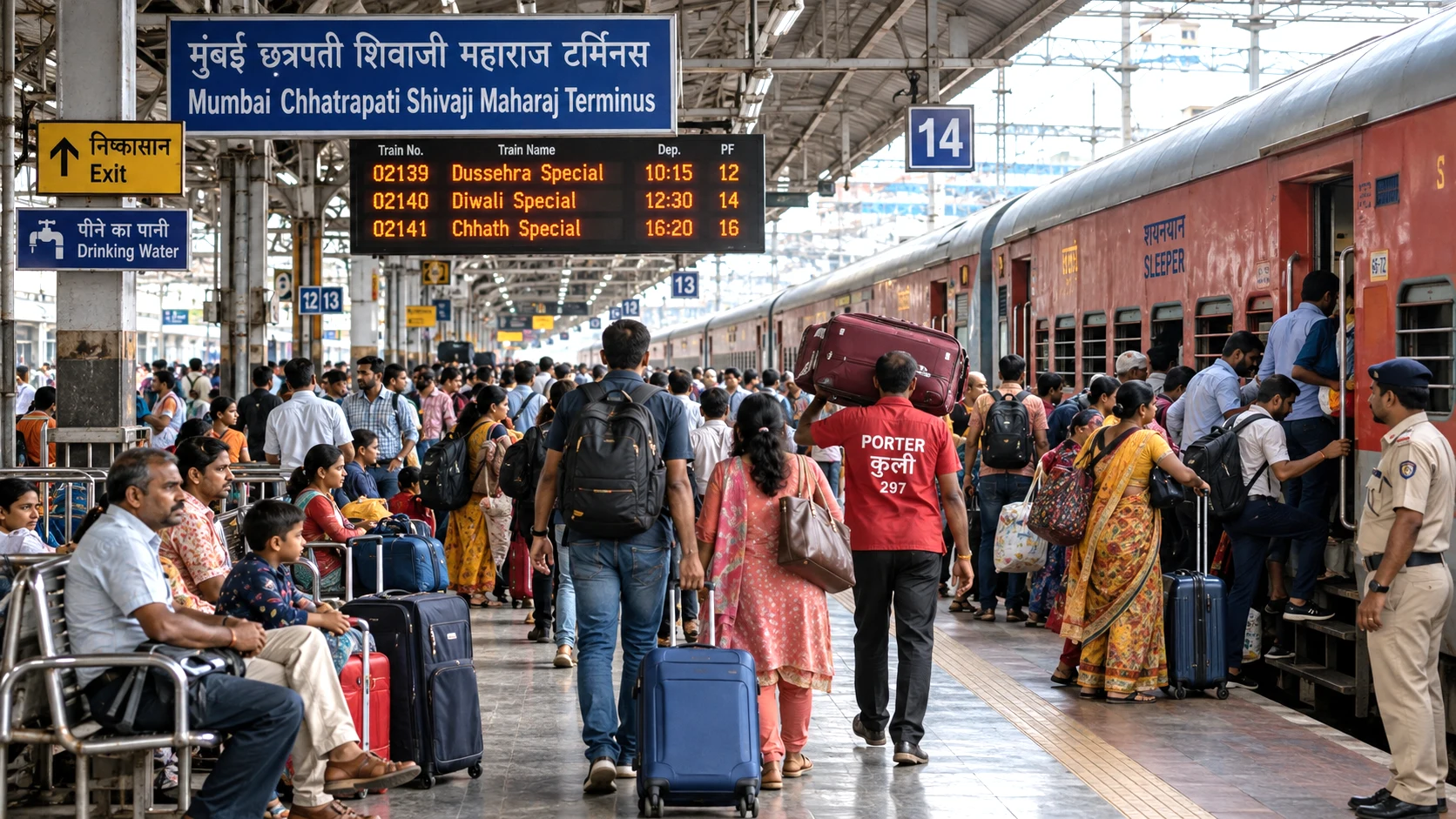
Chhatrapati Shivaji Maharaj Terminus, or Mumbai CSMT, recorded 5,16,52,230 originating passengers.
CSMT is particularly significant because of its combination of suburban and long-distance traffic.
It also occupies a central place in Indian railway history.
India's first passenger railway service began between Bombay and Thane on April 16, 1853. Government railway histories describe the pioneering route as roughly 34 kilometres long.
That creates an unusual historical connection between today's ranking leader, Thane, and the birthplace of passenger railway travel in India.
5. Sealdah — 5.14 Crore Passengers
Sealdah in West Bengal ranks fifth with 5,13,69,230 passengers.
Together, Howrah and Sealdah demonstrate the enormous railway demand generated by the Kolkata metropolitan region and eastern India's wider rail network.
The difference between Mumbai CSMT and Sealdah in this dataset is relatively small: roughly 2.83 lakh passengers over the full financial year.
6. Panvel — 4.63 Crore Passengers
Panvel recorded 4,62,58,375 originating passengers, putting it sixth nationally on this ranking.
Its presence gives the Mumbai metropolitan area another station among India's highest-volume passenger hubs.
Panvel's role connects suburban movement with routes extending towards the wider Maharashtra and Konkan rail network.
7. New Delhi — 3.96 Crore Passengers
Perhaps the biggest surprise is the position of New Delhi Railway Station.
New Delhi recorded 3,96,32,272 passengers, placing it seventh on this passenger-count ranking.
That does not mean New Delhi is an unimportant or relatively small railway station.
The same dataset shows a very different picture when passenger earnings are considered.
New Delhi generated approximately ₹3,337.66 crore in originating passenger earnings, substantially more than Thane's roughly ₹280.97 crore.
The reason passenger count and revenue rankings can differ is straightforward: a suburban commuter travelling a short distance and a reserved long-distance passenger both count as passengers, but the fares associated with their journeys can be very different.
Thus:
Thane leads this passenger-volume ranking. New Delhi is far stronger when measured by originating passenger earnings.
8. Tambaram — 3.28 Crore Passengers
Tambaram in Tamil Nadu recorded 3,27,85,188 originating passengers, ranking eighth.
Its inclusion highlights the importance of Chennai's suburban passenger system.
Like Thane, the large number of unreserved travellers contributes heavily to its overall passenger count.
9. Dadar — 3.23 Crore Passengers
Mumbai's Dadar station ranks ninth with 3,22,69,116 passengers.
Dadar's inclusion means Maharashtra occupies five places in the national top 10:
Thane
Kalyan
Mumbai CSMT
Panvel
Dadar
All five are located within the wider Mumbai metropolitan railway environment.
That concentration helps explain why the Mumbai suburban railway system plays such an outsized role in India's passenger-rail numbers.
10. MGR Chennai Central — 3.06 Crore Passengers
Completing the top 10 is MGR Chennai Central, with 3,05,95,837 passengers.
Unlike the predominantly commuter-driven stations near the top of the ranking, Chennai Central is also a major long-distance terminal.
Tamil Nadu therefore has two stations in the top 10: Tambaram and MGR Chennai Central.
Which State Has the Most Stations in the Top 10?
Maharashtra dominates the list with five stations.
They are:
Thane
Kalyan
Mumbai CSMT
Panvel
Dadar
West Bengal contributes Howrah and Sealdah, while Tamil Nadu contributes Tambaram and MGR Chennai Central. Delhi is represented by New Delhi.
This means half of the national top 10 on this passenger-count measure comes from Maharashtra's Mumbai-region rail system.
What Does “Busiest Railway Station” Actually Mean?
This is the most important part of the ranking.
There is no single universal measurement of station busyness.
A station could be described as busiest according to:
passengers originating there;
total physical footfall;
passengers entering and exiting;
interchange passengers;
trains handled;
suburban services;
long-distance services;
passenger revenue;
or peak-hour crowding.
The Railway Board's September 10, 2024 categorisation order states that its revised station categories are based on passenger earnings and the number of outward passengers handled, using data supplied by zonal railways for FY 2023–24.
Railway rules further explain that passengers handled for categorisation are based on people boarding at the station, covering reserved and unreserved passengers.
Therefore, saying simply “Thane has 9.3 crore people walking through the station every year” would overstate what the underlying dataset establishes.
The safer formulation is:
Thane recorded 9.30 crore originating passengers in FY 2023–24, the highest total in the Railway Board station-categorisation data.
Is the 9.3-Crore Figure From 2026?
No.
This distinction is particularly important because the ranking became widely discussed again in October 2026.
The underlying figures are from financial year 2023–24, not a fresh count of passengers during 2026.
The Railway Board order revising station categorisation was dated September 10, 2024 and states explicitly that the exercise used FY 2023–24 passenger and earnings data supplied by zonal railways.
Readers should therefore not interpret the ranking as saying exactly 9.30 crore people used Thane during calendar year 2026.
Why Does Indian Railways Categorise Stations?
Station categorisation is not merely about creating rankings.
The Ministry of Railways has said passenger numbers and earnings are used partly to determine station categories and help plan passenger amenities and services.
Railway Board rules divide stations into categories including:
Non-Suburban Grade, or NSG;
Suburban Grade, or SG;
and Halt Grade, or HG.
The categorisation is intended to reflect traffic and other operational considerations so that facilities can be planned according to a station's importance and passenger demand.
Railway rules also provide for the categorisation exercise to be reviewed periodically. The 2024 Railway Board order states that the latest revision used FY 2023–24 data.
Thane's Historic Railway Connection
Thane is not only significant because of its modern passenger numbers.
It is inseparably connected with the beginning of passenger railways in India.
On April 16, 1853, India's first passenger train travelled from Bombay to Thane, covering approximately 34 kilometres. Government railway records describe the event as the beginning of passenger railway services in the country.
More than 170 years later, Thane has developed into one of the country's most heavily used railway nodes.
That historical contrast provides a strong visual and editorial angle: the destination of India's first passenger train now sits at the top of a national passenger-volume ranking.
Why the Ranking Matters
The ranking reveals something broader about how Indians use railways.
The stations with the most originating passengers are not exclusively giant long-distance terminals.
Suburban hubs such as Thane and Kalyan rank above globally recognisable stations such as New Delhi because huge commuter populations make repeated short-distance journeys throughout the year.
It also demonstrates why infrastructure planning cannot rely on revenue alone.
In 2017, the Ministry of Railways specifically changed its station-categorisation framework so that passenger numbers would receive greater consideration alongside earnings. The ministry cited stations including Kalyan, Panvel, Tambaram and Thane as examples of high-footfall stations that could qualify for higher categories and improved passenger amenities under the revised approach.
Bottom Line
Thane is the No. 1 railway station in India on the FY 2023–24 originating-passenger ranking, with 9,30,67,283 passengers.
Kalyan ranks second with 8.38 crore, while Howrah, Mumbai CSMT and Sealdah complete the top five.
But the phrase “India's busiest railway station” needs a metric attached to it.
The 9.3-crore figure is based on originating/outward passengers used for Railway Board station categorisation. It is not a count of every person physically passing through the station, nor is it a 2026 passenger figure.
For search and editorial accuracy, the best description is therefore:
“Thane is India's busiest railway station by FY 2023–24 originating passenger count.”
Frequently Asked Questions
Which is the busiest railway station in India?
Thane railway station in Maharashtra records the highest FY 2023–24 originating passenger count, at 9,30,67,283 passengers.
How many passengers use Thane railway station?
Railway Board FY 2023–24 data records 9.30 crore originating passengers. That corresponds to a simple annual average of about 2.54 lakh per day, although it should not be confused with total station footfall.
Is Thane busier than New Delhi railway station?
By the FY 2023–24 originating passenger count, yes. Thane recorded 9.30 crore passengers versus about 3.96 crore at New Delhi. New Delhi, however, generated far higher passenger earnings.
Which is the second-busiest railway station in India?
Kalyan ranks second in this dataset with approximately 8.38 crore originating passengers.
Which is the busiest railway station in West Bengal?
Howrah has the highest passenger total among West Bengal stations in this ranking, with approximately 6.13 crore passengers, followed by Sealdah with 5.14 crore.
Which railway station has the highest passenger revenue?
In the FY 2023–24 station data discussed here, New Delhi records approximately ₹33.38 billion, or about ₹3,337.66 crore, in originating passenger earnings.
Why is Thane railway station so crowded?
Thane is a major Mumbai suburban rail node and is connected with the Central Railway suburban system as well as the Thane–Turbhe–Vashi corridor. Its passenger data is overwhelmingly weighted towards unreserved travel, reflecting heavy commuter use.
Was India's first train connected to Thane?
Yes. India's first passenger train operated between Bombay and Thane on April 16, 1853.
Is this a 2026 ranking?
The ranking is receiving renewed attention in 2026, but the underlying Railway Board figures are based on FY 2023–24 data.
Bottom Line
Thane leads India’s originating-passenger ranking with 9.30 crore in FY 2023–24. Maharashtra dominates the top 10. “Busiest” depends on the metric—passenger count versus revenue tell different stories.
The Rajatheertha Team publishes news, explainers, guides and updates across India and the world. Our coverage follows Rajatheertha's editorial, verification and corrections standards.
Mumbai’s Santacruz observatory recorded 37.6°C on October 8, just days after the southwest monsoon withdrew from the city. Here is why Mumbai often turns unusually hot in October, what monsoon withdrawal changes and what the heatwave warning actually means.
India/ Politics | Election Commission | Supreme Court10 min read
The Supreme Court has listed Rahul Gandhi and other INDIA bloc leaders’ petition over the Election Commission’s Special Intensive Revision of electoral rolls. The plea seeks disclosure of ECI records, an independent audit of voter deletions, safeguards against removal without notice and an interim s
Seriously wounded inside the cockpit of flydubai Flight FZ1073, Captain Smit Machchhar realised the aircraft was descending and forced himself towards the door release. That decision allowed others to enter the cockpit and intervene. Now the Mumbai-born pilot’s actions are drawing recognition from t
Central Railway has announced 418 festival-special services for Puja, Dussehra, Diwali and Chhath 2026. The first reservation batch opened September 27, with another opening September 28. Check train numbers, routes, dates and official booking options.
The Election Commission’s interim freeze on the Trinamool Congress name and ‘Flowers and Grass’ symbol has pushed rival factions to temporary identities. Mamata Banerjee has challenged the order in the Supreme Court, while the October 6 Nandigram bypoll has been further complicated by the withdrawal
Dussehra 2026 falls on Tuesday, October 20 in the widely followed Vijayadashami calendar, while Bengal observes Vijayadashami on October 21. Check the Dashami tithi, Vijay Muhurat, Shastra Puja guidance and what to know about Ravan Dahan timing.










0 Comments