
Table of Contents (15 sections)
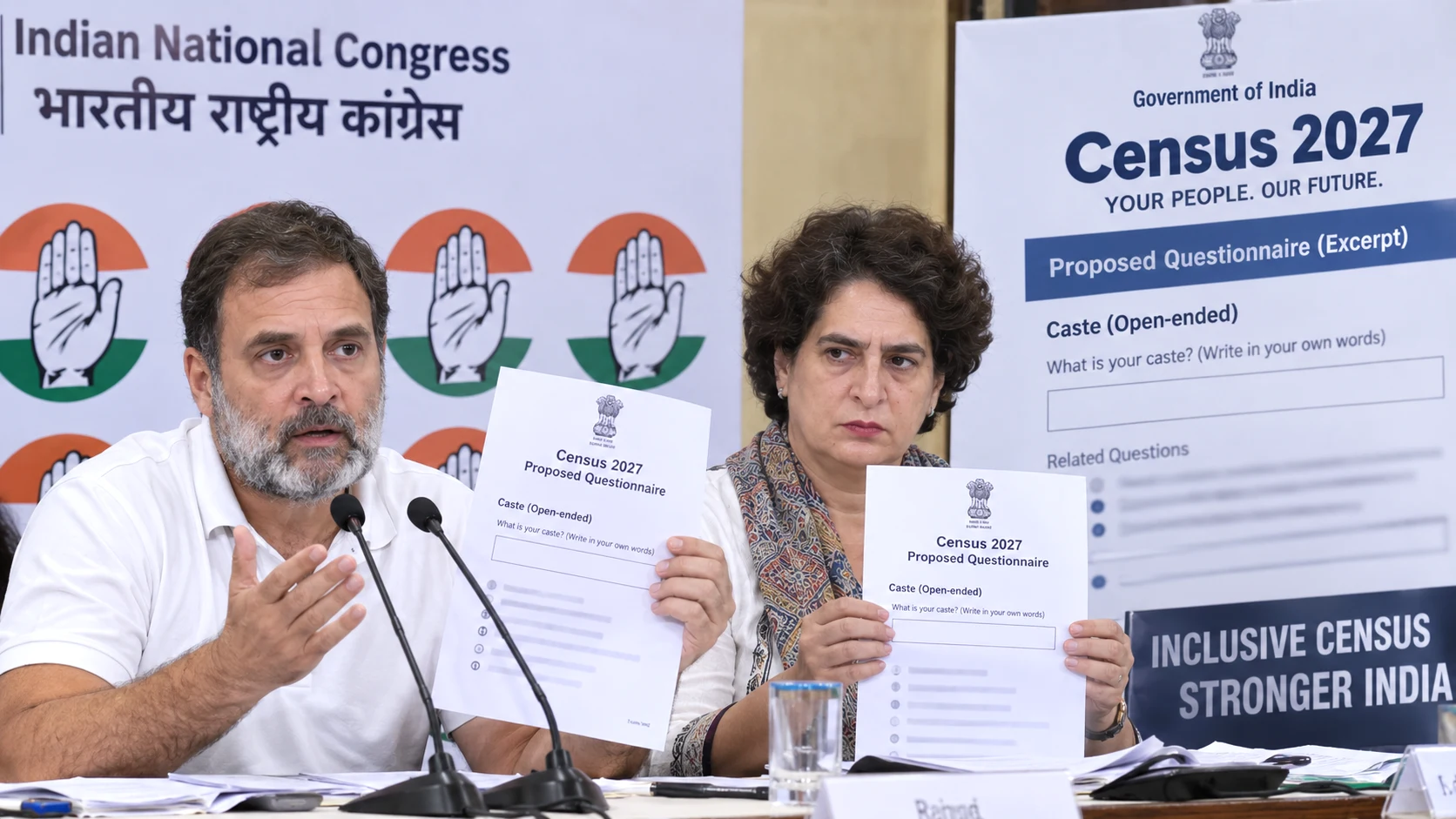
New Delhi, September 10, 2026: The Congress has intensified its attack on the Narendra Modi government over the methodology being used to record caste in Census 2027, describing the open-ended caste question as a “very serious flaw” and demanding that it be replaced with a standardised, certified list of castes.
Congress general secretary in charge of communications Jairam Ramesh said the current format could result in the same caste being recorded under different names, sub-castes and spellings, potentially complicating the consolidation and interpretation of the final data.
Ramesh went further and alleged that it appeared Prime Minister Narendra Modi wanted the caste census process to “fail”. That is a Congress political allegation and has not been established as fact. The methodological question itself, however, is genuine and has become an important political and statistical debate around India’s forthcoming caste enumeration.
The Congress wants the government to scrap the current caste question and prepare a new system based on a pre-verified caste list, pointing to caste surveys conducted in Telangana and Bihar as possible models.
The controversy matters because caste data could eventually influence debates over representation, reservations, welfare programmes and the distribution of government benefits. Accurate classification is therefore likely to be as politically important as the overall count.
Table of Contents
- What has Congress alleged?
- What is the open-ended caste question?
- Why does Congress oppose the format?
- What alternative is Congress proposing?
- Kharge and Rahul Gandhi wrote to PM Modi
- Tamil Nadu Assembly joins the debate
- Why creating a national caste list is complicated
- What does the official census questionnaire show?
- Why caste data has major political significance
- The government’s position and the unanswered questions
- What happens next?
- Key takeaway
What Has Congress Said About the Caste Census Questionnaire?
The latest criticism came from senior Congress leader Jairam Ramesh, who said the party had repeatedly objected to the methodology adopted for collecting caste information.
Ramesh described the government’s decision to use an open-ended question rather than a structured drop-down list as a “very serious flaw”.
According to the Congress argument, allowing respondents to state their caste freely could produce multiple entries referring to essentially the same caste or community.
Differences could emerge because of:
- alternative spellings;
- local and regional names;
- sub-caste identities;
- linguistic variations;
- abbreviations; and
- different ways respondents identify their communities.
Congress argues that such variations could make it difficult to accurately aggregate the final numbers for individual caste groups.
Ramesh summarised the party’s argument by linking accurate questions and reliable data to the broader objective of social justice.
What Is an Open-Ended Caste Question?
The controversy centres on how census enumerators record a person’s caste.
Under an open-ended system, respondents state the caste or community with which they identify, and the response is recorded rather than being selected from a fixed list.
A structured alternative would provide enumerators with a pre-loaded database or drop-down list containing officially standardised caste names.
For example, if the same community is known by slightly different names or spellings in different districts, an open-ended system could potentially produce several entries.
A structured system attempts to avoid that problem by mapping responses to one standard classification.
However, developing such a national database is itself complicated because India’s caste classifications differ across states and between central and state-level lists.
That technical difficulty sits at the centre of the present political disagreement.
Why Congress Says the Current Format Could Distort the Data
Congress’s central concern is data fragmentation.
If one caste is recorded under several variations, the party argues, its actual population could become harder to determine unless those entries are correctly identified and consolidated during data processing.
That issue could be especially important for Other Backward Classes because of the large number of caste and sub-caste identities across different states.
Congress leaders have argued that unreliable aggregation could eventually affect discussions surrounding reservation, education, employment and welfare policy.
At a press conference in Raipur, Congress leaders specifically highlighted Question 10 of the population-enumeration questionnaire and argued that regional dialects and different spellings could generate thousands of fragmented entries.
Whether the final census processing system can successfully standardise those variations is therefore an important technical question.
The existence of an open-ended field does not by itself prove that the final data will be inaccurate. Census authorities may employ coding, validation and data-cleaning procedures after collection.
For that reason, Congress’s argument that the process is designed to fail should be understood as a political accusation, while its concern over classification consistency is a methodological issue that can be independently examined.
Congress Wants a Certified Caste List
The opposition party is demanding that the Centre replace the open-ended approach with a pre-prepared and certified list of castes.
Under such a system, enumerators would select the appropriate caste from a standardised database instead of entering every response independently.
Congress has cited caste surveys conducted in Telangana and Bihar while arguing that structured lists can provide a workable model.
Ramesh said the party wants a revised questionnaire to be prepared after consultations involving political parties, experts and members of the public.
The party’s argument is that standardisation should take place before enumeration rather than relying heavily on post-enumeration classification.
Supporters of this approach say it could reduce spelling variations and make aggregation easier.
But implementing it nationwide would require resolving another complicated question: Which caste list should India use?
Why a National Drop-Down List Is Not Simple
India does not have one uncomplicated caste classification that perfectly applies across every state.
Central and state OBC lists can differ.
A community recognised as an OBC by a state government may have a different status under the Central List. Names and classifications can also vary between regions.
Officials cited in reporting about Census 2027 have pointed to this difficulty while discussing why a structured menu that works in an individual state survey may be harder to implement nationally.
That does not automatically settle the debate in favour of an open-ended question.
Instead, it illustrates the underlying statistical challenge.
A pre-loaded list could improve standardisation but would have to be sufficiently comprehensive to avoid excluding communities or forcing respondents into classifications they do not recognise.
An open field gives respondents greater flexibility but could create a substantial data-coding challenge later.
The real policy question is therefore not simply open field versus drop-down menu. It is how India can collect self-reported caste information while still producing consistent, comparable and statistically reliable data.
Kharge and Rahul Gandhi Raised the Issue With PM Modi
The Congress says its objections did not begin with this week’s political campaign.
According to Jairam Ramesh, Congress president Mallikarjun Kharge and leader of the opposition in the Lok Sabha, Rahul Gandhi, jointly wrote to Prime Minister Modi on August 20, objecting to the current methodology.
Ramesh said the letter sought the withdrawal of the existing questionnaire and preparation of a new one based on a certified caste list.
Congress also sought wider consultations before the methodology was finalised.
Ramesh said on September 9 that the party had not received a response to that letter.
Congress has simultaneously expanded its political campaign around the issue.
Ramesh said the party had organised 17 press conferences across the country over four days to press its demands.
That campaign indicates that caste enumeration is likely to remain a significant national political issue rather than a narrow disagreement over census methodology.
Tamil Nadu Assembly Also Opposes the Open-Column Method
The criticism is not confined to Congress press conferences.
On September 8, the Tamil Nadu Legislative Assembly unanimously adopted a resolution asking the Union government to abandon the open-column method for recording caste information.
The Assembly called for a pre-loaded, standardised list of officially notified castes instead.
Supporters of the resolution argued that standardisation would reduce confusion and inconsistencies during data collection.
The Tamil Nadu development gives the dispute an additional federal dimension.
Caste classifications and reservation policies have significant state-level implications, meaning state governments are likely to scrutinise how national caste data is collected, categorised and eventually published.
What Does the Official Census Questionnaire Show?
The controversy concerns the second phase of Census 2027 — Population Enumeration.
Earlier this year, the Union Home Ministry said the questions for the second phase, including questions relating to caste, would be finalised and notified according to established Census procedures after considering inputs from ministries, departments, organisations and Census data users.
The Office of the Registrar General and Census Commissioner subsequently published the official Gazette notification for the Population Enumeration questionnaire on August 14, 2026.
Reporting on the notified questionnaire says the Population Enumeration phase contains 40 questions, compared with 29 in Census 2011.
The inclusion of caste represents one of the most politically significant changes.
That means the present argument is no longer about whether India should conduct caste enumeration.
The sharper disagreement is now over how caste should be recorded and classified so that the resulting numbers are reliable.
Why Accurate Caste Data Matters
Caste data carries unusual political and social importance in India.
Supporters of comprehensive caste enumeration argue that policymakers need reliable population data to evaluate whether disadvantaged communities are receiving an appropriate share of educational opportunities, government employment, welfare programmes and political representation.
For decades, political parties and social organisations have debated whether existing population estimates adequately reflect changes in India’s social structure.
The current exercise could therefore provide important new evidence for future policy discussions.
But that also makes the methodology highly sensitive.
If communities believe they have been undercounted, incorrectly classified or divided across multiple categories, disputes over the credibility of the final numbers could follow.
Conversely, creating an incomplete predetermined caste list could generate a different set of problems.
The challenge for census authorities is to create a process that is statistically consistent while accurately representing India’s extremely complex social identities.
Politics Around the Caste Census Is Intensifying
The dispute is also unfolding against a broader political battle over caste representation and social justice.
Congress and other opposition parties have made caste enumeration an important part of their political agenda.
The Modi government, meanwhile, decided to include caste enumeration in the Census, turning the debate from whether such an exercise should happen to how it should be implemented.
That shift is important.
Both government and opposition can now claim support for caste enumeration while disagreeing sharply over methodology, implementation and how the resulting data should eventually be used.
Congress is attempting to frame the questionnaire dispute as a test of whether the government’s commitment to caste enumeration is substantive.
The government and census authorities, however, must ultimately be assessed on the actual methodology, safeguards and data-processing procedures used — rather than on claims about political intent.
Is the Questionnaire Really Designed to Make the Census Fail?
There is currently no verified evidence establishing that the questionnaire was deliberately designed to make the caste census fail.
That claim comes from Congress.
Jairam Ramesh said it appeared Modi wanted different caste names, sub-castes and spellings to be recorded so that the exercise would fail.
For neutral reporting, that statement must remain attributed to him and the Congress.
A stronger factual conclusion can only be reached after examining how the Census authorities plan to code, standardise, validate and consolidate open-ended caste responses.
If robust classification procedures exist, some of the risks raised by Congress could potentially be addressed during data processing.
If they do not, concerns about fragmented entries could become more significant.
That technical explanation from the government will therefore be important in determining the strength of the opposition’s criticism.
What Happens Next?
The immediate question is whether the Centre will reconsider the caste field or provide a detailed explanation of how open-ended responses will be standardised.
Congress is demanding three major changes: replacement of the current caste question, preparation of a certified list and wider consultation before proceeding.
The Tamil Nadu Assembly’s resolution adds pressure for the Centre to explain why an open-column method was chosen and how classification problems will be prevented.
The government may also have to explain how central and state caste lists would be reconciled if it moves towards a structured database.
Ultimately, the credibility of caste enumeration will depend less on political slogans from either side and more on whether the methodology produces accurate, consistent and verifiable data.
The political battle has already begun.
The more consequential question is whether India’s Census system can convert millions of individual caste identities into a dataset reliable enough to inform one of the country’s most sensitive debates over representation and social justice.
Key Takeaway
Congress has called the open-ended caste question in Census 2027 a “very serious flaw”, arguing that different names, spellings and sub-caste identities could fragment the data.
The party wants a certified, pre-verified caste list and has cited Telangana and Bihar surveys as possible models.
Mallikarjun Kharge and Rahul Gandhi wrote to Prime Minister Modi on August 20 seeking a revised questionnaire; Congress says it has not received a response.
The Tamil Nadu Assembly has also unanimously opposed the open-column method.
Claims that the questionnaire was designed to make the census fail remain political allegations. The methodological challenge of collecting consistent national caste data is real and unresolved.
Related Reading
- [India Politics News]
- [Census 2027 Explained]
- [Telangana Caste Survey]
- [Bihar Caste Survey]

The Rajatheertha Team publishes news, explainers, guides and updates across India and the world. Our coverage follows Rajatheertha's editorial, verification and corrections standards.
Rajatheertha follows strict editorial standards. If you have corrections, updates or editorial queries, contact our desk.
Submit an Editorial Correction →



0 Comments