BJP Tops Rajasthan Civic Polls With 4,179 Wards; Independents Hold Balance in Several Key Cities
The BJP emerged as the single largest party in Rajasthan’s 2026 urban local body elections, ahead of the Congress, while more than 2,270 Independent victories complicated the picture in Bharatpur, Jodhpur, Ajmer, Pali and other civic bodies.
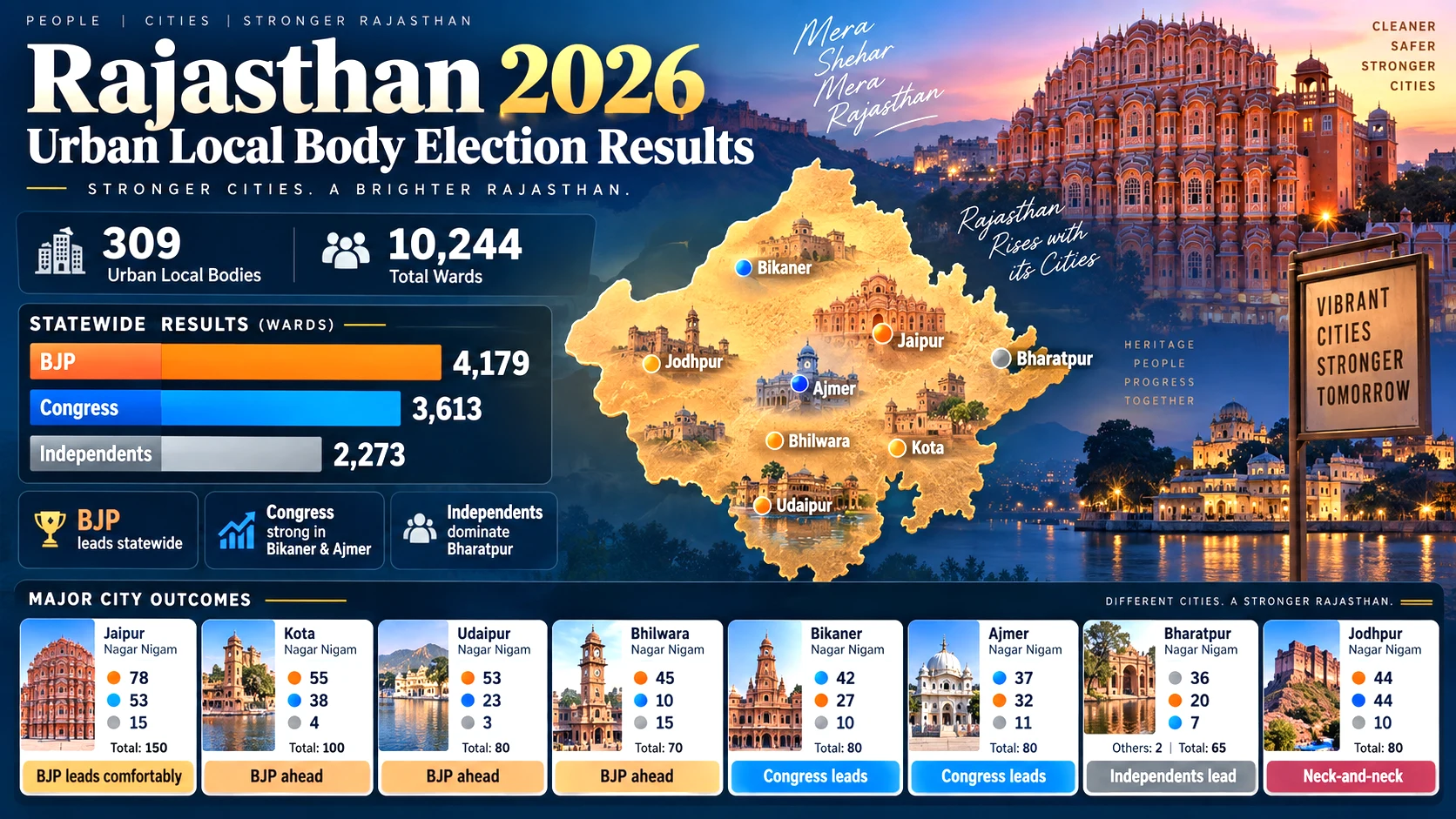
Rajasthan’s 2026 urban local body election results, with BJP, Congress and Indsependent outcomes across major citie
Table of Contents (21 sections)
The Bharatiya Janata Party emerged as the single largest party in Rajasthan’s 2026 urban local body elections, winning 4,179 wards against 3,613 for the Congress as the state completed counting across most of its municipal contests.
According to figures reported from the Rajasthan State Election Commission late on September 14, results had been declared in 10,235 of 10,244 wards under consideration. Independent candidates won 2,273 wards, making them the third-largest bloc and potentially decisive in several urban bodies where neither the BJP nor Congress secured a clear majority.
The statewide numbers translate to approximately 40.8% of declared wards for the BJP, 35.3% for Congress and 22.2% for Independents. These percentages should not be described as statewide vote shares because they measure wards won, not the proportion of all votes cast.
Recommended Reading
Related Stories & In-Depth Guides
Curated editorial perspectives matching this topic.
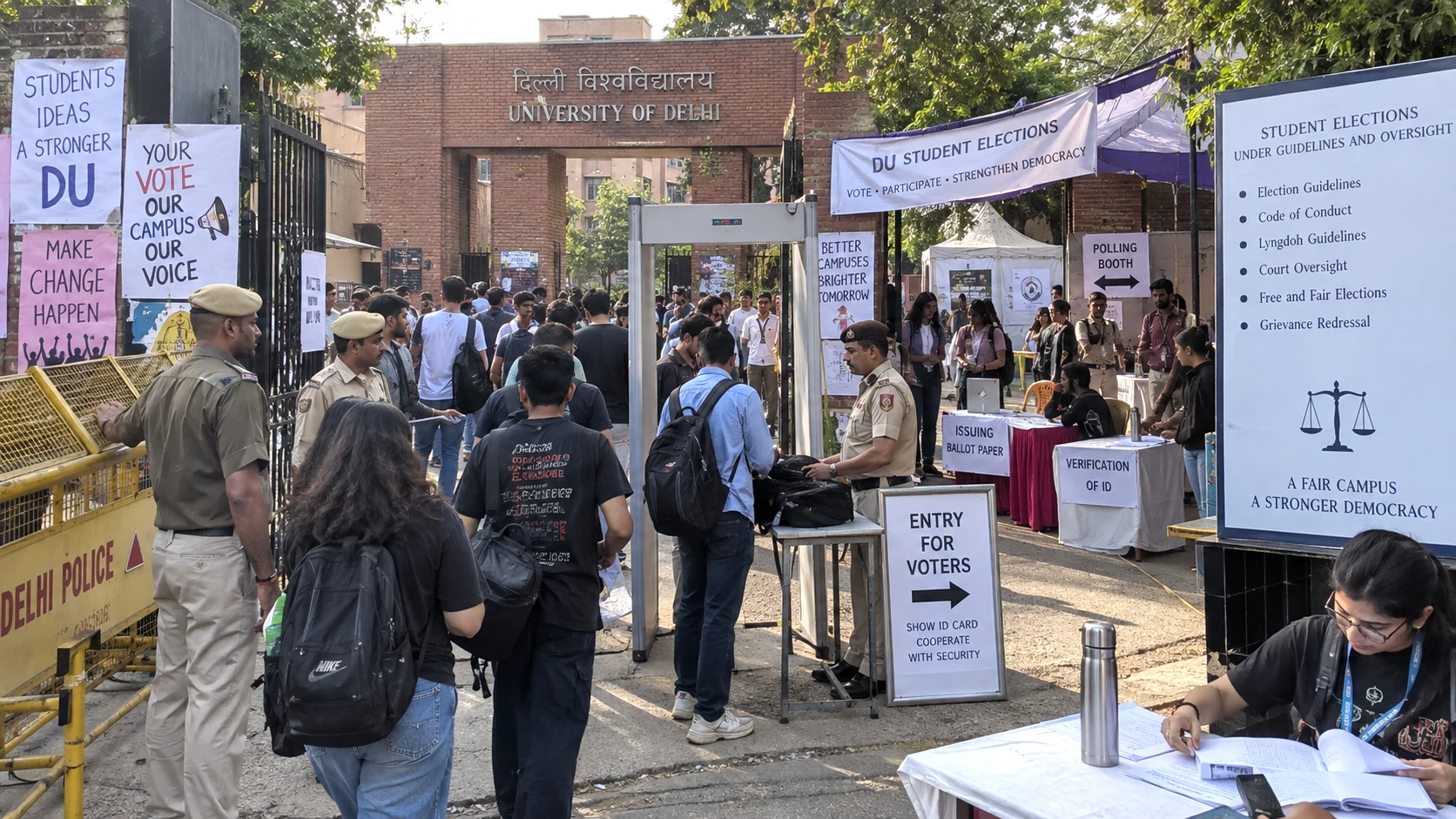
More than 1.51 lakh Delhi University students are eligible to vote for four DUSU posts on September 18. Over 2,000 police and paramilitary personnel have been deployed, while the Delhi High Court has sought reports on alleged campaign violence and election-code violations before deciding whether fur
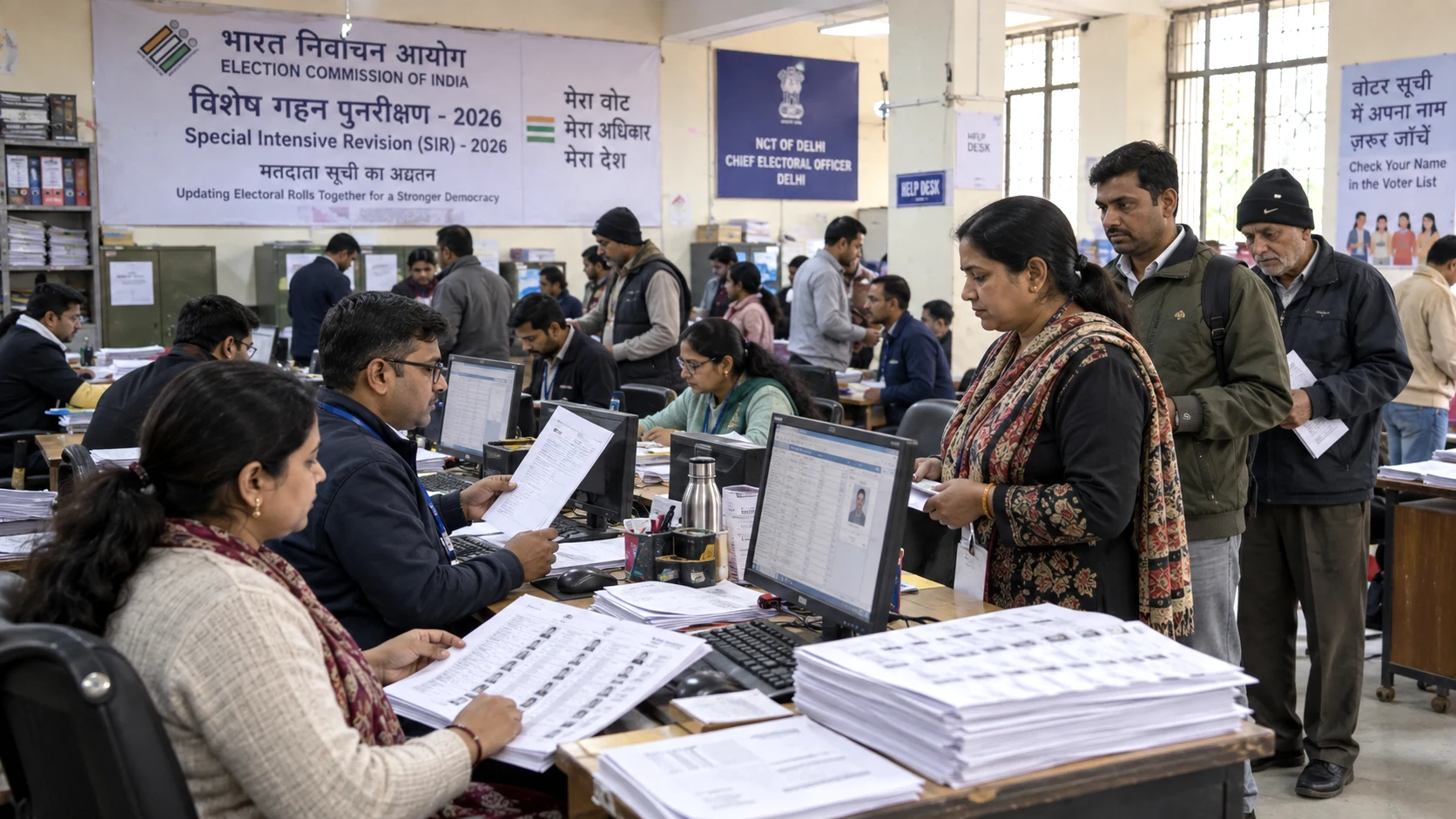
LK Advani, Jagdeep Dhankhar, S Jaishankar and several other prominent Delhi voters have had their SIR records verified and reserved for inclusion in the final electoral roll. Here is what “cleared” means and what ordinary voters should do before key deadlines.
The results gave the ruling BJP a clear numerical advantage overall, but the municipal map was more mixed than the statewide ward tally alone suggests. BJP secured majorities in four of Rajasthan’s 10 municipal corporations — Jaipur, Udaipur, Kota and Bhilwara — while Congress won a majority in Bikaner. In several other large cities, Independents will be important to determining who ultimately controls the municipal board.
Key Takeaways
The BJP won 4,179 of the 10,235 wards whose results had been declared by late September 14, compared with 3,613 for the Congress.
Independents won 2,273 wards, giving them a substantial role in civic bodies where neither major party secured a majority.
The figures represent shares of declared wards, not statewide vote shares: BJP accounted for about 40.8%, Congress 35.3% and Independents 22.2%.
BJP crossed the majority mark in Jaipur, Udaipur, Kota and Bhilwara municipal corporations, while Congress secured a majority in Bikaner.
Congress emerged as the largest party in Ajmer and Pali but fell short of outright majorities.
Independents won a majority in Bharatpur, Chief Minister Bhajan Lal Sharma’s home turf.
Nine ward results remained unresolved because of EVM-related issues, with re-polling ordered at affected booths for September 16 and counting on September 17.
BJP Finishes Ahead With 4,179 Wards
The BJP’s 4,179 victories placed it 566 wards ahead of Congress when the latest statewide tally was compiled.
Congress had won 3,613 wards, while Independents accounted for 2,273.
Smaller parties also secured representation. The Rashtriya Loktantrik Party won 63 wards, the Aam Aadmi Party 42, CPI(M) 38, the Bahujan Samaj Party 19 and Bharat Adivasi Party eight. Together, those figures account for all 10,235 results declared at that stage.
That distribution makes the BJP the clear statewide leader in ward victories without producing a uniform sweep across Rajasthan’s major cities.
Some civic bodies delivered outright majorities, while others produced fragmented verdicts that will require post-election negotiations.
Rajasthan Voted Across 309 Urban Local Bodies
The 2026 election covered 309 urban local bodies across Rajasthan.
The State Election Commission had announced elections covering 10 municipal corporations, 47 municipal councils and 252 municipalities, with voting held in two phases on September 9 and September 11. The election programme covered more than 10,000 councillor positions across the state.
Counting began on September 14.
A small number of results remained pending after technical problems involving electronic voting machines at selected polling stations, meaning the 4,179-3,613 statewide tally was highly advanced but not yet the absolute final result of every ward.
BJP Crosses Majority Mark in Jaipur
Jaipur delivered one of the BJP’s most important victories.
In the 150-member Jaipur Municipal Corporation, the BJP had won 78 wards, crossing the majority threshold of 76. Congress secured 53 wards and Independents won 15 in the results declared before re-polling in four affected wards.
The outstanding wards cannot remove the BJP’s existing majority because the party has already crossed the halfway mark.
At the same time, the margin is relatively narrow. The BJP stands only two seats above the majority threshold in the declared result, making Jaipur more competitive than a simple statewide victory narrative might suggest.
Udaipur Gives BJP a Strong Majority
The BJP recorded a more decisive result in Udaipur Municipal Corporation.
It won 53 of the 80 wards, compared with 23 for Congress. Independents won three and CPI(M) secured one.
With the majority mark at 41, the BJP crossed it comfortably.
The result gives the party direct control without needing support from Independents or smaller parties to form the municipal board.
Bhilwara Also Delivers Clear BJP Verdict
Bhilwara produced another strong BJP result.
The BJP won 45 of the 70 wards in Bhilwara Municipal Corporation, giving it a clear majority. Independents secured 15 wards, while Congress won 10 and fell to third place in the corporation.
The result allows the BJP to retain control of the Bhilwara corporation without depending on post-poll alliances.
The wider Bhilwara district picture was more varied, however, with different parties winning majorities in some smaller municipalities and Independents becoming necessary for board formation in others.
BJP Secures Majority in Kota Despite Pending Re-Polls
The BJP also crossed the majority mark in Kota Municipal Corporation.
The latest count put the BJP at 55 wards, with Congress on 40 and Independents on three. Some ward results remained unresolved because of EVM problems, but the pending contests cannot take the BJP below the 51-seat majority required in the 100-member corporation.
Re-polling has been ordered at affected booths before the remaining ward results are finalised.
The technical problems do not overturn the BJP’s established majority in Kota, but they mean precise final party totals should be updated after the re-poll count.
Congress Wins Bikaner
Congress recorded its clearest major-corporation victory in Bikaner.
The party secured a majority in the Bikaner Municipal Corporation, making it the only one of the 10 municipal corporations where Congress had an outright majority in the latest statewide results.
The result prevented the BJP from converting its statewide ward advantage into control of all major urban centres.
It also illustrates why Rajasthan’s civic election should be viewed as a mixed municipal verdict rather than solely through aggregate statewide totals.
Congress Leads in Ajmer but Falls Short of Majority
Ajmer produced a hung corporation.
Congress emerged as the largest party with 37 of the 80 wards, while the BJP won 32 and Independents secured 11. With 41 needed for an outright majority, Congress will require outside support if it is to control the corporation.
The result was politically significant because Ajmer had been regarded as an important BJP urban stronghold.
However, being the largest party is not the same as having secured control of the municipal board. The eventual governing arrangement will depend on the support decisions of Independent councillors.
Pali Gives Congress the Lead, Independents the Leverage
A similar situation emerged in Pali.
Congress won 29 of the corporation’s 65 wards, ahead of the BJP on 21. Independents won 15, leaving neither major party at the 33-seat majority mark.
Pali also carries additional political interest because it is associated with BJP state president Madan Rathore.
Congress therefore finished first in the ward count, but Independents are positioned to influence who ultimately forms the board.
Bharatpur Independents Deliver Major Upset
One of the most closely watched results came from Bharatpur, the home turf of Rajasthan Chief Minister Bhajan Lal Sharma.
Independent candidates won 36 of the 65 wards, giving them an outright majority. The BJP won 20 wards and Congress seven, while the remaining two went to the BSP and RLP.
The outcome stands out because Independents did not merely act as a balance-of-power bloc in Bharatpur — collectively, they crossed the majority threshold themselves.
For the BJP, the result is a notable local setback despite its broader statewide lead.
It should not automatically be interpreted as a statewide rejection of the Chief Minister, however. Municipal elections are heavily influenced by individual candidates, ward-level organisation, reservation patterns, delimitation and local civic issues.
Jodhpur Produces a Near-Deadlock
Jodhpur was another corporation where neither major party established a decisive advantage.
Late results had the BJP and Congress level at 44 wards each, with Independents holding a significant bloc and an affected booth scheduled for re-polling.
That leaves the eventual composition of the municipal leadership dependent on the final pending result and post-poll support.
The contest reinforces one of the principal themes of the Rajasthan civic election: statewide advantage for the BJP, but substantial local variation from city to city.
Independents Win More Than One in Five Declared Wards
The scale of the Independent performance is one of the most important features of the election.
With 2,273 victories from 10,235 declared wards, Independent candidates accounted for approximately 22.2% of the results.
That is more than one in every five declared wards.
Their influence is especially important in civic bodies such as Ajmer, Pali, Jodhpur and several smaller municipalities where the BJP and Congress failed to reach majority thresholds.
The term “kingmaker” therefore applies to several local bodies, although not universally. In Bharatpur, Independents themselves won a majority rather than merely holding the balance between two larger parties.
Smaller Parties Register Local Breakthroughs
The election also produced notable outcomes beyond the BJP-Congress contest.
The Aam Aadmi Party secured a majority in the Baran Municipal Council, while CPI(M) emerged strongly in Nokha municipality in Bikaner district, winning 29 of 45 wards and positioning itself to form the board.
Statewide, however, these parties remain much smaller than the BJP, Congress and Independent blocs.
RLP’s 63 wards made it the largest party among the smaller organised political parties in the overall tally, followed by AAP with 42 and CPI(M) with 38.
Modi Hails BJP Performance
Prime Minister Narendra Modi welcomed the BJP’s showing after the results became clear.
In a post on X, Modi thanked Rajasthan voters for what he described as a strong mandate for the party and said the result was proof of the “victory of truth over the echo of falsehood.”
He linked the result to support for the BJP’s development and governance agenda under the state and central governments.
Chief Minister Bhajan Lal Sharma similarly described the outcome as an endorsement of his government’s work over the previous two-and-a-half years.
Those statements represent the BJP leadership’s political interpretation of the result.
Congress Points to Delimitation and Close Contests
Congress leaders offered a different assessment.
Rajasthan Congress president Govind Singh Dotasra argued that delimitation had disadvantaged his party and said the result was closer than the BJP’s statewide ward lead suggested. Congress leaders also alleged misuse of government machinery during the electoral process.
Those are political allegations by the opposition and should not be treated as established findings.
What the results do show is that Congress remained competitive across a substantial portion of Rajasthan’s urban map despite finishing behind BJP statewide. It won Bikaner, emerged first in Ajmer and Pali, performed strongly in Jodhpur and also won the Jhalawar Municipal Council, a politically notable result in a region associated with former BJP chief minister Vasundhara Raje.
Nine Ward Results Still Pending
The statewide figures are not yet mathematically complete.
As of late September 14, results were available for 10,235 of 10,244 wards being counted, leaving nine unresolved because of EVM-related issues.
The State Election Commission ordered re-polling at 10 polling stations across Jaipur, Jodhpur, Kota and Suket.
The affected locations include five booths in Jaipur, one in Jodhpur, three in Kota and one in Suket municipality. Re-polling is scheduled for September 16, with counting on September 17.
The remaining results could slightly change the statewide party totals but will not alter several major outcomes where parties have already crossed the majority threshold, including Jaipur and Kota.
What the Results Do — and Do Not — Say About Rajasthan Politics
The BJP can reasonably claim the strongest statewide performance in the civic election because it won the most wards and secured outright control of several important corporations.
Congress, however, retained meaningful urban strength and won or led several high-profile contests.
Independents emerged as a substantial third force at the local level.
These results will inevitably be examined for clues about the 2028 Rajasthan Assembly election, but municipal contests and Assembly elections are structurally different.
Local-body campaigns can turn on ward candidates, civic services, local factionalism, reservation, delimitation and personal networks in ways that do not necessarily translate directly into Assembly voting.
The election is therefore an important political indicator, but not a reliable forecast of the next state election on its own.
What Happens Next
Attention now moves from ward counting to formation of municipal boards and election of mayors and chairpersons.
Where one party already holds a clear majority — including BJP-controlled Jaipur, Udaipur, Kota and Bhilwara and Congress-controlled Bikaner — the route to control is comparatively straightforward.
The more complicated contests will be in corporations and councils where no party crossed the halfway mark.
Ajmer, Pali and Jodhpur are among the places where Independent councillors could have decisive influence.
The remaining re-polls will also need to be completed on September 16 before the outstanding ward results are counted on September 17.
Bottom Line
The BJP has emerged as the single largest party in Rajasthan’s 2026 urban local body elections, winning 4,179 of the 10,235 wards declared by late September 14.
Congress won 3,613 wards and Independents 2,273, giving the three groups approximately 40.8%, 35.3% and 22.2% respectively of the declared ward results. These are ward shares, not vote shares.
The BJP secured outright majorities in Jaipur, Udaipur, Kota and Bhilwara, while Congress won Bikaner. Congress finished first without a majority in Ajmer and Pali, and Independents recorded their most striking result in Bharatpur, where they won 36 of 65 wards in Chief Minister Bhajan Lal Sharma’s home turf.
Prime Minister Narendra Modi hailed the result as a victory for the BJP’s governance agenda, while Congress questioned the impact of delimitation and pointed to its victories and close contests in several cities.
With nine ward results still unresolved because of EVM-related issues, the precise statewide totals can move slightly after re-polling. The broader verdict, however, is already clear: BJP finished ahead statewide, Congress remained competitive in several important urban centres, and Independents emerged with enough strength to shape the next stage of civic government formation across Rajasthan.
Key Takeaway
BJP won 4,179 wards in Rajasthan’s 2026 civic polls, ahead of Congress at 3,613.
Independents secured 2,273 wards and hold the balance in several key cities.
BJP has majorities in Jaipur, Udaipur, Kota and Bhilwara; Congress won Bikaner.
Nine ward results remain pending after EVM issues.
The Rajatheertha Team publishes news, explainers, guides and updates across India and the world. Our coverage follows Rajatheertha's editorial, verification and corrections standards.
Receiving a Delhi SIR notice does not automatically remove a voter from the electoral roll, the CEO's office has clarified. Voters can respond, submit documents and receive a hearing before any decision is taken.
Tamil Nadu Chief Minister C Joseph Vijay's first official meeting with Prime Minister Narendra Modi focused on issues ranging from Mekedatu and fishermen to state funds and Tamil identity. With the two leaders expected to share a Chennai stage on October 11, here is what the meetings mean politicall
The September 15 collision occurred in international waters in the northern Arabian Sea and caused no major damage, according to India’s Ministry of External Affairs. New Delhi says the Pakistani naval vessel’s conduct breached Article 10 of a 1991 bilateral military agreement.
The Supreme Court has delivered differing opinions over whether challenges to the 2023 CEC appointment law require a Constitution Bench. The case now goes to the CJI for consideration of a larger bench, while the law remains in force.
The Election Commission says all final decisions taken by the full Commission over the past year, including SIR-related measures, were unanimous despite reported objections raised during internal deliberations. Here is what the dispute means for voters.
President Donald Trump announced the restrictions on September 18, accusing the three outlets of publishing what he called “fake news”; journalists from all three organizations were turned away from the White House the following day.


0 Comments