UAE Says Flydubai Co-Pilot Used Crash Axe in Attempted ‘Terrorist Act’; Indian Captain Smit Machchhar Praised for Courage
UAE investigators say the co-pilot of flydubai flight FZ1073 attacked Indian captain Smit Machchhar with a cockpit crash axe and tried to seize the aircraft controls in an attempted “terrorist act.” The investigation into motive and possible links remains ongoing.
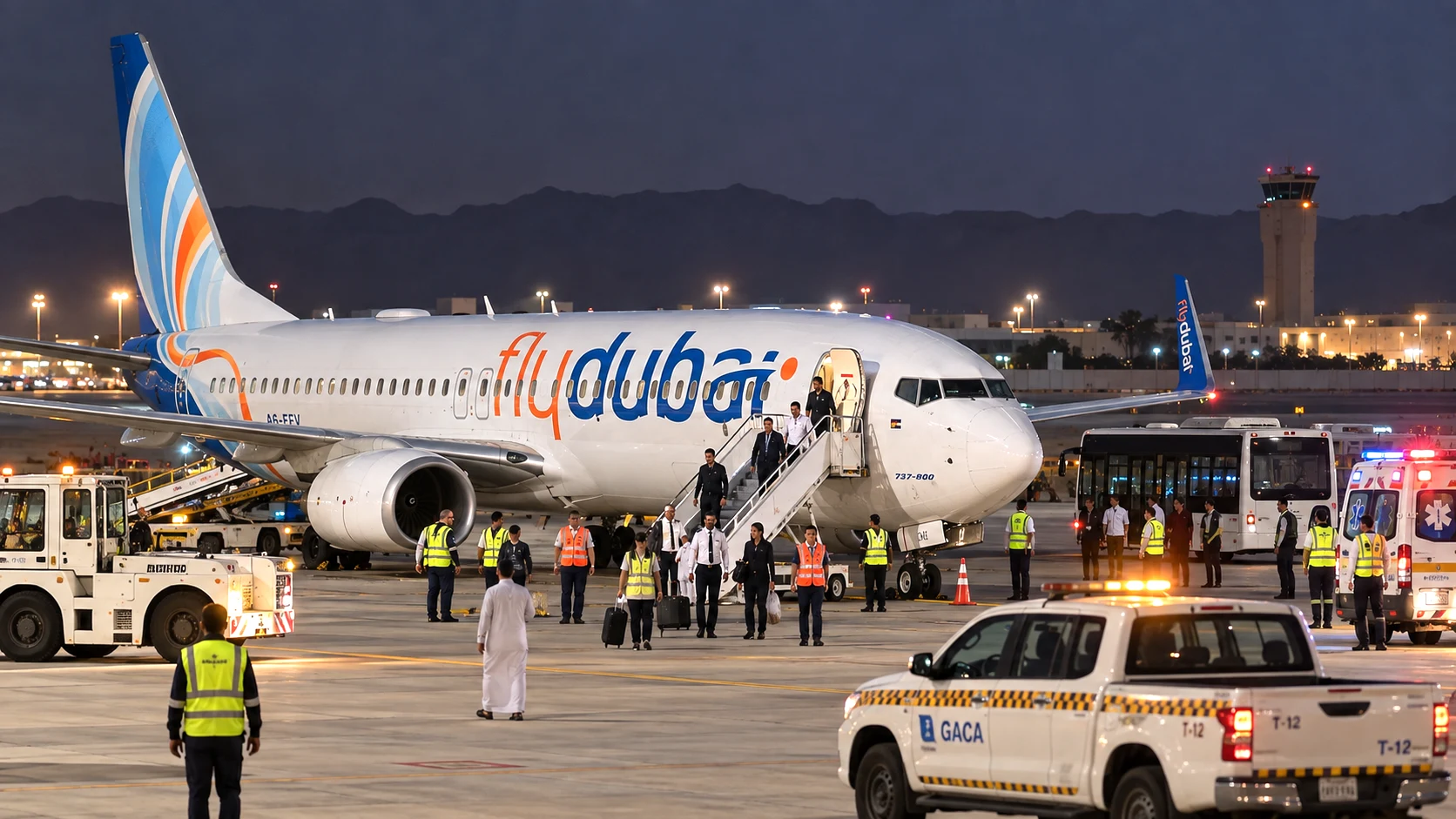
Flydubai aircraft involved in flight FZ1073 as UAE authorities investigate an attempted terrorist act against Indian captain Smit Machchhar
Table of Contents (21 sections)
Updated October 4, 2026
The United Arab Emirates has officially described the violent cockpit incident aboard flydubai flight FZ1073 as an attempted terrorist act, providing the clearest official account yet of what happened aboard the Dubai-to-Tel Aviv flight on September 30.
UAE Attorney-General Dr Hamad Saif Al Shamsi said investigators found that the flight’s co-pilot began carrying out a plan during the journey, attacked the captain inside the flight deck with a crash axe, and attempted to take control of the aircraft’s flight controls.
The announcement marks a major development from the first hours after the incident, when flydubai had confirmed only that an “altercation” occurred on the flight deck and said the cause and motive remained subject to investigation. Rajatheertha’s original October 1 report reflected that more limited official information available at the time.
The UAE statement does not, however, mean the entire investigation is complete.
Recommended Reading
Related Stories & In-Depth Guides
Curated editorial perspectives matching this topic.
Indian flydubai captain Smit Machchhar was seriously injured during a cockpit altercation on Dubai-Tel Aviv flight FZ1073, which plunged more than 14,000 feet before being diverted safely to Tabuk. Investigators have not yet established the co-pilot's motive.
The Florida Republican says Hispanic voters who helped return Donald Trump to the White House now “feel betrayed,” while polling shows broader erosion in support for the president’s immigration approach. Separately, Speaker Mike Johnson has sent the House home early for the campaign season, drawing
Al Shamsi said authorities are still examining the full circumstances, the motive behind the incident, any associated links, technical evidence, physical evidence and digital material. Final findings are expected only after those investigative procedures are completed.
That distinction remains important: UAE authorities have officially characterised the attempted action as terrorist in nature, but questions including why it was carried out, whether anyone else was involved and whether the co-pilot had links to a wider organisation or network remain under investigation.
Key Verified Developments
UAE investigators say the co-pilot attempted to carry out a terrorist act aboard FZ1073.
The Attorney-General says the captain was attacked inside the cockpit using a crash axe, an emergency tool normally kept on the flight deck.
The co-pilot then attempted to take control of the aircraft’s controls.
Indian captain Smit Machchhar was seriously injured but helped create the opportunity for other crew members and passengers to intervene.
UAE aviation authorities have publicly praised Machchhar, the crew and passengers for their rapid response.
A reserve flydubai pilot travelling aboard the aircraft subsequently took control and landed the plane safely in Tabuk, Saudi Arabia.
More than 170 passengers and crew were aboard, most of them Israeli, according to Reuters.
Reuters says sources have identified the co-pilot as Hammam al-Hammami, an Omani national, but UAE authorities and flydubai had not publicly confirmed his identity in the Attorney-General’s October 3 statement.
The UAE-led investigation into motive, possible connections and digital and physical evidence is continuing.
What Did the UAE Attorney-General Confirm?
The October 3 statement carried by the official Emirates News Agency, WAM, represents the most authoritative public account released by Emirati investigators so far.
According to Al Shamsi, investigators concluded that the co-pilot attempted to carry out a terrorist act and began implementing that plan while FZ1073 was in flight.
The Attorney-General said the co-pilot attacked the captain with a crash axe before attempting to take control of the aircraft.
A crash axe is an emergency tool normally carried on the flight deck for use in situations such as evacuation, fire or structural emergencies. Reuters noted that such an axe is typically stored in the cockpit for emergency purposes.
The official statement therefore resolves one of the biggest uncertainties in the initial reporting: the weapon was not merely an unidentified sharp object or knife, but a cockpit emergency crash axe, according to UAE investigators.
What Happened on Flydubai Flight FZ1073?
Flight FZ1073 was travelling from Dubai International Airport to Ben Gurion International Airport near Tel Aviv on September 30 when the violent confrontation occurred.
Flydubai initially said there had been an altercation on the flight deck and that crew members travelling aboard the aircraft intervened, regained control and diverted safely to Tabuk Airport in Saudi Arabia. The airline said passengers were safe and pledged to cooperate with authorities.
Subsequent accounts from Israeli authorities, passengers and investigators described a much more serious emergency.
Reuters reported that the captain was attacked, passengers and crew helped subdue the co-pilot, and a reserve flydubai pilot who was travelling aboard the flight ultimately took control and landed the aircraft in Tabuk.
The UAE Attorney-General has now officially confirmed the key allegation at the centre of those accounts: the co-pilot attacked the captain with a crash axe and attempted to seize the flight controls as part of what investigators describe as an attempted terrorist act.
Captain Smit Machchhar’s Role
Indian captain Smit Machchhar has received widespread praise for his response to the emergency.
The UAE General Civil Aviation Authority said on October 2 that Machchhar, the flydubai crew and passengers who intervened displayed “remarkable courage” and responded rapidly enough to help prevent more serious consequences.
The authority also confirmed that Machchhar had returned safely to the UAE, was in good condition and was receiving medical treatment.
Prime Minister Narendra Modi publicly described Machchhar as a hero, saying that despite suffering serious injuries, he showed extraordinary courage and determination to protect other people aboard the aircraft. Modi said the captain's actions helped save hundreds of lives and avert a major tragedy.
Modi later spoke directly with Machchhar while the pilot was recovering. During the interaction, the Prime Minister again praised his conduct and thanked Saudi Arabia and the UAE for the medical assistance provided after the incident.
Calling Machchhar a “hero” is therefore not merely a social-media description. The characterization has been used publicly by India's Prime Minister, while the UAE's aviation regulator has formally commended his courage and response.
How Was the Attack Stopped?
The available accounts indicate that Machchhar's actions were crucial to allowing help into the cockpit despite his injuries.
UAE aviation authorities have praised not only the captain but also the crew and passengers who helped bring the situation under control.
Reuters reports that passengers and crew subdued the co-pilot after the captain was attacked. A reserve flydubai pilot travelling on the aircraft then took control and safely landed it at Tabuk.
The episode therefore involved several layers of intervention: Machchhar resisting the attack and helping enable assistance, crew members and passengers overpowering the assailant, and another qualified pilot taking control of the aircraft.
It would be inaccurate to credit the safe outcome to only one person. Machchhar's role has been publicly praised as exceptional, but the UAE GCAA specifically recognised the combined response of the captain, crew and passengers.
How Far Did the Aircraft Fall?
Earlier flight-tracking information cited by Rajatheertha showed an extremely rapid loss of altitude during the cockpit crisis.
Reuters has since reported, citing Flightradar24 data, that the aircraft dropped approximately 16,625 feet in just over 30 seconds while over Saudi Arabia.
This is somewhat larger than the 14,125-foot interval cited in Rajatheertha's original October 1 article from an earlier set of tracking points. The article should therefore be updated to make clear that the newer Reuters report based on Flightradar24 describes an approximately 16,625-foot fall during the wider rapid descent.
The rapid altitude loss is likely to remain an important part of the technical investigation because investigators will need to reconstruct what control inputs were made, how the aircraft responded and how control was recovered.
Who Is the Accused Co-Pilot?
Reuters reported on October 3 that two sources with knowledge of the matter identified the co-pilot as Hammam al-Hammami, an Omani national.
That identification requires careful attribution.
Reuters explicitly noted that UAE authorities and flydubai had not publicly identified him in their official statements at that stage. Israeli officials had also previously said the co-pilot was Omani.
For that reason, Rajatheertha should not write that the UAE Attorney-General officially named Hammami unless Emirati authorities subsequently release such confirmation.
The safest wording is:
“The co-pilot, identified by Reuters sources as Omani national Hammam al-Hammami…”
The spelling of names transliterated from Arabic can also vary between outlets.
Was This Officially Declared Terrorism?
The UAE Attorney-General has said the investigation found that the co-pilot attempted to carry out a terrorist act. That is now an official Emirati investigative characterization and can be reported as such.
However, Rajatheertha should continue attributing the description to UAE authorities rather than turning it into an unqualified final judicial finding.
The criminal investigation is ongoing, and authorities have not yet publicly released their complete evidence, established all motives or announced the final outcome of any prosecution.
Accordingly, headlines such as “UAE says…”, “UAE investigators say…” or “UAE Attorney-General says…” are preferable to declaring a final legal conclusion independently.
Is the Motive Known?
Not fully.
The Attorney-General specifically said investigators are continuing work to establish the incident's circumstances, motives and related connections. Technical examinations and analysis of both physical and digital evidence are also continuing.
This means speculation concerning ideology, political motives, religious motives, external direction or membership in an extremist organisation should not be presented as established fact unless investigators confirm it.
The GCAA has separately urged the public to rely on official information and avoid circulating unverified claims that could prejudge or interfere with the investigation.
What Happened to the Accused After Landing?
After the aircraft landed at Tabuk in northwestern Saudi Arabia, the co-pilot was detained by Saudi authorities, according to Reuters.
Reuters reported that he was transferred from Saudi Arabia to Abu Dhabi on October 1, with the UAE taking the lead in the investigation. An Israeli government official told Reuters that Israeli investigators were expected to participate alongside Emirati authorities.
Those investigative arrangements are significant because the aircraft was operated by a Dubai-based carrier, the incident occurred during an international flight bound for Israel, and the emergency landing took place in Saudi Arabia.
How Many People Were Aboard?
Various early reports produced differing passenger counts.
Reuters' October 3 report says more than 170 passengers and crew were aboard, most of them Israeli nationals.
Because public reports have cited somewhat different totals, Rajatheertha should avoid treating one disputed passenger count as definitive until flydubai or investigators publish an authoritative manifest-based number.
For the article, “more than 170 passengers and crew” is the safest current formulation.
What Has Flydubai Said?
Flydubai's initial statement confirmed that an incident occurred during FZ1073's journey from Dubai to Tel Aviv and that the aircraft landed safely in Tabuk.
In a later statement, the airline described an altercation in the flight deck and said flydubai crew travelling aboard the aircraft regained control. At that stage it cautioned that the underlying causes and motives had not yet been established.
Following the UAE Attorney-General's announcement, Reuters reported that flydubai said the circumstances remained under investigation and that it was not in a position to comment further.
That does not contradict the Attorney-General. Rather, it reflects the airline's decision to defer to the continuing official investigation.
Why the UAE Announcement Matters
The October 3 statement significantly changes the evidentiary status of several claims that circulated immediately after the incident.
On October 1, reports that the co-pilot had deliberately attempted to crash the aircraft came primarily from Israeli officials and passenger accounts, while flydubai itself was still describing the incident more cautiously.
Rajatheertha therefore correctly treated deliberate-crash and terrorism claims as allegations at that stage.
Now, the UAE's top federal prosecution authority has publicly stated that investigators found an attempted terrorist act, a crash-axe assault and an effort to seize the aircraft controls.
That is a substantial new fact and justifies a prominent update to the original article.
Questions Now Facing Investigators
The biggest unanswered question is motive.
Investigators will also need to establish whether the alleged plan was conceived by the co-pilot alone, whether there were communications with other individuals, what relevant digital evidence exists, whether warning signs were previously identified and whether aviation-security or crew-vetting procedures require changes.
Reuters reported that authorities are examining whether there were wider connections, while the UAE Attorney-General has explicitly said both physical and digital evidence are being analysed.
The investigation may therefore extend beyond reconstruction of the cockpit struggle into employment history, communications, security vetting and any potential outside contacts.
No conclusion about those issues should be published before reliable evidence emerges.
Why the Incident Raises Aviation-Security Questions
Modern aviation security is designed heavily around preventing unauthorised people from gaining access to the flight deck.
FZ1073 raises a different and particularly difficult problem: a threat allegedly originating from a crew member who already had authorised cockpit access.
The UAE investigation could consequently influence discussion around pilot screening, behavioural reporting, cockpit emergency equipment and procedures for situations in which one flight crew member becomes a threat to another.
That does not mean any particular regulatory change has already been ordered.
At present, the priority for investigators is reconstructing the event and establishing motive and responsibility.
Captain Machchhar's Condition
The latest official UAE aviation update reviewed by Rajatheertha said Captain Machchhar had returned safely to the UAE, was in good condition and continued to receive necessary medical treatment.
His injuries had earlier been described as serious, and images from his subsequent interaction with Prime Minister Modi showed him undergoing treatment.
The Prime Minister has publicly wished him a full recovery and described his conduct as an example of extraordinary bravery.
What Happens Next?
The UAE-led investigation remains active.
The Attorney-General says investigators are completing technical examinations and analysing physical and digital evidence. They are also working to establish the suspect's motive and any related links.
The GCAA has said relevant regional and international authorities and organisations are cooperating and that official findings will be released when required procedures are complete.
Future findings could clarify the precise sequence of cockpit events, the accused co-pilot's background, how the aircraft entered its rapid descent, whether anyone else was connected to the alleged plan and whether additional aviation-security measures will follow.
Until then, those questions remain unresolved.
Latest Verified Position — October 4, 2026
The UAE Attorney-General has officially said that the co-pilot of FZ1073 attempted a terrorist act, attacked Captain Smit Machchhar with a cockpit crash axe and tried to seize the aircraft's controls.
Machchhar, an Indian national, has been formally praised by the UAE GCAA along with the crew and passengers whose intervention helped bring the emergency under control.
Prime Minister Narendra Modi has also publicly called Machchhar a hero and said his actions helped avert a major tragedy.
Reuters reports that a reserve flydubai pilot subsequently landed the aircraft safely in Tabuk and that more than 170 passengers and crew were aboard.
The co-pilot has been identified by Reuters sources as Omani national Hammam al-Hammami, but that identity was not formally stated in the UAE Attorney-General's announcement.
The investigation into motive, possible associates or connections, technical evidence and digital evidence remains ongoing.
Frequently Asked Questions
What happened on flydubai flight FZ1073?
The September 30 flight from Dubai to Tel Aviv was diverted to Tabuk, Saudi Arabia, after a violent cockpit incident. UAE investigators now say the co-pilot attacked Captain Smit Machchhar with a crash axe and attempted to seize the aircraft controls in an attempted terrorist act.
Did the co-pilot really use an axe?
Yes. The UAE Attorney-General specifically said a crash axe was used to attack the captain inside the flight deck.
What is a crash axe?
It is an emergency tool normally kept on an aircraft's flight deck for use in situations such as fires, crashes or emergency access. Reuters says such an axe is typically carried in the cockpit for emergency purposes.
Is the incident officially being treated as terrorism?
The UAE Attorney-General says investigators found that the co-pilot attempted to carry out a terrorist act. The wider investigation and any eventual criminal proceedings are still ongoing.
Who is Captain Smit Machchhar?
Smit Machchhar is the Indian captain of flydubai flight FZ1073. UAE aviation authorities and Indian Prime Minister Narendra Modi have praised his response during the emergency.
Is Captain Smit Machchhar safe?
The UAE GCAA said on October 2 that he had returned safely to the UAE, was in good condition and was receiving medical treatment.
Who was the accused co-pilot?
Reuters says sources identified him as Hammam al-Hammami, an Omani national. The UAE and flydubai had not publicly confirmed that identity in the official October 3 announcement.
Did the co-pilot try to crash the aircraft?
The UAE Attorney-General says the co-pilot attempted to take control of the aircraft after attacking the captain. Reuters says the incident was an apparent attempt to crash the aircraft and that the plane underwent an extreme rapid descent.
How was the aircraft saved?
Passengers and crew subdued the co-pilot, according to Reuters, and a reserve flydubai pilot travelling aboard the flight took control and landed safely in Tabuk. The UAE GCAA has praised Machchhar, the crew and passengers for their collective response.
Is the investigation finished?
No. UAE authorities are still examining the motive, possible connections, physical evidence, digital evidence and technical aspects of the incident.
Bottom Line
UAE investigators have officially said the co-pilot of flydubai FZ1073 attempted a terrorist act, attacking Indian captain Smit Machchhar with a crash axe and trying to seize the aircraft controls.
Machchhar has been praised as a hero by PM Modi and the UAE aviation authority. A reserve pilot landed the plane safely in Tabuk. The investigation into motive and possible links continues.
Key Takeaway
UAE: FZ1073 co-pilot used crash axe in attempted terrorist act.
Capt. Smit Machchhar praised for courage.
Aircraft dropped ~16,625 ft; landed safely in Tabuk.
The Rajatheertha Team publishes news, explainers, guides and updates across India and the world. Our coverage follows Rajatheertha's editorial, verification and corrections standards.
The House approved the Lindsey O. Graham Sanctioning Russia and Iran Act of 2026 by 262-159 after the Senate passed it 86-11. The measure now awaits President Donald Trump’s signature and could subject major buyers of Russian oil or gas to additional US tariffs of up to 100%, although India and Chin
The House voted 262-159 to approve the Lindsey O. Graham Sanctioning Russia and Iran Act of 2026 after the Senate backed it 86-11 in August. The bill targets Russian banks, energy, defence and its “shadow fleet” while creating secondary tariffs for major buyers of Russian oil and gas. It now goes to
The new US law targets Russia’s energy, financial and defence networks and allows additional tariffs of up to 100% on goods from the largest buyers of Russian oil and gas. India faces significant exposure because of its large Russian crude imports, but a 100% tariff on Indian goods has not been impo
European Commission President Ursula von der Leyen has proposed opening the door for Canada to become the EU’s first “associate member,” but the status does not yet legally exist and has not been approved by the bloc’s 27 governments. Mark Carney welcomed the ambition in Strasbourg as Donald Trump w
Chinese President Xi Jinping has arrived in Washington for a three-day state visit and high-stakes talks with Donald Trump. The US says the bilateral trade truce has been extended by two months to January 10, 2027.
The United States and China have extended their trade truce from November 10 to January 10, 2027, giving negotiators two more months to pursue a broader deal. Existing tariffs remain, while rare earths, agriculture and tariff cuts remain under negotiation.










0 Comments