PM Modi in Tamil Nadu Today: Schedule, ₹13,000 Crore Projects and Political Message
Prime Minister Narendra Modi is in Chennai on October 11 for a Metro ride and the launch of development projects worth over ₹13,000 crore. The programme also puts the spotlight on his first major joint public engagement with Tamil Nadu Chief Minister C Joseph Vijay after TVK’s recent bypoll victorie
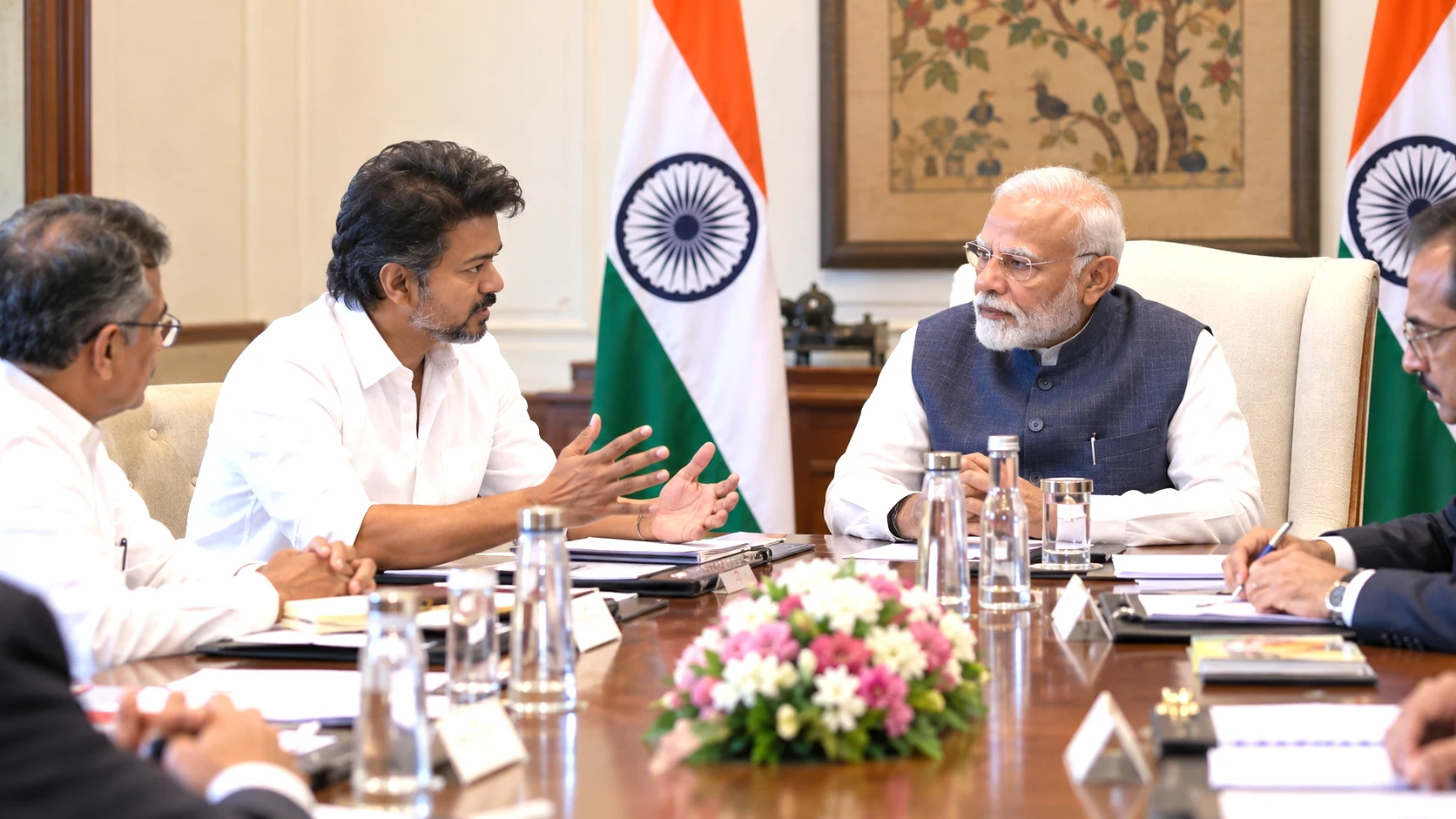
Editorial illustration representing PM Modi’s Chennai visit, Chennai Metro Phase II and Tamil Nadu infrastructure projects
Table of Contents (19 sections)
Prime Minister Narendra Modi is scheduled to spend much of Sunday, October 11, in Chennai for a programme centred on the opening and foundation-laying of development projects worth more than ₹13,000 crore, including a major section of Chennai Metro Phase II.
The visit combines transport, roads, railways, ports, petroleum infrastructure, scientific research and education. It also carries unusual political interest because Tamil Nadu Chief Minister C Joseph Vijay is expected to participate in the Metro programme, creating the first major joint public government engagement between the two leaders since Vijay took office earlier this year.
The political context has also changed significantly since Modi’s earlier Tamil Nadu visits.
Vijay now heads the TVK-led government, and his party has just won the Madurantakam and Dharapuram Assembly by-elections, its first major electoral test after forming the government. The joint Chennai programme therefore brings together a Prime Minister leading the BJP-led Union government and a relatively new Tamil Nadu administration whose political identity remains distinct from the BJP.
Recommended Reading
Related Stories & In-Depth Guides
Curated editorial perspectives matching this topic.
Politics/ India | Tamil Nadu Development13 min read
Prime Minister Narendra Modi launched and laid foundation stones for more than ₹13,000 crore worth of projects in Tamil Nadu on October 11, 2026. Here is the verified sector-wise list covering Chennai Metro, highways, railways, ports, petroleum and IIT Madras, along with the costs disclosed by the g
Spanish Prime Minister Pedro Sánchez has called a snap general election for November 29 after a major parliamentary defeat over emergency housing measures. Housing costs, the PP-Vox challenge and Sánchez's fragile coalition are set to dominate the campaign.
That makes it important to separate two things throughout the day: the confirmed government programme and the political interpretation surrounding it.
A Centre-state infrastructure event is evidence of administrative cooperation. It is not, by itself, evidence of an electoral alliance.
Key Takeaways
PM Modi in Chennai on October 11 for projects worth over ₹13,000 crore.
Centrepiece: Inauguration of Poonamallee–Vadapalani stretch of Chennai Metro Phase II.
CM C Joseph Vijay expected to join the Metro ride — first major joint public engagement.
Package covers highways (~₹3,700 crore), railways, ports, petroleum and IIT Madras research.
Visit follows TVK’s Madurantakam and Dharapuram bypoll victories.
PM Modi’s Chennai Schedule Today
According to the official programme announced by the Prime Minister’s Office, Modi’s Chennai engagements are scheduled to begin around late morning.
Time
Scheduled programme
11:30 AM
Metro ride from Porur Bypass Station to Poonamallee Bypass Station and back
Around 12:15 PM
Darshan and pooja at Jalakandeswarar Temple in Chennai
After temple visit
Walkthrough of the Sudha Gopalakrishnan Brain Centre at IIT Madras
Around 1:30 PM
Foundation stone laying, inauguration and dedication of development projects worth over ₹13,000 crore, followed by an address
Around 3:00 PM
Golden Jubilee celebrations of Jaigopal Garodia Hindu Vidyalaya Matriculation Higher Secondary School and address
Because this article is being published before the principal programme begins, any remarks delivered by Modi, Vijay or other political leaders later in the day should be treated as subsequent updates rather than written into the story in advance.
Chennai Metro Phase II Is the Centrepiece
The most visible element of the visit is the inauguration of the Poonamallee-Vadapalani stretch of Chennai Metro Rail Phase II.
The section has been built at an estimated cost of about ₹4,900 crore.
According to the Prime Minister’s Office, the corridor incorporates a 3.7-km double-decker structure and advanced signalling systems designed to support driverless operations.
For commuters, the significance is more immediate than the political ceremony around it.
The new Metro section is intended to strengthen public transport links between Chennai’s fast-growing western suburbs and the central parts of the city. Better rail connectivity can reduce road dependence, shorten journeys and increase access to employment, education and commercial centres along the corridor.
Modi is scheduled to travel from Porur Bypass to Poonamallee Bypass and return before proceeding to the next engagement.
Tamil Nadu Chief Minister C Joseph Vijay has also been reported as participating in the Metro programme.
That shared ride is likely to attract much of the political attention around the visit, but the infrastructure itself remains the more important long-term development for Chennai residents.
Highway Projects Worth Around ₹3,700 Crore
The Prime Minister is also scheduled to inaugurate and lay foundation stones for National Highway projects worth approximately ₹3,700 crore.
One of the projects being inaugurated is the 36-km four-laned Vadugapatti-Therkuvenganallur section of NH-744.
The Centre says the upgraded stretch will improve links to pilgrimage, industrial and commercial centres and make the movement of passengers and freight more efficient.
Another completed project is the approximately 30-km four-laned Madurai Ring Road section of NH-744A.
Its principal purpose is to allow through traffic to move around Madurai more efficiently instead of adding to congestion inside the city.
The foundation stone is also scheduled to be laid for the four-lane Thiruvarur Bypass on the Nagapattinam-Thanjavur section of NH-83.
Bypass projects are particularly significant in growing towns where highway traffic, local vehicles, pedestrians and commercial activity increasingly compete for the same road space.
Railway Package Includes Karaikal-Peralam Line and Five Amrit Stations
Rail infrastructure worth more than ₹750 crore is another part of the October 11 programme.
The Prime Minister is scheduled to dedicate the Karaikal-Peralam railway line.
Three rail flyovers in and around Coimbatore are also part of the package. Their stated purpose is to reduce delays at busy crossings, improve safety and allow road and railway traffic to move more efficiently.
Five redeveloped railway stations under the Amrit Bharat Station Scheme are also scheduled to be inaugurated.
They are:
Palani
Vellore Cantonment
Ambasamudram
Paramakkudi
Namakkal
For passengers outside Chennai, these railway works are among the most directly relevant elements of a programme that is formally taking place in the state capital but covers projects across Tamil Nadu.
Chennai, Kamarajar and V O Chidambaranar Ports
Ports form another substantial part of the programme.
At Chennai Port, four infrastructure projects are scheduled for inauguration: a paved storage yard, four EXIM godowns, an upgraded cruise terminal and a Seafarers Club.
The improvements are intended to expand storage and warehousing capacity, improve passenger handling at the cruise terminal and provide better facilities for maritime personnel.
At V O Chidambaranar Port, the Prime Minister is scheduled to inaugurate and lay foundation stones for eight projects.
These works are intended to expand cargo and container handling, improve cargo evacuation and logistics and support the transition towards cleaner maritime energy infrastructure.
At Kamarajar Port, the programme includes the inauguration of the Coal Berth-3 project and the foundation stone for capital dredging related to Container Terminal Phase-I, Stage-II.
Taken together, the port investments demonstrate why Tamil Nadu’s coastline remains central to both the state’s manufacturing economy and India’s wider logistics strategy.
₹1,620-Crore Petroleum Project at Manali Refinery
Another major component is a Group II/III Lube Oil Base Stocks project at Chennai Petroleum Corporation Limited’s Manali Refinery.
The project is estimated to cost around ₹1,620 crore.
The planned facility will have annual capacity of approximately 270 thousand metric tonnes and is intended to produce higher-grade base stocks used in the manufacture of premium lubricants.
For consumers, this is a less visible project than a new Metro line or highway.
Industrially, however, domestic production of specialised petroleum inputs can affect manufacturing supply chains and reduce dependence on imports in segments where higher-grade products are required.
IIT Madras Brain Centre Adds a Scientific Dimension
The Prime Minister is also scheduled to dedicate the Sudha Gopalakrishnan Brain Centre at IIT Madras to the nation.
The centre is pursuing an ambitious research programme involving detailed three-dimensional cellular mapping of more than 100 human brains across different stages of life.
Modi is also scheduled to release C-STROKE, an atlas of the human ischaemic stroke brain containing more than 1,000 annotated microscopic sections.
The research component makes the Chennai programme broader than a conventional infrastructure launch.
Roads, railways, ports and Metro systems dominate the financial value of the package, while the IIT Madras project places biomedical science and advanced research within the same development programme.
Why the Modi-Vijay Appearance Matters Politically
The infrastructure programme is taking place against a transformed Tamil Nadu political landscape.
In the May 2026 Assembly election, TVK emerged as the largest party with 108 seats in the 234-member House.
It did not reach the 118-seat majority mark on its own, but Vijay subsequently formed the government with support from Congress and other parties.
He was sworn in as Chief Minister in May.
That alone changed the context in which the Union government engages Tamil Nadu.
For decades, most Centre-state political attention in Tamil Nadu revolved around the DMK and AIADMK. TVK’s rise created a third political structure that had not previously governed the state.
Today’s public appearance with Modi therefore has administrative and political significance, although those two dimensions should not be confused.
Vijay is attending as Tamil Nadu’s Chief Minister.
Modi is attending as Prime Minister.
Major Metro, road, rail, port and industrial projects involve institutions and financing across different levels of government, making cooperation between the Centre and state normal and often necessary.
The Bypoll Results Make the Timing More Interesting
The visit comes only days after the Madurantakam and Dharapuram Assembly by-elections.
TVK won both seats.
The results were closely watched because they represented the first significant electoral test faced by Vijay’s government after coming to power.
Vijay and the opposition offered sharply different political readings of the results.
TVK treated the victories as evidence of public support for the new government, while DMK leaders challenged that interpretation and argued that the results should not be treated as an unqualified endorsement.
Whatever interpretation individual parties prefer, the bypolls gave TVK a fresh electoral talking point immediately before Vijay’s high-profile public engagement with Modi.
That makes the timing politically notable without proving any change in TVK’s relationship with the BJP.
A Day After Vijay’s Meeting with Rahul Gandhi
There is another layer to the weekend’s political optics.
Vijay met Congress leader and Lok Sabha Leader of the Opposition Rahul Gandhi in Chennai on Saturday.
Congress is among the political forces supporting the Vijay-led administration.
Less than a day later, Vijay is expected to participate in an official programme with Modi.
Those two engagements reflect the separate roles a Chief Minister is required to manage.
Party alliances operate in the electoral and legislative sphere.
Centre-state relations operate through government institutions, financing, infrastructure approvals, intergovernmental negotiations and constitutional responsibilities.
A Chief Minister meeting an allied national opposition leader one day and appearing with the Prime Minister at an official development programme the next does not automatically indicate political realignment.
Any claim of a BJP-TVK electoral understanding would require evidence beyond ceremonial appearances or government meetings.
What Does the Visit Mean for the TVK Government?
For Vijay’s administration, the immediate question is whether it can convert political change into visible governance outcomes.
The Metro opening gives the state government an opportunity to associate itself with a major urban transport milestone.
The wider package also gives Tamil Nadu projects in roads, ports, railways and industry national visibility.
At the same time, Vijay has previously raised state issues with Modi in Delhi, including questions relating to central funding, Tamil Nadu’s development requirements and other matters requiring Union government involvement.
Rajatheertha previously examined those meetings and why official cooperation should not automatically be interpreted as an electoral alliance.
Today’s Chennai programme moves that relationship from closed-door government meetings to a highly visible joint public setting.
What matters after the photographs and speeches will be whether the working relationship produces measurable outcomes for projects, funding and unresolved state issues.
What Does the Visit Mean for Modi and the Centre?
For the Union government, the programme provides an opportunity to highlight central participation in a wide range of Tamil Nadu infrastructure projects.
The package spans sectors with broad economic consequences: metropolitan transport, national highways, railways, ports, petroleum refining, education and scientific research.
It also allows Modi to address a Tamil Nadu audience at a moment when the state’s party system has undergone substantial change.
That political context is relevant, but it should not overwhelm the project details.
Voters and commuters are likely to judge infrastructure eventually by whether it operates efficiently, reduces travel time, expands capacity and delivers the benefits promised when the projects were announced.
Are There Party Reactions to the Visit Yet?
As of the morning publication of this article, the principal scheduled events and speeches had not yet taken place.
No visit-specific political reaction should therefore be invented or inferred from unrelated statements.
The Prime Minister’s Office has framed the visit primarily around development and infrastructure.
Vijay’s participation places the Tamil Nadu government within the official programme.
Any comments subsequently issued by TVK, BJP, DMK, AIADMK, Congress or other parties should be added only after they are publicly made and their wording is verified.
That distinction is especially important in political coverage because comments made about another dispute, election or protest should not be repackaged as reactions to Modi’s Chennai visit.
Chennai Traffic Restrictions During the Visit
Motorists should also expect disruption in parts of Chennai while the Prime Minister is in the city.
Traffic arrangements reported ahead of the visit include restrictions and diversions affecting commercial and heavy vehicles between approximately 8 AM and 4:30 PM in several parts of the city.
Residents travelling around the airport, Porur, Poonamallee and other areas connected to the Prime Minister’s movements should check the latest traffic-police advice before leaving.
Diversions can change depending on security and convoy movements.
What to Watch After the 1:30 PM Programme
The most important update will come after Modi addresses the main development programme.
Several questions will then become clearer.
Did the Prime Minister make any announcement beyond the projects already listed by the PMO?
What did Vijay say about the Metro opening and Centre-state cooperation?
Were any new financial commitments or deadlines announced?
Did either leader raise contentious political or state issues?
Did opposition parties respond specifically to the programme?
Were all projects inaugurated or launched according to the published schedule?
Those are the developments that should determine any later update to this story.
The Larger Significance of October 11
For Chennai residents, the most lasting consequence of October 11 is likely to be the expansion of the Metro network rather than the political symbolism surrounding the inauguration.
For businesses and freight operators, the highway, port and rail projects may have greater importance.
For researchers, the IIT Madras Brain Centre represents a very different kind of investment in long-term scientific capability.
Politically, however, the day will inevitably be viewed through the unusual relationship between the BJP-led Union government and Tamil Nadu’s new TVK-led administration.
Vijay has political allies who oppose the BJP nationally.
Modi leads the Union government with which Tamil Nadu must work on infrastructure, finance, interstate questions and other policy areas.
The two facts can exist at the same time.
Until either party says otherwise or produces evidence of a formal political understanding, the most accurate description of today’s programme is straightforward: a major Centre-state development event taking place in a Tamil Nadu political environment that has changed dramatically since the 2026 Assembly election.
What Happens Next
The article should be updated after the main afternoon programme if Modi or Vijay announces anything not contained in the official pre-visit schedule.
Any political reaction section should also be updated only with verified, attributable comments.
The most important post-event questions will be whether the announced projects entered service as planned, what timelines were given for the projects whose foundation stones were laid and whether either government made additional commitments affecting Tamil Nadu.
For now, the verified focus is clear: more than ₹13,000 crore of projects, the opening of an important Chennai Metro Phase II section and a politically watched joint appearance involving Prime Minister Narendra Modi and Chief Minister C Joseph Vijay.
Key Takeaway
PM Modi launches ₹13,000+ crore projects in Chennai today.
Metro Phase II stretch and major highway, rail, port works form the core.
Joint appearance with CM C Joseph Vijay draws political attention after TVK bypoll wins.
Infrastructure cooperation should not be read as electoral alliance without further evidence.
The Rajatheertha Team publishes news, explainers, guides and updates across India and the world. Our coverage follows Rajatheertha's editorial, verification and corrections standards.
Tamil Nadu Chief Minister C Joseph Vijay's first official meeting with Prime Minister Narendra Modi focused on issues ranging from Mekedatu and fishermen to state funds and Tamil identity. With the two leaders expected to share a Chennai stage on October 11, here is what the meetings mean politicall
Counting is underway for the Nagaon Lok Sabha bypoll and five Assembly by-elections in Tamil Nadu, West Bengal and Puducherry. Track the latest seat-wise leads, margins and winners here.
The political confrontation over India’s electoral rolls has moved from statements and parliamentary demands to sustained street protests, with Opposition parties calling for Chief Election Commissioner Gyanesh Kumar to resign and seeking the cancellation of the ongoing Special Intensive Revision of
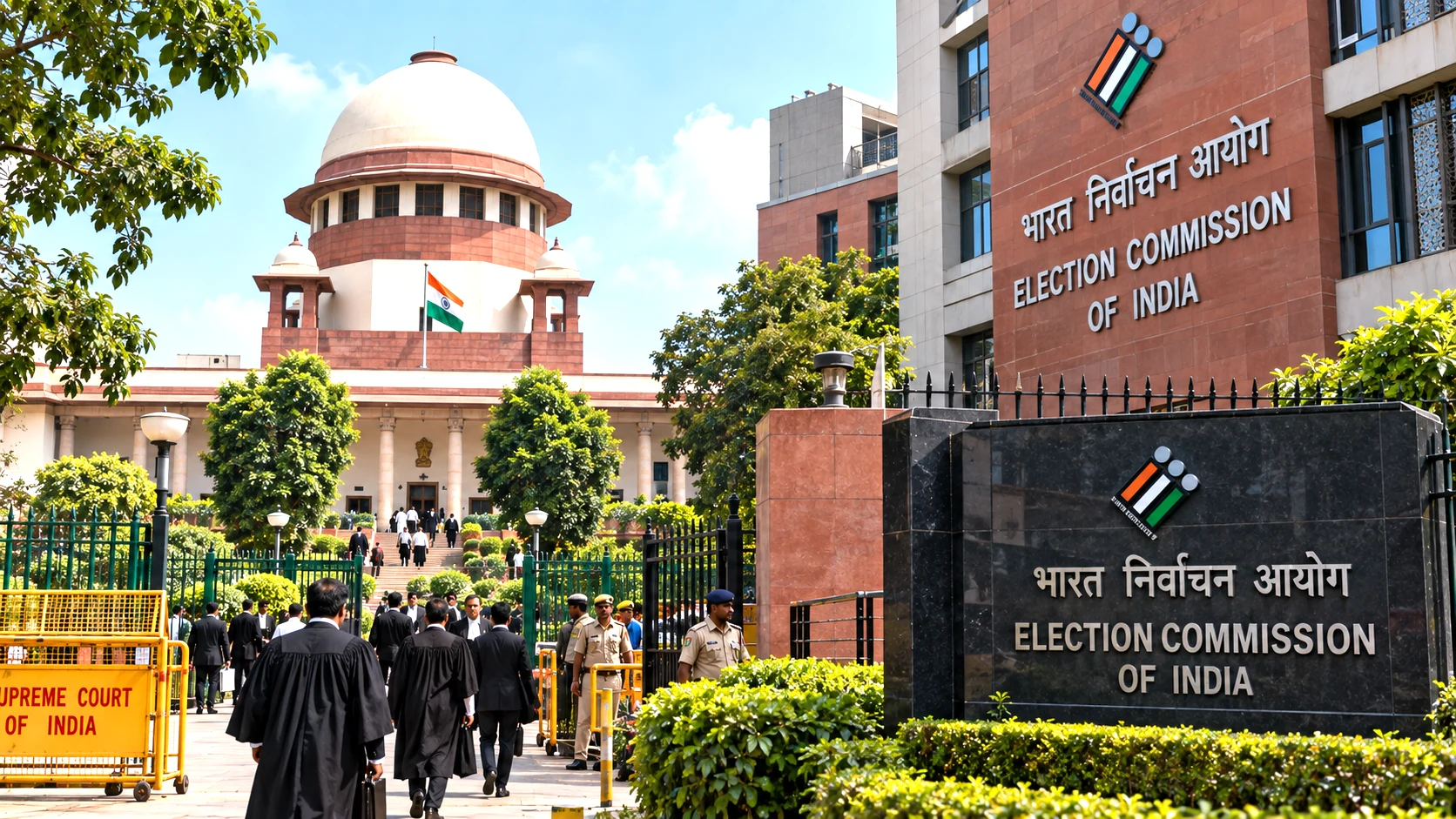
The Supreme Court has issued notice on the opposition leaders’ SIR petition and made it returnable on October 27. The Court has not recorded a stay on the electoral-roll revision, while the Election Commission and other respondents now have an opportunity to reply.
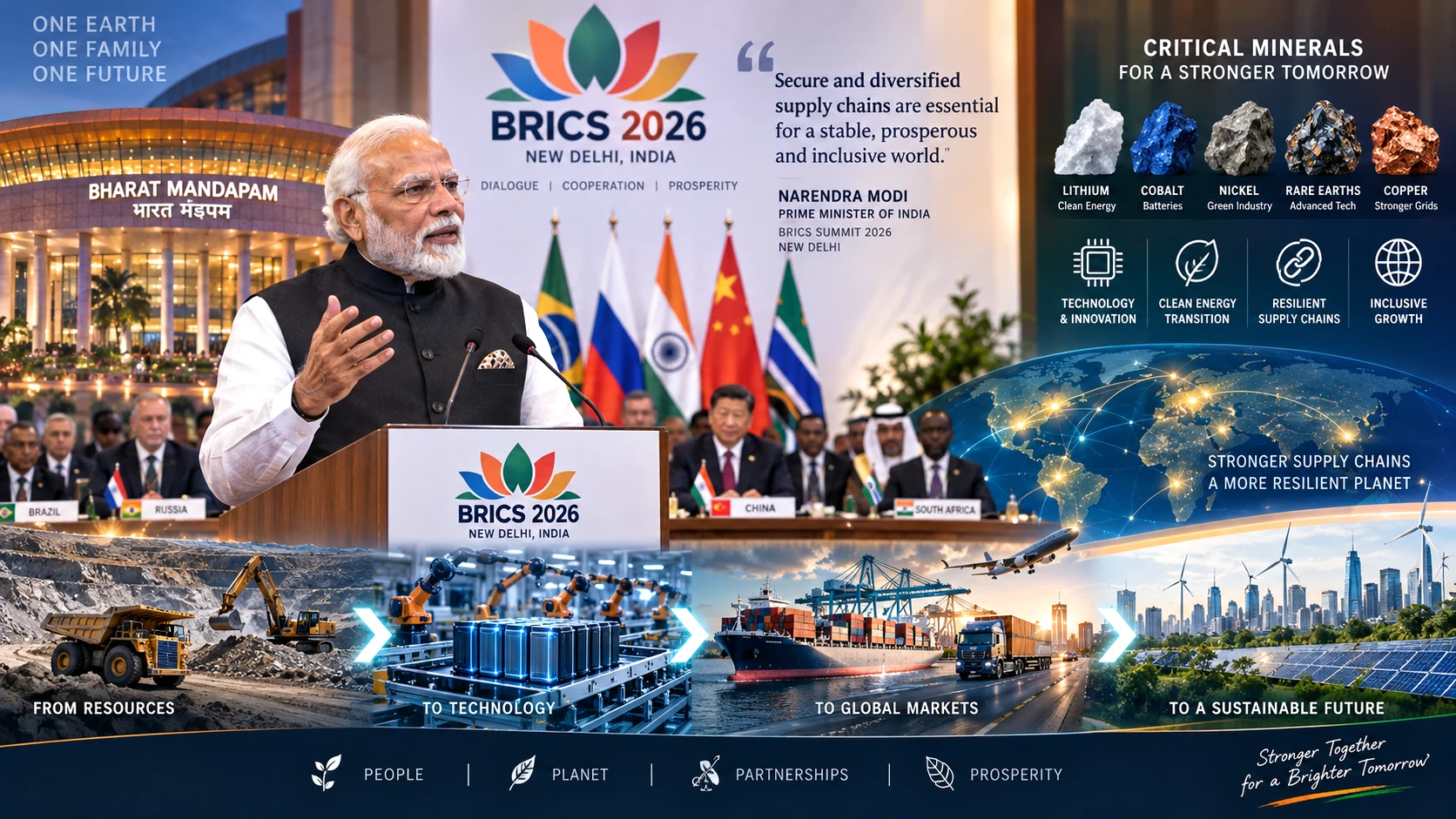
Prime Minister Narendra Modi warned BRICS leaders that the “weaponisation of technology and critical minerals” could obstruct shared development, as the New Delhi Declaration backed resilient supply chains and wider technology cooperation.
BJP candidate Hasi Rani Rath won the Nandigram Assembly bypoll by 122,753 votes, while the party also secured Rejinagar. Here are the verified results from all six October 2026 bypoll contests.








0 Comments