2026 US Midterm Elections Heat Up as Mail Voting Begins and Battle for Congress Intensifies
Voting has begun in the 2026 US midterm elections as North Carolina sends the first mail ballots, while control of Congress, mail-voting rules and redistricting dominate the campaign.
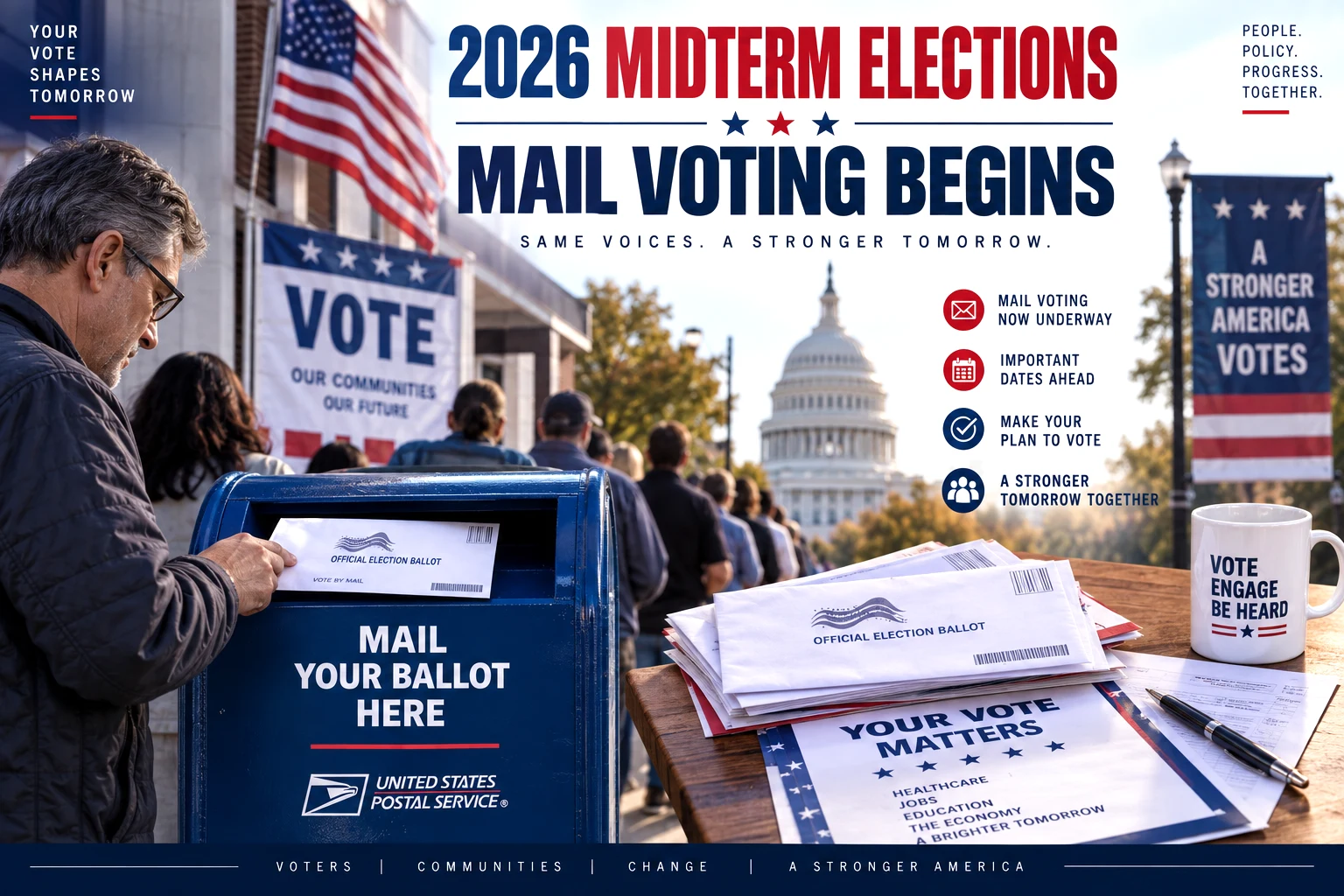
US voters and election materials representing the start of mail voting in the 2026 midterm elections
Table of Contents (22 sections)
The 2026 United States midterm elections have entered their decisive final phase, with the first absentee ballots already being mailed to voters and both Republicans and Democrats intensifying their campaigns ahead of Election Day on 3 November.
North Carolina became the first state in the country to broadly send absentee-by-mail ballots on 4 September, formally beginning the voting period for an election that will determine control of the US Congress for the remaining two years of President Donald Trump’s term.
All 435 seats in the House of Representatives are being contested, while roughly one-third of the 100-member Senate is also up for election.
Recommended Reading
Related Stories & In-Depth Guides
Curated editorial perspectives matching this topic.
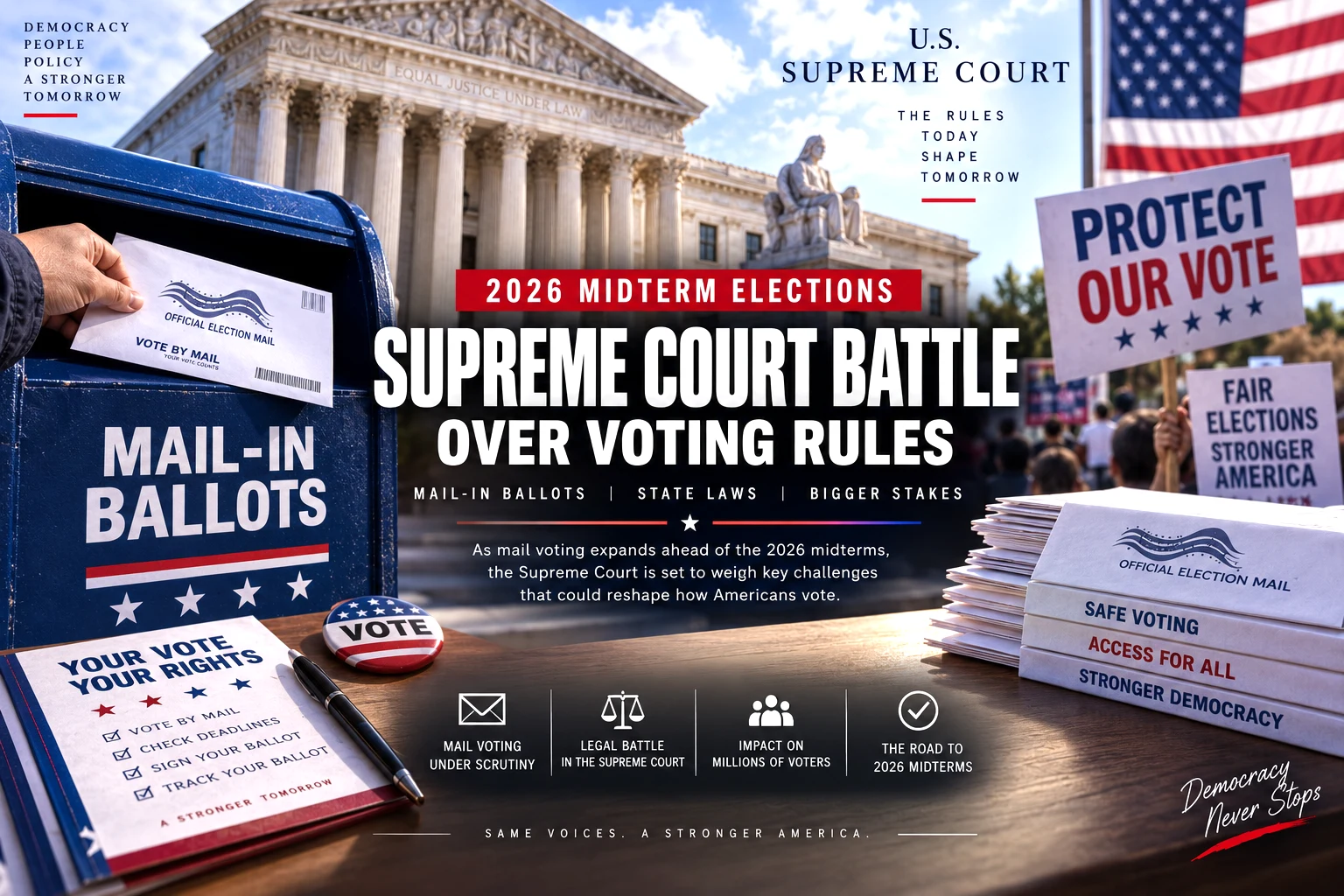
The 2026 US midterms have entered a crucial phase as voting begins and Trump’s administration asks the Supreme Court to allow new restrictions affecting mail ballots.
Canada has imposed new retaliatory tariffs of up to 50% on U.S. goods after trade negotiations with the Trump administration collapsed, escalating the Canada-US trade war.
The campaign is unfolding against several major political and legal battles.
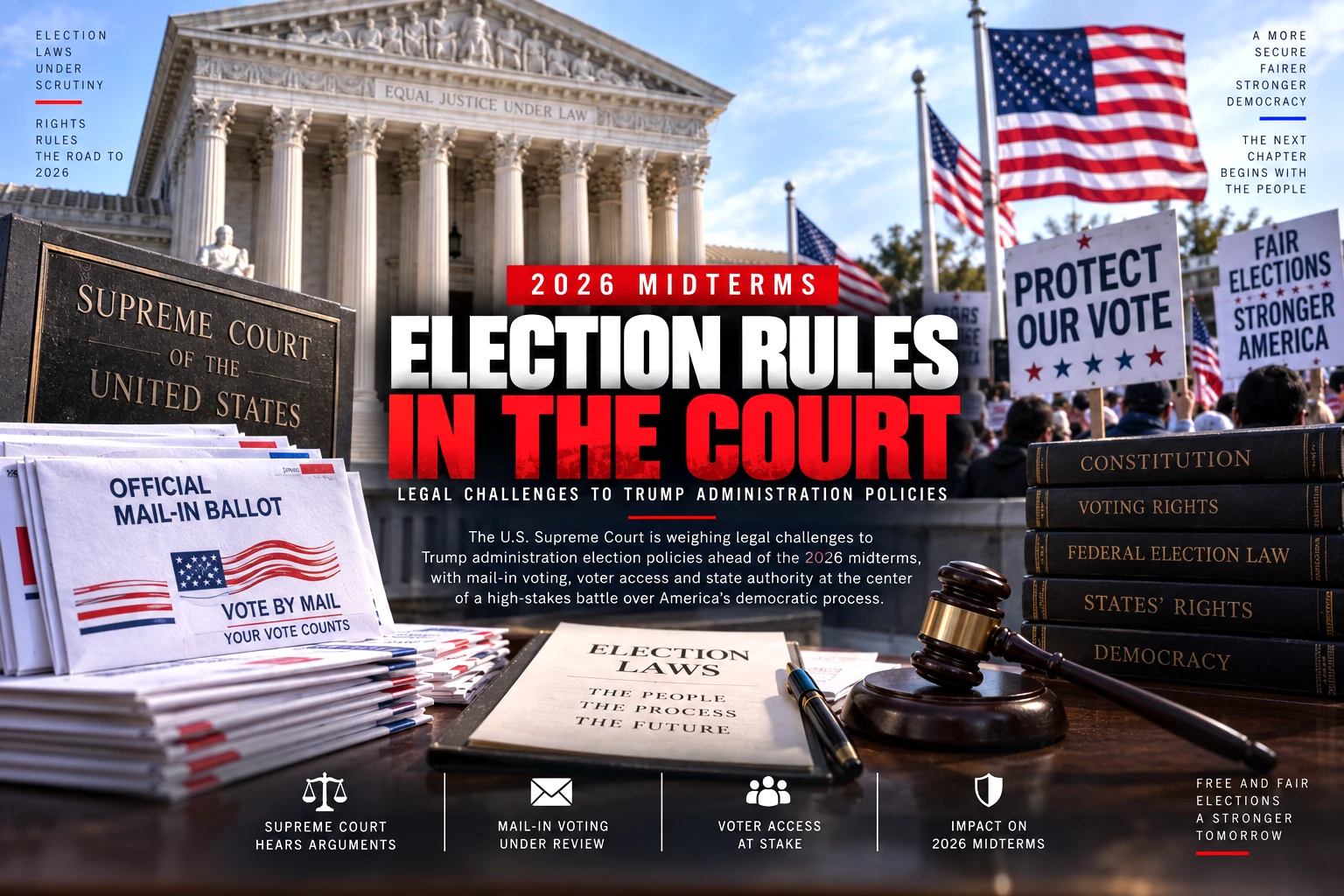
The Trump administration is asking the US Supreme Court to allow new restrictions affecting the handling of mail ballots. Congressional redistricting has reshaped the House battlefield in several states. Meanwhile, candidates are fighting over the economy, affordability, immigration, policing and crime, healthcare and foreign policy.
The Jeffrey Epstein controversy has also entered some congressional campaigns, with candidates and political groups using Epstein-related associations, donations and votes over disclosure of government records as attack lines.
However, some of those claims have lacked important context, making careful fact-checking essential.
Table of Contents
Voting begins in the 2026 midterms
Why North Carolina matters
What Americans are voting for
Republicans hold narrow congressional majorities
Trump administration takes mail-voting fight to Supreme Court
What the proposed mail rules would change
Why election officials are concerned
Redistricting reshapes the House battlefield
Wisconsin’s congressional map remains under legal challenge
Democrats see an opportunity to win the House
Senate battle remains much closer
Economy and affordability dominate voter concerns
Crime, immigration and policing feature heavily in campaign ads
Epstein-related attacks enter Senate campaigns
Why Epstein claims require careful fact-checking
What happens between now and November 3
Key takeaway
Voting in the 2026 US Midterms Has Already Begun
Election Day remains almost two months away, but voting has already started.
The North Carolina State Board of Elections confirmed that county election boards began sending absentee-by-mail ballots on Friday, 4 September.
That made North Carolina the first US state to broadly distribute absentee ballots for the 2026 general election.
Any registered voter in North Carolina can request an absentee ballot without providing a special reason.
The state will subsequently begin its in-person early-voting period on 15 October, continuing through 31 October.
Election Day is Tuesday, 3 November 2026.
Other states are now preparing to send their own absentee ballots.
That means the US election campaign has reached the point where political developments are no longer influencing only future voters.
Some Americans can already cast their votes.
Why North Carolina Is Particularly Important
North Carolina is more than simply the first state to begin mailing ballots.
It is also home to one of the country’s most closely watched Senate contests.
Republican Senator Thom Tillis is retiring, creating an open-seat race between former Democratic Governor Roy Cooper and Republican Michael Whatley.
Reuters identifies North Carolina as one of nine Senate contests likely to play a significant role in deciding control of the chamber.
The state also has 14 US House seats on the ballot, alongside numerous state and local contests.
North Carolina’s early start therefore provides one of the first practical tests of election administration in what is expected to be a highly competitive national campaign.
What Is at Stake on November 3?
The midterm election will determine the political balance in Washington for the final two years of Trump’s current presidential term.
Voters will elect:
All 435 members of the US House of Representatives
Senators in 35 states
Numerous governors
State legislators
Judges
Local officials
Republicans currently hold a narrow advantage in the House.
Reuters places the current House alignment at approximately 218 Republicans to 214 Democrats, making even a relatively small number of seat changes potentially decisive.
The Senate is also competitive.
Democrats need to gain four Republican-held seats to win control of the 100-member chamber under the current political alignment.
Why Control of the House Matters
The House majority determines far more than which party holds a larger number of seats.
The majority controls congressional committees, much of the legislative agenda and significant investigative authority.
If Democrats regain the House, they could launch investigations into the Trump administration and make it considerably more difficult for the White House to advance legislation without Democratic support.
If Republicans retain control, Trump would have a much stronger congressional position during the final two years of his term.
That makes the House election effectively a national judgment on both parties — and particularly on the sitting president.
Historically, the president’s party usually loses House seats in midterm elections.
Trump Administration Takes Mail-Voting Fight to Supreme Court
One of the most consequential legal battles concerns voting by mail.
On 6 September, the Trump administration renewed an emergency request asking the US Supreme Court to allow new mail-ballot restrictions to take effect for the November elections.
The dispute originates from an executive order signed by Trump in March and a subsequent US Postal Service rule.
A federal judge, US District Judge Indira Talwani, blocked the new requirements from taking effect for the midterm elections.
The administration is now asking the Supreme Court to intervene.
This is important because states have already begun putting ballots into the mail.
What Would the New Mail-Ballot Rules Do?
The disputed rules would impose additional requirements involving election officials and the US Postal Service.
According to Reuters, states would have to provide USPS with lists of mail-ballot recipients.
Outbound and returned ballot envelopes would also need unique barcodes.
The Postal Service could refuse to handle ballots that did not comply with the new requirements or were associated with voters who did not appear on the relevant lists.
The Trump administration argues these are reasonable preparation and security requirements.
Opponents — including Democratic-led states and voting-rights organisations — argue that the federal government lacks the authority to impose the changes in this way and that introducing them immediately before an election could disenfranchise eligible voters.
The Supreme Court has not yet issued a final ruling resolving the legality of the system.
Why Election Officials Are Worried About Timing
The timing is one of the biggest practical problems.
North Carolina ballots are already being mailed.
Alabama is expected to begin shortly, followed by several additional states.
Once ballot envelopes have entered the postal system, election administrators cannot simply retrieve and redesign them.
Election officials have warned that implementing new technical requirements immediately before a national election could create logistical difficulties.
Nearly a third of American voters used mail ballots in the 2024 election, according to current reporting.
That means changes to postal voting procedures could potentially affect millions of people.
Trump and his administration argue that the proposed measures would improve election security and reliability.
Opponents argue that the requirements could instead create confusion and result in otherwise eligible ballots not being delivered or counted.
The courts will determine the legal questions.
Redistricting Has Changed the House Battlefield
Another major factor in 2026 is redistricting.
Normally, congressional districts are redrawn after the once-a-decade US Census.
But the current cycle has seen an unusually intense mid-decade redistricting battle.
Republican-controlled states have redrawn congressional maps in ways expected to improve Republican prospects in several districts.
Reuters estimates Republicans could gain as many as 10 House seats based solely on newly drawn maps.
Other analyses put the Republican structural advantage from post-2024 redistricting at roughly nine seats.
That gives Republicans a potentially important buffer against an otherwise difficult national political environment.
Wisconsin’s Congressional Map Remains Under Legal Challenge
Wisconsin is one of the states where congressional boundaries remain the subject of litigation.
A challenge known as Bothfeld v. Wisconsin Elections Commission argues that Wisconsin’s congressional map is an unconstitutional partisan gerrymander under the state constitution.
A three-judge state panel dismissed that challenge on 31 March 2026, concluding that it did not have authority to override the Wisconsin Supreme Court’s earlier map decision.
The plaintiffs appealed.
The Wisconsin Supreme Court accepted the case as an appeal in June, and briefing has continued through the summer.
Another Wisconsin challenge has also questioned the state’s congressional map on different constitutional grounds.
The existence of these cases does not mean the current districts have already been ruled unconstitutional.
They remain legal disputes.
For national election coverage, it is therefore more accurate to say redistricting battles across several states have reshaped the 2026 House contest, with Wisconsin among the states where congressional maps remain contested.
Democrats Currently See an Opportunity in the House
The political environment currently presents significant challenges for Republicans.
Reuters reported on 7 September that Trump’s approval rating has fallen to a low point in its polling, with dissatisfaction over the economy and the war in Iran contributing to voter concerns.
Registered voters in Reuters/Ipsos polling currently show a preference for Democratic congressional candidates over Republicans.
Democratic voters have also demonstrated comparatively high enthusiasm in recent elections.
History adds another challenge for Republicans.
The sitting president’s party has lost House seats in almost every midterm election since the late 1930s.
However, none of that guarantees a Democratic victory.
Republicans Still Have Important Advantages
Republicans retain several structural and financial strengths.
Redistricting has improved the party’s position in the House.
Republican-aligned political organisations also have substantial financial resources available for the final campaign.
Trump’s own super PAC reportedly has a war chest of approximately $400 million.
Democrats, meanwhile, face internal ideological disagreements between moderate candidates and a number of progressive challengers who have performed strongly in party contests.
The House therefore remains competitive even if the current national political environment appears to favour Democrats.
The Senate Battle Is More Difficult to Predict
Control of the Senate is considerably less straightforward.
Reuters identifies nine competitive Senate contests:
North Carolina, Michigan, Texas, Alaska, Iowa, Maine, Georgia, Ohio and New Hampshire.
Democrats need to gain four Republican-held seats to secure control.
But even victories in several traditional battlegrounds may not be sufficient.
They could also need to win states that Trump carried comfortably in the 2024 presidential election.
That creates a difficult electoral map for Democrats even if the national political mood favours them.
The Senate should therefore not be treated as following automatically from the House.
It is entirely possible for voters to produce different party outcomes in the two chambers.
Economy and Affordability Remain Central
Despite intense political controversies, economic concerns remain among the most important issues facing voters.
Current polling and campaign analysis consistently identify concerns such as:
Cost of living
Inflation and affordability
Jobs and the broader economy
Healthcare
These issues are particularly dangerous for the party controlling the White House because midterm elections often become referendums on the incumbent president’s performance.
Republicans are attempting to persuade voters that their policies offer greater economic security.
Democrats are arguing that voters remain dissatisfied with affordability under Republican control.
The final two months will see enormous advertising spending around those competing economic messages.
Crime, Immigration and Policing Feature Heavily in Campaign Advertising
Crime and public safety are also major campaign themes.
Research from the Wesleyan Media Project, examining local broadcast Senate advertisements through early August, found significant attention to both policing and immigration from campaigns aligned with both parties.
Among Republican Senate advertising, immigration and policing were the two most frequently mentioned issues in the analysis.
Democratic Senate advertising also devoted substantial attention to policing and immigration.
House advertising showed somewhat different priorities, with Democrats focusing more heavily on cost-of-living concerns while Republicans discussed issues including crime and taxes.
This provides a more accurate picture than simply saying that “campaign ads are about crime.”
The messaging varies by party, race and state.
Jeffrey Epstein Has Entered the Midterm Campaign
Another unexpected campaign theme is the late convicted sex offender Jeffrey Epstein.
Epstein-related political attacks have appeared in Senate campaigns in states including Georgia, Ohio and Texas.
Candidates and opposition researchers have highlighted matters including:
Political donations involving people associated with Epstein
Candidates’ votes relating to disclosure of Epstein records
Past statements about Epstein
Associations with people who had social or financial relationships with him
The issue can be politically potent because it combines questions of character, powerful elites, transparency and accountability.
But it is also particularly vulnerable to misleading claims.
Why Epstein-Related Claims Need Careful Fact-Checking
Merely appearing in records associated with Epstein does not establish criminal wrongdoing.
Likewise, receiving a political donation from somebody who once interacted socially or professionally with Epstein does not establish involvement in Epstein’s crimes.
PolitiFact has already found important context missing from several campaign claims.
For example, an advertisement from Democratic Senator Jon Ossoff’s campaign in Georgia attacked Republican opponent Mike Collins over comments concerning Trump’s appearance in Epstein-related files.
PolitiFact rated the claim Mostly False, finding that the advertisement omitted important context surrounding Collins’ remarks.
Ohio campaigns have similarly exchanged accusations involving donations from people described as Epstein “associates,” even though some connections were largely social and did not establish ties to Epstein’s crimes.
That is an important warning for election coverage.
Campaign advertisements are advocacy.
They should not automatically be treated as verified factual statements.
Surveillance and AI Are Emerging as Campaign Issues Too
Another interesting 2026 development is the growing political debate over AI-powered surveillance.
Automated licence-plate cameras operated by Flock Safety have become an issue in races across several states.
Candidates from both parties have raised concerns about privacy and government access to large-scale vehicle-location data.
In Wisconsin’s gubernatorial race, both Democratic nominee David Crowley and Republican Tom Tiffany have proposed restrictions or stronger safeguards involving the technology.
That demonstrates how technology and privacy are beginning to enter campaigns alongside traditional issues such as crime, taxes and healthcare.
Two Months Remain Until Election Day
Election Day is 3 November 2026.
But the campaign calendar is already accelerating.
North Carolina has begun sending absentee ballots.
Other states will follow.
In-person early voting will begin at different times across the country.
Court decisions could still affect mail-voting procedures.
Campaign advertising will intensify.
And polling could change significantly during the remaining weeks.
For that reason, today’s projections should not be interpreted as election results.
What Will Decide the 2026 Midterms?
Several factors could ultimately determine control of Congress.
The first is the economy.
If voters remain dissatisfied with affordability and economic conditions, Republicans could face a difficult environment.
The second is Trump’s popularity.
Because he dominates the Republican Party, perceptions of his presidency are likely to influence congressional candidates even though Trump himself is not on the ballot.
Third is redistricting.
Republican map advantages could protect the party from some of the national swing towards Democrats.
Fourth is turnout.
The party that can motivate more supporters in competitive states and districts will have an enormous advantage.
Finally, individual candidates matter.
Senate contests in particular can diverge significantly from national trends.
Key Takeaway
The 2026 US midterm election campaign has entered its final sprint, and voting has already begun.
North Carolina became the first state to broadly send absentee ballots on 4 September, ahead of Election Day on 3 November.
The Trump administration has renewed its request for the Supreme Court to permit new restrictions affecting mail ballots, but the legal dispute remains unresolved.
Redistricting has given Republicans additional structural advantages in the House, while Wisconsin is among the states where congressional maps remain subject to litigation.
Democrats currently see a strong opportunity to retake the House, while control of the Senate remains much harder to predict.
The economy, affordability, immigration, policing, crime, healthcare and foreign policy are major campaign issues.
Epstein-related attacks have also entered several races, but some claims have lacked important context and should be independently verified rather than repeated as fact.
With ballots already entering the mail, the 2026 midterms are no longer simply an approaching political contest.
Editorial Note: Polls, projections and campaign claims are not election results. Allegations made in political advertisements — including claims involving Jeffrey Epstein or political opponents — should be independently verified and clearly attributed. The Supreme Court dispute over mail-ballot rules remains active, and election procedures may change following further court decisions.
The Rajatheertha Team publishes news, explainers, guides and updates across India and the world. Our coverage follows Rajatheertha's editorial, verification and corrections standards.
The Trump administration faces multiple legal battles over mail voting, citizenship checks, voter data and election authority as the November 2026 midterms approach.
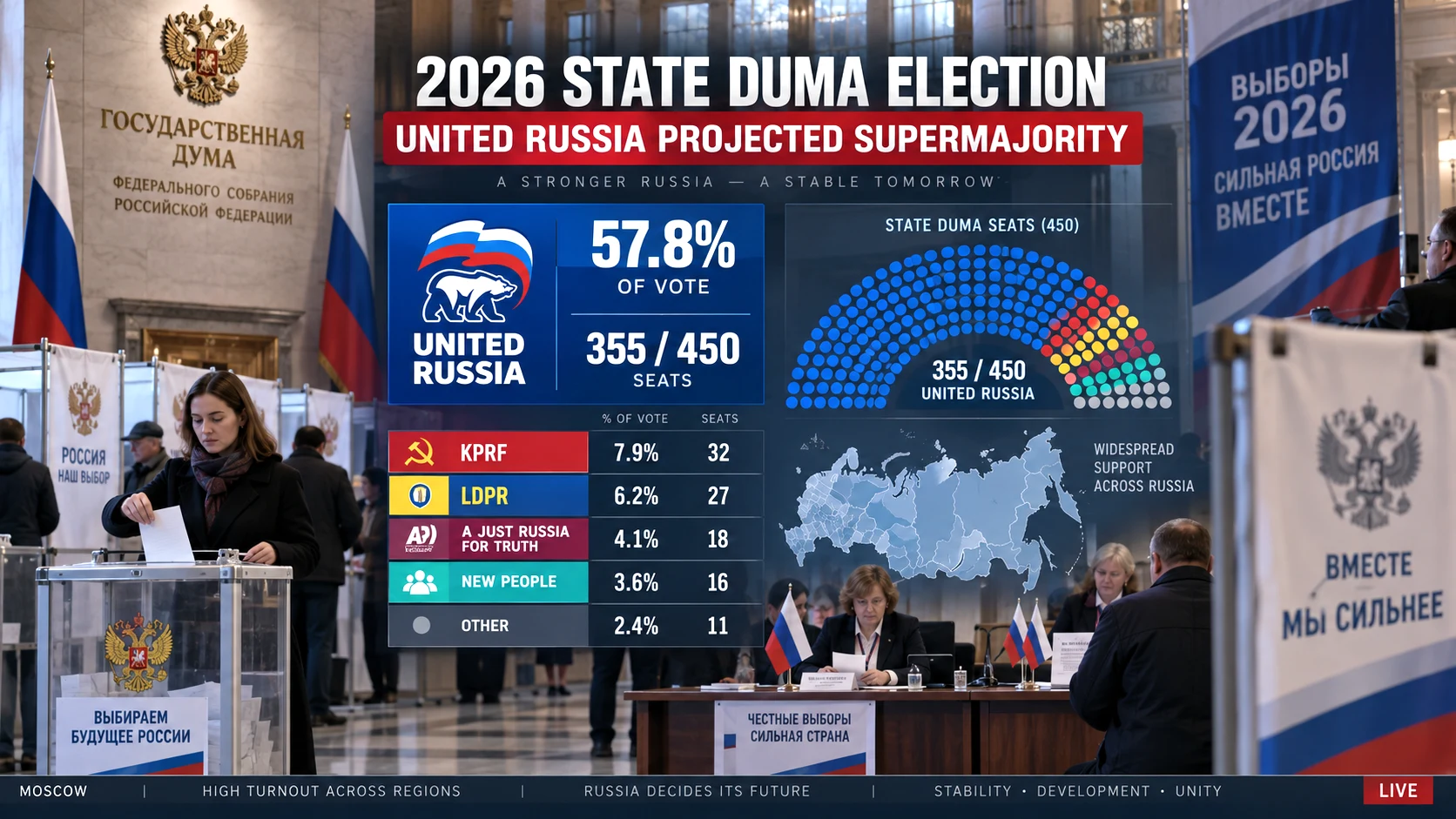
Russia’s ruling United Russia party has secured a decisive victory in the country’s 2026 parliamentary election, according to near-complete official results, putting the Kremlin-aligned party on course for a record 355 seats in the 450-member State Duma. The vote was Russia’s first parliamentary ele
The EU has announced a €200 million Greenland partnership covering minerals, energy and connectivity as Trump’s push for US control keeps Arctic sovereignty in focus.
Major US television networks have suspended shared pool coverage of President Donald Trump after CNN was blocked from its scheduled duties, while CNN, MS NOW and Politico have sued over their White House access ban.
Harrison Butker drilled a 40-yard field goal at the final second of overtime as Patrick Mahomes and the Kansas City Chiefs survived a dramatic Indianapolis Colts challenge 33-30 on Sunday Night Football. Mahomes threw for 382 yards and three touchdowns, while Kenneth Walker III produced 178 yards fr
Qatar has launched an intensified diplomatic push to revive negotiations between Iran and the United States, shuttling proposals between Tehran and Washington as both sides combine threats of further military action with signals that a negotiated settlement remains possible. Iran has conveyed condit








0 Comments