EU Deepens Greenland Partnership With €200 Million Investment Amid Trump Pressure
The EU has announced a €200 million Greenland partnership covering minerals, energy and connectivity as Trump’s push for US control keeps Arctic sovereignty in focus.
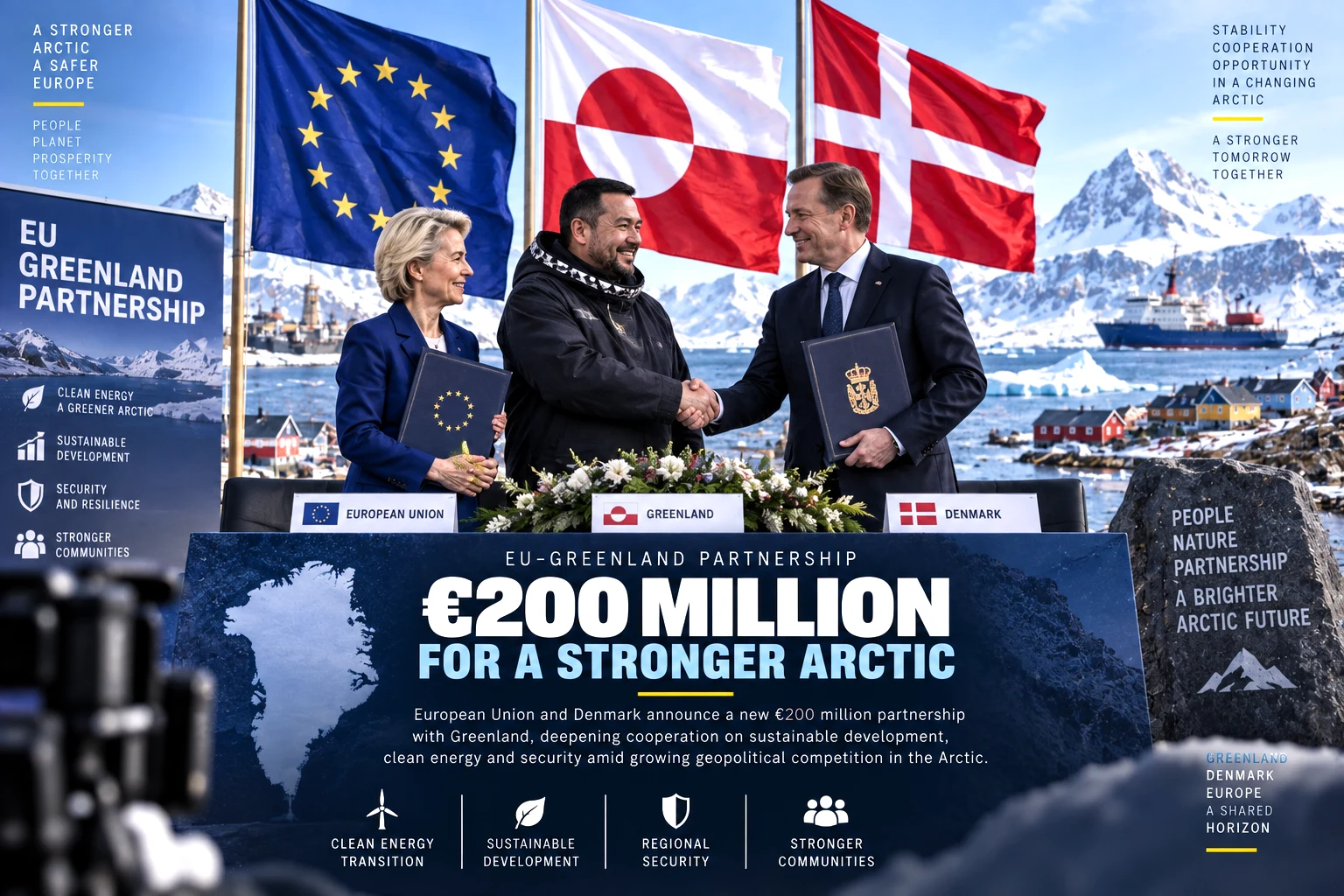
European Union, Greenland and Danish flags representing a new €200 million partnership amid growing Arctic geopolitical competition
Table of Contents (18 sections)
The European Union has significantly expanded its partnership with Greenland, announcing a €200 million investment package and a broader political agreement as the strategically important Arctic island remains at the centre of geopolitical tensions involving the United States, Europe and Denmark.
European Commission President Ursula von der Leyen travelled to Nuuk for the announcement on 7 September 2026, joining Greenlandic Prime Minister Jens-Frederik Nielsen and Danish Prime Minister Mette Frederiksen.
The three leaders signed a renewed Joint Declaration covering economic development, critical raw materials, clean energy, digital connectivity, infrastructure, fisheries, education, security and Arctic cooperation.
Alongside the declaration, Brussels announced a €200 million Global Gateway Partnership Package, to be invested during 2026 and 2027.
The agreement comes amid continued pressure from U.S. President Donald Trump, who has repeatedly argued that the United States should control Greenland for national security reasons.
Recommended Reading
Related Stories & In-Depth Guides
Curated editorial perspectives matching this topic.
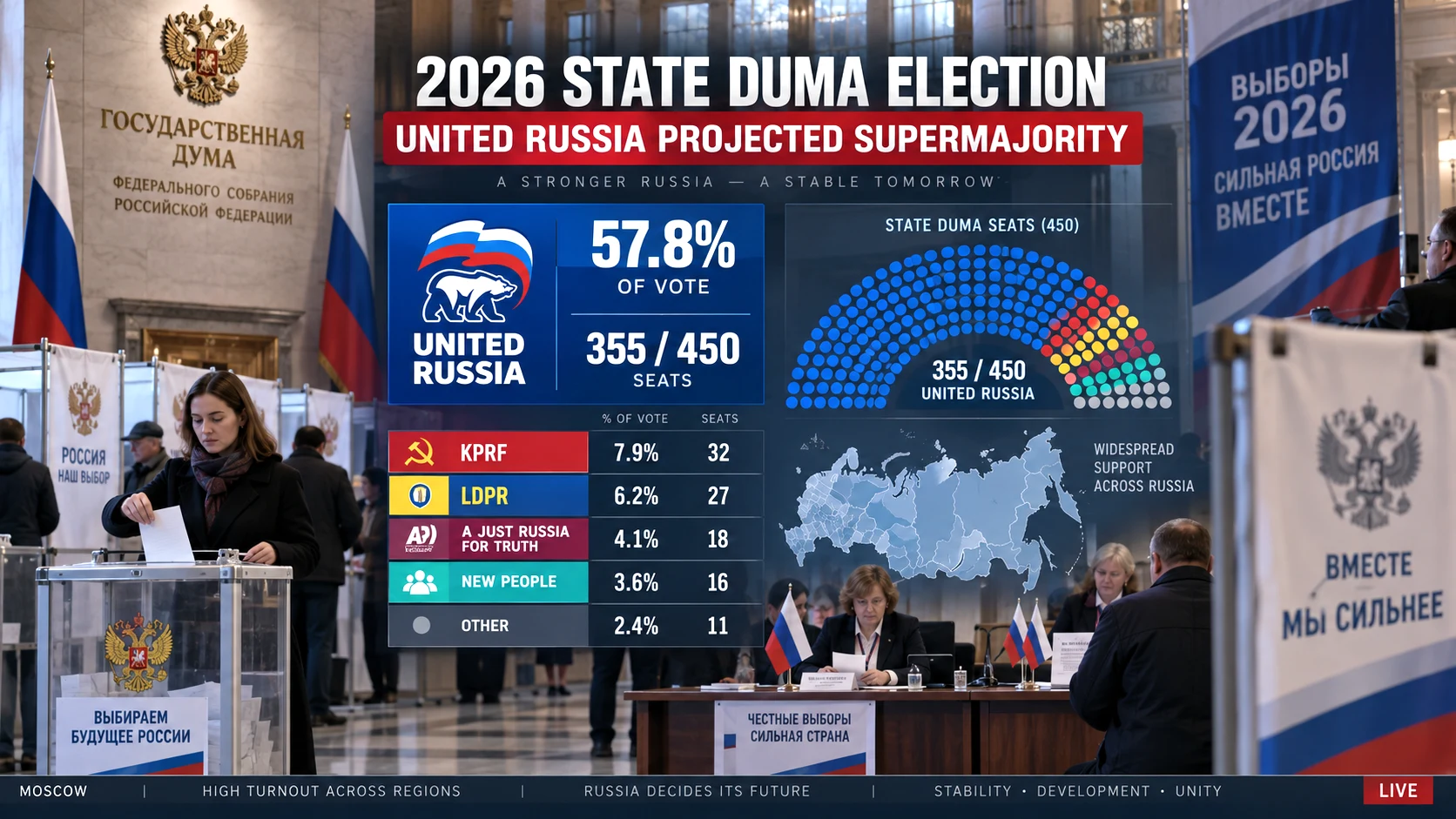
Russia’s ruling United Russia party has secured a decisive victory in the country’s 2026 parliamentary election, according to near-complete official results, putting the Kremlin-aligned party on course for a record 355 seats in the 450-member State Duma. The vote was Russia’s first parliamentary ele
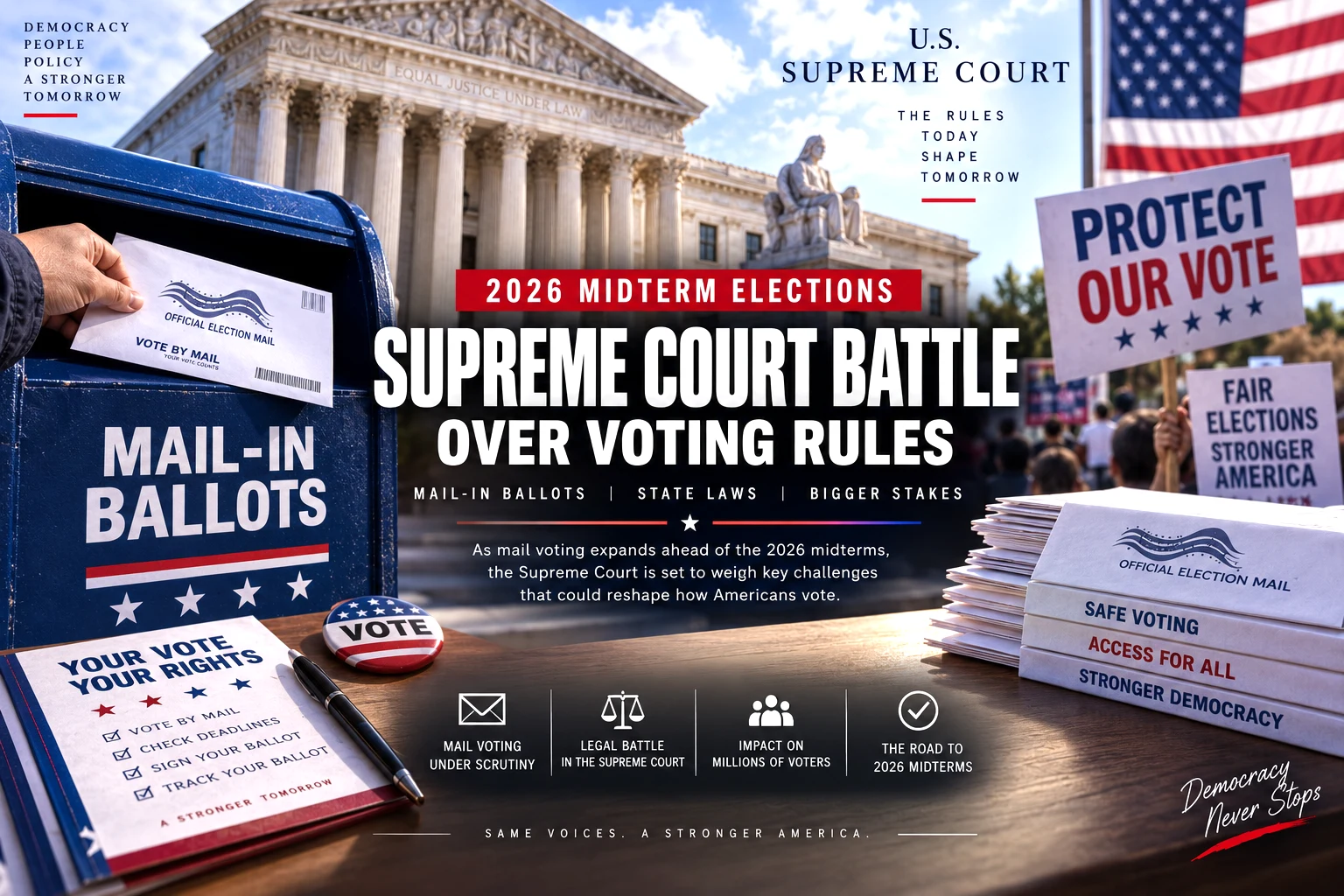
The Trump administration faces multiple legal battles over mail voting, citizenship checks, voter data and election authority as the November 2026 midterms approach.
Greenland and Denmark have rejected that position.
Von der Leyen used her visit to reinforce Europe’s position that decisions about Greenland’s future belong to Greenlanders themselves within the existing constitutional relationship with Denmark.
The result is an agreement that is economic on paper but carries much wider geopolitical significance.
Table of Contents
What did the EU and Greenland agree on?
Where will the €200 million be invested?
Why Greenland matters strategically
Critical minerals become a major focus
Europe invests in Greenland’s connectivity
Renewable energy and hydropower plans
Why Trump’s Greenland campaign matters
What Greenland and Denmark say about sovereignty
Is Greenland part of the European Union?
The EU plans to more than double future funding
Arctic security becomes part of the partnership
Greenland’s economic independence challenge
US-Greenland negotiations continue
What happens next?
Key takeaway
EU Announces €200 Million Greenland Partnership
The European Commission describes the new programme as a Global Gateway Partnership Package.
It is worth €200 million, with investments planned for this year and 2027.
The package substantially broadens Europe’s existing economic engagement with Greenland.
EU assistance has traditionally concentrated heavily on education and fisheries.
The new programme moves into strategically important areas, including:
Digital and satellite connectivity
Critical raw materials
Renewable energy
Hydropower
Sustainable tourism
Housing
Fisheries
Education
Small businesses
Institutional capacity
The objective is both to improve everyday economic opportunities for Greenlanders and to strengthen Europe’s long-term presence in the Arctic.
A New EU-Greenland-Denmark Declaration
The investment package accompanies a new political declaration signed by the EU, Greenland and Denmark.
It updates an earlier declaration from 2015.
The new document recognises Greenland’s increasing strategic importance and expands cooperation into areas including infrastructure, raw materials, clean energy, digital networks, research, civil protection, resilience, cybersecurity and Arctic affairs.
It also commits the parties to stronger political dialogue and more exchanges involving students and researchers.
However, there is an important legal distinction.
The declaration explicitly says it is not intended to create new legal or financial obligations under domestic or international law.
It is therefore a political framework for deeper cooperation rather than a treaty transferring sovereignty or creating EU authority over Greenland.
Critical Minerals Are a Major Part of the Strategy
Greenland possesses significant deposits of minerals that could become increasingly important to advanced economies.
The EU wants to develop sustainable raw-material supply chains linking Greenland with European industry.
The new package includes support for technical analysis, investor matchmaking and mining projects.
One example is the Amitsoq graphite project, which has been designated an EU Strategic Project under Europe’s Critical Raw Materials Act.
The EU also points to the Malmbjerg mining project as an example of existing investment.
This matters because Europe is attempting to reduce excessive dependence on external suppliers for minerals used in batteries, renewable-energy systems, electronics and other advanced technologies.
Greenland could eventually become part of that diversification strategy.
Better Internet and Satellite Connections
Digital infrastructure is another major element.
Greenland’s enormous geography and small, dispersed population make communications expensive and technically challenging.
The EU will support an Enhanced Satellite Connectivity project involving Greenlandic telecommunications company Tusass and European providers.
The programme is intended to improve internet reliability, speed and resilience across remote settlements.
Brussels is also supporting work on west-coast digital connectivity and studying whether data centres could become commercially viable as Greenland develops additional renewable electricity and communications infrastructure.
The investment therefore combines economic development with strategic resilience.
EU Backs Renewable Energy
Energy is another priority.
The EU plans to support Greenland’s national utility, Nukissiorfiit, in modernising electricity systems in remote communities.
Hybrid renewable-energy systems are expected to reduce reliance on fossil fuels while improving electricity reliability.
Europe and Greenland are also exploring support for expansion of the Buksefjord hydropower plant, which supplies Nuuk.
That project could become increasingly important as the capital grows and electricity demand rises.
Renewable electricity could also support future industries, including mining and data infrastructure.
Why Greenland Has Become So Strategically Important
Greenland’s importance extends far beyond its population.
It is the world’s largest island and occupies a crucial position between North America and Europe.
Its location matters for:
Arctic defence
Missile warning
North Atlantic security
Satellite operations
Shipping routes
Critical minerals
Climate research
Climate change is adding another dimension.
As Arctic ice retreats, previously difficult shipping routes and mineral resources become more accessible.
That has increased strategic interest from the United States, Europe, Russia and China.
Von der Leyen described the Arctic as a place where the “tectonic plates of geopolitics collide.”
Trump’s Push for US Control Changed the Political Environment
President Trump has repeatedly argued that Greenland should come under American control.
He says the island is essential to U.S. national security and has questioned Denmark’s ability to defend it.
Those statements triggered a serious dispute involving Washington, Copenhagen, Nuuk and other European capitals.
Greenland and Denmark rejected the idea that the territory could simply be transferred to the United States.
European governments responded by stressing the principle of territorial integrity and Greenlanders’ right to determine their own future.
The dispute also created unusual tensions inside NATO because both Denmark and the United States are alliance members.
Greenland Is Already Covered by NATO
Another important point is often lost in the debate.
Greenland is already within the NATO security framework through the Kingdom of Denmark.
The United States also already maintains a military presence in Greenland and has longstanding treaty rights allowing it to expand security activities under agreed arrangements.
This complicates the argument that American ownership is necessary simply to maintain a U.S. military presence.
European governments instead favour strengthening NATO’s Arctic capabilities while preserving Greenland’s existing sovereignty arrangements.
Earlier this year, NATO allies increased Arctic security cooperation after tensions over Trump’s proposals intensified.
The US, Denmark and Greenland Are Still Talking
The dispute has moved increasingly towards diplomacy.
Greenland’s Foreign Minister Mute Egede said on 2 September that dialogue with Washington remained underway.
He declined to reveal details.
The negotiations followed an agreement for officials from the United States, Denmark and Greenland to discuss their differences.
No agreement transferring control of Greenland to the United States has emerged.
Trump has nevertheless continued publicly expressing his desire for U.S. control.
That means the sovereignty dispute has not disappeared even as formal negotiations continue.
Greenland’s Future Belongs to Greenlanders
Von der Leyen used her Nuuk visit to reiterate Europe’s position.
She said Greenland’s future is for the people of Greenland and Denmark to decide — not an outside power.
That principle is also reflected in the new Joint Declaration.
Greenland has extensive self-government within the Kingdom of Denmark.
Its 2009 Self-Government Act recognises the Greenlandic people’s right to determine their future in accordance with the principle of self-determination.
The island, therefore, should not be described simply as a piece of territory that Denmark, Europe or the United States can unilaterally trade.
Greenland Is Not an EU Member
Greenland’s relationship with Europe is unusual.
Denmark belongs to the European Union.
Greenland does not.
Greenland left the European Communities in 1985 after a referendum, largely because of disputes over fisheries.
It nevertheless maintains a close association with the EU as an overseas country and territory.
Greenlanders are Danish citizens and therefore also hold EU citizenship.
The new agreement deepens that relationship without bringing Greenland back into the EU.
There has been no announcement that Greenland is seeking EU membership.
EU Could More Than Double Future Funding
The €200 million package is only part of Europe’s longer-term plan.
Greenland is already allocated approximately €225 million under the EU’s 2021–2027 budget, with most of that support directed towards education.
For the next EU budget period covering 2028–2034, the European Commission has proposed approximately €530 million for Greenland.
If approved through the EU budget process, that would more than double the current allocation.
The €530 million figure is therefore a proposal, not money already guaranteed.
The final EU budget still requires negotiation and approval.
Greenland Wants Investment, Not Just Geopolitical Attention
There is another important side to the story.
Greenland has attracted enormous geopolitical attention, but converting that attention into sustainable economic development has proved difficult.
Mining projects face high costs, difficult weather, limited infrastructure and logistical challenges.
Greenland also depends heavily on an annual financial grant from Denmark.
Greater private investment could help diversify the economy and potentially support Greenland’s long-term ambitions for greater independence.
Tourism, renewable energy, mining and digital infrastructure are among the sectors policymakers hope can generate jobs and government revenue.
The EU package is therefore significant not only because of Trump or Arctic rivalry.
It could also influence Greenland’s domestic economic future.
Arctic Security Is Becoming Part of Europe’s Strategy
The EU is preparing a new Arctic strategy expected in the coming months.
Brussels increasingly views economic investment, infrastructure, cybersecurity and defence resilience as interconnected.
The new Greenland declaration specifically includes cooperation on:
Civil protection
Disaster preparedness
Cybersecurity
Secure communications
Critical infrastructure
Hybrid threats
Foreign information manipulation
That illustrates how the European approach to Greenland has evolved.
The island is no longer viewed mainly through fisheries, development aid and environmental cooperation.
It is increasingly part of Europe’s broader security strategy.
What Happens Next?
Implementation of the €200 million programme will now become the immediate focus.
Projects involving satellite connectivity, energy and raw materials are already being developed.
The EU and Greenland will also explore additional programmes involving housing and sustainable tourism.
At the geopolitical level, attention will remain on U.S.-Greenland-Denmark negotiations.
Europe is also expected to publish its new Arctic strategy.
And negotiations over the EU’s proposed €530 million Greenland allocation for 2028–2034 will determine how far Europe’s investment push ultimately expands.
Key Takeaway
The EU-Greenland partnership announced on September 7 is real and strategically significant.
The European Union is committing €200 million for investments during 2026 and 2027, while Greenland, Denmark and the EU have signed a renewed political declaration expanding their cooperation.
The money will support areas including digital connectivity, renewable energy, critical minerals, housing, tourism, education and fisheries.
Europe is also proposing to increase its regular Greenland funding from €225 million in the current budget period to approximately €530 million for 2028–2034.
The timing cannot be separated from President Donald Trump’s repeated calls for U.S. control of Greenland.
But describing the agreement purely as an anti-Trump deal would oversimplify it.
The EU and Greenland have had a longstanding relationship, and many of the investments address genuine Greenlandic economic and infrastructure needs.
What Trump’s campaign has done is dramatically increase the geopolitical importance of that partnership.
Greenland now sits at the intersection of Arctic security, critical minerals, climate change, NATO strategy and great-power competition.
Europe’s message from Nuuk is therefore clear:
It intends to remain a major economic and political partner in Greenland — and it supports the principle that Greenlanders themselves determine Greenland’s future.
Editorial Note: Do not describe the €530 million figure as approved funding; it is the European Commission’s proposed allocation for 2028–2034. The €200 million package for 2026–2027 is the newly announced partnership package. Trump’s position should be described as his push or demand for U.S. control of Greenland, while Greenlandic and Danish sovereignty positions should be clearly attributed.
The Rajatheertha Team publishes news, explainers, guides and updates across India and the world. Our coverage follows Rajatheertha's editorial, verification and corrections standards.
The 2026 US midterms have entered a crucial phase as voting begins and Trump’s administration asks the Supreme Court to allow new restrictions affecting mail ballots.
Voting has begun in the 2026 US midterm elections as North Carolina sends the first mail ballots, while control of Congress, mail-voting rules and redistricting dominate the campaign.
Qatar has launched an intensified diplomatic push to revive negotiations between Iran and the United States, shuttling proposals between Tehran and Washington as both sides combine threats of further military action with signals that a negotiated settlement remains possible. Iran has conveyed condit
Canada has imposed new retaliatory tariffs of up to 50% on U.S. goods after trade negotiations with the Trump administration collapsed, escalating the Canada-US trade war.
U.S. envoys Steve Witkoff and Jared Kushner have met Vladimir Putin and Volodymyr Zelenskyy in a renewed push for Ukraine peace talks, but major differences remain as Russia resumes ballistic missile attacks on Kyiv.
The US-Iran conflict has entered another dangerous phase as strikes on tankers, missile attacks and renewed disruption in the Strait of Hormuz threaten global energy supplies.


0 Comments