Germany’s AfD Wins Historic Saxony-Anhalt Election, Sending Shockwaves Through Berlin and Europe
Germany’s far-right AfD has won 43.8% in Saxony-Anhalt, more than doubling its previous vote share and dealing a major blow to Chancellor Friedrich Merz’s CDU.
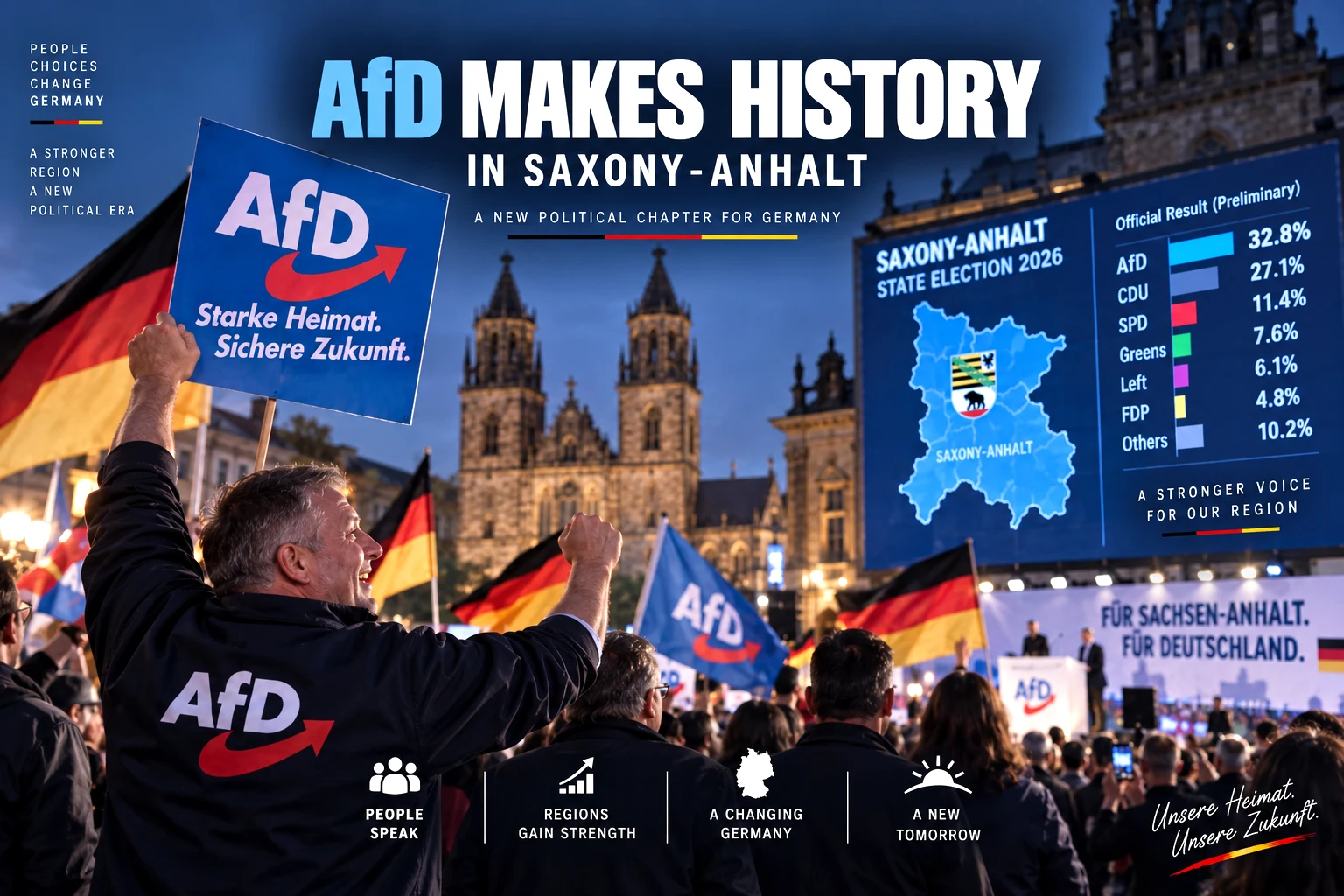
AfD supporters and German election imagery following the party’s historic victory in the 2026 Saxony-Anhalt state election
Table of Contents (24 sections)
Germany’s political landscape has been shaken by a historic election result in the eastern state of Saxony-Anhalt, where the far-right Alternative for Germany (AfD) surged to first place with 43.8% of the party-list vote.
Official preliminary results from the state election authority show the AfD more than doubled its support compared with the previous state election in 2021, gaining approximately 23 percentage points.
Chancellor Friedrich Merz’s Christian Democratic Union (CDU) suffered a dramatic defeat, falling to just 17.2%, down 19.9 percentage points from 2021.
The result is unquestionably a breakthrough for the AfD.
But one important distinction is essential.
Recommended Reading
Related Stories & In-Depth Guides
Curated editorial perspectives matching this topic.
Russia’s ruling United Russia party has secured a decisive victory in the country’s 2026 parliamentary election, according to near-complete official results, putting the Kremlin-aligned party on course for a record 355 seats in the 450-member State Duma. The vote was Russia’s first parliamentary ele
Voting has begun in the 2026 US midterm elections as North Carolina sends the first mail ballots, while control of Congress, mail-voting rules and redistricting dominate the campaign.
The AfD won the election but did not win an absolute majority in the Saxony-Anhalt parliament.
It secured 39 of 83 seats, leaving it three seats short of the 42 needed to govern alone.
That means the central political question has shifted from who won the election to something more complicated:
Can the AfD actually form a government?
The answer could have consequences extending far beyond Saxony-Anhalt, testing Germany’s longstanding political “firewall” against cooperation with the AfD and adding momentum to the wider rise of populist and far-right parties across Europe.
Table of Contents
AfD wins Saxony-Anhalt election
Official 2026 election results
How dramatic was the AfD’s rise?
CDU suffers historic defeat
Can the AfD actually form a government?
What is Germany’s political “firewall”?
AfD appeals to conservative lawmakers
Could BSW become a partner?
Why Saxony-Anhalt matters nationally
Why voters moved towards the AfD
Immigration and national identity
Russia and Ukraine become election issues
Economic frustration in eastern Germany
Why the result is a major problem for Friedrich Merz
AfD’s growing strength beyond eastern Germany
Why the result is attracting attention across Europe
Is Europe experiencing a broader populist shift?
What the result does not mean
What happens next?
Key takeaway
AfD Wins Saxony-Anhalt With 43.8%
The election took place on Sunday, 6 September 2026.
Official preliminary results show the AfD receiving 576,037 party-list votes, equivalent to 43.8%.
The CDU finished a distant second with 17.2%.
The Social Democratic Party, or SPD, received 9.3%.
The Greens secured 8.9%, while the Left Party received 8.6%.
The Sahra Wagenknecht Alliance, known as BSW, entered the state parliament with 5.3%.
The Free Democratic Party received only 2.6%, below the threshold required for representation.
Voter turnout reached a remarkable 77.8%, up 17.5 percentage points from the previous state election.
That high turnout makes it difficult to dismiss the AfD’s victory as simply the product of unusually low participation by supporters of other parties.
How Historic Was the AfD’s Rise?
The scale of the change is extraordinary.
In 2021, the AfD received approximately 20.8% of the party-list vote in Saxony-Anhalt.
In 2026: 43.8%.
That represents an increase of approximately 23 percentage points.
The AfD therefore more than doubled its share of the vote in five years.
Lead candidate Ulrich Siegmund, 35, described the result as historic and argued that voters had given his party a mandate for political change.
National AfD leaders also presented the result as evidence that the party is moving closer to becoming a governing force rather than remaining a protest or opposition party.
That is what makes Saxony-Anhalt particularly important.
CDU Suffers a Crushing Defeat
The other side of the election result is the collapse of the CDU.
The centre-right party had received 37.1% in 2021.
This time it received only 17.2%.
That is a decline of almost 20 percentage points.
The result is particularly painful because the CDU had governed Saxony-Anhalt for 24 years.
Its new state premier, Sven Schulze, had taken over from longtime premier Reiner Haseloff earlier in 2026.
The transition failed to prevent voters from moving away from the party in large numbers.
The CDU still secured 15 seats, but its position as the dominant political force in the state has been decisively broken.
Friedrich Merz Says Result Shook CDU ‘to Its Foundations’
The political damage extends directly to Chancellor Friedrich Merz.
Merz acknowledged the severity of the result on Monday.
According to Reuters, he said the outcome had shaken the CDU “to its very foundations” and described the party as deeply shocked.
He nevertheless rejected suggestions that he should resign.
Merz said his government would continue broadly with its reform agenda and insisted that Germany should maintain its support for Ukraine.
The result comes at a difficult moment for the chancellor.
His approval ratings have weakened, while his coalition government has struggled with economic dissatisfaction and voter frustration.
More state elections are approaching, increasing pressure on the CDU to understand why so many voters moved towards the AfD.
Can the AfD Form a Government?
This is the biggest unresolved question.
Winning the most votes does not automatically mean the AfD will govern Saxony-Anhalt.
Germany uses a parliamentary system.
A government needs enough support in the state parliament to elect a premier and maintain a functioning majority.
The new parliament has 83 seats.
An outright majority requires 42.
The AfD has 39.
It is therefore only three seats short — but those three seats may prove extremely difficult to obtain.
Germany’s mainstream political parties have traditionally refused to cooperate with the AfD.
What Is Germany’s ‘Firewall’ Against the AfD?
The German political establishment frequently refers to a Brandmauer, or firewall, separating mainstream parties from the AfD.
The principle is that established democratic parties should not form coalitions with or depend on AfD support.
Germany’s history under Nazi rule makes cooperation with parties classified as far-right particularly sensitive.
The AfD argues that the firewall is undemocratic because it can prevent the largest party from governing despite receiving the most votes.
Its opponents argue that election results do not obligate other parties to enter coalitions with it and that parliamentary democracy allows parties to decide whom they will cooperate with.
That argument will now become much more intense.
Merz Rules Out Cooperation With AfD
Chancellor Merz has again rejected cooperation between his CDU and the AfD.
That is crucial.
If the CDU maintains that position, a straightforward AfD–CDU coalition is impossible.
But AfD national co-leader Tino Chrupalla has appealed directly to conservative lawmakers.
He has argued that CDU representatives should help create what he describes as a centre-right conservative majority in Saxony-Anhalt.
That creates pressure on individual CDU politicians.
The question is whether the firewall remains intact when the AfD is not merely a significant opposition party but holds almost 44% of the vote.
Could BSW Help AfD Govern?
The Sahra Wagenknecht Alliance (BSW) could become particularly important.
BSW received 5.3% and entered the parliament.
Unlike Germany’s mainstream parties, BSW has indicated greater openness to cooperation with the AfD under some circumstances.
The two parties come from very different political traditions, but they overlap on several issues.
Both are critical of large-scale immigration.
Both favour ending Germany’s military support for Ukraine.
Both advocate rebuilding relations with Russia.
Both have also criticised sanctions against Moscow.
However, overlapping positions do not automatically produce a coalition.
Negotiations would still involve substantial political and ideological differences.
Why Saxony-Anhalt Matters Beyond Its Size
Saxony-Anhalt has a population of a little over two million people.
It is therefore not one of Germany’s largest states.
Its direct influence on national policy is limited compared with states such as North Rhine-Westphalia, Bavaria or Baden-Württemberg.
But politically, the election carries much greater significance than the state’s population might suggest.
If AfD eventually leads the state government, it would mark a major breakthrough.
The party has never headed a government in any of Germany’s 16 states or at the federal level.
A state government would give AfD direct responsibility for important areas, including education and internal security.
It could also help normalise the party as a governing force ahead of Germany’s next federal election, scheduled for 2029.
Why Did So Many Voters Choose AfD?
There is no single explanation.
Polling and election analysis point towards several overlapping factors.
One is dissatisfaction with Germany’s established political parties.
Reuters reported that polling by broadcaster ARD found widespread unhappiness with the federal government.
Many voters who left the CDU believed the party had failed to deliver on its promises.
AfD successfully presented itself as an alternative to what it describes as an out-of-touch political establishment.
The party campaigned on immigration, public safety, German national identity, economic frustration and opposition to the federal government’s policies towards Russia and Ukraine.
Immigration Remains Central to AfD’s Appeal
Immigration is one of the AfD’s defining issues.
The party advocates significantly stricter immigration controls and deportation policies.
In Saxony-Anhalt, its programme included proposals for a major deportation drive.
The party also wants changes in schools and cultural institutions that it argues would strengthen traditional German identity.
Critics describe many of these policies as discriminatory or extremist.
The AfD rejects those descriptions and says its proposals reflect legitimate concerns over immigration, integration, public services and national identity.
That political conflict has become one of the defining debates in modern Germany.
AfD’s Extremism Classification Matters
Saxony-Anhalt’s AfD branch has been classified as a confirmed right-wing extremist organisation by the state’s domestic intelligence authority.
That designation is an important factual part of the story.
The AfD strongly rejects the classification.
It argues that accusations of extremism are politically motivated and unfairly stigmatise millions of its voters.
The classification nevertheless contributes heavily to mainstream parties’ refusal to cooperate with the AfD.
It also means that the debate over a potential AfD-led government is not simply a conventional coalition negotiation.
It raises broader questions about Germany’s democratic institutions and political boundaries.
Russia and Ukraine Became Major Election Issues
Foreign policy also played an unusually significant role.
AfD opposes Germany’s military support for Ukraine and advocates rebuilding relations with Moscow.
It argues that sanctions against Russia have harmed German economic interests, particularly by cutting businesses off from inexpensive Russian energy.
BSW takes a broadly similar position on several of these issues.
Reuters reported that “peace in Europe” was the second-biggest factor influencing voters’ choices, according to ARD data.
Merz responded to the election result by strongly defending his government’s position.
He said Germany should not move away from supporting Ukraine and argued that abandoning Kyiv would make the security situation worse.
Foreign policy is formally decided at the federal rather than the state level, but the issue clearly influenced the Saxony-Anhalt campaign.
Eastern Germany Remains AfD’s Strongest Region
AfD’s strongest support continues to come from Germany’s eastern states.
Several factors are frequently identified in explaining the political divide.
Eastern Germany remains economically weaker than many western regions.
Some voters believe reunification did not deliver equal economic and social outcomes.
Others express nostalgia for aspects of life in the former East Germany.
There is also greater distrust of political institutions among some sections of the electorate.
AfD has successfully channelled parts of that frustration into electoral support.
But describing its success as exclusively an eastern German phenomenon is becoming increasingly inaccurate.
AfD Is Growing in Western Germany Too
Earlier in 2026, AfD received around 20% of the vote in Baden-Württemberg and Rhineland-Palatinate, according to Reuters.
Those are western German states.
Nationally, a recent INSA poll cited by Reuters put AfD at approximately 28%, ahead of the CDU/CSU conservatives at around 20%.
Individual opinion polls can change and should not be treated as election results.
But the trend demonstrates why Saxony-Anhalt is attracting national attention.
AfD’s support is no longer confined to a few eastern regions.
The party increasingly presents itself as a challenger for national power.
AfD Targets 40% Nationally by 2029
National co-leader Alice Weidel described the Saxony-Anhalt result as a milestone.
She said AfD aims to secure at least 40% in Germany’s next federal election in 2029.
That is a political target, not a forecast.
Winning 43.8% in one eastern state does not mean AfD will automatically achieve similar support across Germany.
Voting behaviour differs significantly between states.
Nevertheless, Saxony-Anhalt provides the party with evidence that support levels above 40% are possible in at least some regions.
Why Europe Is Watching
The result has attracted attention beyond Germany.
Far-right and right-wing populist parties have already made substantial gains across parts of Europe.
Immigration, economic dissatisfaction, distrust of political institutions, national identity and opposition to established parties have contributed to their growth.
The Saxony-Anhalt result therefore fits into a broader debate over whether European politics is undergoing a durable shift towards populist and nationalist parties.
However, Europe is not politically uniform.
Different countries have different electoral systems, political histories and reasons for supporting populist parties.
Germany’s experience cannot automatically be used to predict elections in France, Italy, Poland or elsewhere.
France and Poland React With Concern
The size of the AfD victory nevertheless generated concern among some European politicians.
French Finance Minister Roland Lescure described the result as a “very, very worrying signal”, according to Reuters.
He linked it to what he described as a broader populist wave.
The concern is particularly significant because France is itself heading towards national elections in 2027.
Germany and France are the European Union’s two largest economies and traditionally play central roles in shaping EU policy.
A major political shift in Germany therefore has implications for European debates over migration, defence, Ukraine, Russia and economic policy.
What the Election Does Not Mean
Several conclusions should not be drawn from Sunday’s result.
First, AfD has not yet taken control of Saxony-Anhalt’s government.
It won the election but lacks an outright parliamentary majority.
Second, the result does not mean Germany as a whole has elected a far-right government.
This was a state election involving approximately 1.7 million eligible voters.
Third, the result does not guarantee AfD will win the 2029 federal election.
National voting patterns are different.
Finally, the result does not automatically mean the CDU’s firewall has collapsed.
Merz has explicitly reaffirmed his refusal to cooperate with AfD.
Those distinctions are important when describing the election as “historic”.
The Coalition Puzzle Could Be Extremely Difficult
The parliamentary arithmetic now creates a complicated problem.
AfD has 39 seats.
CDU has 15.
SPD, Greens and Left each have eight.
BSW has five.
A government needs sufficient parliamentary support to elect and sustain a premier.
Because several parties refuse to cooperate with AfD — and the CDU has historically also rejected formal cooperation with the Left — building a stable majority could require politically difficult compromises.
Negotiations could therefore take time.
The party that wins the most votes in Germany does not automatically receive the right to govern without parliamentary support.
What Happens Next?
Political attention will now focus on coalition negotiations.
AfD will attempt to convert its 43.8% vote share into governing power.
Its leaders are likely to increase pressure on CDU lawmakers to reconsider the firewall.
The CDU will face an equally difficult decision about how to respond to an electorate in which nearly 44% voted for AfD while maintaining its national position against cooperation.
BSW’s five lawmakers could also become important depending on negotiations.
Meanwhile, Chancellor Merz faces the broader national challenge of preventing the Saxony-Anhalt result from being repeated elsewhere.
Further state elections will provide evidence about whether Sunday’s result represents an unusually strong regional performance or part of a larger acceleration in AfD support.
Key Takeaway
Germany’s Alternative for Germany has achieved a historic victory in Saxony-Anhalt, winning 43.8% of the party-list vote in the 6 September 2026 state election.
The CDU suffered a dramatic collapse to 17.2%, ending decades of dominance in the state.
AfD more than doubled its 2021 support.
But the party did not win an outright majority.
It secured 39 of 83 seats, three short of the 42 required.
Whether AfD can actually form a government now depends on parliamentary cooperation — and Chancellor Friedrich Merz has again ruled out a CDU alliance with the party.
The election therefore represents both a historic breakthrough and an unresolved political battle.
For Germany, it tests the durability of the mainstream parties’ firewall against AfD.
For Europe, it adds another powerful example to the wider debate over the growth of populist and far-right political movements.
And for Chancellor Merz, the result is a warning that voter dissatisfaction with Germany’s established political order has become impossible to ignore.
Related Reading
[Latest Germany News]
[Latest Europe News]
[World Politics and Election Updates]
Editorial Note: The AfD is widely described as far-right, and its Saxony-Anhalt branch has been classified as a confirmed right-wing extremist organisation by the state’s domestic intelligence authority. The AfD rejects that classification. Winning the largest number of seats does not automatically give a party control of a German state government; coalition and parliamentary support remain necessary.
The Rajatheertha Team publishes news, explainers, guides and updates across India and the world. Our coverage follows Rajatheertha's editorial, verification and corrections standards.
U.S. envoys Steve Witkoff and Jared Kushner have met Vladimir Putin and Volodymyr Zelenskyy in a renewed push for Ukraine peace talks, but major differences remain as Russia resumes ballistic missile attacks on Kyiv.
Major US television networks have suspended shared pool coverage of President Donald Trump after CNN was blocked from its scheduled duties, while CNN, MS NOW and Politico have sued over their White House access ban.
The Trump administration faces multiple legal battles over mail voting, citizenship checks, voter data and election authority as the November 2026 midterms approach.
Qatar has launched an intensified diplomatic push to revive negotiations between Iran and the United States, shuttling proposals between Tehran and Washington as both sides combine threats of further military action with signals that a negotiated settlement remains possible. Iran has conveyed condit
The 2026 US midterms have entered a crucial phase as voting begins and Trump’s administration asks the Supreme Court to allow new restrictions affecting mail ballots.
The EU has announced a €200 million Greenland partnership covering minerals, energy and connectivity as Trump’s push for US control keeps Arctic sovereignty in focus.












0 Comments