US-Iran Conflict Escalates as Strait of Hormuz Crisis Threatens Global Oil Supply
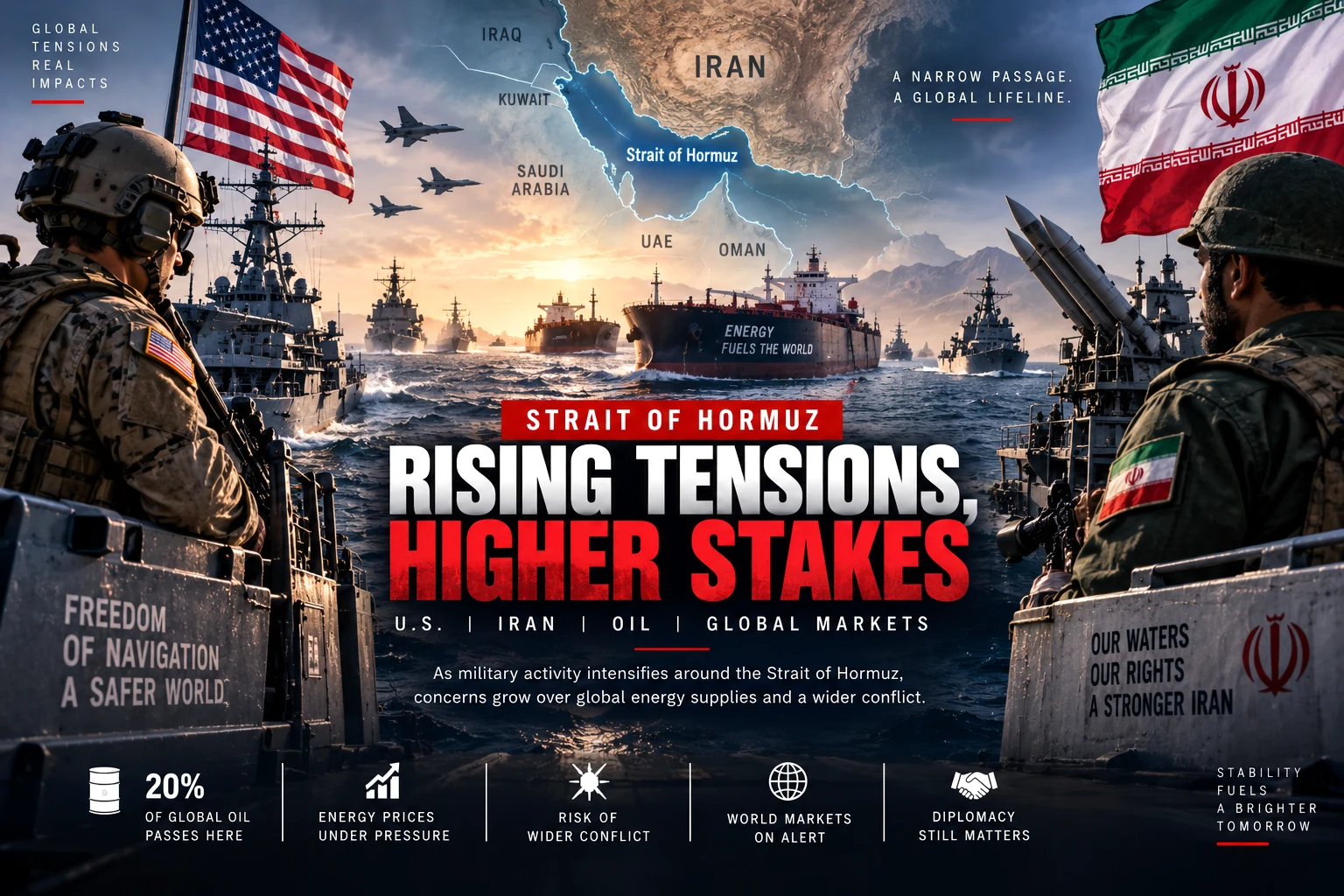
The US-Iran conflict has entered another dangerous phase as strikes on tankers, missile attacks and renewed disruption in the Strait of Hormuz threaten global energy supplies.
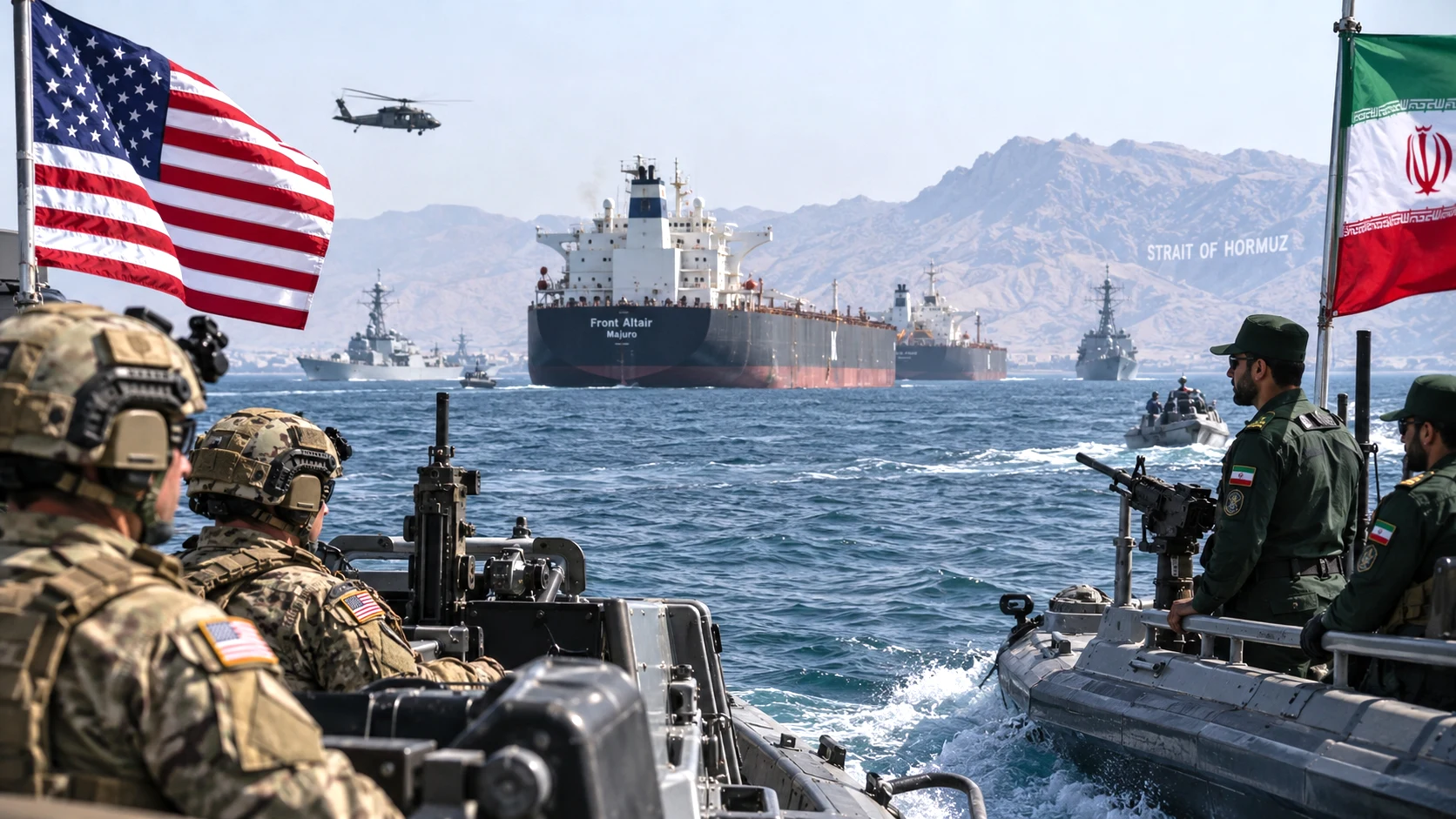
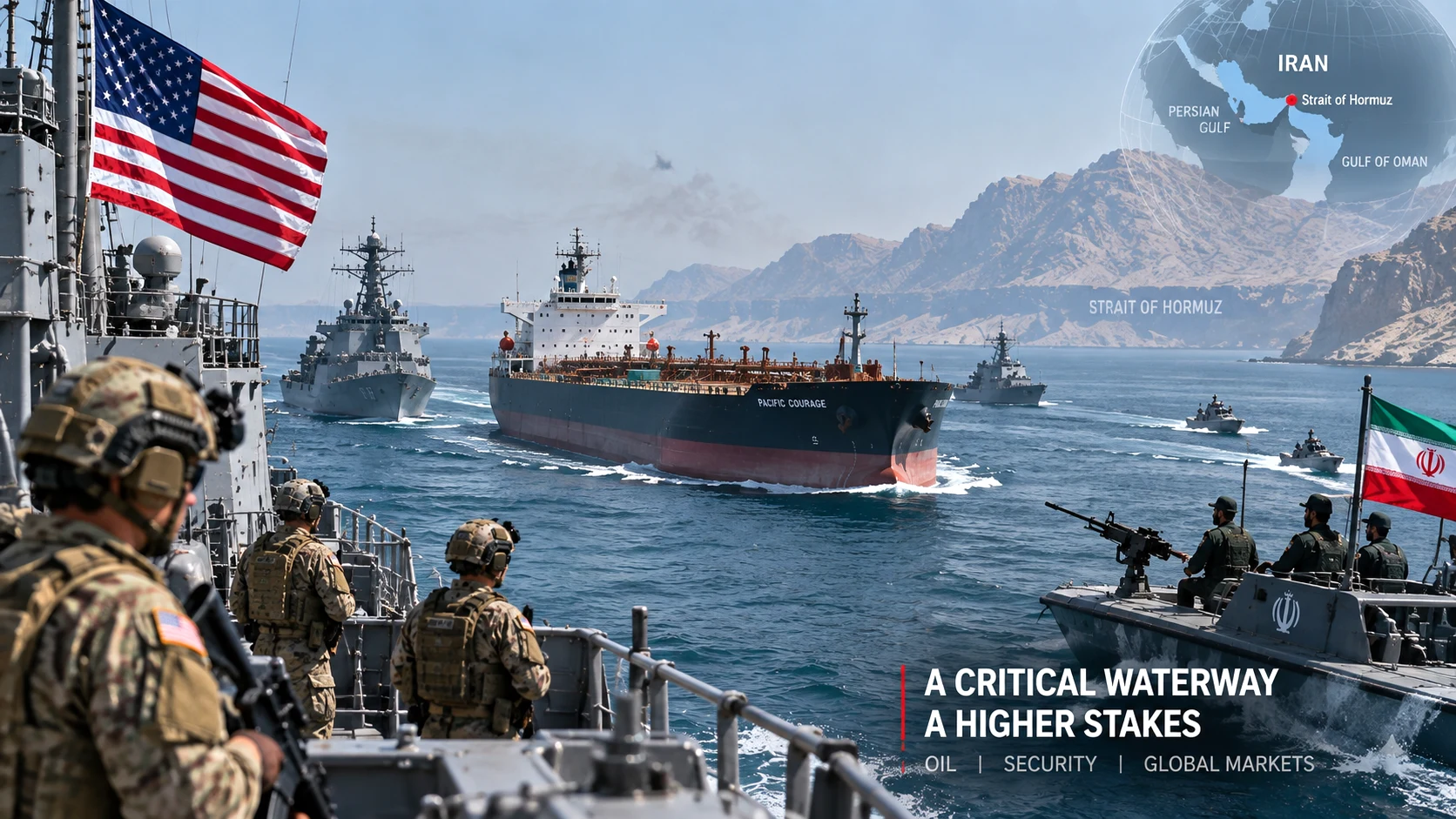
US and Iranian military forces and oil tankers representing escalating conflict around the Strait of Hormuz and global energy supplies
Table of Contents (27 sections)
The US-Iran conflict has entered another dangerous phase, with American strikes on Iranian oil tankers, Iranian missile attacks aimed at U.S. naval vessels, and renewed disruption in the Strait of Hormuz raising fears of a wider regional and global energy crisis.
The latest escalation follows months of intermittent warfare that began in late February 2026.
Over the weekend, U.S. forces struck three oil tankers that Washington described as part of a network supporting Iran’s Revolutionary Guard and allied groups. The American military said the operation followed Iranian ballistic-missile attacks directed at U.S. naval vessels.
Recommended Reading
Related Stories & In-Depth Guides
Curated editorial perspectives matching this topic.
The US says it destroyed five Iranian oil tankers before Iran fired missiles toward a US-used base in Jordan and claimed attacks on ships near the Strait of Hormuz.
Russia’s ruling United Russia party has secured a decisive victory in the country’s 2026 parliamentary election, according to near-complete official results, putting the Kremlin-aligned party on course for a record 355 seats in the 450-member State Duma. The vote was Russia’s first parliamentary ele
Iran subsequently said it had retaliated against American vessels and oil tankers, although some Iranian battlefield claims have not been independently verified.
On 8 September, Tehran escalated its rhetoric further.
Mohsen Rezaei, secretary of Iran’s Supreme National Security Council, threatened what he called “economic warfare” against the United States and said Iran was preparing a new restricted maritime zone in the Persian Gulf.
Iranian media have also claimed that Tehran fired an advanced Qassem Basir ballistic missile towards U.S. warships near the Strait of Hormuz. The U.S. military says its ships evaded the attacks.
The immediate global concern is no longer confined to the battlefield.
The Strait of Hormuz is one of the world’s most important energy corridors. Shipping through it has fallen sharply again, disrupting Gulf oil exports and contributing to higher energy prices.
Table of Contents
What is happening between the US and Iran?
Latest US strikes on Iranian oil tankers
Iran targets US naval vessels
What is the Qassem Basir missile?
Iran threatens a maritime exclusion zone
Is the Strait of Hormuz completely closed?
Why Hormuz matters to the world
How much oil normally moves through Hormuz?
Gulf oil exports have fallen sharply
Why oil remains below $100
Physical oil markets show greater stress
Alternative export routes provide some relief
Saudi Arabia and the Houthis add another risk
What does Trump say about the war?
What does Iran want?
Nuclear dispute remains unresolved
Could the conflict expand further?
Impact on India and Asian economies
What happens next?
Key takeaway
What Is Happening Between the US and Iran?
The current confrontation is no longer simply a diplomatic dispute over Iran’s nuclear programme.
It has developed into a prolonged military and economic conflict involving strikes on military installations, missile and drone attacks, maritime operations, sanctions, oil infrastructure and commercial shipping.
The war began in late February with U.S. and Israeli attacks on Iran.
Since then, the intensity of fighting has varied.
There have been periods of reduced military activity and attempts at negotiations, followed by renewed strikes.
The latest escalation began around the end of August and has continued into September.
The United States has attacked Iranian military and maritime targets.
Iran has responded with missiles, drones and threats against American forces and shipping.
The Strait of Hormuz has become one of Tehran’s most important sources of leverage.
US Strikes Three Iranian Oil Tankers
One of the most serious recent developments occurred on 5 September.
U.S. forces struck three Iranian-linked oil tankers, according to the American military.
Washington said the strikes came after Iran targeted an American aircraft carrier and destroyer with ballistic missiles.
The U.S. military said its vessels avoided the attacks and that no American personnel were injured.
Two Iranian oil carriers were described by U.S. Central Command as permanently disabled.
A third tanker, which was reportedly unladen, was struck in the Gulf of Oman after its crew was instructed to abandon the vessel.
One of the tankers was struck near Kharg Island, which plays a central role in Iranian oil exports.
Another was hit near Jask, east of the Strait of Hormuz.
The United States described the vessels as part of a network helping finance Iran’s Islamic Revolutionary Guard Corps and armed groups aligned with Tehran.
Iran condemned the attacks.
Its Foreign Ministry described them as unlawful aggression and warned that Washington and its allies would bear responsibility for further escalation.
Iran Says It Retaliated
Iran subsequently said its forces struck back against American and commercial maritime targets.
Iranian state media reported attacks on three U.S. vessels and three oil tankers.
However, those specific Iranian claims were not independently confirmed in the initial reporting.
That distinction is important.
In an active conflict, both sides release information designed partly for military and political messaging.
Claims regarding destroyed vessels, intercepted missiles and battlefield success should therefore be attributed to the government or military making them unless independent evidence is available.
What is independently clear is that maritime security conditions around the Persian Gulf and Strait of Hormuz have deteriorated significantly.
Iran Says It Fired Qassem Basir Missile at US Warships
Iranian media have also reported the use of an advanced ballistic missile known as the Qassem Basir against U.S. naval forces.
Iran describes the missile as an upgraded weapon with improved manoeuvrability and resistance to electronic warfare.
Iranian reporting says the missile was directed towards American warships near Hormuz.
The U.S. military says its vessels successfully evaded missile attacks.
The Qassem Basir had previously been reported as used in combat against Israel in 2025.
Iran’s continued ability to launch ballistic missiles is strategically important because months of U.S. attacks have targeted the country’s missile, radar and military infrastructure.
Washington has degraded parts of Iran’s conventional military capabilities, but Tehran retains enough missile and drone capacity to threaten ships and military installations across the region.
Iran Threatens New Maritime Exclusion Zone
The latest development could have even greater consequences for commercial shipping.
Iran says it is preparing to establish a new restricted maritime zone in the Persian Gulf.
Mohsen Rezaei, secretary of Iran’s Supreme National Security Council, said the zone would extend from areas around what Tehran describes as the American blockade of Iran into parts of the Gulf.
Iran has threatened to place vessels entering the restricted area on an Iranian sanctions list.
Tehran has also said it intends to publish maps showing a new shipping corridor through the Strait of Hormuz.
Exactly how the proposed system would operate remains unclear.
It is also unclear how international shipping companies, Gulf governments and the U.S. military would respond.
But the announcement adds another layer of uncertainty for vessels attempting to navigate the region.
Is the Strait of Hormuz Completely Closed?
No.
This is one of the most important corrections for headlines about the crisis.
The Strait of Hormuz is severely disrupted, but it is not completely closed to all shipping.
Oil and commodity vessels continue to move through it.
However, traffic has fallen dramatically compared with normal pre-war levels.
Shipping data have also become more difficult to interpret because some vessels travel with their automatic identification systems switched off for security reasons.
This means public vessel-tracking systems do not necessarily capture every transit.
The accurate description is therefore:
Shipping through the Strait of Hormuz is heavily disrupted and operating far below normal levels.
Not:
“Iran has completely closed the Strait of Hormuz.”
Why Is the Strait of Hormuz So Important?
Geography makes Hormuz extraordinarily important.
The narrow waterway connects the Persian Gulf with the Gulf of Oman and Arabian Sea.
Major energy exporters, including Saudi Arabia, Iraq, Kuwait, Qatar, United Arab Emirates and Iran, depend heavily on Gulf shipping routes.
Before the war, approximately one-fifth of global oil and liquefied natural gas shipments passed through the Strait of Hormuz.
That means a disruption there can affect energy markets thousands of kilometres away.
Asian economies are particularly exposed because countries including China, India, Japan and South Korea import large quantities of Middle Eastern energy.
Gulf Oil Exports Have Fallen Sharply
The scale of disruption is already substantial.
According to data cited by Reuters, crude shipments from Middle Eastern producers have fallen from approximately 18 million barrels per day before the Iran war to around 11 million barrels per day currently.
Flows through Hormuz have fluctuated significantly during the conflict.
Before fighting intensified again on August 30, around 8 million to 9 million barrels per day were reportedly moving through the strait.
Flows subsequently dropped below 2 million barrels per day at one stage.
The moving daily average has been around 4 million to 5 million barrels, according to one industry estimate.
Other estimates put daily exports somewhat higher, illustrating how difficult real-time measurement has become.
What is clear is that the amount moving through Hormuz remains significantly below normal.
Shipping Slows Again in Early September
The latest escalation has again reduced traffic.
Kpler data cited by Reuters showed only seven commodity vessels passing through Hormuz on Monday, compared with eight the previous day.
Some vessels may have crossed with transponders switched off and therefore may not appear in standard tracking counts.
Nevertheless, the trend indicates renewed caution among shipowners.
Commercial shipping companies must consider not only whether a route is physically open but also whether the risk of missile, drone or naval attack makes a voyage economically and operationally acceptable.
Insurance costs can also rise sharply during periods of conflict.
Why Isn’t Brent Crude Above $100?
Given the scale of the disruption, a natural question is why global benchmark oil prices have not moved dramatically beyond $100 a barrel.
Brent crude has rallied but remained below $100 in the latest Reuters analysis.
There are several reasons.
First, some oil continues to move through Hormuz.
Second, Gulf exporters are using alternative routes.
Third, non-OPEC producers, including the United States, Canada and Guyana, are helping provide additional supply.
Fourth, global demand has softened in some important markets.
And fifth, major consuming countries have oil inventories and strategic reserves that provide temporary protection against supply disruptions.
These factors have prevented the disruption from translating directly into an uncontrolled benchmark-price surge.
Physical Oil Markets Look Much Tighter
Benchmark futures do not tell the entire story.
Reuters reports that some physical crude markets are already trading above $100.
Oman futures were around $104.54 a barrel on Monday, while cash Dubai traded around $105.10.
Physical-market premiums have also risen substantially.
Diesel markets are particularly tight.
This distinction matters.
A headline saying simply “oil remains below $100” could give the impression that the Hormuz crisis has had little effect.
In reality, particular crude grades and refined products are already showing much greater stress than headline Brent prices suggest.
Banks Raise Oil Forecasts
Major financial institutions are adjusting their forecasts.
Morgan Stanley expects Brent to average around $100 a barrel in the fourth quarter of 2026, according to Reuters.
Goldman Sachs has also increased its forecasts for Brent and West Texas Intermediate.
Goldman expects disruptions to Middle Eastern shipping to continue into 2027.
These are analyst forecasts, not guaranteed future prices.
Oil markets can change rapidly based on military developments, demand, alternative supplies and diplomatic progress.
But the upward revisions demonstrate how seriously financial markets are taking the Hormuz disruption.
Gulf Producers Search for Alternative Routes
Energy exporters have been working to reduce their dependence on the strait.
Saudi Arabia can move some oil westwards towards the Red Sea.
Other producers have used ship-to-ship transfers and alternative export facilities.
Exports through Egypt’s Sidi Kerir port reportedly increased significantly during August.
Iraqi exports also recovered during the month.
These workarounds have helped prevent an even larger global supply shock.
But alternative routes cannot necessarily replace every barrel normally exported through Hormuz.
Some of those routes also face their own security risks.
Houthi Attacks Add Another Regional Threat
The situation is complicated further by Yemen’s Iran-aligned Houthi movement.
On Tuesday, Houthi attacks on several Saudi cities injured 73 people, according to the Saudi-led coalition in Yemen.
That development raises the risk that the U.S.-Iran conflict could spread further across the region.
The Houthis also pose a threat to Red Sea shipping.
That matters because the Red Sea is one of the alternative routes used to move Gulf energy when Hormuz becomes difficult.
If both Hormuz and Red Sea routes experience major disruption simultaneously, the pressure on global shipping could increase significantly.
Trump’s Objectives Remain Unfulfilled
President Donald Trump launched what Washington calls Operation Epic Fury in February.
His stated objectives included ending Iran’s nuclear programme, preventing Iran from threatening neighbouring countries, and creating conditions for political change inside Iran.
Six months later, those objectives have not been fully achieved.
Iran’s clerical leadership remains in power.
Tehran retains missile and drone capabilities.
And the nuclear dispute remains unresolved.
Trump has nevertheless argued that the United States is winning the conflict.
He has also predicted that oil prices will fall sharply once the United States achieves victory.
Those are political claims and predictions, not established outcomes.
Trump Says Renewed Campaign Will Not Last Long
Following the renewed U.S. strikes at the beginning of September, Trump said the latest phase of the military campaign would not last long.
The U.S. has targeted Iranian missile systems, radar installations and other military infrastructure near Hormuz.
Washington says these strikes are intended to reduce Iran’s ability to threaten commercial shipping and American forces.
But Tehran has continued launching or threatening missile and drone attacks.
That raises questions over whether either side can achieve its objectives without another substantial escalation.
Iran Is Also Under Severe Economic Pressure
The conflict is inflicting major economic damage inside Iran.
The port city of Bandar Abbas, one of the country’s most important maritime centres, has suffered heavily from U.S. sanctions, the blockade and reduced commercial activity.
Associated Press reporting from the city describes dramatically reduced port activity, falling incomes and rapidly rising costs for ordinary residents.
Imports have also become more difficult.
Iran’s currency has been under pressure, adding to inflation.
The economic dimension is central to Washington’s strategy.
The United States is attempting to reduce Tehran’s ability to finance its military and force Iran towards political concessions.
Iran, in response, is using the Strait of Hormuz as economic leverage against Washington and Gulf energy exporters.
Iran Calls Its Strategy ‘Economic Warfare’
Tehran is increasingly framing Hormuz as an economic battlefield.
Rezaei said American economic pressure would be met with Iranian “economic warfare.”
The logic is straightforward.
The United States can damage Iran’s economy through sanctions, blockade measures and attacks on oil infrastructure.
Iran can potentially impose costs on the international economy by disrupting one of the world’s most important energy corridors.
That creates a dangerous cycle.
The more economic pressure Washington places on Tehran, the greater Iran’s incentive may become to interfere with Gulf shipping.
The more Iran disrupts shipping, the stronger the U.S. justification becomes for additional military action.
Breaking that cycle would likely require a diplomatic agreement.
Nuclear Diplomacy Has Stalled
The nuclear dispute remains at the centre of the broader confrontation.
Negotiations between Washington and Tehran made limited progress earlier in the year.
The United States and Iran signed a memorandum of understanding in June.
But subsequent negotiations broke down.
The United States, Britain, France and Germany are now seeking greater pressure on Iran over its nuclear reporting obligations.
International Atomic Energy Agency chief Rafael Grossi has urged Tehran to re-engage with the nuclear watchdog.
Iran says it will respond if the IAEA adopts measures against it.
This means the diplomatic dispute that contributed to the war remains unresolved even as the military conflict expands.
Could the Conflict Become a Wider Middle East War?
The risk exists, but a wider regional war is not inevitable.
Iran has missile and drone capabilities capable of reaching U.S. bases and infrastructure in neighbouring Gulf states.
American forces are deployed across the region.
Iran-aligned armed groups also operate outside Iran.
Recent Houthi attacks on Saudi Arabia illustrate how quickly another front can become involved.
At the same time, governments across the Gulf have strong incentives to prevent escalation.
A regional war could threaten oil exports, infrastructure, tourism, investment and economic diversification plans.
Diplomatic pressure for de-escalation is therefore likely to continue even as military operations persist.
What Does the Crisis Mean for India?
India has an important economic interest in stability in the Gulf.
The country imports a large share of the crude oil it consumes.
A sustained increase in global oil prices can raise India’s import bill.
Higher crude prices can also put pressure on:
Petrol and diesel economics
Aviation fuel costs
Transportation
Manufacturing
Inflation
The rupee
Government finances
India also has millions of citizens living and working across Gulf countries.
That gives New Delhi both an economic and humanitarian interest in avoiding a wider regional conflict.
The actual impact on Indian fuel prices will depend on global crude prices, exchange rates, taxation and domestic pricing decisions.
It would therefore be premature to predict a specific increase in petrol or diesel prices.
Why Asia Is Particularly Vulnerable
China, India, Japan and South Korea are major consumers of Middle Eastern energy.
Disruption in Hormuz therefore affects Asian economies particularly strongly.
China has significant oil reserves, which provide some protection.
Reuters reports estimates of Chinese reserves at around 1.17 billion barrels.
But strategic reserves are buffers, not permanent replacements for normal supply.
If the conflict continues for many months, governments and refiners may need to find more alternative sources.
That could reshape global oil trade.
What Could Send Oil Much Higher?
Several developments could trigger another major energy-price shock.
A complete or near-complete shutdown of Hormuz would be the most obvious.
Major damage to Saudi, Emirati, Iraqi or Qatari energy infrastructure could also reduce supply.
Escalating Houthi attacks in the Red Sea could constrain alternative routes.
Damage to major refineries could tighten supplies of petrol, diesel and aviation fuel even if crude itself remains available.
Conversely, a ceasefire or diplomatic agreement reopening Hormuz to normal traffic could push prices lower.
That is why oil markets are reacting so sharply to military headlines.
What Happens Next?
Three developments require close attention.
The first is Iran’s promised maritime exclusion zone.
Details of the zone and the proposed shipping corridor could determine whether commercial traffic falls further.
The second is the military response.
If the United States conducts additional strikes on Iranian ships or infrastructure, Tehran has threatened further retaliation.
The third is diplomacy.
Without renewed negotiations, the current pattern of pauses followed by military escalation could continue.
The Strait of Hormuz will remain central because it gives Iran one of its strongest tools for exerting pressure on the global economy.
Key Takeaway
The US-Iran conflict has escalated again, and the Strait of Hormuz is at the centre of the crisis.
U.S. forces struck three Iranian-linked oil tankers after Washington said Iran targeted American naval vessels with ballistic missiles.
Iran says it has retaliated and has threatened a new restricted maritime zone across parts of the Persian Gulf.
Tehran also says it fired an advanced Qassem Basir missile towards U.S. warships, while the American military says its vessels evaded Iranian missile attacks.
Commercial traffic through Hormuz has fallen sharply again.
But the strait is not completely closed.
Oil continues to move through it at significantly reduced and highly variable levels.
Middle Eastern crude shipments have fallen substantially compared with pre-war levels, while physical oil markets and diesel supplies are showing considerable stress.
For the global economy, the danger is straightforward:
If military escalation further restricts Hormuz — or spreads simultaneously to other critical energy routes — the conflict could turn from a regional military crisis into an even larger global energy shock.
For now, some alternative export routes, non-OPEC production, weaker demand and oil reserves are limiting the price impact.
But the system remains under significant pressure.
Editorial Update Note: This is an active military conflict. Claims about missile strikes, damaged ships and battlefield outcomes from the United States and Iran should remain attributed unless independently verified. Shipping volumes and oil prices can also change rapidly.
The Rajatheertha Team publishes news, explainers, guides and updates across India and the world. Our coverage follows Rajatheertha's editorial, verification and corrections standards.
Iran says it attacked 10 ships near the Strait of Hormuz after the US destroyed five Iranian oil tankers, sending Brent crude above $100 as global supply fears intensify.
U.S. envoys Steve Witkoff and Jared Kushner have met Vladimir Putin and Volodymyr Zelenskyy in a renewed push for Ukraine peace talks, but major differences remain as Russia resumes ballistic missile attacks on Kyiv.
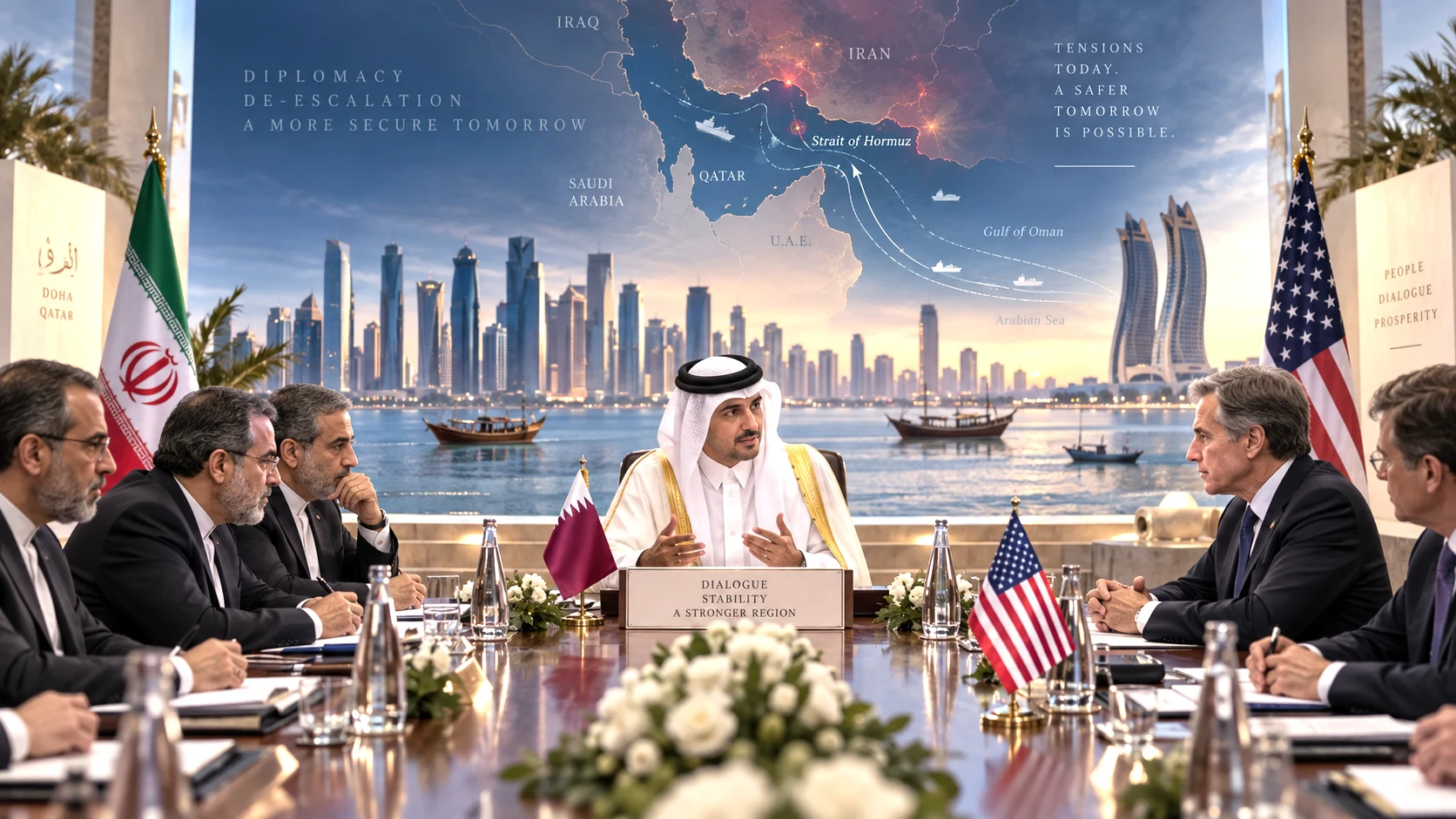
Qatar has launched an intensified diplomatic push to revive negotiations between Iran and the United States, shuttling proposals between Tehran and Washington as both sides combine threats of further military action with signals that a negotiated settlement remains possible. Iran has conveyed condit
The 2026 US midterms have entered a crucial phase as voting begins and Trump’s administration asks the Supreme Court to allow new restrictions affecting mail ballots.
Voting has begun in the 2026 US midterm elections as North Carolina sends the first mail ballots, while control of Congress, mail-voting rules and redistricting dominate the campaign.
The Trump administration faces multiple legal battles over mail voting, citizenship checks, voter data and election authority as the November 2026 midterms approach.






0 Comments