Sensex at 71,910 After 8-Week Slide: What Markets Are Watching Ahead of RBI Decision
Sensex closed at 71,909.70 and Nifty at 22,421.95 after an eighth straight weekly decline. With RBI's October 7 policy decision approaching, investors are watching interest rates, crude oil, foreign selling, the rupee and global bond yields.
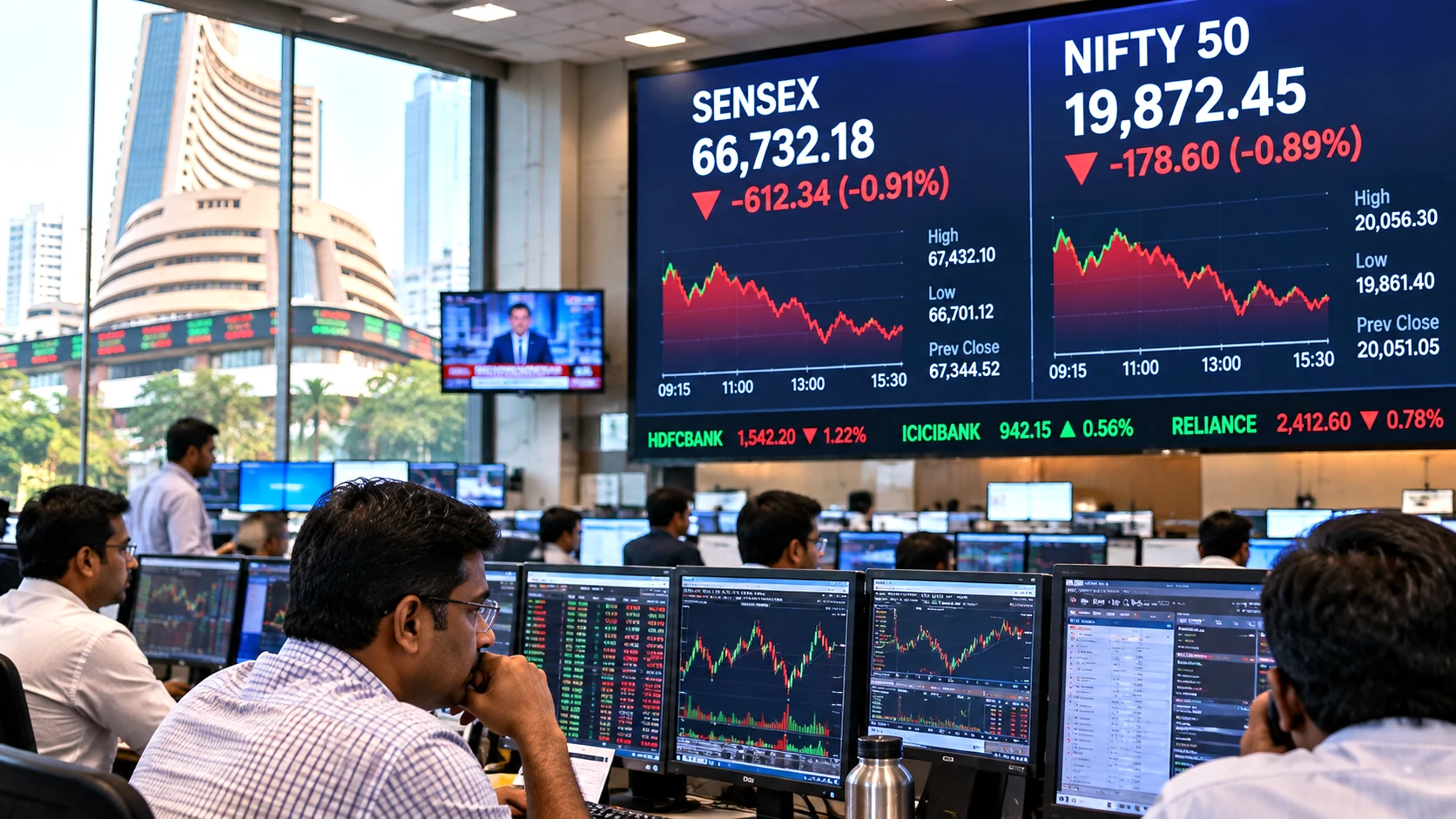
Bombay Stock Exchange and RBI imagery representing Sensex weakness ahead of the October 2026 monetary-policy decision
Table of Contents (23 sections)
Indian equities will return to trading on Monday, October 5, 2026, after a difficult holiday-shortened week that left the Sensex and Nifty at multi-month lows and extended their weekly losing streak to eight.
The latest available close is from Thursday, October 1.
The BSE Sensex ended at 71,909.70, down 570.59 points or 0.79%, while the Nifty 50 closed at 22,421.95, losing 198.50 points or 0.88%. Indian exchanges were closed on Friday, October 2 for Gandhi Jayanti and are also shut during the weekend.
The benchmarks have now fallen for eight consecutive weeks, their longest weekly losing run in about 25 years.
During the latest week, the Nifty fell approximately 3.1% and the Sensex declined around 2.7%. Across the eight-week decline, the indices have lost roughly 8.7% and 8.4%, respectively.
Recommended Reading
Related Stories & In-Depth Guides
Curated editorial perspectives matching this topic.
Sensex and Nifty opened higher and extended gains on September 23, led by metals, FMCG and realty stocks as crude oil eased and global cues improved. Bajaj Finance, Hindalco and Tata Steel were among the strongest Nifty gainers.
Brent crude remains above $100 as Iran says normal Strait of Hormuz passage will not resume until its conditions are met. A 100-million-barrel G7 emergency stock release and stronger Middle East exports are limiting further oil-price gains.
Attention now turns to the Reserve Bank of India.
The Monetary Policy Committee is scheduled to meet from October 5 to October 7, with its interest-rate decision expected on Wednesday, October 7.
A Reuters poll conducted in late September found that 35 of 61 economists — nearly 60% — expect the RBI to raise the repo rate by 25 basis points from 5.25% to 5.50%. If delivered, it would be India's first rate increase since 2023.
That expectation, combined with high crude-oil prices, foreign investor outflows, pressure on the rupee and unusually elevated global bond yields, means markets may remain volatile in the sessions surrounding the policy announcement.
Latest Sensex and Nifty Closing Levels
As of the latest available Indian-market close on October 1:
Sensex: 71,909.70
Sensex change: -570.59 points
Sensex percentage change: -0.79%
Nifty 50: 22,421.95
Nifty change: -198.50 points
Nifty percentage change: -0.88%
The Sensex had fallen as much as 1,187 points during Thursday's session before recovering part of its losses before the close.
The Nifty likewise recovered from deeper intraday declines but still finished below 22,450.
The weakness was broad rather than being limited to one sector.
Reuters reported that 15 of India's 16 major sectors posted weekly losses, while mid-cap and small-cap shares also declined sharply.
Eight Straight Weeks of Losses
The latest decline is significant because it extends one of the longest periods of sustained weekly weakness in Indian equities in decades.
Reuters reported that the eight-week losing streak is the longest for the benchmark indices in approximately 25 years.
The Nifty has fallen roughly 8.7% during the eight weeks, while the Sensex is down around 8.4%.
The latest week was particularly weak, with the Nifty registering its steepest weekly fall in more than six months and the Sensex its largest in more than four months.
This does not necessarily mean stocks must continue falling.
But it illustrates how a combination of domestic and international pressures has changed market sentiment compared with earlier in 2026.
Why Is the Indian Stock Market Falling?
There is no single explanation.
The current correction reflects several pressures occurring at the same time.
1. Heavy Foreign Investor Selling
Persistent foreign portfolio investor selling remains one of the biggest pressures on Indian equities.
Reuters reported that foreign outflows from Indian stocks had reached approximately $27.8 billion in 2026 by October 1, a record amount for the period.
Large foreign outflows can weigh on benchmark stocks because global institutional investors hold substantial positions in major Indian companies.
Selling can also affect the rupee when foreign investors convert proceeds into foreign currency.
Domestic institutions have continued buying equities and have partially absorbed foreign selling, but they have not been sufficient to prevent the broader market decline.
2. Crude Oil Above $100
Energy prices are another major concern for India.
Brent crude settled at about $102.25 per barrel on Friday, October 2, according to Reuters.
India imports a large proportion of the crude oil it consumes.
Higher crude prices can therefore increase:
the country's import bill;
inflation risks;
pressure on the rupee;
transportation costs;
corporate input costs; and
concerns about the current-account balance.
That relationship has become particularly important ahead of the RBI decision because sustained expensive energy could make monetary-policy easing more difficult.
3. Global Bond Yields Remain High
A sharp rise in government bond yields globally has also affected Indian equities.
The US 10-year Treasury yield recently reached around 5.34%, its highest level in roughly 24 years, before moving lower and then rebounding.
Higher US yields can make American bonds comparatively more attractive to international investors.
That can reduce the relative appeal of emerging-market assets, including Indian stocks.
Higher global borrowing costs may also pressure valuations, particularly for companies whose share prices depend heavily on future earnings growth.
4. Rupee Weakness
The Indian rupee is another key variable.
On October 1, the rupee fell about 0.5% to 96.3150 against the US dollar, its weakest level in approximately two months.
A weaker rupee can benefit some exporters, including parts of the IT sector.
But sustained depreciation can also make imports — particularly crude oil — more expensive and add to inflation concerns.
This creates a difficult policy balance for the RBI.
Why the RBI Meeting Matters So Much
The RBI's Monetary Policy Committee is scheduled to meet from October 5 through October 7.
The current repo rate is 5.25%.
According to a Reuters survey, 35 of 61 economists expect policymakers to raise it by 25 basis points to 5.50%.
That expectation has strengthened because inflation has moved higher while economic activity has remained relatively resilient.
India's consumer inflation accelerated to 4.82% in August, above the RBI's 4% medium-term target for the third consecutive month.
Higher energy and food prices have contributed to those pressures.
Would an RBI Rate Hike Be Negative for Stocks?
Not necessarily across the entire market, and the eventual reaction could depend heavily on what investors have already priced in.
A rate increase generally raises borrowing costs and can affect interest-rate-sensitive sectors such as:
banking;
housing;
automobiles;
real estate;
consumer durables; and
highly leveraged businesses.
However, markets often react more strongly to surprises than to decisions widely anticipated beforehand.
If investors already expect a 25-basis-point hike, attention may shift toward RBI Governor Sanjay Malhotra's comments on:
future rate increases;
inflation;
growth;
liquidity;
the rupee;
crude-oil risks; and
the likely direction of monetary policy.
A smaller-than-expected move, a larger hike or unexpectedly hawkish guidance could therefore produce very different market reactions.
Could the RBI Leave Rates Unchanged?
Yes.
A rate increase is the majority expectation in the Reuters poll, but it is not unanimous.
Around 40% of surveyed economists did not forecast the 25-basis-point October hike.
The final decision will be taken by the Monetary Policy Committee, and forecasts should not be reported as an official RBI commitment.
That distinction is especially important before the policy announcement.
Why Inflation Has Changed the Debate
At its previous August meeting, the RBI kept the repo rate at 5.25%.
But inflation conditions have become less comfortable.
Reuters reported that price increases have broadened across a larger share of India's inflation basket, while higher food and energy costs have pushed headline inflation further above the RBI's central target.
At the same time, economic growth and credit expansion have remained strong enough for some economists to argue that the economy could absorb moderately higher rates.
The October meeting therefore presents the RBI with a trade-off between containing inflation and avoiding unnecessary pressure on growth.
What Changed Globally While Indian Markets Were Closed?
Indian markets were shut on Friday, but global markets continued trading.
One potentially supportive development came from the United States.
US employers added only 29,000 jobs in September, considerably below economists' expectations of about 90,000.
The weaker labour-market report reduced expectations that the US Federal Reserve would raise interest rates again in October.
Wall Street responded positively:
the Dow Jones Industrial Average rose about 0.5%;
the S&P 500 gained about 0.7%; and
the Nasdaq Composite advanced approximately 1.2%.
That improved international equity sentiment could provide some support when Indian markets reopen Monday.
However, the picture is not entirely positive.
US Treasury yields rebounded later in Friday trading, while Brent crude remained above $100 a barrel.
The international backdrop therefore remains mixed.
What Could Happen When Sensex Opens on Monday?
A precise market direction cannot be predicted reliably.
But several competing forces are likely to shape the October 5 session.
Possible supportive factors
Indian equities could receive some relief from:
Friday's gains on Wall Street;
reduced expectations of another immediate US Federal Reserve rate hike;
potentially attractive valuations after eight weeks of declines; and
continued domestic institutional buying.
Factors that could keep pressure on stocks
Risks include:
Brent crude remaining above $100;
continued FPI selling;
elevated international bond yields;
rupee weakness;
uncertainty over the RBI decision; and
geopolitical developments affecting energy markets.
The market may therefore remain sensitive to overnight global movements until the RBI announcement provides more clarity.
Which Sectors Are Most Sensitive to the RBI Decision?
Banks and Financial Services
Banks could react to changes in borrowing costs, deposit rates, loan growth and RBI liquidity guidance.
The impact is not automatically positive or negative because higher rates can support lending yields while also increasing funding costs and affecting credit demand.
Automobiles
Auto shares have already been under considerable pressure.
Reuters reported that the Nifty Auto index dropped about 5.9% during the latest week.
Higher borrowing costs could matter for vehicle purchases financed through loans.
Consumer Durables
Consumer-durable stocks fell around 6.2% during the week, according to Reuters.
This sector can also be sensitive to interest rates and discretionary spending.
Real Estate
Higher mortgage costs can influence housing affordability and demand expectations, making real-estate shares especially sensitive to changes in rate expectations.
Information Technology
IT was an exception during the latest sell-off.
The Nifty IT index gained about 2.2% on October 1 and was the only major sector to finish the week higher, rising around 0.5%.
A weaker rupee can support the rupee value of overseas revenue for export-oriented technology companies, although individual-company earnings and global technology demand remain important.
Foreign Selling Remains the Key Market Test
One of the clearest signs that sentiment has stabilised would be a moderation in foreign selling.
Foreign investor flows matter because they influence:
large-cap equity demand;
currency movements;
liquidity;
market valuations; and
risk sentiment.
If foreign outflows continue at their recent pace, domestic buyers may need to absorb considerable supply before a sustained market recovery develops.
Reuters cited one fund manager as saying the market may be approaching a bottom but that he did not expect a sharp recovery over the following three to four months. That represents one analyst's view, not a market-wide forecast.
Is the Market Near a Bottom?
It cannot be established from the current data.
Eight consecutive losing weeks may make valuations more attractive in parts of the market, but a long decline by itself does not guarantee that the bottom has been reached.
A more durable improvement could depend on some combination of:
falling crude-oil prices;
stabilisation in the rupee;
lower global bond yields;
reduced foreign selling;
supportive corporate earnings;
declining inflation pressure; and
clearer RBI guidance.
Without improvement in those factors, volatility could persist.
What Investors Should Watch Before October 7
Rather than focusing only on whether the Sensex rises or falls on one session, the main indicators ahead of the RBI decision are:
RBI rate expectations:
A 25-basis-point increase is the current majority economist forecast, but it is not certain.
Brent crude:
Oil remains above $100 and therefore continues to present an imported-inflation risk for India.
Foreign flows:
Persistent foreign withdrawals remain one of the most important sources of market pressure.
US Treasury yields:
Elevated US bond yields can affect foreign demand for emerging-market assets.
The rupee:
Further depreciation could reinforce inflation and interest-rate concerns.
Global equities:
Friday's Wall Street recovery offers a somewhat more supportive signal for Monday's opening, but global sentiment remains volatile.
What Will Matter in the RBI Statement Beyond the Repo Rate?
The headline rate decision may receive the most attention, but markets will also examine the central bank's language closely.
Important areas include:
Inflation forecast
Investors will look for any revision in projected inflation following recent increases in food and energy prices.
Growth outlook
The RBI's assessment of economic momentum could influence expectations for corporate earnings and future monetary policy.
Future rate path
Markets will want clues on whether a possible October hike would be a one-time adjustment or the start of a wider tightening cycle.
A Reuters poll found a slim majority of economists expect at least another 25-basis-point increase by December.
Liquidity
Banking stocks and bond markets will pay close attention to the RBI's approach to financial-system liquidity.
Rupee and global risks
High oil prices, foreign outflows and global bond volatility are likely to remain important parts of the broader policy environment.
Sensex Outlook Ahead of RBI Policy
The near-term market setup can best be described as cautious and volatile rather than definitively bearish or bullish.
Indian benchmarks have undergone a substantial eight-week correction, and Friday's stronger US market may improve the initial global cue for Monday.
At the same time, several of the forces responsible for the sell-off remain unresolved.
Crude oil remains above $100, foreign investors have continued withdrawing money, the rupee is under pressure and global bond yields remain high.
The RBI meeting adds another layer of uncertainty.
A widely anticipated 25-basis-point increase may already be partly reflected in asset prices, meaning the central bank's guidance could prove just as important as the rate decision itself.
Investors should therefore distinguish between a short-term relief rally and evidence of a more durable trend reversal.
Latest Verified Market Position
As of Saturday, October 3, 2026:
India's latest stock-market close was Thursday, October 1.
The Sensex closed at 71,909.70, down 570.59 points or 0.79%.
The Nifty 50 ended at 22,421.95, down 198.50 points or 0.88%.
The benchmarks recorded their eighth consecutive weekly loss, their longest such run in about 25 years.
Nifty lost approximately 3.1% during the week, while Sensex fell around 2.7%.
Indian markets were closed October 2 for Gandhi Jayanti and will reopen Monday, October 5.
The RBI MPC meets October 5–7.
The policy decision is expected on October 7.
A Reuters poll found 35 of 61 economists expect a 25-basis-point hike to 5.50%.
Foreign equity outflows have reached approximately $27.8 billion so far in 2026, according to Reuters.
Brent crude settled Friday at about $102.25 a barrel.
US equities rose Friday after weaker employment data reduced expectations of an October Federal Reserve hike.
Frequently Asked Questions
What is the latest Sensex closing level?
The latest available Sensex close is 71,909.70, recorded on Thursday, October 1, 2026. It fell 570.59 points, or 0.79%, during the session.
What is the latest Nifty 50 closing level?
The Nifty 50 closed at 22,421.95, down 198.50 points or 0.88% on October 1.
Why was there no stock-market close on October 2?
BSE and NSE were closed on Friday, October 2 for Mahatma Gandhi Jayanti. They are also closed over the weekend and reopen Monday, October 5.
When is the next RBI monetary-policy decision?
The Monetary Policy Committee meets from October 5 to October 7, with the decision expected on Wednesday, October 7, 2026.
Will the RBI raise the repo rate?
A rate increase is expected by a majority of economists surveyed by Reuters, but it is not certain. Thirty-five of 61 economists forecast a 25-basis-point increase from 5.25% to 5.50%.
Why have Sensex and Nifty been falling?
Major pressures include persistent foreign investor selling, high crude-oil prices, rising global bond yields, rupee weakness and concerns about higher interest rates.
How many weeks have Indian markets fallen?
Sensex and Nifty have now recorded eight consecutive weekly declines, the longest such losing streak in around 25 years.
Could markets recover on Monday?
A recovery is possible but cannot be predicted reliably. Friday's gains on Wall Street provide a more positive global equity cue, while high oil prices, bond yields, FPI selling and RBI uncertainty continue to present risks.
Is this financial advice?
No. This article explains market conditions, economic data and monetary-policy expectations for general informational purposes. Individual investment decisions depend on risk tolerance, financial circumstances and investment objectives.
Bottom Line
Sensex closed at 71,909.70 and Nifty at 22,421.95 on October 1 after an eighth consecutive weekly loss. Markets reopen October 5 ahead of the RBI’s October 7 policy decision.
Key watchpoints: possible 25-bps repo hike, crude above $100, foreign outflows, rupee and global yields.
The Rajatheertha Team publishes news, explainers, guides and updates across India and the world. Our coverage follows Rajatheertha's editorial, verification and corrections standards.
Sensex and Nifty rebounded on September 25 after Thursday's sharp selloff. At 2:35 PM IST, Sensex was up 328 points at 73,908 while Nifty gained 68 points to 23,131, helped by value buying and softer crude.
Iran’s economy contracted by 10.1% year-on-year during the first quarter of its current Persian calendar year, according to official data, with a collapse in oil and natural-gas activity driving much of the decline. The figures cover the first months of the US-Israel conflict with Iran, although the
Global crude oil prices fell sharply on September 21, 2026, with Brent dropping toward $102 a barrel and US West Texas Intermediate slipping below $99, as recovering Saudi Arabian export flows and hopes for renewed US-Iran diplomacy outweighed immediate fears from Houthi missile and drone attacks on
The claim is confirmed by the Bloomberg Billionaires Index and fresh September 18 reporting. Zhang Yiming’s estimated wealth has climbed to about $105 billion as higher ByteDance valuations and the company’s expanding AI business push him ahead of Gautam Adani.
G7 leaders have agreed to release 100 million barrels of emergency oil stocks over four months, with substantial diesel supplies due in the first 20 days, as geopolitical disruptions keep global fuel markets under pressure.
Karnataka has suspended food licences linked to Amazon, Swiggy Instamart and BigBasket until further orders after authorities found poisonous Datura fruits and seeds being offered online as food. Here’s what actually happened and what the order means for consumers.











0 Comments