Crude Oil Price Today: Brent Falls Near $102 as Saudi Supply Recovery Offsets Houthi Attack Risks
Global crude oil prices fell sharply on September 21, 2026, with Brent dropping toward $102 a barrel and US West Texas Intermediate slipping below $99, as recovering Saudi Arabian export flows and hopes for renewed US-Iran diplomacy outweighed immediate fears from Houthi missile and drone attacks on
global crude oil price movements amid Middle East supply risks and Saudi export recovery
Table of Contents (24 sections)
LONDON, September 21, 2026: Crude oil prices retreated to their lowest levels in 11 days on Monday even as security risks remained elevated across the Middle East.
November Brent crude futures were trading at about $101.75 per barrel at 0859 GMT, down $2.12, or roughly 2%.
US West Texas Intermediate crude for October, which expires this week, fell to around $98.34 per barrel.
Both benchmarks touched their lowest levels since September 10 during Monday's session.
The decline represents a notable reversal from the sharp price increases seen earlier in September, when repeated attacks on Saudi energy infrastructure, reduced Strait of Hormuz shipping and concern over Red Sea supply routes pushed Brent above $107.
Recommended Reading
Related Stories & In-Depth Guides
Curated editorial perspectives matching this topic.
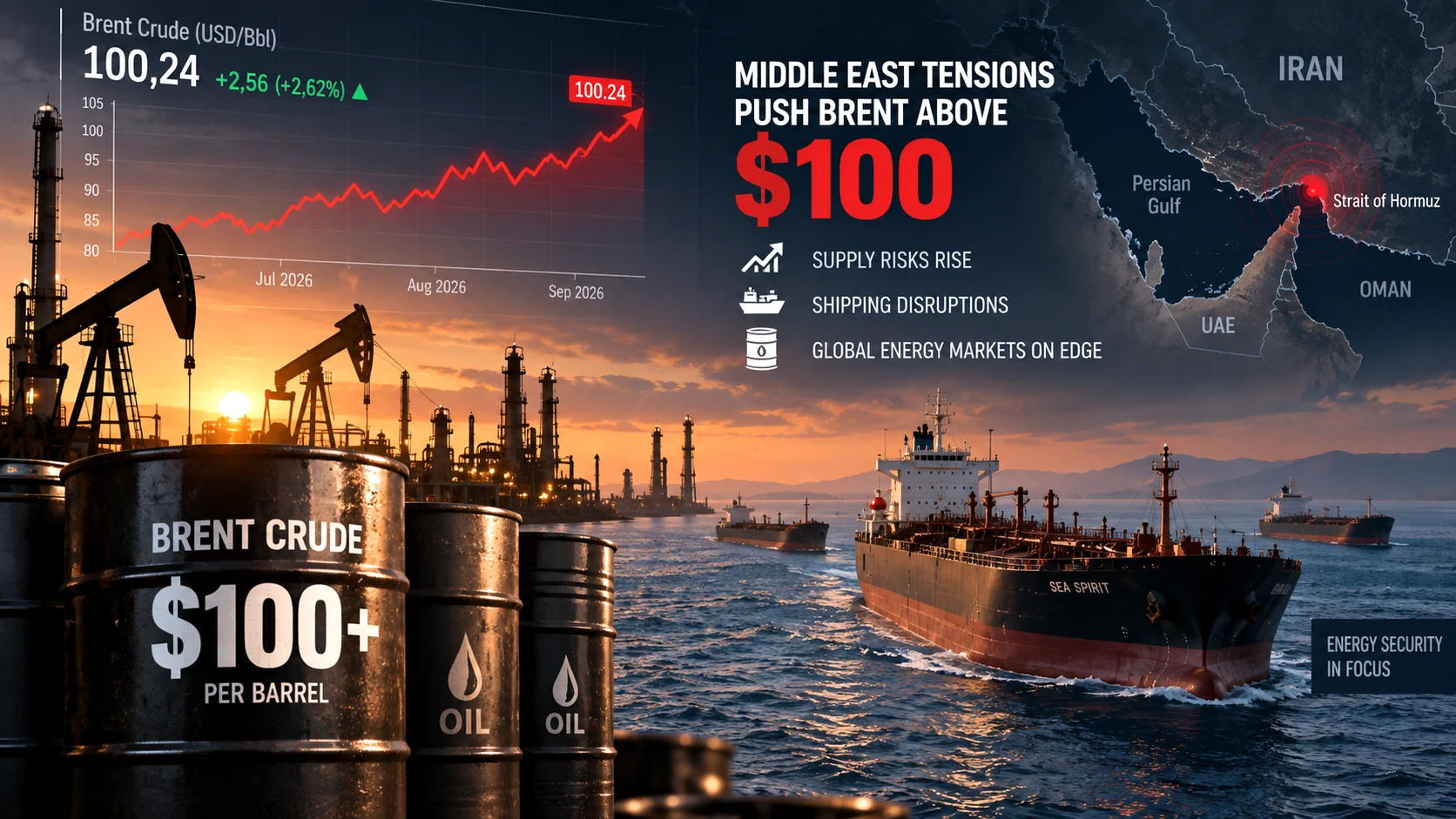
Brent crude has surged above $100 as US-Iran hostilities disrupt Middle East oil supplies, raising concerns over inflation, markets and India’s import costs.
ONGC has struck natural gas at a deepwater well about 43 km off Konark in Odisha's Mahanadi Offshore Basin. The well has shown encouraging flow and reservoir pressure, but reserve size and commercial viability still require appraisal.
Key Takeaways
Brent crude falls to about $101.75 per barrel; WTI slips to around $98.34.
Prices reach lowest levels since September 10.
Saudi Arabia increases Gulf exports and ship-to-ship transfers to offset Red Sea disruptions.
Houthi attacks keep geopolitical risk elevated.
Hopes for US-Iran diplomacy add downward pressure.
Strait of Hormuz commercial traffic remains far below normal.
Crude Oil Price Today
Latest widely reported prices on September 21:
Benchmark
Latest price
Daily move
Brent crude, November
about $101.75/barrel
-2.0%
WTI crude, October
about $98.34/barrel
around -2%
Prices can change throughout the trading session, so these figures represent a market snapshot rather than the final daily settlement.
Oil Initially Reacts to Houthi Escalation
The weekend began with new fears over Saudi supply security.
Yemen's Houthi movement claimed missile and drone attacks on targets in Saudi Arabia, including sites in Riyadh and energy infrastructure associated with Saudi Aramco.
Saudi authorities confirmed intercepting a ballistic missile aimed at Riyadh and said other attacks targeting areas including Yanbu were thwarted.
Reuters also documented flames and a large plume of smoke close to King Khalid International Airport following the Riyadh attack, although Saudi authorities did not confirm that the ballistic missile itself directly struck the airport.
The attacks initially supported oil prices because of fears that further escalation could disrupt output or exports from the world's largest crude exporter.
But that reaction did not last.
Saudi Supply Recovery Becomes Bigger Market Story
By Monday, traders were paying more attention to signs that Saudi Arabia had succeeded in keeping significant quantities of crude moving despite damage to its normal Red Sea export system.
Houthi attacks had disrupted the kingdom's East-West pipeline, which moves crude from eastern Saudi production areas to the Red Sea port of Yanbu.
That route is strategically important because it gives Saudi Arabia an alternative to the Strait of Hormuz.
Damage to the pipeline initially raised fears that a substantial portion of Saudi export capacity could become unavailable.
Saudi Aramco, however, has increased shipments through Gulf routes and expanded ship-to-ship transfer operations near Oman to compensate.
Aramco Boosts Exports Through Hormuz
Ship-tracking and satellite data indicate that Saudi crude flows through the Strait of Hormuz have increased significantly.
Reuters reported that the Saudi export route was carrying approximately 2.9 million barrels per day as Aramco redirected barrels that would otherwise have moved toward the Red Sea.
Separate Reuters reporting said Aramco planned to ship roughly 60 million barrels of crude during September and October through Gulf export routes combined with ship-to-ship transfers near Sohar, Oman.
Those additional flows are being directed primarily toward Asian refiners in markets including China, India, Japan and South Korea.
The recovery has convinced some traders that Saudi Arabia can maintain much more of its export programme than feared immediately after the pipeline attacks.
That reduced part of the geopolitical premium embedded in crude prices.
Saudi Recovery Is Only Partial
The situation should not be described as a complete restoration of normal Saudi supply.
The damaged East-West pipeline and Yanbu export system remain important constraints.
Reuters shipping data showed no Saudi crude loadings from Yanbu since September 16, underscoring the continuing disruption on the Red Sea side.
Saudi Arabia is effectively compensating by moving more crude eastward and then using alternative shipping and transfer arrangements.
Those workarounds allow oil to continue reaching customers, but they are more expensive and logistically complex.
Ship-to-Ship Transfers Keep Gulf Oil Moving
Ship-to-ship transfers have become one of the most important adaptations in the current Middle East energy crisis.
Instead of every tanker loading and completing its journey through normal routes, producers are increasingly moving crude between vessels near Oman.
Reuters analysis estimated that ship-to-ship transfers reached roughly 2.5 million barrels per day in September, up from around 1.4 million barrels per day in August.
The workaround has helped prevent a much larger physical supply shock.
But it comes with significant costs.
Supertanker freight rates have surged, vessel availability is constrained and some producers must offer discounts or absorb higher transportation expenses.
The result is an oil market where physical barrels are still moving — but at considerably greater cost and operational risk.
Strait of Hormuz Remains Severely Disrupted
Despite stronger Saudi crude flows, normal commercial traffic through Hormuz remains far below pre-war levels.
Reuters reported that only 17 trackable commodity vessels crossed the Strait of Hormuz over the latest weekend.
That compared with 37 vessels the previous weekend and a pre-war average of approximately 125 vessels per day.
Some tankers are believed to be operating without normal public tracking signals, meaning visible ship counts do not capture every barrel moving through the region.
Still, the data show that normal commercial navigation remains severely reduced.
42 Million Barrels Moved Through Hormuz in One Week
Saudi Arabia's efforts to compensate for Red Sea disruption are visible in tanker activity.
Reuters reported that 22 tankers carrying approximately 42 million barrels exited through Hormuz during the week beginning September 13.
That flow has reassured markets that Saudi exports have not collapsed despite damage to strategic infrastructure.
The key question is how sustainable the workaround will prove if Houthi attacks continue.
Houthi Attacks Keep Risk Premium Alive
Oil prices falling toward $102 does not mean traders believe the Middle East threat has disappeared.
The Houthis have demonstrated an ability to attack Saudi territory with long-range missiles and drones.
Their operations have also increased concerns about the security of Bab el-Mandeb, the narrow waterway connecting the Red Sea and Gulf of Aden.
Traffic through Bab el-Mandeb has also declined, with Reuters reporting 51 vessels crossing during the latest weekend, down from 57 the weekend before.
That matters because Saudi Arabia now faces pressure around both of its main export corridors.
The Red Sea route is exposed to Houthi operations.
The Gulf route depends on passage through the Strait of Hormuz amid the US-Iran conflict.
Oil Remains Above $100 Despite Monday Decline
Brent's fall should also be seen in a wider context.
Prices remain historically elevated at more than $100 per barrel.
Only days ago, Brent was trading above $107 following attacks on Saudi Arabia and shipping disruptions.
On September 18, Brent settled at $104.87, while WTI ended at $100.30.
Monday's move therefore reflects an easing of immediate supply fears rather than a return to normal pre-conflict oil-market conditions.
US-Iran Diplomacy Pressures Prices
Saudi supply recovery was not the only reason for Monday's selloff.
Investors are also watching diplomatic activity around the United Nations General Assembly.
Qatar has been attempting to revive negotiations between the United States and Iran, while President Donald Trump has signalled that he could be willing to meet Iranian President Masoud Pezeshkian.
Markets interpreted the possibility of renewed diplomacy as reducing the probability of an immediate expansion of the war.
That added downward pressure to crude prices.
No new comprehensive US-Iran ceasefire has yet been announced, however.
Diplomatic expectations can therefore reverse quickly if negotiations fail or military operations intensify.
China Urges Iran to Restrain Houthis
Another development affecting market sentiment is China's diplomatic involvement.
After requests from Saudi Arabia, Beijing urged Iran to use its influence to restrain Houthi attacks on Saudi energy infrastructure, according to Reuters.
China is the world's largest crude importer and has a strong economic interest in maintaining stable oil flows from the Gulf.
Any reduction in attacks on Saudi infrastructure would reduce the probability of severe supply disruption.
Why Oil Fell Despite an Attack on Riyadh
At first glance, lower crude prices immediately after a missile attack aimed at the Saudi capital may appear contradictory.
Oil markets, however, price expected future supply rather than only headlines.
The market is currently balancing two competing forces.
On one side:
Houthi missile and drone attacks;
damaged Saudi infrastructure;
reduced Red Sea shipping;
instability around Hormuz;
the continuing US-Iran conflict.
On the other:
stronger Saudi crude exports through alternative routes;
expanding ship-to-ship transfers;
evidence that Asian refiners continue receiving barrels;
Chinese diplomatic pressure;
hopes for renewed US-Iran talks.
On Monday, the second group of factors temporarily outweighed the first.
Saudi Pipeline Remains Critical
The future direction of crude prices may depend heavily on how quickly Saudi Arabia restores its East-West pipeline.
The pipeline has been strategically important for decades because it allows the kingdom to bypass Hormuz and send oil directly to the Red Sea.
Earlier reporting indicated that Aramco hoped to restore part of the pipeline relatively quickly, although a return to full capacity could take longer.
Until that route is restored, Saudi exports remain unusually dependent on Gulf shipping.
A renewed disruption in Hormuz could therefore have a much greater impact than it would under normal conditions.
Some European Deliveries Affected
The pipeline damage has already affected customers.
Reuters reported that Saudi Aramco halted planned October deliveries to at least two European refiners following the attack on the East-West pipeline.
Some European buyers have subsequently sought replacement crude from other regions, including the North Sea.
That illustrates the difference between total Saudi exports recovering and every normal customer receiving crude on schedule.
The kingdom may be successfully redirecting substantial volumes, but the geographic distribution of those barrels has changed.
Diesel Market Remains Particularly Tight
Crude oil is only one part of the global energy problem.
Diesel and other refined-product markets remain under additional pressure because of refinery disruptions in several regions.
Russian refineries have been repeatedly damaged by Ukrainian drone attacks.
And higher tanker costs can eventually feed into refined fuel prices.
This means crude prices could fall while consumers still face elevated diesel, jet-fuel and transportation costs.
India Watches Crude Decline Closely
For India, Monday's decline offers some relief.
India imports the large majority of the crude oil it consumes, meaning higher global oil prices increase the country's import bill and can contribute to inflation and pressure on the rupee.
Reuters reported that Indian equities advanced modestly on September 21, with lower crude prices helping market sentiment even though oil remained historically expensive.
The rupee also received some support from falling oil prices, although importer demand for dollars limited the currency's gains.
A sustained fall in Brent would be considerably more important for India than a one-day decline.
What Could Push Oil Higher Again?
Several developments could rapidly reverse Monday's price decline.
Another major Houthi strike
A successful attack causing prolonged damage to a major Saudi production or export facility could quickly restore the supply-risk premium.
Strait of Hormuz closure
Hormuz remains the most important danger.
Any sustained interruption preventing major volumes of oil from exiting the Gulf could produce a much larger price response.
Failure of Iran-US diplomacy
Markets currently attach some value to the possibility of negotiations.
If talks clearly collapse and military escalation follows, oil could move higher again.
Further damage to East-West pipeline
Additional attacks could delay restoration of Saudi Arabia's alternative export route.
Bab el-Mandeb disruption
Greater Houthi control over Red Sea shipping could increase freight costs and force more vessels onto longer routes.
What Could Push Crude Lower?
Prices could continue falling if:
Saudi pipeline capacity returns faster than expected;
Saudi crude exports remain above 4 million barrels per day;
Hormuz traffic becomes more reliable;
Qatar-mediated US-Iran talks produce credible progress;
or Houthi attacks on Saudi infrastructure decrease.
In that scenario, part of the geopolitical premium that pushed Brent above $100 could unwind further.
The Market Is Still Fragile
The most important conclusion from Monday's price movement is that physical supply has proved more resilient than traders feared.
Saudi Arabia has found ways to continue exporting substantial crude volumes.
Other Gulf producers are also using alternative tanker arrangements.
But the system is fragile.
Shipping costs are unusually high.
Normal tanker traffic is sharply reduced.
Yanbu loadings are disrupted.
And the two major waterways connecting Gulf and Red Sea energy flows remain exposed to conflict.
A functioning workaround is not the same as a return to normal.
Crude Oil Price Outlook Today
As of September 21, the market picture can be summarized as follows:
Brent: around $101.75 per barrel
WTI: around $98.34 per barrel
Direction today: sharply lower
Main bearish factor: recovery in Saudi export flows
Second bearish factor: hopes for US-Iran diplomatic progress
Main bullish risk: further Houthi attacks on Saudi oil infrastructure
Saudi Red Sea route: still disrupted
Saudi Gulf exports: increasing
Hormuz commercial traffic: remains far below normal levels
Overall supply risk: elevated but currently manageable
Bottom Line
Crude oil is falling today because Saudi Arabia has so far managed to prevent Houthi attacks from causing the severe export collapse that markets initially feared.
Aramco is moving more crude through the Gulf, expanding ship-to-ship transfers and redirecting supplies toward Asian buyers.
That resilience has pushed Brent toward $102 and WTI below $99.
But the underlying geopolitical risk remains high.
Saudi Arabia's Red Sea pipeline system is not fully restored.
The Strait of Hormuz remains disrupted.
Houthi attacks continue.
And US-Iran diplomacy has not yet produced a ceasefire.
For now, Saudi supply recovery is winning the market argument.
Another major infrastructure strike or disruption to Hormuz could change that calculation very quickly.
Key Takeaway
Brent falls near $102; WTI below $99.
Saudi export recovery offsets Houthi attack fears.
Hormuz traffic still disrupted; diplomacy adds downside.
The Rajatheertha Team publishes news, explainers, guides and updates across India and the world. Our coverage follows Rajatheertha's editorial, verification and corrections standards.
Indian Oil has approved ₹2,448.70 crore for a 424.65-km natural gas pipeline linking Kochi with Thoothukudi via Kanyakumari. The project will have 6.84 MMSCMD capacity and strengthen gas connectivity across southern India.
The claim is confirmed by the Bloomberg Billionaires Index and fresh September 18 reporting. Zhang Yiming’s estimated wealth has climbed to about $105 billion as higher ByteDance valuations and the company’s expanding AI business push him ahead of Gautam Adani.
Claude maker Anthropic is preparing for a potentially historic IPO, with investors discussing a valuation of $2 trillion or more, though the filing timetable remains subject to change.
The Federal Reserve unanimously lifted its benchmark rate by 25 basis points to 3.75%-4.00% as inflation remained stubbornly above target. President Donald Trump demanded rates of 1% or lower and attacked the Fed board as political, although he said he still has confidence in Chair Kevin Warsh.
The Tata Sons board voted 4-1 to give N. Chandrasekaran another five years as executive chairman after his current term ends in February 2027. Noel Tata opposed the proposal, while Tata Trusts has formally argued that the resolution is invalid under Tata Sons’ Articles of Association.
John Ternus has officially succeeded Tim Cook as Apple CEO, while Cook remains at the technology giant as executive chairman after 15 years at the helm.












0 Comments