Ukraine Launches Largest-Ever Drone Attack on Moscow; Oil Refinery Hit as Russia Reports More Than 1,000 UAVs
A huge Ukrainian long-range attack sent hundreds of drones toward Moscow and other parts of Russia early Sunday, damaging the Moscow Oil Refinery, disrupting civilian areas and putting Russian air defences under intense pressure. Russian officials described it as the largest drone attack yet directe
a large-scale Ukrainian drone operation targeting Moscow and Russian energy infrastructure
Table of Contents (19 sections)
MOSCOW/KYIV, September 20, 2026: Ukraine carried out an unprecedented wave of long-range strikes against Russia overnight, with hundreds of drones directed toward Moscow as part of a much larger nationwide attack that also targeted Russian energy and logistics infrastructure.
Moscow Mayor Sergei Sobyanin described the operation as the largest drone attack the Russian capital has faced during the war.
Russian authorities said more than 1,600 drones had been intercepted across different defensive lines since Saturday, including approximately 450 that were approaching Moscow. Russia's Defence Ministry separately reported that 1,110 Ukrainian drones were destroyed or intercepted overnight across Russia, Russian-occupied Crimea and the Black Sea.
Those numbers should not be interpreted as 1,600 drones striking Moscow itself.
Recommended Reading
Related Stories & In-Depth Guides
Curated editorial perspectives matching this topic.
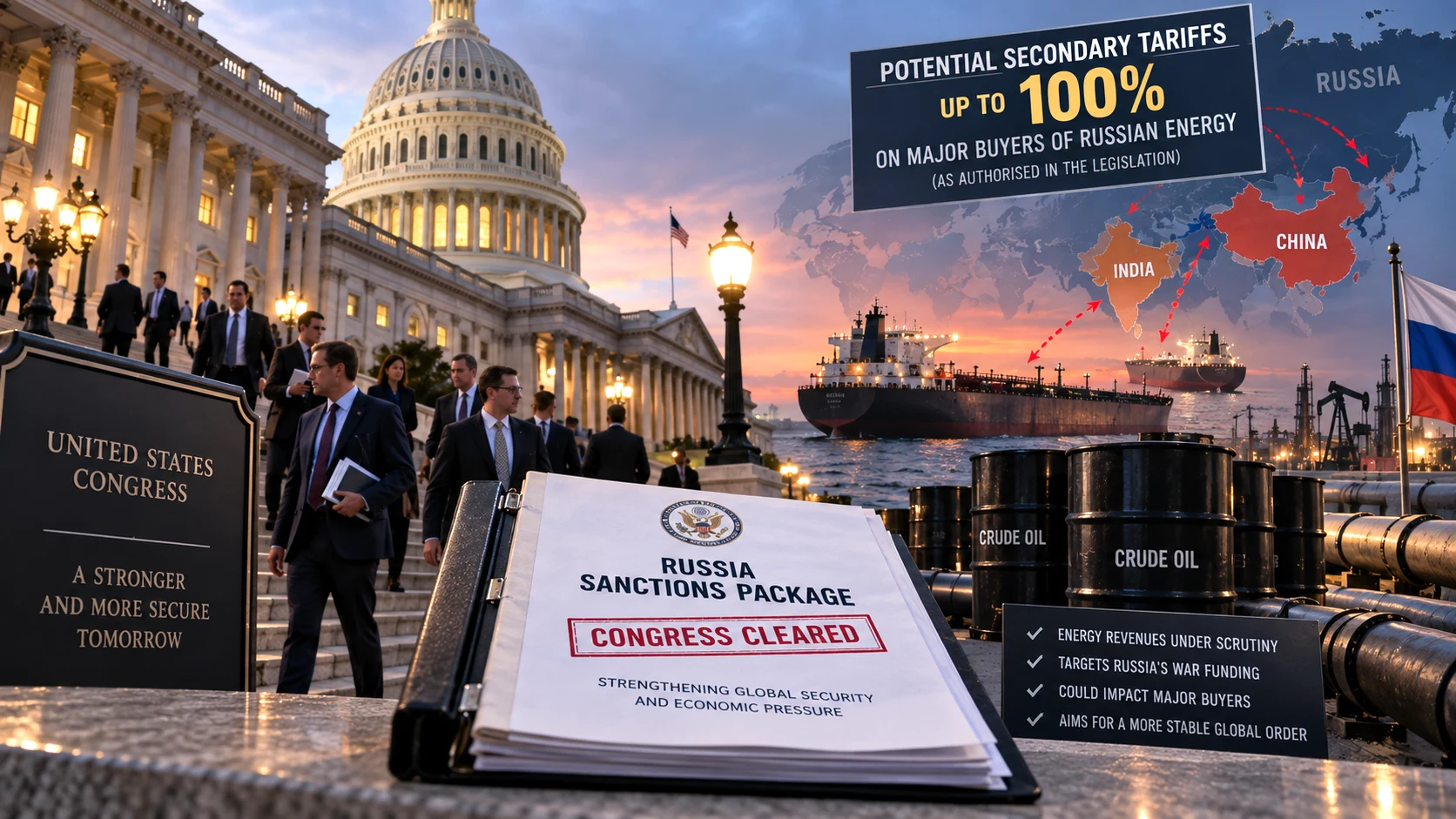
The new US law targets Russia’s energy, financial and defence networks and allows additional tariffs of up to 100% on goods from the largest buyers of Russian oil and gas. India faces significant exposure because of its large Russian crude imports, but a 100% tariff on Indian goods has not been impo
European Commission President Ursula von der Leyen has proposed opening the door for Canada to become the EU’s first “associate member,” but the status does not yet legally exist and has not been approved by the bloc’s 27 governments. Mark Carney welcomed the ambition in Strasbourg as Donald Trump w
The most accurate description based on the information available is that Russia claims more than 1,000 Ukrainian drones were involved in the broader overnight offensive, with around 450 directed toward the capital.
The reported numbers come largely from Russian authorities and cannot yet be independently verified in full. Associated Press reported the operation as involving more than 1,000 drones across Russia.
Key Takeaways
Ukraine launched an exceptionally large long-range drone attack against Russia overnight into September 20.
Russian officials described it as the largest drone attack yet directed at Moscow.
About 450 drones were said to have approached the capital; more than 1,000 were reported intercepted nationwide.
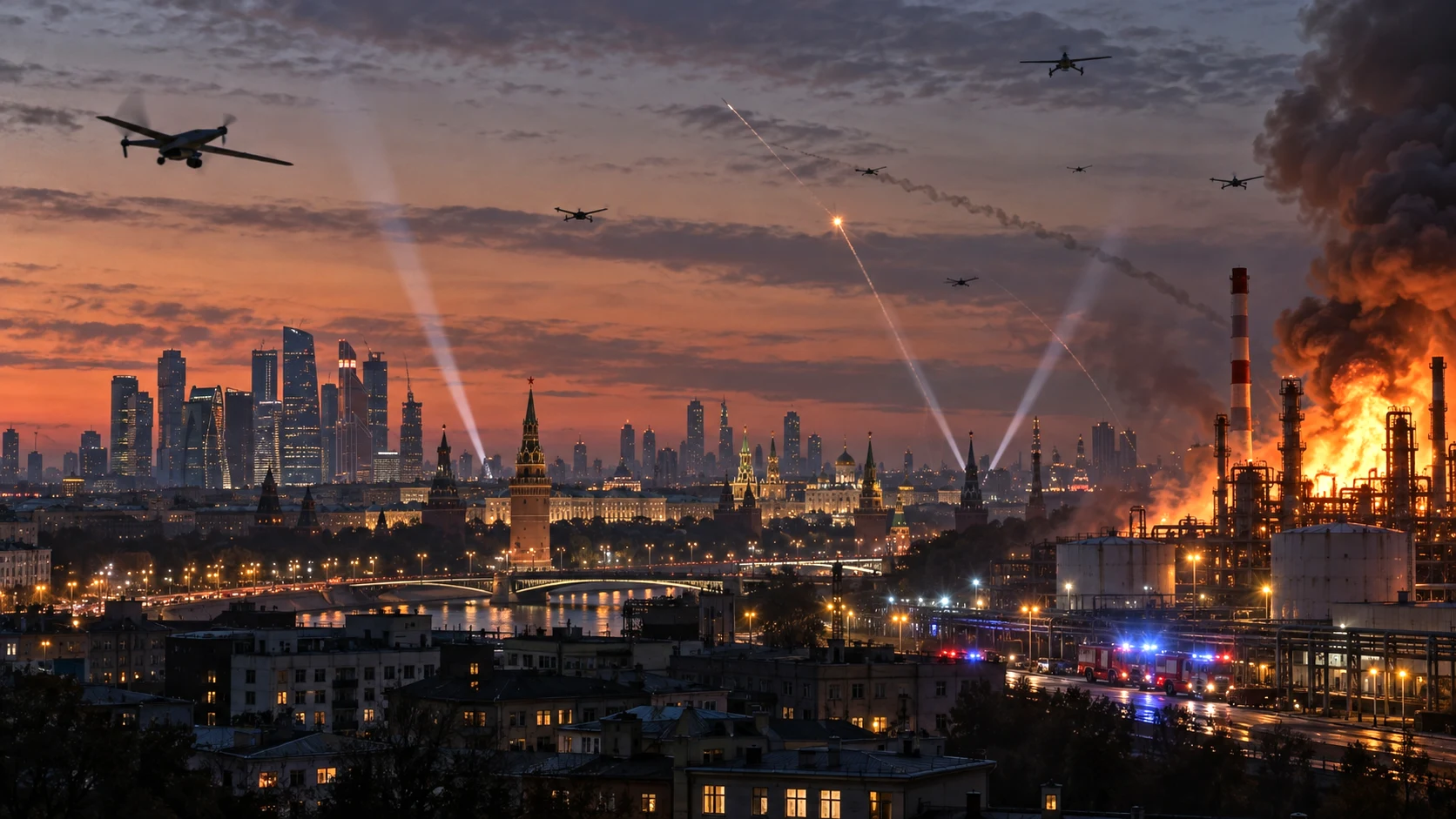
The Moscow Oil Refinery in Kapotnya was hit and fires were visible at the site.
Two civilians were killed and 20 injured in the wider Moscow region.
Ukrainian President Volodymyr Zelenskyy later acknowledged strikes on Russian oil and logistics infrastructure.
Moscow Oil Refinery Hit as Smoke Rises Over Capital
One of the most significant confirmed targets was the Moscow Oil Refinery in the Kapotnya district, on the southeastern edge of the Russian capital.
Sobyanin acknowledged that several drones reached the refinery complex and damaged a facility there.
Reuters witnesses in Moscow reported hearing explosions and seeing large columns of smoke rising from the refinery site. Images from the area showed fires and smoke over the industrial complex. The full extent of the latest damage was not immediately established.
The distinction between a confirmed strike and claims about destruction is important.
As of publication, there is credible evidence that the refinery was hit and that fires occurred at the complex. There is not yet a reliable independent assessment showing that the entire refinery was destroyed, and reports making that claim go beyond the evidence currently available.
Refinery Was Already Badly Damaged Before Sunday’s Attack
The Moscow refinery was not operating under normal circumstances before the September 20 strike.
It had already suffered major damage during Ukrainian drone attacks in June 2026.
Reuters reported in June, citing industry sources, that the Gazprom Neft-operated plant could remain out of operation for at least six months following earlier attacks.
The facility processed around 11.6 million metric tonnes of crude oil in 2024, producing about 2.9 million tonnes of gasoline and 3.2 million tonnes of diesel, according to data cited by Reuters.
That means Sunday’s attack was directed at a strategic energy complex that Russia was already attempting to repair.
Whether the new damage significantly extends the refinery’s shutdown will depend on which units were affected and how severely. No authoritative damage assessment was available at the time of publication.
Two Killed and 20 Injured in Moscow Region
The attack also had a civilian toll.
Moscow regional Governor Andrei Vorobyov said two people were killed in separate incidents in the region and 20 others were injured.
The dead were identified by Russian authorities as a 74-year-old man and a 44-year-old woman.
The fatalities occurred in the wider Moscow region rather than Moscow city itself.
Authorities also reported damage to residential buildings and vehicles in several districts.
In the Ramenskoye district, a drone or falling debris struck a 21-storey residential building, starting a fire and prompting the evacuation of around 400 residents, including approximately 70 children.
A separate residential building was also reported damaged.
Russian officials said there were no confirmed fatalities inside Moscow city from the refinery strike or the residential impact there at the time of their latest statements.
Why the 1,600-Drone Number Needs Qualification
The headline figure circulating widely on social media — more than 1,600 drones — requires context.
Sobyanin said Russian forces had intercepted more than 1,600 drones since Saturday across defensive lines, with 450 of those approaching Moscow.
Russia’s Defence Ministry issued a narrower overnight figure of about 1,110 intercepted drones across a very large geographic area that included multiple Russian regions, Crimea and the Black Sea.
The figures therefore refer to different time periods and geographic areas.
They should not be combined or rewritten as “1,600 drones struck Moscow.”
A factual formulation is:
Russian authorities say more than 1,600 drones were intercepted since Saturday, including about 450 directed toward Moscow, while the Defence Ministry reported more than 1,100 interceptions overnight nationwide.
Independent verification of the overall launch and interception totals remains difficult during an active military operation.
Ukraine Confirms Strikes on Russian Oil and Logistics Targets
Early reports from Reuters noted that Ukraine had not immediately commented on the attack.
Later on Sunday, however, Ukrainian President Volodymyr Zelenskyy acknowledged Ukrainian strikes against Russian oil and logistics infrastructure, according to subsequent reporting by Associated Press and other international outlets.
Zelenskyy said a major Russian oil facility and a logistics installation had been hit, describing the targets as part of the economic infrastructure supporting Russia’s war effort.
Ukraine has increasingly described attacks on Russian refineries, fuel depots, military factories and logistics networks as a campaign of long-range economic pressure intended to reduce Moscow’s capacity to sustain its invasion.
Zelenskyy has previously referred to such operations as Ukraine’s own form of long-range sanctions, arguing that Russian oil, military production and logistics infrastructure are legitimate military-economic targets.
Moscow Attack Comes During Russian Parliamentary Elections
The timing has added a major political dimension.
Sunday was the third and final day of Russia’s parliamentary elections, the country’s first State Duma vote since Russia launched its full-scale invasion of Ukraine in February 2022.
Sobyanin accused Ukraine of deliberately timing the attack to interfere with the vote.
He said the operation had failed to disrupt the election.
That allegation should be treated as a Russian government claim, not an established fact.
Russian authorities had not publicly presented evidence proving that disruption of voting was the operation’s primary purpose.
Ukraine’s public explanation instead emphasized strikes against oil and logistics targets connected to Russia’s war economy.
The parliamentary election itself is taking place in a heavily controlled political environment.
Most meaningful anti-war opposition has been excluded, while the ruling United Russia party is widely expected to retain its dominant position in the State Duma.
Russia has also conducted voting in Ukrainian territories it occupies and claims to have annexed, votes that Kyiv rejects as illegal.
Airports Face Disruption as Drones Approach Moscow
The scale of the attack also disrupted aviation around the Russian capital.
Flight operations at Moscow airports were restricted during the attack as Russian authorities attempted to secure the airspace.
Large drone attacks have repeatedly forced temporary closures, delays and diversions at airports serving Moscow because even relatively small unmanned aircraft can pose a major hazard to commercial aviation.
Reports on Sunday’s operation said flights at major Moscow airports were temporarily affected while air defences responded to the incoming threat.
The repeated disruption demonstrates one of the effects of long-range drone warfare beyond direct physical damage: even drones that never reach their intended targets can force expensive defensive responses and disrupt transport networks.
Why the Attack Is Strategically Important
The significance of the September 20 operation lies not only in the number of drones involved.
Moscow sits hundreds of kilometres from the Ukrainian border and is protected by one of Russia’s most extensive air-defence networks.
Sending hundreds of unmanned aircraft toward the capital forces Russian forces to detect, track and intercept targets across multiple directions.
Even if the majority are destroyed, a small percentage reaching economically important sites can still create substantial disruption.
Sunday’s attack demonstrated that Ukraine retains the ability to conduct large-scale operations deep inside Russian territory despite Moscow’s efforts to strengthen air defences around the capital.
The attack also shows how the war has moved increasingly toward mass drone warfare.
Rather than relying exclusively on expensive cruise or ballistic missiles, both Ukraine and Russia now use large numbers of unmanned aircraft to overwhelm defences, strike infrastructure and force opponents to expend costly interceptor missiles.
Associated Press notes that Ukraine has developed extensive domestic drone capabilities during the war and has increasingly paired long-range unmanned aircraft with domestically produced missile systems.
Energy Infrastructure Remains a Central Battlefield
The Moscow refinery strike fits into a much larger Ukrainian campaign against Russia’s oil industry.
Russian refineries have come under repeated drone attack throughout 2026.
Reuters reported on September 15 that several of Russia’s largest diesel-producing refineries had reduced or suspended output following repeated attacks, tightening domestic fuel supplies and contributing to restrictions on fuel exports.
Oil exports and refined petroleum products remain economically important to Russia.
Ukraine’s strategy appears designed to impose costs at multiple levels: damaging processing equipment, forcing Russia to invest in repairs, diverting air-defence systems away from other areas and reducing revenues that Kyiv says help finance Moscow’s war.
The effect is not limited to Russia.
Reduced Russian refining capacity can tighten global diesel markets, particularly when other major energy-producing regions are experiencing disruption.
That makes refinery attacks important not only militarily and economically, but also for international energy markets.
Why Moscow Oil Refinery Matters
The refinery’s location gives it particular significance.
Unlike many Russian energy installations located hundreds of kilometres from major population centres, the Moscow refinery sits inside the country’s capital.
It has historically been an important supplier of fuel to Moscow and its surrounding region.
Before the recent series of attacks, the plant was capable of processing more than 11 million tonnes of crude annually.
Earlier Ukrainian strikes in June damaged key processing units badly enough that Reuters sources expected the facility to remain offline for months.
A new strike therefore puts additional pressure on a facility that Moscow was already trying to restore.
It also carries symbolic significance: smoke rising from a major industrial facility inside Moscow visibly brings the consequences of the war to Russia’s largest city.
Russia and Ukraine Continue Exchanging Long-Range Strikes
Sunday’s events did not occur in isolation.
Russia has continued large-scale missile and drone attacks against Ukrainian cities and infrastructure.
On the same day as the Moscow attack, Russian strikes in Ukraine’s Kyiv region killed four civilians, including three children, according to Ukrainian authorities cited by Reuters. Buildings, industrial facilities and other civilian infrastructure were damaged across several districts.
Both countries now routinely deploy long-range drones against targets far behind the conventional front line.
Ukraine focuses heavily on Russian oil, military-industrial and logistics facilities.
Russia continues attacks against Ukrainian energy facilities, transport networks, military targets and cities.
Both governments say they do not deliberately target civilians, while civilian deaths and damage continue to be recorded on both sides.
Questions Over Proposed Halt to Energy Attacks
The new strikes are especially notable because they come days after U.S. President Donald Trump said Russia and Ukraine had agreed to halt attacks on each other’s energy infrastructure.
The practical status of such an understanding has remained unclear.
Ukraine previously said it was prepared to consider reciprocal restraint if Russia made and observed a firm commitment to stop striking Ukrainian critical infrastructure.
Russian and Ukrainian attacks on energy-related facilities have nevertheless continued.
The September 20 Moscow refinery attack therefore raises fresh questions about whether any energy ceasefire currently exists in an enforceable form.
Without a detailed agreement, monitoring mechanism and reciprocal commitments, both sides appear to remain willing to strike infrastructure they regard as contributing to the other’s war effort.
Was This Really Moscow’s Largest Drone Attack?
Based on statements from Moscow authorities and reporting by Reuters, AP and the Financial Times, the operation is being described as the largest drone attack yet directed at the Russian capital.
That description is credible as an attribution to Moscow authorities.
The exact scale, however, remains subject to verification.
A distinction must be maintained between:
the total number of drones Russia says were launched or intercepted across the country;
the number Russia says were approaching Moscow;
and the much smaller number that actually penetrated air defences and struck locations in or around the capital.
At present, the strongest available figure for Moscow specifically is the Russian mayor’s claim that about 450 drones were intercepted while heading toward the city.
That figure alone would still represent an extraordinary escalation compared with earlier individual drone attacks on Moscow.
What the Attack Tells Us About the Next Phase of the War
The operation illustrates how rapidly long-range warfare between Russia and Ukraine is evolving.
For much of the earlier war, deep strikes depended mainly on comparatively scarce missiles.
By 2026, mass-produced drones have changed the economics.
An attacker can launch large numbers of comparatively inexpensive unmanned aircraft, forcing defenders to activate radars, electronic warfare systems, fighter aircraft and surface-to-air missiles.
The defender may successfully destroy most of the incoming drones and still face significant consequences if only a few reach valuable targets.
Ukraine’s September 20 operation appears to have followed precisely that pattern.
Russian officials claim the overwhelming majority of drones were stopped, yet the Moscow refinery was still hit, residential buildings were damaged and civilian casualties were reported in the surrounding region.
That combination — high interception rates alongside some successful penetrations — demonstrates why mass drone attacks have become central to modern warfare.
What Remains Unconfirmed
Several important questions remain unanswered.
Russian authorities have not released a complete independently verifiable accounting of the drones involved.
The exact extent of damage at the Moscow Oil Refinery is still unclear.
It is also too early to determine whether Sunday’s strike will further delay repairs already underway after the June attacks.
Similarly, Moscow’s assertion that the operation was principally intended to interfere with parliamentary voting has not been independently demonstrated.
Further satellite imagery, industrial assessments and official statements may provide clearer information in the coming days.
Confirmed Picture So Far
What can be stated with reasonable confidence is this:
Ukraine conducted an exceptionally large long-range attack against Russia overnight into September 20.
Hundreds of drones were directed toward Moscow, and Russian officials described it as the largest such attack yet on the capital.
A facility at the Moscow Oil Refinery was hit and fires were visible at the site.
Two civilians were reported killed and 20 injured in the wider Moscow region.
Residential buildings were damaged, hundreds of people were temporarily evacuated, and aviation around Moscow was disrupted.
Russia claims more than 1,000 drones were intercepted during the wider operation, but those figures remain largely dependent on Russian official reporting and should not be presented as independently established totals.
The attack also reinforces a broader trend that has become increasingly important in the Russia-Ukraine war: the battlefield no longer ends anywhere near the front line.
Oil refineries, logistics hubs, power systems, airports and industrial sites hundreds of kilometres from the fighting are increasingly part of the conflict.
For Moscow, September 20 delivered one of the clearest demonstrations yet of that reality.
And for the wider war, the scale of the drone operation suggests that long-range attacks on critical economic infrastructure are likely to remain a central source of escalation unless Russia and Ukraine reach a workable agreement to restrict them.
Bottom Line
Ukraine launched an unprecedented long-range drone attack against Russia on September 20, with hundreds of unmanned aircraft directed toward Moscow.
Russian officials described it as the largest such operation yet against the capital. A facility at the Moscow Oil Refinery was hit and fires were visible. Two civilians were killed and 20 injured in the wider Moscow region.
Russia reported more than 1,000 drones intercepted nationwide, including about 450 approaching Moscow. Ukrainian President Volodymyr Zelenskyy later acknowledged strikes on Russian oil and logistics infrastructure.
The attack underscores the growing role of mass drone warfare and the vulnerability of energy and logistics targets far behind the front line.
Key Takeaway
Ukraine stages largest reported drone attack on Moscow.
Moscow Oil Refinery hit; fires visible at the site.
Two killed and 20 injured in the Moscow region.
Hundreds of drones directed at the capital; more than 1,000 claimed intercepted nationwide.
The Rajatheertha Team publishes news, explainers, guides and updates across India and the world. Our coverage follows Rajatheertha's editorial, verification and corrections standards.
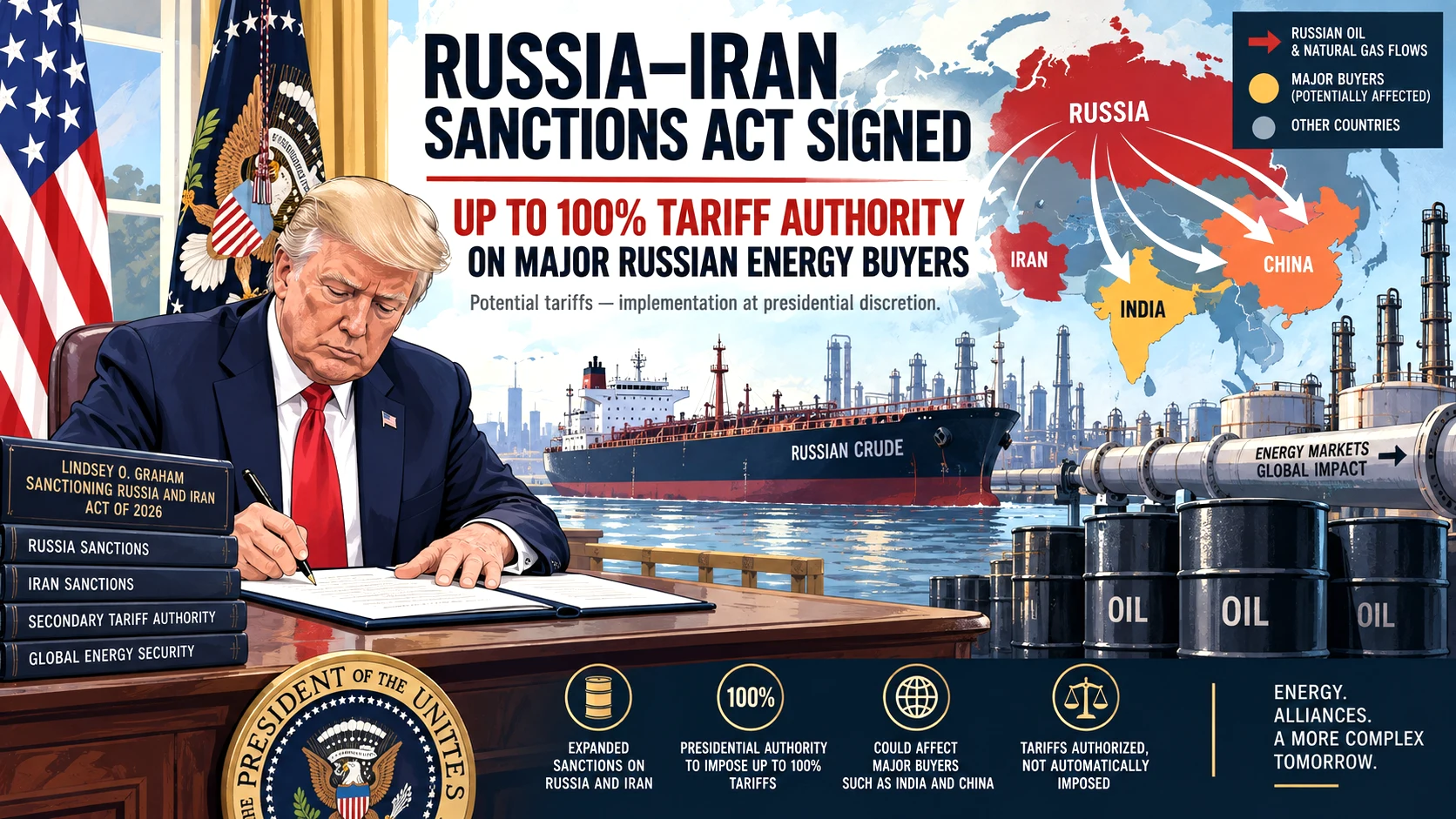
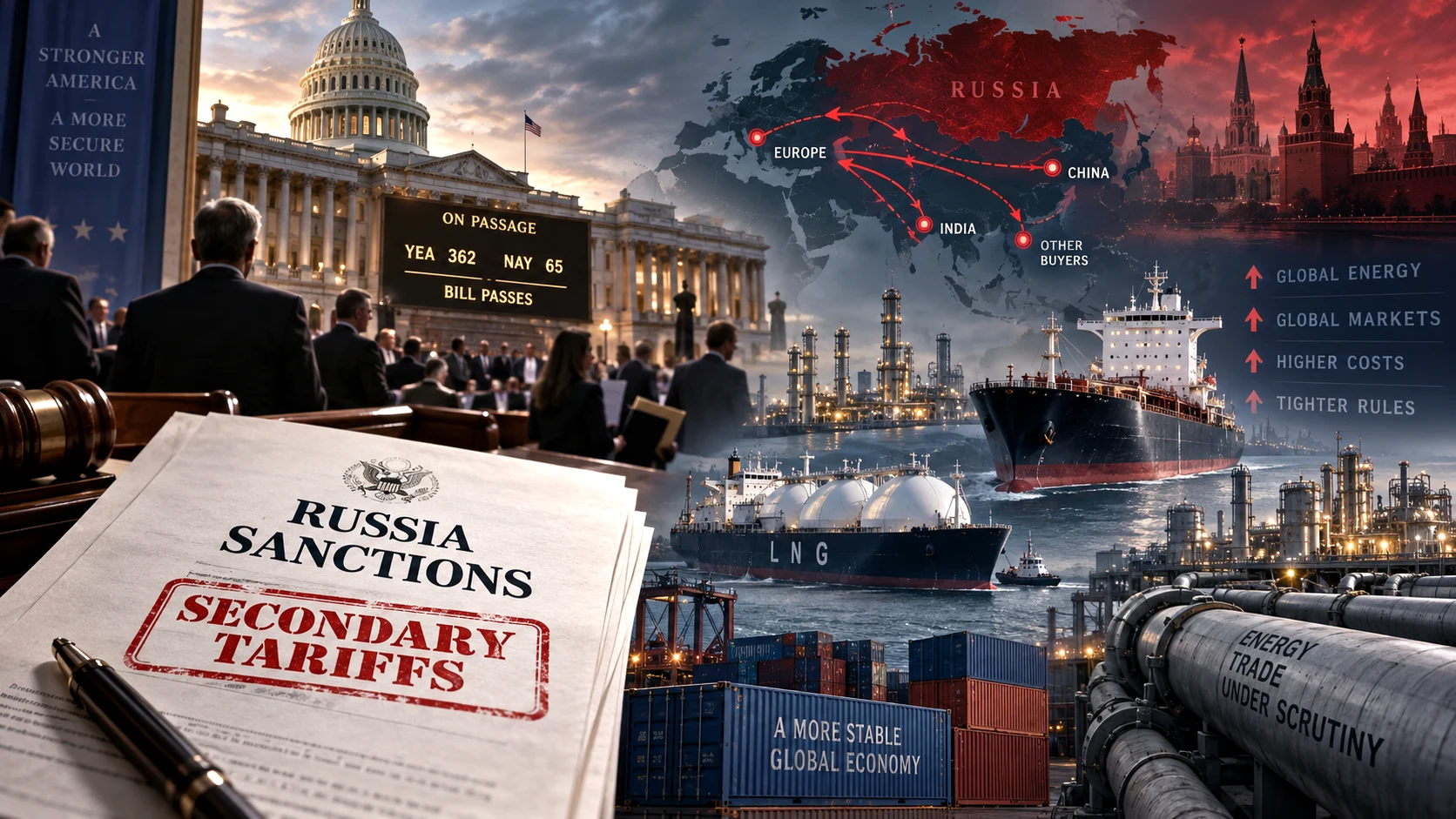
The House voted 262-159 to approve the Lindsey O. Graham Sanctioning Russia and Iran Act of 2026 after the Senate backed it 86-11 in August. The bill targets Russian banks, energy, defence and its “shadow fleet” while creating secondary tariffs for major buyers of Russian oil and gas. It now goes to
The House approved the Lindsey O. Graham Sanctioning Russia and Iran Act of 2026 by 262-159 after the Senate passed it 86-11. The measure now awaits President Donald Trump’s signature and could subject major buyers of Russian oil or gas to additional US tariffs of up to 100%, although India and Chin
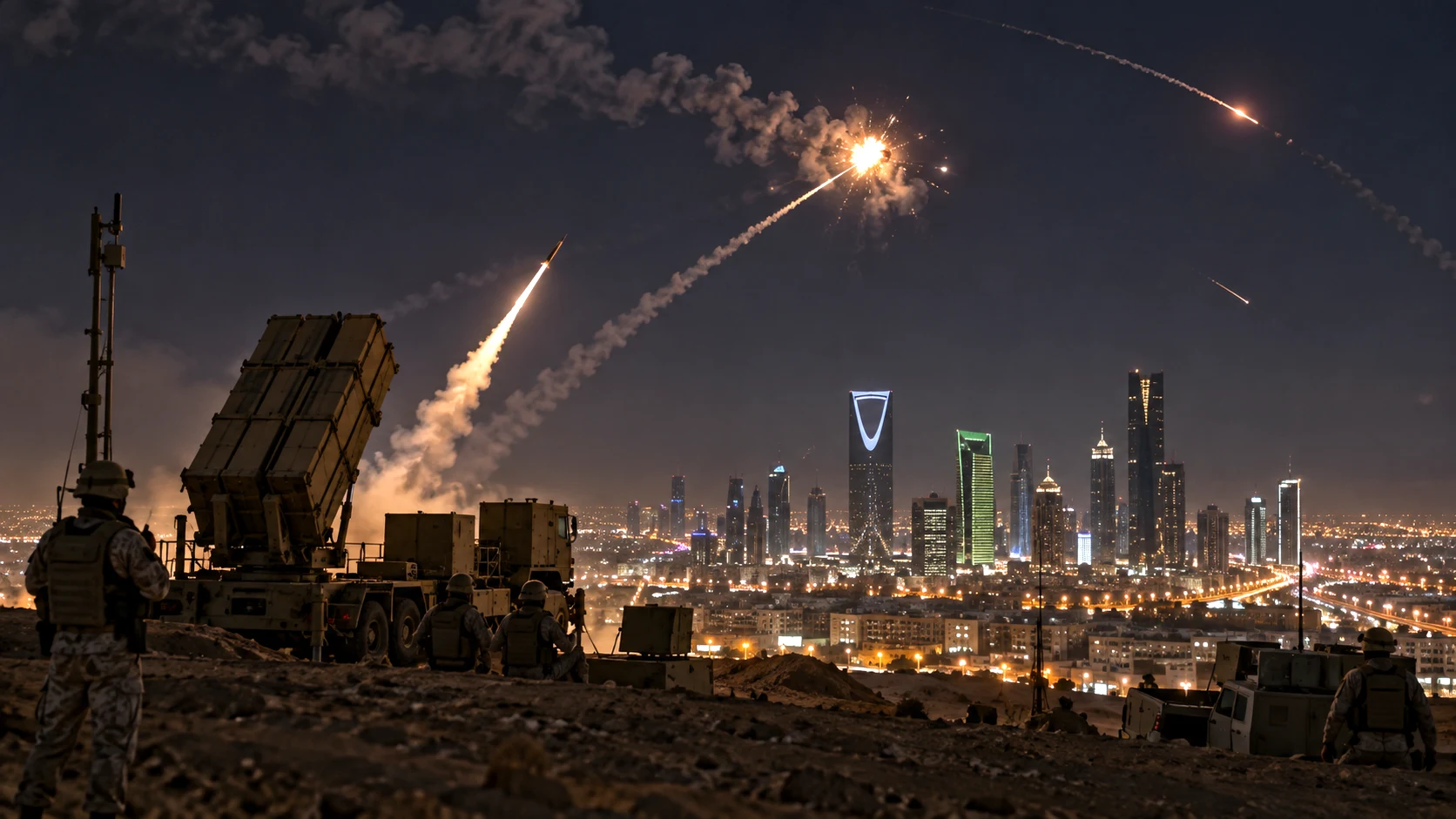
A Houthi ballistic missile aimed at Riyadh was intercepted by Saudi air defences as explosions and smoke were reported near the Saudi capital’s main airport, marking a sharp escalation in the renewed Saudi-Houthi confrontation. The attack comes alongside strikes on Saudi energy infrastructure, inten
The Florida Republican says Hispanic voters who helped return Donald Trump to the White House now “feel betrayed,” while polling shows broader erosion in support for the president’s immigration approach. Separately, Speaker Mike Johnson has sent the House home early for the campaign season, drawing
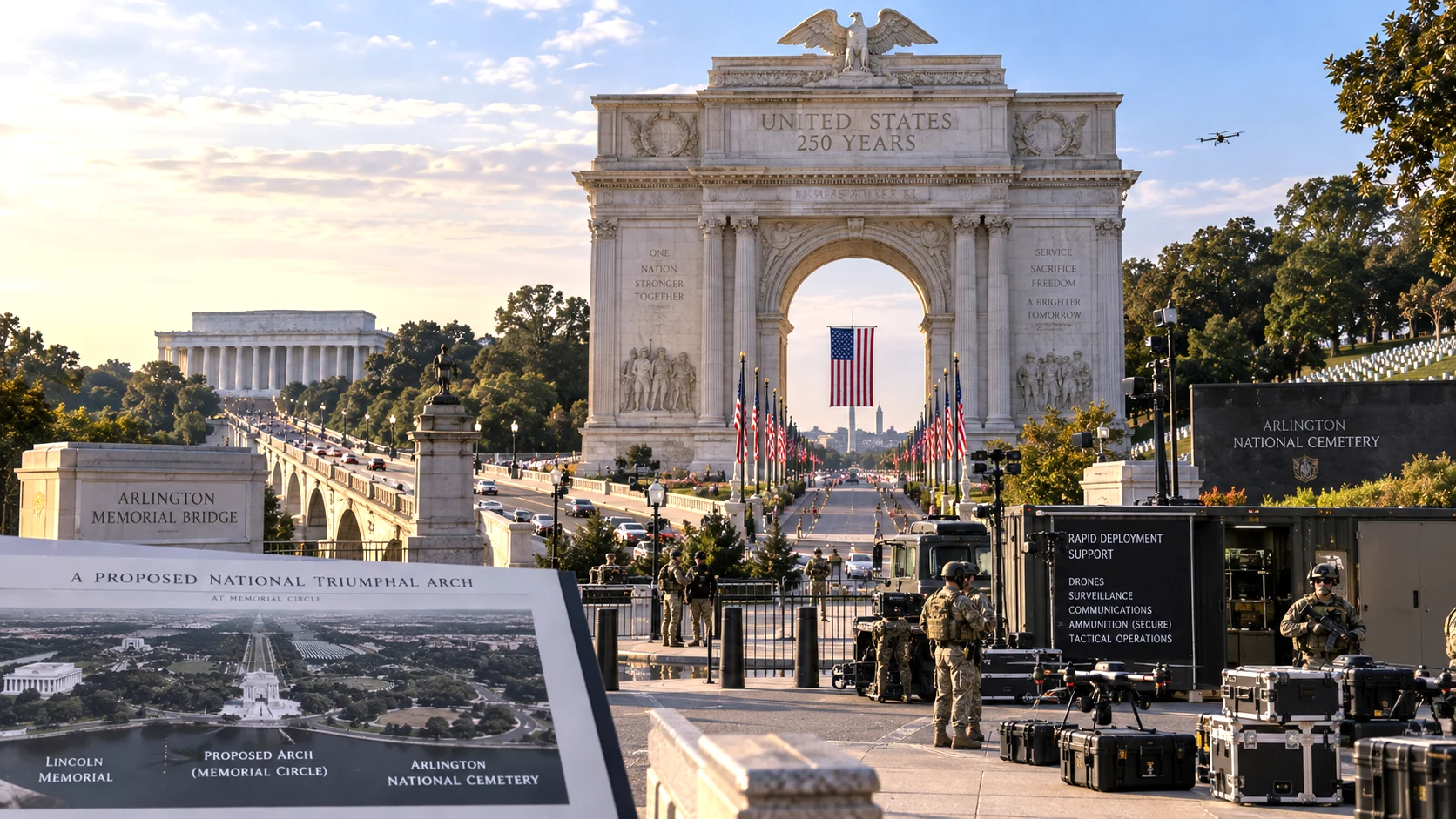
President Donald Trump says his proposed 250-foot triumphal arch near Arlington National Cemetery will now be designed as a dual-purpose military facility capable of housing drones, sniper positions and ammunition. The announcement adds a national-security dimension to an already controversial Washi
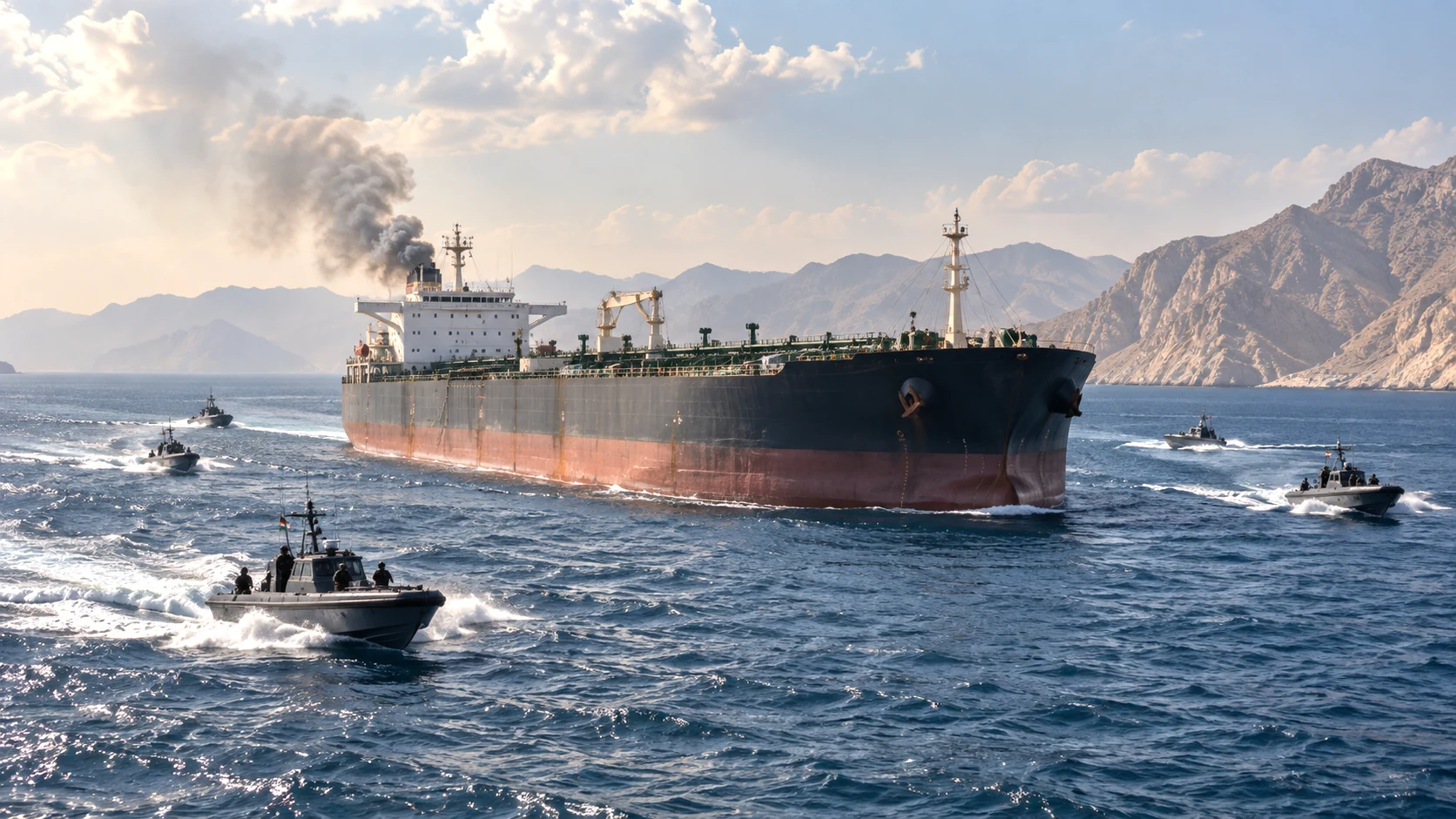
Iran’s Revolutionary Guards Navy says the Togo-flagged oil-products tanker caught fire and stopped after attempting what Tehran called an “illegal passage” on September 17. No independent confirmation of the strike, casualties or cargo damage was immediately available as shipping through the strateg




0 Comments